
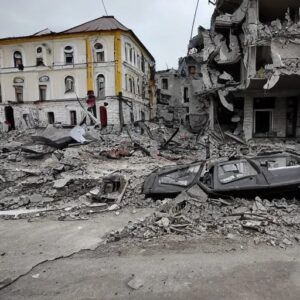
The Russian army’s meagre successes in Ukraine – such as taking the ruined town of Avdiivka, at horrendous human cost – have produced a new round of western politicians’ statements and commentators’ articles about possible peace negotiations.
Hopes are not high, because the Kremlin shows no appetite for such talks. Its actions, such as nightly bombing of civilians and civilian infrastructure, speak louder than political and diplomatic words on all sides.
The desire and hope for peace is widely shared, and I share it too. How can it be achieved?
Among “left” writers, the “campists” and one-sided “anti-imperialists”, who deny Ukraine’s right to resist Russian aggression, say that peace talks could start now … if only the western powers did not stand in the way. (By “campism”, I mean the view that the world is divided simplistically between a western imperialist camp dominated by the US, and another camp comprising China, Russia and other countries, in which some progressive potential resides.)

The “campist” case is made by literally ignoring what is actually going on in Ukraine, and Russia, and focusing – often exclusively – on the political and diplomatic shenanigans in western countries.
In this blog post I will look at seven recent articles by “campist” writers. All of them call for peace talks; and all claim that the main obstacle is the western powers.
I will cover (1) the selection of subject matter by these authors; (2) what little they actually say about peace negotiations; and (3) why the claim that the western powers sabotaged peace talks in April 2022 is less convincing than they believe it to be.
The seven articles are: “Europe sleepwalks through its own dilemmas” by Vijay Prashad (Counterpunch, Brave New Europe, Countercurrents and elsewhere); “Exit of Victoria Nuland creates opportunity for peace in Ukraine” by Medea Benjamin and Nicolas Davies (Common Dreams, Morning Star, Consortium News and elsewhere); “Ukraine: Pope pipes up for peace” by Andrew Murray (Stop the War coalition); “Where are the righteous Ukraine partisans now?” by Branko Marcetic (Brave New Europe); “Diplomacy is the art of compromise: that’s what’s needed for peace in Ukraine” by Alexander Hill (Stop the War coalition); “US repeatedly blocked Ukraine peace deals; is it rethinking its strategy yet?” by John Wojcik and C.J. Atkins (People’s World); and “The Grinding War in Ukraine Could have ended a long time ago” by Branko Marcetic (Jacobin).
Selection of subject matter
None of the seven articles says one word about Russia’s political system, its politicians’ nationalist rhetoric or its war economy, which are among the central causes of the war. Not a word. Only one of the articles (Alexander Hill’s) attempts to assess Russian war aims; one more (Andrew Murray’s) makes glancing reference to these.
Only one of the articles (Hill’s, again) touches on what Ukrainian people are thinking or doing. None of the other six articles says a word about this, despite Ukrainian popular resistance being, by any measure, a key factor in the war.
Only one of the articles (Hill’s, again) says much about what has happened on the battlefield. One more (Branko Marcetic in Jacobin) has one paragraph on Ukrainian battlefield losses, but no mention of Russian losses. Two more (Murray’s, and Wojcik and Atkins’s) have very brief references to this.
While saying almost nothing about what is going on in Ukraine, or Russia, all seven articles discuss statements by western politicians, diplomats and/or military leaders. At length.
Five of the articles (by Medea Benjamin and Nicolas Davies, by Hill, by Wojcik and Atkins, and two by Marcetic) focus on a peace deal that was supposedly on the table in April 2022, and claim that western politicians, who twisted president Zelensky’s arm, wrecked it (see last section). On the other hand, only two of the articles (Hill and Murray) make any suggestion about what peace talks might look like (see next section).
Dear readers, I can hear you say: but you have just picked seven articles at random. No. It’s a fair sample. I searched the largest-circulation English language “left” web sites; these were the most visible articles by don’t-support-Ukrainian-resistance writers.
The key point is that none of these writers mention how the Kremlin works. No reference to Vladimir Putin’s attitude to the world, or whether it has changed. No assessment of the deranged nationalist, even genocidal, rants about Ukraine by him, his close colleagues and high-profile Russian TV personalities. No mention of whether Russia can be considered an imperialist power or not. Not a word about the way that its invasion of Ukraine not only breached international agreements and laws, but also offends the principle of nations’ right to self-determination that socialists have held dear since the 19th century.
It is telling, too, that these “campist” writers have no interest in what Ukrainian people say or do. Nor Russian people. They don’t pretend to look at the interaction of social, political and economic forces. They are concerned largely – some of them, exclusively – with the western elite. They see themselves as its opposite and its nemesis. Russian or Ukrainian soldiers, Russian anti-war protesters, Ukrainian trade unionists on the front line, Ukrainian refugees – these are bit part players in a drama played out in Washington, London and Berlin.
The result is a fantasy world that bears only indirect relation to reality.
When I say “campists”, I mean a very narrow group among “left” writers, who embrace a fake “anti-imperialism”, historically descended from 20th century Stalinism.
They do not speak for the labour movement more broadly, or for the millions of people in western countries who think of themselves as “left wing”, or who vote for Social Democratic parties. These are powerful forces for change. But the “campist” influence is dangerous and divisive.
Of course many journalists in the mainstream press also focus exclusively on this elite world of diplomats and politicians. But they usually see themselves as part of it. The “campists” sees themselves in opposition – but only to the western powers, the US above all. For them, the American empire is the only empire worth fighting.
Whether Russia might have traits of empire, whether China might seek to construct some sort of empire, whether bloodthirsty dictators like Bashar al-Assad are tied to imperial interests – all this is excluded from the conversation. Real struggles that confront the American empire, such as the Palestinians’, are welcomed; those that face other enemies, such as Ukrainians resisting Putin, or Syrians and Palestinians resisting Assad, are shunned.
–
What could peace negotiations look like
Andrew Murray writes:
Moving from ceasefire to a permanent peace will of course be challenging. Russia will need to accept a sovereign and independent Ukrainian state, and Ukraine will have to accept remaining outside NATO and self-determination for minorities within its borders.
The Stop the War coalition, in which Murray is a leading voice, sets out its policies in the form of calls for UK government action. So it’s fair to assume that this, too, is a call for the UK government to take a particular stance – in this case, the most pro-Russian stance possible. Going through the points in turn:
1. “Russia will need to accept a sovereign and independent Ukrainian state” is meaningless. It did so, in the Belovezha accords that dissolved the Soviet Union (1991), and the Budapest memorandum under which Ukraine gave up its nuclear weapons (1994). Since 2014 Russia has been pounding Ukraine militarily, in breach of those agreements. Any attempts to stop the fighting in Ukraine diplomatically would have to start by recognising that reality – which is why a peace treaty, as opposed to a ceasefire or simply “freezing” the conflict, is extremely unlikely.
2. “Ukraine will have to accept remaining outside NATO” is essentially a demand for NATO to allow Russia to decide which states join (why no objection to Finland and Sweden?!). The UK government may indeed be cynical enough to take such a position, but why should the labour movement encourage it to do so? What sort of solidarity is that with the Ukrainian population – which before 2014 was in its vast majority opposed to NATO membership, but has largely come to see it as the only security arrangement that can prevent their country being invaded again and again?
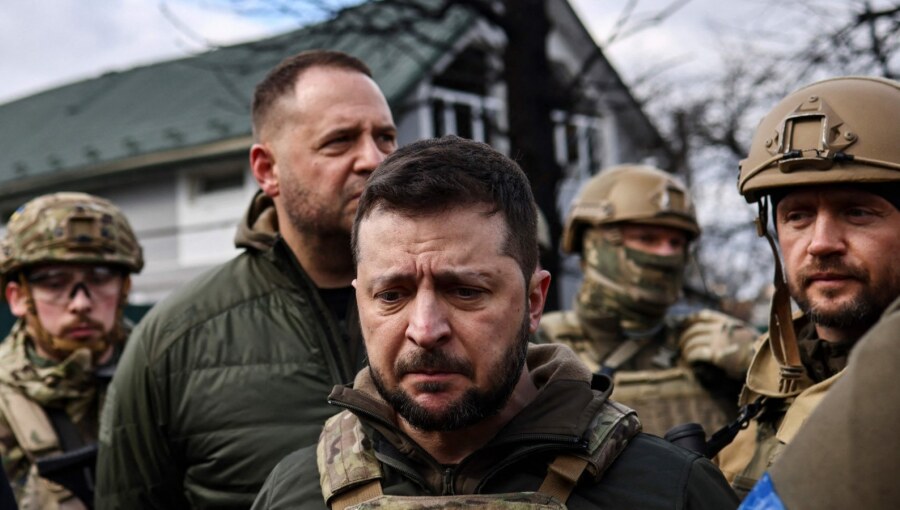
3. “Self-determination for minorities within its [Ukraine’s] borders.” This is a distortion of the principle of the right of nations to self-determination, historically embraced by socialists. Self-determination includes the right to secession. (It is relevant that Russia killed tens of thousands of people in Chechnya in the early 2000s, to help ensure that this right would not be exercised.)
From 2014, the extreme right in Russia called for the establishment of a new state, “Novorossiya”, in south-eastern Ukraine, effectively a demand for “self-determination” of Russian people there – but the Kremlin refused to support this. Moscow was aware that the vast majority of Russian-speaking Ukrainians neither wanted “self-determination” nor regarded themselves as Russian. The exception was Crimea, where a referendum on annexation by Russia (a strange type of “self-determination”) was held under military occupation.
Long before 2014, there had been support in eastern Ukraine for greater autonomy within the Ukrainian state, and distrust of Ukrainian nationalist politicians in Kyiv. The Kremlin did its best to whip up divisions among Ukrainians on this basis. It engaged in a long campaign of disinformation, claiming to support the rights of Russian speakers in Ukraine. (I wrote about this e.g. here.) But on a diplomatic level, until 2022, the Kremlin pretended that the Russian army was not present in Ukraine, although it was, and left the status of the Luhansk and Donetsk “republics” vague. All this changed in 2022, when the Kremlin recognised the “republics” and invaded Ukraine.
In 2022, people in Donetsk, Luhansk, Kherson and Zaporizhzhyia voted – sometimes literally looking down the barrel of a soldier’s gun, and always under the shadow of the biggest military operation in mainland Europe since world war two – on accession to the Russian federation. This is the Kremlin’s version of “self-determination for minorities within Ukraine’s borders”. The Stop the War coalition has been conspicuous in its failure to denounce this violent abomination.
Why, then, demand that the UK government raise the issue of “self-determination for minorities” in peace talks? Andrew Murray can not believe there is the least chance of them doing so. The point is to preserve the fantasy world in which “campism” lives, in which Russian imperialism, Russian assaults on democratic rights and the Kremlin’s distortion of democratic principles for its political ends do not exist.
Alexander Hill writes:
The key outcome [of peace talks] will be the separation of the Russian-dominated Donbass and Crimea from the remainder of Ukraine – something that will hopefully be the cornerstone of a lasting peace in the region.
Although Hill clearly favours a ceasefire, and the Stop the War coalition opposed the Russian invasion in 2022, that is not what is under discussion here. Hill is envisaging the outcome of peace negotiations. Why endorse the imperial power’s demands in this way? Where is the evidence that, if these demands are met, “lasting peace” will ensue? How is this in the labour movement’s interests or the interests of international solidarity?
–
What happened in April 2022
The idea that peace talks have been blocked solely by the western powers – rather than by Russia’s war strategy – has been repeated over and over again by the “campists” over the past two years. They claim, in particular, that a deal was on the table in Istanbul in April 2022, that Ukraine was ready to sign, but that Boris Johnson, then UK premier, visited Kyiv and persuaded president Zelensky not to do so.
This version of events was demolished by Volodymyr Artiukh and Taras Fedirko in October 2022. They showed that the single source for the claim, a report in Ukrainska Pravda, had been misinterpreted, and that a mass of evidence suggested that the talks failed due to Ukrainian and Russian political factors, and the dynamics of military operations. Commentators who focus on “a magic turning point when everything could have gone otherwise” ignore that “in Russia’s repertoire, diplomacy has consistently been subordinated to the use of force,” they wrote. I urge readers to read this thoughtful, rounded argument.
Recently, accounts of the Istanbul talks have surfaced from people who were involved: the former Israeli prime minister Naftali Bennett, and the Ukrainian politicians Davyd Arakhamia and Oleksiy Arestovich. The “campists” have cherry-picked lines from these sources to revive their narrative.
Branko Marcetic of Jacobin claimed that an interview given in July last year by Bennett, who had been in touch with the Russian and Ukrainian governments, was a “bombshell”. Bennett said that in April 2022 there had been “a good chance of reaching a ceasefire”, and when asked “had they [who?] not curbed it”, “he replied with a nod”.
While it is unclear what that nod meant, and who “they” referred to, Bennett’s statement that the April deal was killed off by the revelation of the Russian army’s massacre of civilians at Bucha, outside Kyiv, is unequivocal. In Marcetic’s own words:
“Once that [Bucha] happened, I [Bennett] said, ‘It’s over,’” he recounts. Bennett pointed to the potential for such an atrocity to emerge and derail the political prospects for peace in Ukraine as proof of the importance of making haste on negotiations at the time. The Pravda report likewise pointed to Johnson’s visit as only one “obstacle” to peace, with the discovery of the Bucha killings the other.
Marcetic, writing in early August last year, chose not to look more widely at the circumstances in which Bennett gave his interview. Shortly beforehand, in June, the leaders of Comoros, Senegal, South Africa and other African nations had met with both Zelensky and Putin to propose peace talks. Putin had told them that one of their proposed starting-points for talks – accepting Ukraine’s internationally recognised borders – was unacceptable. (During this meeting, Putin held up what he claimed was the draft of the April agreement, although this has not been published before or since.)
A proper account of the failure of peace initiatives would mention not only the western powers, who of course influence decision-making in Kyiv (in recent months increasingly to constrain the war effort), but also Russia’s real intentions. Marcetic ignores that.
In November last year, Wojcik and Atkins sculpted another piece of evidence that Boris Johnson, and the western powers, were the obstacle to peace, from an interview with Davyd Arakhamia, one of the leaders of Zelensky’s Servant of the People party. They quoted Arakhamia reflecting on the Istanbul talks as follows:
“[The Russians] were ready to end the war if we accepted neutrality like Finland once did. And we were ready to make a commitment that we would not join NATO. When we returned from Istanbul, [then-British Prime Minister] Boris Johnson came to Kiev and said: ‘Do not sign anything with them at all; just go to war,’” Arakhamia said.
Now let’s look at what Arakhamia actually said, as reported by the Russian opposition web site, Meduza. Wojcik and Atkins have cut out a key passage, after the words “would not join NATO”. I have put it back, in bold type.
“They actually hoped until nearly the last moment that they could press us into signing this agreement, adopting neutrality. That was their biggest priority. They were willing to end the war if we took on neutrality, like Finland once did, and gave assurances that we wouldn’t join NATO. That was essentially the main point. Everything else was cosmetic and political embellishments about ‘denazification’, the Russian-speaking population, blah blah blah,” Arakhamia said.
When asked why Ukraine didn’t agree to Russia’s terms, Arakhamia was resolute:
First of all, to agree to this point, we would have to change the [Ukrainian] Constitution. Our path to NATO is written into the Constitution. Second of all, we did not and still do not trust the Russians to keep their word. This would only have been possible if we had security guarantees. We couldn’t sign something, walk away, everyone would breathe a sigh of relief, and then [Russia] would invade, only more prepared this time — because the first time they invaded, they were actually unprepared for us to resist so much. So we could only work [with them] if we were 100 percent confident that this wouldn’t happen a second time. And we don’t have that confidence.
Moreover, when we returned from Istanbul, Boris Johnson came to Kyiv and said that we wouldn’t sign anything with them at all, and that we should just fight.
Oh dear! The really important part – that Ukraine needed guarantees that Russia would not once again break its word and invade – went missing!!
This reminds me of Soviet censors who, when a Communist party leader fell out of favour, would cut the unhappy has-been out of official photos. Snip snip snip.
Arakhamia’s statement, in full, suggests that, with Russia’s brutal invasion at its height, the Ukrainian side needed a more substantial security guarantee than Putin’s piece of paper.
Of course, what Arakhamia said should be treated with scepticism, as should all statements from all politicians. But it shouldn’t have vital parts surgically removed, to make it say the opposite. All the more care is needed, given the efforts by Russian state propagandists to distort Arakhamia’s meaning.
In March this year, Benjamin and Davies cited a third source – Oleksiy Arestovich, Zelensky’s former spokesman – in support of the claim that Putin’s Istanbul deal had been negotiated and “already had the champagne corks popping in Kyiv”. Again a politician, and one whose words need to be treated with special care. Readers should read his interview themselves.
But to pretend that Arestovich’s account shows that the western powers wrecked the peace talks is deceitful. Asked if Johnson twisted Zelensky’s arm, Arestovich says:
I don’t know exactly if that is true or false. He came to Kiev but nobody knows what they spoke about except, I think, Zelensky and Boris Johnson himself. I think it was the second of April, and I was in Bucha the next day. The president got in [to Bucha] one day later. […]
Arestovich here underlined his point that: “The president was shocked about Bucha. All of us were shocked about Bucha. […] Zelensky completely changed face when he came into Bucha and saw what happened.”
My conclusion is not that news of the Bucha massacre alone changed Zelensky’s mind. My best guess is that Bucha, combined with the other brutal Russian offensive operations in progress – especially the attack on Mariupol – focused the minds of Zelensky and others on the issue of security guarantees outside of NATO. And they could not see clearly what these were.
Despite the importance attached to Bucha by Bennett, Arakhamia and Arestovich, none of the “campists” mention it – except for that one dismissive reference by Marcetic (see above). They live in a fantasy world where Russian imperialism is absent, and its crimes of no consequence.
And that is not really a problem about Ukraine, but about the deep political malaise of a section of the western “left”. There is no path to real international solidarity and effective anti-imperialism through this fantasy world. And no path to peace either. SP, 8 April 2024.
 If you’ve read this far, you were pretty interested, right? Isn’t that worth a few bucks -maybe more? Please


Leave a Reply