Blog

  • The Greek Grassroots Challenge to the Politics of Austerity

    Harrison and Landy recently returned from a trip to Greece, where they met with activists and others to gain a better understanding of the popular upsurge against the Greek government’s austerity program.

         The crisis in Greece began with the discovery that the Greek government had been concealing the size of its debt in order to stay within the monetary union guidelines: it was revealed to be 120 percent of GDP, one of the highest percentages in the world. This massive debt was the result of several factors: reckless borrowing, for example to finance the Olympics and to buy weaponry from Germany and the U.S. (Greece spends more on defense as a proportion of GDP than any other EU member) and flagrant tax evasion by the rich—but also the structure of the Eurozone itself, which was designed to create a market for German exports in Greece and the other weaker European economies by replacing weak local currencies with the Euro. This encouraged excessive borrowing. The “Troika” of the European Central Bank, the European Commission, and the International Monetary Fund agreed to a “rescue package”—three big chunks of bailout money—in return for Greece signing a “memorandum” promising massive privatization of public assets and harsh austerity measures—cutting government spending on wages, pensions, social welfare—to free up money for paying down the debt.

         In part because of the worldwide recession, government revenues fell despite the spending cuts, and the debt continued to grow. Meanwhile, the austerity program provoked massive resistance from the Greek people. Huge protest marches on May Day 2010 were attacked by the riot police and followed by a general strike—the first of 16 since that date. Over the next two years, hundreds of thousands demonstrated repeatedly in the streets of Athens and other cities, Parliament was stormed several times, clashes with the riot police were a regular occurrence, and public squares across the country, including Syntagma Square in Athens, were occupied. As Parliament continued to do the Troika’s bidding, passing one savage austerity package after another, popular support for the two political parties that have dominated Greek politics since the 70s—the conservative New Democracy and the nominally socialist PASOK—collapsed.

         Elections in the spring of 2012 constituted a political earthquake. In the first round of voting in May, the Coalition of the Radical Left, SYRIZA, hitherto one of the country’s several minor parties, came in second, with nearly 17 percent of the vote, just behind New Democracy. PASOK saw its share of the vote plummet from 44 percent in the last election in 2009 to 13 percent. At the same time, the neo-Nazi Golden Dawn gained parliamentary seats—18—for the first time as a result of winning more than 425,000 votes, close to seven percent of the total. This is in comparison to three years before, when Golden Dawn had a tiny .46 percent of the vote. After attempts to form a new government failed, another election was scheduled for June 17. With opinion polls showing that SYRIZA might come in first, the Greek corporate media and European, especially German, officials went into high gear, warning the Greek people that a victory by SYRIZA would bring internal anarchy and result in Greece’s expulsion from the Eurozone. To a certain extent this terror campaign worked. Despite the growing popularity of SYRIZA and its leader Alexis Tsipras, many voters apparently took fright and either abstained or voted for the parties of the memorandum. By the same token, however, many other voters rallied to SYRIZA for refusing to back down on its opposition to the memorandum. As a result, while SYRIZA again came in second, this time it won an astounding 27 percent of the vote.

         Everyone seems to expect that the current coalition government of New Democracy, PASOK, and Democratic Left—a more conservative social-democratic split-off from SYRIZA—will be short-lived and that new elections might very well bring SYRIZA to power. The Troika has so far appeared determined to make an example of Greece by not allowing any renegotiation of the memorandum. Meanwhile, the country is enduring depression-like conditions, with official unemployment now at 23 percent but probably closer to 30 percent in reality, and youth unemployment exceeding 50 percent.

         This was the background to our visit to Athens, July 5-12. We met with a number of SYRIZA activists, including party leaders, a woman involved in immigrant rights, and two young men from the Front of the Greek Anti-Capitalist Left, ANTARSYA. We also spoke to several people who were not political activists.

         Athens certainly does not look like a city in the midst of great upheaval, let alone on the verge of revolution. We were in a working class district at one point and in another residential area that seemed pretty modest, as well as in the center. Especially for foreign visitors, signs of economic distress were hard to detect, although we were told that there is great suffering “behind closed doors.” We can’t recall seeing any begging. Wherever we were, we scarcely ever noticed political signs or posters or people leafleting. Of course, it was summertime, when things simmer down for a while. Perhaps too we were seeing signs of fatigue after two and a half years of militant protest. On the other hand, steel workers were on strike in an Athens suburb, and there were environmentalist protests against gold mining in Chalkidiki. And we heard and read about almost daily attacks on immigrants by members of the neo-Nazi Golden Dawn, Chrysi Avgi (more about which below.)

    SYRIZA

         Michalis Spourdalakis, a professor at the University of Athens, told us some of the history of SYRIZA. Until now, it has been a coalition of several parties rather than a single organization. The largest by far is Synaspismós, whose older leaders come out of the Eurocommunist current that split with the Communist Party, the KKE, in the 1980s. SYRIZA itself emerged from the Greek wing of the anti-globalization movement about eleven years ago. But it was the great popular upsurge against austerity that turned SYRIZA into a major force. Since the crisis began, the organization has been joined by some of the more leftwing members of PASOK, including a few members of parliament. Its mass support, however, is recent and comes from the streets. Time and again we heard that SYRIZA had earned the respect and loyalty of activists, especially of young people, by its intense involvement in and its “non-hegemonic” approach to the strikes, demonstrations and occupations. SYRIZA, we were told, showed its commitment to listening to and building the movement—rather than simply recruiting members, building their own organization, and heavy-handedly insisting on acceptance of SYRIZA’s agenda.

         Spourdalakis stressed, as did most of the Greeks we spoke to, that SYRIZA is not a typical electoral machine but is instead rooted quite deliberately in mass actions—strikes, demonstrations, occupations—in the midst of which its MPs and officials can be found along with rank and filers. SYRIZA people we spoke to seemed acutely aware of the danger of substitutionism, that is, substituting the party for social movements. At the same time, Spourdalakis insisted, having a presence in parliament is essential because that is where so much media attention is focused and where, of course, major decisions are made.

         Now that it has achieved a position of great trust and potential responsibility, SYRIZA has decided to transform itself into a unified organization, rather than a coalition of different organizations, and to recruit aggressively. While we were in Athens, SYRIZA announced that it was launching a big membership drive with the goal of growing from the current 15,000 to a party with many times that number of members. The separate components of the SYRIZA coalition will be able to become tendencies within the party. Recruitment will take place at worksites, on campuses, in the streets and at the local assemblies that SYRIZA has been holding since before the elections. We attended one of these assemblies in an open area in the working-class suburb of Peristeri, attended by around 600 people, according to our estimate. Tsipras gave a rousing speech, and we were told there would have been a discussion period following the talk had it not been so hot outside.

         Spourdalakis was cautiously optimistic about SYRIZA’s future and said the party’s ability to grow depended very much on staying deeply connected to extra-parliamentary struggles. For one thing, SYRIZA is now engaged in organizing unorganized workers—for example, bookstore employees, couriers, tutors, and other urban service workers—into new unions. Greece has two main labor federations, one for public employees and the other for private, both of them controlled by PASOK, and a third, smaller but still sizeable federation run by the KKE. Most Greek unions contain caucuses that are linked to SYRIZA and ANTARSYA. We were told by ANTARSYA that their group is especially significant in the teachers’ union, as is SYRIZA.

         SYRIZA declares that its first act, on winning power, will be to repudiate the memorandum. It will then demand re-negotiation of the debt to write off a major part of it. If that demand is rejected, a SYRIZA-led government will stop debt repayments. The party promises to impose heavy taxation on corporations and the wealthy, to nationalize the banks and re-nationalize those public services that have been privatized, to restore the minimum wage and labor contracts that have been undermined during the crisis, to drastically cut military spending, to emphasize renewable sources of energy, and to construct a strong social welfare state.

         Panos Trigazis, head of Synaspismós’s foreign policy section, was our genial host in Athens, introducing us to SYRIZA leaders and intellectuals and bringing us to a press conference, where we met Alexis Tsipras. Panos explained a great deal, including the meaning of SYRIZA’s emblem: three superimposed banners, red for socialism, green for environmentalism, and purple for feminism and other social movements. As far we could see, the party’s foreign policy is not too well defined at this point. Its printed statements in English are pretty much limited to relations with the EU and to regional disputes. SYRIZA takes the position that Cyprus should be re-united as bicommunal, bizonal federation without foreign armies and foreign bases. It wants better relations with Turkey and a mutual reduction in armaments, and it calls for a nuclear-free zone in the Middle East. SYRIZA’s platform advocates the withdrawal of Greek troops from Afghanistan and the Balkans, and declares “No Greek soldiers beyond our own borders.” It calls for the abolition of military cooperation with Israel, and support for the creation of a Palestinian State within the 1967 borders. The platform does call for Greek withdrawal from NATO, but a few people told us that this meant severing the military connection only. In any case, the platform also calls for closing down the U.S. base in Greece.

    The KKE and ANTARSYA

         As for the KKE, virtually every leftist we spoke to expressed disgust for its grotesque Stalinism (this is not just an epithet; the party actually glorifies Stalin) and fanatical sectarianism, which has seriously undermined the anti-austerity movement. The KKE has refused to join any kind of united front, and apparently its chief slogan during the elections was “Do Not Trust SYRIZA.” In general, the KKE will not participate in any action it does not control—for example the huge annual Anti-Racism Festival, which we were lucky enough to attend. This three-day festival has been held in a park on the outskirts of Athens every summer for 16 years and is a moving expression of solidarity with the country’s beleaguered immigrant communities. This July organizers estimated that more than 22,000 people, immigrants and non-immigrants, had attended.

         The KKE is anti-EU, but so are other elements on the left, including a group within SYRIZA, the Communist Organization of Greece, the KOE, which has Maoist roots. Also in favor of an immediate “Grexit” from the EU is ANTARSYA. One afternoon at a café near Syntagma Square, we talked with two of its young members. They were worried about popular demobilization now that the elections were over and were skeptical of SYRIZA’s ability or willingness to spearhead struggles against the new government’s plans to privatize much of Greece’s state assets. They warned that SYRIZA was not preparing people for a showdown with the Troika and the EU. ANTARSYA calls for unilateral cancellation of the Greek debt, except for money owed to pension funds; this in contrast to SYRIZA’s position of repudiating some of the debt but negotiating the rest. And it advocates immediate withdrawal from the EU rather than attempting to transform and democratize it, which is the stand taken by SYRIZA’s leading elements.

         The ANTARSYA members said that SYRIZA is run by a small group around Tsipras, which is fairly autonomous, even in relation to Synaspismós members, and that a strong presence among SYRIZA’s leadership is also occupied by former PASOK MPs. The revolutionary groups within SYRIZA have almost no public profile, they said, and instead of pushing the party further to the left have restrained themselves in response to pressure from what they describe as the dominant social-democratic elements and a perceived need for unity. They claimed that after the June election, Tsipras had said that SYRIZA would not put people in the streets but would act as a “responsible” opposition.

          It was difficult for us to assess the validity of ANTARSYA’s various critiques of SYRIZA and its strategy of immediate exit from the Euro, but in any event we asked the young ANTARSYA members if the group might not be more effective as a left wing within SYRIZA, rather than outside it. They said no, it was necessary to maintain their organizational independence to avoid cooptation, which they charged was or would be the inevitable fate of internal critics. We questioned this conclusion. It seemed to us that SYRIZA was a party in motion, attracting mass support and membership, and with, yes, the possibility of capitulating to the Greek and pan-European elites, but also with the potential of sparking a powerful chain of resistance to those elites. It should be noted that many ANTARSYA members voted for SYRIZA instead of the party’s own candidates in June, and that some of ANTARSYA’s leaders have gone over to SYRIZA.

    Lessons for the U.S.

         In fact we were struck by the contrast between SYRIZA, with its base in popular movements and its radical possibilities, and the Democratic Party in the U.S., which year after year corrals progressive movements into a party dominated by corporate interests incapable of fighting for progressive goals. In our country there has been plenty of direct action in the streets, in the public squares, on campuses, in workplaces. But unlike Greece, this has not been accompanied by direct action at the ballot box through a political party that is not beholden to big business and is clearly a party of the left. We think that the millions of Americans who are outraged by the ruthless pillaging of their society by arrogant elites desperately need an electoral movement like SYRIZA that is rooted in popular struggles and committed to winning and using political power to achieve progressive change.

    Golden Dawn

         While we were inspired, even exhilarated, by the strength of SYRIZA and its meteoric growth in influence and potential power, at the same time, we became increasingly aware of the ominous threat posed by the rise of Golden Dawn. Although it denies any association with neo-Nazism, Golden Dawn has adopted Third Reich paraphernalia and uses a symbol closely resembling the swastika. Its leaders have written and spoken of their admiration for Hitler and the Nazis. It is mobilizing anti-immigrant sentiment among many Greeks who blame immigrants for the economic crisis. Currently, SYRIZA has 71 MPs, compared with Golden Dawn’s 18, which reflects the fact that so far they have been more successful than the right wing in gathering support from people enraged by the country’s economic horrors. But there is no guarantee that this relative success will last.

         Golden Dawn regularly terrorizes immigrants, particularly those from Afghanistan and Pakistan, in the streets, in the public squares, on the metro, and in immigrant neighborhoods. They recruit bodybuilders from the gyms, and clothed in black, run through the streets in groups of 30 or 40, shouting anti-immigrant slogans, threatening and beating people with darker skins. Many of its members are criminals convicted of contract killings, trafficking, assaults, rapes, and armed robberies. At the same time, they position themselves as the defenders of public order, for example offering to accompany older people to ATM machines to protect them from robbers.

         Golden Dawn has an alarming degree of support from the police, especially the riot police. It has been reported that as many as 50 percent of the police voted for its candidates in the June elections. Rather than protecting immigrants, the police regularly turn a blind eye to Golden Dawn’s assaults. They often tell immigrants who complain of being attacked that they will have to defend themselves, or that they will have to pay a fee in order to file a formal complaint. In fact there are no such fees. [For a fuller account, see the Human Rights Watch report “Hate on the Streets: Xenophobic Violence in Greece,” July 10, 2012.]

         Golden Dawn’s vicious xenophobia is accompanied by a crude male chauvinism that is shocking to see in the 21st century. We were told that the party believes that woman’s place is in the home not in public positions of power. This was acted out on a television talk show ten days before the June elections, when Golden Dawn spokesman Ilias Kasidiaris threw water in the face of one female SYRIZA MP, Rena Dourou, and then hit another woman, Liana Kanelli, a Communist MP, three times in the face. Kasidiaris was elected to his seat in parliament in the elections that followed soon after this grotesque incident. The British Guardian reported “Several hours after the incident, with the group still resolutely refusing to apologise, two MPs with the socialist Pasok party were attacked by Golden Dawn supporters as they campaigned in northern Greece…. In recent months, and especially in the weeks that have elapsed between Greece's two [May and June 2012] ballots, the party has been linked to a number of attacks on migrants, liberals, human rights activists and journalists, particularly women. [“Golden Dawn MP's live TV assault shocks Greece,” by Helena Smith, June 7 2012.]

         Hilary Wainwright, founding editor of the lively left-wing British magazine Red Pepper, was in Greece at the same time we were. She has written an account of her trip in the current issue entitled “Greece: Syriza Shines a Light.” Wainwright gives the following account of SYRIZA’s response to Golden Dawn’s virulent racist behavior:

    On 23 June, for example, a gang of Golden Dawn thugs raided Pakistani grocers’ shops in the working class suburb of Nikea, near the port of Piraeus, telling them they had one week to get ready and go, ‘or else’. Syriza had won 38 per cent of the vote in Nikea . . . and after the attack the party helped to organise a rally and march of 3,000 in support of the shopkeepers. . . .

         SYRIZA has long opposed racism in Greece. It has for many years participated in the Anti-Racism Festivals. Meanwhile, however, the brutal attacks on immigrants continue, and we asked people in SYRIZA how the party was responding to these assaults on a day-to-day basis. Specifically we asked if, in light of the failure of the police to defend the immigrants, was SYRIZA organizing any kind of physical response to the Golden Dawn attacks.

         Leaders of SYRIZA told us that they believed that the effective response to Golden Dawn was political, to put forward a radical democratic agenda that could address the economic crisis in a progressive way rather than scapegoating immigrants. They also advocate human rights training for police and call on the police to do their job and protect victims of racist assault. They said that in their opinion to resist Golden Dawn physically would simply lead to disastrous fighting in the streets. SYRIZA wants to prevent the media from portraying a confrontation with Golden Dawn as a “clash of two extremes.”

         We were concerned that the SYRIZA response, while good in many respects, is not adequate, and we found that several young SYRIZA members and supporters we spoke with also thought that more was needed. One young woman, for example, told us that when she had seen a Golden Dawn thug menacing an immigrant on the metro, she walked over and confronted him, demanding that he stop. Which he did. But, she said, if there had been five Golden Dawn thugs instead of just one, she doesn’t think she would have been able to intervene in the same way. SYRIZA has to mount some kind of organized physical defense for the beleaguered immigrants, she thought.

         Another young SYRIZA member told us that recently in response to the repeated physical assaults on immigrants a group of young anarchists had beaten up a number of Golden Dawn members. He said that while SYRIZA wasn’t able to confront the Golden Dawn this way, he was very glad that this had happened. It was a blow against impunity.

         When we asked SYRIZA leaders whether Golden Dawn could attack SYRIZA, they replied that Golden Dawn “wouldn’t dare,” suggesting that SYRIZA was so much stronger and more numerous that such an attack would be foolhardy. But we were concerned that, in addition to the moral imperative to defend immigrant victims, a failure to respond to Golden Dawn more forcefully now could embolden them for broader aggression against the left down the road. Even now, as we noted above, women, journalists, human rights activists and leftists have been targeted on occasion.

         There is a battle between the left and Golden Dawn as to who will be able to tap into and organize the rage of Greeks responding to their desperate conditions. We were told by a young SYRIZA member how this struggle emerged as early as the 2010 occupation of Syntagma Square. As we knew, the lower part of the Square was occupied by SYRIZA supporters and other leftists, but we learned that the upper Square was occupied by non-political people and right wingers who were waving huge Greek flags and saying that all politicians, including leftists, are corrupt and hopeless sell-outs.

         Large sections of the Greek population are cynical about all politicians, and this cynicism is justified by the record not only of avowedly conservative and centrist parties but also purportedly left parties like PASOK and Democratic Left, which have shown themselves unwilling to challenge the Troika’s austerity prescriptions. The June elections of 2012 were marked by a historically low participation rate, which reflected this popular distrust of all political parties.

    The Challenge Ahead

         This is the challenge now facing SYRIZA: Can it sustain resistance to the Troika and crucially, if elected, can it carry out a radical program that addresses the needs of the Greek people? Admittedly this won’t be easy. There is a good chance that Greece will be forced out of the Eurozone if there is a SYRIZA government, though it seems that the country may be ejected even before that. Greece today revives many of the old questions about whether one can build “socialism in one country,” and we saw the disastrous consequences of the attempt to pursue that path in the Soviet Union. SYRIZA will need to implement the maximum possible anti-capitalist program at home, while at the same time engaging in the critical task of winning support for a radical, democratic socialist alternative from the rest of Europe—from other countries with weak economies like Spain and Italy, to the countries of Northern Europe which, while more prosperous, also suffer from inequality, insecurity, and down the line, instability.

    Solidarity

         Dimitris Vitsas, the secretary of Synaspismós, discussed with us the need to build international solidarity, not just with SYRIZA but with the Greek resistance as a whole. He suggested strengthening an international campaign that has already started around the slogan, “We Are All Greeks.” Vitsas said that Greeks refuse to be the guinea pigs for extreme neoliberalism. Greece has been the weak link in the chain of austerity, but now SYRIZA’s success offers the possibility that Greeks can show the way to fight back. We at the Campaign for Peace and Democracy plan to organize a campaign along these lines in the U.S., building on the Occupy Wall Street solidarity initiative several months ago. Stay tuned for future developments.


    Thomas Harrison and Joanne Landy are Co-Directors of the Campaign for Peace and Democracy in New York. They can be reached by email here. This article originally appeared on the website of the Campaign for Peace and Democracy.

  • Reply to Balderston: Longview Contract Was Not a Victory

    [Reply to Bill Balderston's article, "Occupy Oakland and the Labor Movement."]

         I am going to focus my remarks on section 2 of Bill Balderston's article, which he subtitled "The Battle of Longview". Bill and I have very different views of the outcome of this battle, and what that outcome is likely to mean.

         I disagree with much of what Bill wrote in his section on Longview, but probably found the biggest problem to be what he omitted. "The Battle of Longview" fails to discuss the battle's outcome. This is like staging a three-act play without the third act. Not coincidentally, the article does not discuss the actions of the ILWU International leadership in isolating the Longview local by a series of orchestrated steps, before stepping in to negotiate and deliver a contract worse than what the Longview workers struck over in the first place.

         From just reading Bill's article, one might conclude that "The Battle of Longview" was a victory, and one might think that the contract was a decent deal.

         Here are some of the inconvenient but necessary details:

         The ILWU International, which had opposed the December 12 West Coast Port Shutdown, was even more adamantly opposed to the Occupy movement's planned mass caravan to Longview to block loading of the first EGT vessel to dock at the Longview grain terminal. So when, on January 5, Dan Coffman, president of ILWU Local 21 (Longview) appeared at a meeting in Portland that included Occupy speakers, the International leadership immediately responded by removing pickets from all the other locals from Longview, leaving the small 233-member local isolated.

         To underline its hostility to Longview Local 21 acting jointly with Occupy to block the first EGT ship at Longview, on the following day (January 6) local presidents from the Seattle, Portland, and Tacoma locals, together with a handful of their supporters, disrupted a Seattle meeting at which several prominent ILWU activists from Longview and Oakland were speaking along with representatives from Occupy Seattle, Portland, and Oakland. The International used this provocation as an excuse to draw a line in the sand between the ILWU and Occupy.

         Bill does mention the January 6 meeting in Seattle that was disrupted by ILWU local leaders and goons. Bill does not, however, mention this in context of what happened before and what happened next. The previous night, January 5, the same crew of local presidents and their goons attempted to disrupt a meeting in Portland where Local 21 President Dan Coffman was speaking, along with speakers from Occupy. Following the meeting—in retaliation for Coffman daring to speak on a platform with Occupy—the International retaliated by pulling the pickets from all other Northwest locals out of Longview, leaving the 230-member Local 21 to fend for itself.] Then, following the January 6 meeting, the ILWU International flew all local presidents to San Francisco to meet with the International leadership for the purposes of totally isolating and quarantining the Local 21 leadership. Having cut the Local off from the Occupy movement, the ILWU leadership took complete control of the negotiations; they sat down with the company and the state and announced "a tentative agreement 'in principle,'" with the specifics to be worked out. In other words, the International agreed to agree—terms to be mailed in later.

         Bill does not deal with the actual contract. Veteran longshore activists I respect call it an awful deal. Local 21 (Longview) gave up control of the master panel, a major concession that will impact work rules and attrition. The contract does preserve a hiring hall, but in name only: all names must be submitted to the company in advance (facilitating blacklisting). The contract eliminates all of the traditionally strong clauses that have allowed ILWU members to express labor solidarity—honor community picket lines; refuse to handle "hot-cargoed" goods, etc.—and three violations will invalidate the entire contract (and the company has basically dictated the composition of the arbitration board). And on and on. It is down the line a major defeat when compared to the west coast master agreement—and will be used as the basis for the shipping bosses demands when that agreement is up in two years. (The full contract is available on the web at transportworkers.org. The same web site has a detailed breakdown of the rotten deal.)

         What do Longview rank and file members think of the contract? What do the Local 10 (Oakland / San Francisco) activists think? What do those mentioned in Bill's article think? I urge everyone to view the following video, where all of these folks hold forth for nearly two hours at a January 29 forum. You will find that as far as the contract is concerned, the views from Occupy Oakland, from the ILWU Local 10 activists, from the Committee to Defend the ILWU, from the Longview rank-and-filers are identical: "Sellout."

         It should be clear that the ILWU International leadership worked hand in hand with the state and the company to impose the contract. It is true that the ILWU retained jurisdiction at the port of Longview. But beyond that, the contract was a massive defeat, a setback that will have reverberations two years from now when the west coast master labor agreement comes up for renewal. The opportunity to wage a militant struggle with powerful community support was not just discarded; the ILWU International actively suppressed it. This is consistent with the "team concept" of management / labor collaboration that has proved to be so disastrous in auto and, indeed, throughout the private sector (where unions now barely represent one in 20 workers). The same losing strategy is being applied in the public sector by labor tops like the AFT's Randi Weingarten and the NEA's Dennis van Roekel. It is leading to the same disastrous end. Longview could have been otherwise, had it not been actively throttled by the International. There would have been a mass caravan, at a time when Occupy still could organize thousands, and at a time when the mass actions of October, and especially of November 2 and December 12, still resonated. At a minimum, this collaboration should have been cultivated, not forcibly severed as the International deliberately did.

         There are many questions that an article on this topic ought to address. Did Local 21 have to accede to the International's demand that it cut communications with Occupy? (This was done under the threat of the International refusing to defend the local against the massive fines threatened by the company and the state.) How does labor deal with the legal noose that functions to stifle strikes and other forms of militancy? What can and should be done besides just solidarity demos? (Rank and file caucuses? Organize the unorganized? Reject legalism? Organize against state intervention into the labor movement? And how?) These are important questions. Unfortunately, the article does not explore them.

         (Full disclosure: I was involved in occupy Oakland labor solidarity work through early February. Since then, I have focused my time on working to build the Occupy Oakland Education Committee (the group that organized and led the Lakeview sit-in and People's School for Public Education see saveoaklandschools.org for more information). So I haven't been closely involved with the labor support committee since February, and therefore won't comment on the last section of Bill's article.)

  • Mexican Movement Fights “Imposition” of PRI’s Enrique Pena Nieto

          The Mexican presidential election that took place on July 2 is over—but it is not done. Tens of thousands of Mexicans have been marching every week for almost a month in Mexico City and other cities throughout the country against what they call the “imposition” by Mexican election authorities of Enrique Peña Nieto of the Institutional Revolutionary Party (PRI) as president of Mexico.

         Inspired by the “I am #132” student movement and forming part of the newly organized National Front Against Imposition, on July 27 some ten thousand people initiated a 24-hour symbolic siege of the Mexico City broadcast center of Televisa, the institution they see as representing the economic elite’s control of the political process. Many spent the night in tents, some wearing the Guy Fawkes masks inspired by the film “V for Vendetta” that were so popular during the Occupy movement’s encampments in the United States. At the same time, hackers supporting the movement succeeded in infiltrating the Televisa system and sending Televisa twitter messages against Peña Nieto.

         Meanwhile in the Federal Electoral Tribunal (TEPJF) and in the Congress there are proposals to investigate election vote buying, to void the election because of fraud, and to install an interim president until a new election can be held.

         While initially it was students who protested against Peña Nieto, beginning before the election, they have since been joined by Mexicans from all walks of life, among them school teachers, electrical workers, the urban poor and peasants. The students’ carnivalesque demonstrations have been completely different from the marches and rallies of political parties and labor union that are usually carefully managed, highly disciplined and usually serious affairs.

         This is a youth movement, with all of its creativity and energy, and now with its older allies, attempting to stir the conscience of the nation, speaking out against a man and a party that its adherents see as representing everything that is wrong with Mexico, and seeing in this election an opportunity to change the course of the country. While they like others object to the alleged election fraud, they also object to what they see as an authoritarian party that will continue the neoliberal economic programs of the last 25 years.

    Everything is Up in the Air

         While it is almost a month since Mexican election authorities announced that Peña Nieto had received 38.21 percent of the votes, a plurality that should have made him the victor in the national elections held on July 2, still everything appears to remain up in the air.

    • The election authorities have not yet certified the election and formally declared Peña Nieto to be president-elect.
    • Opposition candidate Andrés Manuel López Obrador of the left-of-center Party of the Democratic Revolution (PRD), who came in second with 31.59 percent of the vote, alleges that there is enough evidence to show that the PRI spent more money than allowed, bought votes with gift cards, and in other ways committed fraud. He is demanding that the TEPJF void the election and that the Congress install an interim president until a new election can be held. There are no provisions in the Constitution for an interim president as the result of a fraudulent election.
    • The Permanent Commission of the Mexican Congress has discussed the possibility of a revision of the Constitution to create a mechanism by which Congress would choose an interim president, though some have suggested that the President of the Supreme Court would become interim president.
    • The PRD and the conservative National Action Party (PAN, whose candidate Josefina Vásquez Mota won 25 percent of the vote), have called for Congressional investigations into the alleged vote buying. The PAN, however, is not seeking to overturn the election.
    • Meanwhile, tens of thousands of Mexicans, inspired by the “I am #132” student movement, have marched every Sunday since the election through the boulevards of Mexico City and the avenues of dozens of other cities throughout the country to oppose the “imposition” of Enrique Peña Nieto and the PRI on the Mexican people.

    Students Take the Lead

         The “I am #132” student movement has been the leader of the mass movement which has grown up in opposition to the “imposition” of Peña Nieto. “I am #132” defines itself as an autonomous, peaceful, student social and political movement, completely independent of political parties, candidates and electoral organizations. The PRI claims that López Obrador controls or manipulates the movement, a charge that its leaders deny. Many of those active in the movement no doubt are supporters of López Obrador, but they do not carry his signs, wear his t-shirts, and hardly mention his name; the struggle they say is about democracy.

    National Convention Against Imposition

         Arguing that “we cannot do it alone,” the students brought together hundreds of popular organizations, including unions, community organizations, and peasant groups in a National Convention Against Imposition held in mid-July. The meeting was attended by 115 delegates from 17 states who came representing hundreds of organizations and gave birth to the National Front Against Imposition, which organized the latest protest of ten thousand at Televisa.

         The Front takes the position that Enrique Peña Nieto “should not be president, not only because of the corrupt regime that he represents and because of his collusion with and subordination to Televsia, but also because of the threat that he represents for our country: privatization of petroleum, increases in taxes, labor law reform that will legalize the exploitation of works and the privatization of the health sector and pensions.”

         The Convention boldly laid out a timetable of further protests through October:

    • September 1—A National Day of Struggle against the Imposition, including a march from the TEPJF to the House of Representatives to demonstrate against Felipe Calderón’s presentation of his Sixth State of the Union Address.
    • September 6—which is the day by which the TEPJF must certify the election—another National Day of Struggle to include the taking of public places, blocking of highways, the taking over of toll booths and opening of toll gates.
    • September 15-16—Mexico’s National Independence Day — the occupation of the public plazas of the country with the cry: “Long Live Mexico without the PRI!”
    • October 2—a national student strike accompanied by marches.
    • Finally, a possible encirclement of the Congress to prevent Enrique Peña Nieto from taking office.

    Protesters a Minority

         This is of course a minority movement. Two-thirds of the country voted for the conservative National Action Party or the Institutional Revolutionary Party with its history of authoritarianism and corruption. While tens of thousands are marching, tens of millions either supported Peña Nieto or accept the election results, even if they believe fraud may have been involved. The question is whether or not the students and their allies can stir the inert millions on the left who tend to agree with them into action. They only have a few months to do so, and they are fighting the government, the parties, and the media.

  • Overlooking Outsourcing

             I have read many analyses of the failure to recall Gov. Walker in Wisconsin, and I am astonished that not one even mentions American industries either outsourcing or just folding their tents because they are unable to compete with foreign companies. Steel is an example of the latter: many steel workers now work as greeters at Walmart.

             Surely this is an important cause of labor’s sad decline. Industrial capitalism has given way to finance capitalism, as everyone knows.

             Leftists are adept at flagellating themselves—if only we had done X, Y, or Z. But perhaps the real reason for this omission is that industries’ outsourcing and giving up are too painful to consider.

  • Statement on Mexican Election from Group in Veracruz

    [Introduction by Dan La Botz: As tens of thousands throughout the country protest the results of Mexico’s presidential elections, a group in the State of Veracruz has issued a statement calling upon Mexicans to both refuse to recognize the results of the election and to engage in a campaign of civil disobedience to make it impossible for the new government to rule. The statement was issued by the Network United for Human Rights of the Huasteca-Totonaca region in the State of Veracruz, a region with a high percentage of Totonaca peoples, one of Mexico’s many indigenous peoples.

    The Network received some notoriety a couple of years ago because of its advocacy of withdrawing from the national capitalist economy and creating an alternative market place and currency. In September 2010 when they first began to circulate a new and unofficial currency called the túmin, from the Totonacan word for money, the Banco de Mexico, Mexico’s central bank, brought charges through the Attorney General’s office against the creators of the túmin.

    The group’s statement on the election combines criticism of the recent election with a general denunciation of Mexico’s political parties and the state and the advocacy of a turn to a communal economy and local self-governance.

    The English translation is followed by the Spanish original.]

    DECLARATION OF THE NETWORK UNITED FOR HUMAN RIGHTS
    WE WILL NOT LET THEM GOVERN
    WE DO NOT RECOGNIZE ENRIQUE PEÑA NIETO AS PRESIDENT

    1. While our movement and our Network United for Human Rights (RUDH) in the Huasteca-Totonacapan is non-partisan and doesn’t participate as an organization in the electoral process because we don’t believe in the state institutions or in the political party system, at the same time we refuse to recognize Enrique Peña Nieto as the winner of the republic’s national elections on July 1, 2012.
    2. We express our rejection of the manipulation of the media and of the polling organizations in the electoral process, and we reject the lack of democratic commitment on the part of the institutions and the functionaries of the government, in particular of [President] Felipe Calderón, whom we have also refused to recognize as president since the fraud of 2006.
    3. We reject in the name of democracy that we are having imposed upon us another president who has been repudiated throughout the country, for whom only a minority of people voted, people who were brought to the polls to vote under pressure, were tricked, or were corrupted with money and other gifts. We reject all forms of fraud, including the computer fraud that has been tolerated by the Federal Electoral Institute (IFE). The IFE is an organization which completely lacks credibility because it has not guaranteed the validity of the elections. It is an instrument of social domination, with the exception of a good number of citizens of good faith who participated as precinct officials, who were also duped.
    4. We invite conscious citizens to defend their vote, and once they have become fed up with the institutional avenues [of protest], to join us in putting aside the institutions of the state and together look for new forms of political activity, based on cooperation, equity, freedom and a real sense of democracy where the people give the orders and the government obeys. Don’t participate any more in the elections called by the IFE which only serve to elevate the political class and to legitimize the perversion of the government.
    5. We invited our fellow citizens to begin a stage of civil disobedience, disobeying the government in every way possible. This is about a peaceful revolution. If you can, don’t let them count you, don’t tell them anything, don’t pay fines, don’t pay sales taxes, don’t pay other taxes. Our taxes can be seen in the insulating salaries of the political class, in the pensions of the ex-presidents, the traitors to our country, in the financing of electoral fraud, in the rescue of the bankers and the businessmen who have taken over the firms that once belonged to all Mexicans. They themselves don’t pay taxes enriching themselves at the expense of the nation.
    6. If you are a teacher, teach the students about what is happening in our Mexico: tell them who the traitors, thieves, and murders are, those who deceive and kill the people. Create with the children the missing pages in the textbooks and change what isn’t true. Create a new generation of citizens conscious and courageous, human beings concerned about their country and about humanity.
    7. Don’t let them govern. Let’s think collectively about what we can do to stop obeying. If it is possible, don’t pay your credit cards. Liberate yourself from that slavery which has shackled us. Feel proud to have bad credit. Feel ashamed to be docile and to do everything they tell you to. If possible, don’t buy in the big supermarkets or in the transnational chains or in the shopping centers, and least of all in Soriana. Buy in the small Mexican stores. Buy natural products. Buy in the informal economy.
    8. When it is possible, buy pirate goods; don’t consume luxury products. Give things away. Freely offer a product or a service. Don’t accept anything from the government, whether it’s cheap or given away free. Don’t ask the government for anything. Don’t demand. Don’t protest. Ignore it. See with your heart and trust people. If it is possible, go with your neighbors and change your street name, at least on your block. If possible, put up a sign outside your house declaring “Autonomous Home.”
    9. If it is possible, don’t pay the light bill, cut it off. If it is possible, don’t respect daylight savings time. Don’t buy patent medicines, go to a natural healer. If it is possible, produce in your own home, let’s create family gardens and offer alternative products. Let’s make every home an informal store. Lower your prices. Exchange products. Accept alternative currency. When it is possible and only if it is absolutely necessary, name an alternative authority who will lead by obeying, but not as part of the government.
    10. If it is possible for you, conspire, because all of this is not enough, and the government is conspiring against you all of the time. This is a revolution of consciousness, and that’s the beginning.

    From the Huasteca-Totonacapan, México
    July 7, 2012

    “Sow justice and the fruit will be peace.”
    Network United for Human Rights

    Translation by Dan La Botz

    Spanish original:

    PRONUNCIAMIENTO DE LA RUDH
    NO NOS DEJAREMOS GOBERNAR
    DESCONOCEMOS A ENRIQUE PEÑA NIETO COMO PRESIDENTE

    1. Si bien nuestro movimiento y nuestra Red Unidos por los Derechos Humanos (RUDH), en la región Huasteca-Totonacapan, se declaran apartidistas y no participan como organización en el proceso electoral por no creer en las instituciones del estado ni en el sistema de partidos políticos, desconocemos a Enrique Peña Nieto como triunfador en las elecciones a la presidencia de la república el pasado 1 de julio de 2012.
    2. Expresamos nuestro rechazo a la manipulación de los medios de comunicación y de las llamadas casas encuestadoras en los procesos electorales, y rechazamos la falta de vocación democrática de las instituciones y funcionarios de gobierno, en especial de Felipe Calderón, a quien también desconocemos como presidente desde el fraude electoral de 2006.
    3. Rechazamos que a nombre de la democracia se nos imponga otro presidente que ha sido repudiado en todo el territorio nacional, para el cual sólo votó una minoría de gente acarreada, presionada, engañada, denigrada con dinero y otras dádivas. Rechazamos todas las formas de fraude, incluido el fraude cibernético, tolerados por el Instituto Federal Electoral (IFE), el cual carece de toda credibilidad al no garantizar la certidumbre de los comicios y al ser un instrumento de dominación social –con excepción de un buen número de ciudadanos que de buena fe participaron como funcionarios de casillas, los cuales también fueron engañados.
    4. Invitamos a la ciudadanía consciente a que defienda su voto y, una vez agotadas las vías institucionales, hagamos a un lado las instituciones del estado y juntos busquemos nuevas formas de hacer política, basadas en la cooperación, en la equidad, en la libertad y en una verdadera democracia donde el pueblo manda y el gobernante obedece. No se acuda más a los comicios convocados por el IFE, pues sólo sirven para encumbrar a la clase política y legitimar la perversión del gobierno.
    5. Invitamos a la ciudadanía a que comience una etapa de desobediencia civil, a que desobedezca al gobierno en todo lo que pueda. Se trata de una revolución pacífica. Si le es posible, no se deje censar, no informe, no pague multas, no facture, no pague impuestos. Los impuestos sólo se reflejan en los insultantes sueldos de la clase política, en las pensiones de los ex presidentes, traidores a la patria; en el financiamiento del fraude electoral; en el rescate a los banqueros y a los empresarios que se han apropiado de las empresas que eran de todos los mexicanos y que, además, no pagan impuestos, enriqueciéndose a costillas de la nación.
    6. Si es usted un buen maestro, enseñe a los estudiantes lo que pasa en nuestro México: quiénes son los traidores, los ladrones, los asesinos, los que engañan y matan al pueblo. Construya con los niños las páginas que faltan en los libros de texto, cambie lo que no es cierto. Construya un nuevo ciudadano consciente y valiente, un ser preocupado por su patria y por la humanidad.
    7. No se deje gobernar. Pensemos colectivamente en lo que podemos dejar de obedecer. Si le es posible, no pague sus tarjetas de crédito, libérese de esa esclavitud a la que nos han orillado; siéntase orgulloso de estar en el buró de crédito, sienta vergüenza de ser dócil y cumplir todo lo que le imponen. Si le es posible, no compre en los grandes supermercados ni en tiendas transnacionales ni en centros comerciales, mucho menos en Soriana; compre en pequeñas tiendas mexicanas; compre productos naturales; compre en el comercio informal.
    8. Cuando sea posible, compre productos piratas; no consuma productos de lujo. Regale, ofrezca gratuitamente un producto, un servicio. No acepte nada del gobierno, ni barato ni regalado; no le pida nada, no le exija, no proteste, ignórelo. Vea usted con el corazón y confíe en la gente. Si le es posible, cambie con los vecinos el nombre de su calle, por lo menos el de su cuadra. Si le es posible, ponga un letrero afuera de su casa y declárese “Hogar Autónomo”.
    9. Si le es posible, no pague la luz, cuélguese. Si le es posible, no respete el horario de verano. No compre medicinas de patente, acuda a la medicina naturista. Si le es posible, produzca en casa, tengamos huertos familiares y ofrezca productos alternativos; hagamos de cada casa una tienda informal. Baje sus precios, intercambie, acepte monedas alternativas. Cuando sea posible, si y sólo si en verdad es necesario, nombren una autoridad alternativa que mande obedeciendo, pero no un representante ante el gobierno.
    10. Si le es posible, conspire, porque todo esto no basta, y el gobierno todo el tiempo conspira contra usted. Ésta es una revolución de conciencias, para empezar.

    Desde la Huasteca-Totonacapan, México
    7 de julio de 2012

    “Sembremos justicia y el fruto será la paz”
    Red Unidos por los Derechos Humanos


    Dan La Botz is a Cincinnati-based teacher, writer and activist. He is the editor of Mexican Labor News & Analysis.

  • "Right-to-Work," Organized Labor, and "The Proletariat as a Whole"

         On January 31, 2012, the Republican majorities in both the Indiana Senate and House passed "right-to-work" legislation, riding roughshod over both the Democratic minority and tens of thousands mobilized workers and their allies. Indiana thus became the first new "right-to-work" state since Oklahoma, which became one in 2002—and a possible harbinger of more defeats for organized labor to come.

         "Right-to-work," of course, means no such thing, as it has no direct bearing on the unemployment rate; its proponents tout it as a means to promote economic development and create new jobs, but no such results have been firmly established. In fact, just the opposite—"right-to-work" states have not benefited from an influx of new jobs, and the general economic effect of 'right-to-work" legislation has been to reduce workers' pay, eliminate benefits, and erode on-the-job protection for those employed. All of this has been documented in study after study.

         Organized workers make up a small minority—11.8 percent—of what Marx and Engels called "the proletariat as a whole." Compare this to 1955 when organized labor represented about 35% of the U.S. workforce. Associated Press reporter Sam Hananel noted earlier this year, "public-sector workers had a union membership rate of 37 percent, more than five times that of private-sector workers…. About 7.6 million employees in the public sector belonged to a union last year [2011], compared with 7.2 million workers in the private sector." Though the number of union workers increased slightly last year, the actual union share of the workforce dropped from 11.9% to 11.8%, "the lowest percentage of union workers since the Great Depression of the 1930s." Moreover, this slight increase in union membership came after a loss of nearly 1.4 million workers in the last two years alone, with steady declines in union membership since the 1990s and before. Back in 1991 labor lawyer Thomas Geoghegan noted in his book Which Side Are You On? (Plume Books ed., 1992, p. 256) that "unions barely organize 0.3 percent of the workforce annually," with the obvious consequence that "the unionized share of our work force drops every year."

         In Indiana, according to data from the Bureau of Labor Statistics, organized labor lost 99,000 members between 2001 and 2011, despite a gain of 23,000 from 2010 and 2011. The rate of unionization in Indiana dropped from 14.6% in 2001 to 11.3% in 2011—below the national average. New York Times labor reporter Steven Greenhouse notes that while the percentage of union workers in Indiana's private sector, 8.2% in 2011, was above the national average of 6.9%, this was down by nearly 20% since the 1980s because of Indiana's loss of manufacturing jobs. In Indiana and nationwide, then, there were slight gains for organized labor after three prior decades of heavy losses.

         Of course, in the past—not really so long ago, though it seems like an eternity now—even non-union workers benefitted from organized labor's relative strength vis-à-vis capital and from the gains it achieved in the 1930s, 1940s, 1950s, 1960s, even into the 1970s: the weekend, the 40-hour workweek, overtime pay, a minimum wage that tended to increase over time, relatively high wages coupled with benefits and real pensions that made industrial workers part of that "middle class" whose purchasing power sustained a general prosperity. Significant economic and social gains were made even by the least well-off sectors of the working class—African Americans, Hispanics and other minorities, and women—which, though still unequal compared to those gained by white males, opened doors of opportunity that had hitherto been closed, and fueled social and political militancy coupled with organizational savvy, much of it learned from organized labor itself. This managed to occur even in those dreary days of Meany/Kirkland complacency and even when the official labor movement was hostile to organizing women and minorities outside of its boundaries.

         Each of these real gains, gains made possible by organized labor's former strength, is now under fire and faces demands for massive cutback, even elimination. And not just for the non-unionized but for the unionized themselves, forced increasingly into purely defensive battles just to sustain what they once had without question. Clearly, there is an aggressive class war being waged against "the proletariat as a whole," and the lines of battle have been drawn in crucial states such as Wisconsin, Ohio and Indiana. Some labor leaders even publicly doubt that there will be labor unions five years from now.

         Organized labor "lifted all working-class boats" when it was a force with strength; now, with its palpable decline, union workers' boats sink along with those of non-union workers. Just as the strength of the organized minority benefitted "the proletariat as a whole," today the decline of organized labor threatens "the proletariat as a whole." But organized labor hasn't seemed to have gotten the message—it still narrowly organizes on its own parochial turf, going it alone and looking out for the interests of only union workers, even in the face of support from non-union forces who realize that more is at stake than just organized labor's ability to provide high wages and substantial benefits and protections for its own membership. Forces such as students, activists and others understand that organized labor is bigger than itself; that it is a beleaguered, steadily shrinking army in the class struggle, of which the attacks on unions are only a part, although the most visible part.

         But despite a greater verbal militancy on the part of certain labor leaders, notably AFL-CIO President Richard Trumka, and even public statements of support and identification with the Occupy movements, organized labor as a whole is still mired in the discredited, complacent policies of the Meany/Kirkland era; still devoted to the stale "union philosophy" of Sam Gompers, "More!" and still not actively reaching out to and building alliances with non-union forces who understand what organized labor has yet to really grasp—that "An injury to one is an injury to all" and that the vital need of organized labor is to "Organize the unorganized." This was made palpably clear here in Indianapolis, Indiana, where I live, where, both in 2011 and in 2012, Indiana's organized labor force made no effort whatsoever to mobilize non-union workers and supporters to fight "right-to-work," relying instead only on its own minority forces and Democratic Party members of Indiana's General Assembly. The result was a standstill on "right-to-work" in 2011, and a major defeat in 2012, as an aggressive, Tea Party-dominated Republican majority used every method available, scrupulous and unscrupulous, formally democratic and blatantly undemocratic, to ram through "right-to-work" legislation in both House and Senate of the General Assembly and present it for signature to an eagerly-awaiting Republican Governor Mitch Daniels.

         In the wake of this major defeat, all Indiana's union leaders and the Indiana AFL-CIO itself would say is "Just wait till the 2012 elections!" Appeals to defeat "right-to-work" during the legislative session were made on strictly economistic grounds (i.e., "right-to-work" won't bring the economic growth and increased numbers of new jobs its proponents tout; it's just the "right to work for less" when, as of January 2012, Indiana's unemployment rate was 8.7%, which meant 279,000 workers were without jobs, period!), and this ineffectiveness was seconded by labor allies such as the chapters of Jobs with Justice and other social movement forces. No appeal whatsoever was made to Indiana's 88.7% of the workforce who are non-union to join in solidarity on this issue that vitally affects "the proletariat as a whole," but which Indiana organized labor saw as only affecting itself and made appeals only to others to come down to the Indiana Statehouse downtown to join organized labor's rallies and lobby their state legislators—much of this activity taking place during Super Bowl Week (Indianapolis hosted Super Bowl XLVI on February 5, 2012), when simply to park one's car cost $20 per vehicle, where even normally metered parking (if one could find a spot) is $1.50 an hour, where public transportation in Indianapolis is glaringly inadequate and frequently nonexistent, and where, except for fast food, all downtown restaurants are upscale and expensive—effectively freezing out many supporters such as myself who had the "leisure time" to participate because of unemployment, but not the wherewithal to make their physical presence felt.

         The Indiana AFL-CIO merely reflects, rather than tries to change, the generally right-wing, Red State nature of Indiana politics; it deliberately eschewed and stood apart from the several Occupy movements that had grown in Indiana towns, cities and campuses; and tolerated their involvement on "right-to-work" only as long as they followed where the union leadership wished to lead. (One Central Indiana DSA member of my acquaintance once complained that the labor movement here is still mired in the Henry "Scoop" Jackson "Guns and Butter" model of Cold War anti-communist liberalism.) Organized labor as a whole and at the national level is not much better, and is certainly not trying to be a voice for "the proletariat as a whole."

         Consider UCubed, the "union of the unemployed" organized by the International Association of Machinists (IAM): it organizes the unemployed only as a voting bloc to pressure politicians to vote for "pro-labor" legislation rather than as an actual, grassroots organization of the unemployed; and on the issue of unemployment, despite occasional calls for a new WPA which are never advanced seriously, is quite willing to follow Obama's lead as advanced in his tepid "jobs program" that would provide only 1.2 million jobs when there are still 13 million workers unemployed, many of them long-term. It's now the case that "help" for the unemployed consists mostly of websites for unemployed workers on how to fine-tune their already-useless résumés for a job market where, despite some recent job growth, there is still 8.2% national unemployment. In some states, of which Indiana is one, because the official unemployment rate is below 9%, extended unemployment benefits will no longer be available; and it's become increasingly fashionable to blame the unemployed for their unemployment, and to require new, humiliating screening of the unemployed (such as mandatory drug tests) in order to "qualify" for the "privilege" of receiving unemployment (which is capped in Indiana at the princely sum of $390 per week, or the equivalent of 40 hours at $9.75 an hour; but for many unemployed workers, the amount they can receive is much less).

         Indeed, the currently fashionable cry for "right-to-work" legislation and other punitive measures against the very idea of union representation and collective bargaining is yet another capitulation to the "race to the bottom," where the "high wages" achieved by unionized U.S. workers allegedly render the U.S. economy "uncompetitive" with low-wage powerhouses such as the People's Republic of China. Organized labor's chief response to the "Chinese threat" has been only to decry "unfair trade practices" and "deliberate undervaluation of the yuan" and call for sanctions against the Chinese government, not call out in the least for worldwide solidarity with the overworked, low-paid Chinese proletariat. But this is a Chinese proletariat that has become increasingly militant the last couple of years in demanding real union representation and an end to those intolerably-low wages and slave-like working conditions notoriously exemplified in Foxconn, chief manufacturer of the popular Apple iPhones and other electronic gadgets.[1] This militant Chinese proletariat should be seen as a role model, not a threat!

         As regards "the proletariat as a whole" internationally, U.S. workers' greatest need is to stand in solidarity with their Chinese and other foreign counterparts, and the U.S. labor movement should be taking the lead in organizing this solidarity. Instead, organized labor focuses on "Buy American" campaigns and other displays of narrow nationalism.

         And while it is the Republican Party generally that is most vociferous in beating the drums of "free trade" and blaming unions for making the U.S. economy "uncompetitive," this is truly a bipartisan effort, with not only many leading Democrats but the Obama Administration itself supporting new "free trade" agreements and touting the return of jobs to the U.S. in low-wage (and "right-to-work") states such as Arkansas.

         Instead of cheering low-wage jobs, addressing this travesty should be the labor movement's focus. It is precisely in this neglect of "the proletariat as a whole" that we see where organized labor has gone amiss—failing to organize the unorganized and undermining what it can gain for its own members. Not only are those who are worst-off usually excluded from, even shunned by, the unions themselves, but the situation is made worse for all. The condition of the working poor in the United States is extremely grim:

         In 2011, the US Department of Labor reported at least 10 million people worked and were still below the unrealistic official US poverty line, an increase of 1.5 million more than the last time they checked. The US poverty line is $18,530 for a mom and two kids….About 7 percent of all workers and 4 percent of all full-time workers earn wages that leave them below the poverty line….

         These are certainly an integral, numerically significant part of the "proletariat as a whole." They are also certainly among those least likely to be unionized, and that's important—unionization of a significant part of the U.S. and other countries' workforce was crucial to creating the broad "middle-class prosperity" that characterized the U.S. and Western European economies in the 1950s and 1960s, and in expanding the "welfare state" (tepidly in the U.S., more substantially in Western Europe).

         Now we're all feeling the brunt. Unionized UAW auto workers who are newly-hired make only around $15 an hour, down substantially from the average of around $28 an hour that used to prevail in the UAW-organized shops. Unemployed college graduates are as vulnerable to long-term unemployment now as high school dropouts. In 2010, only 56% of new college graduates found jobs. Young workers looking for entry-level positions will find that their salary prospects are much dimmer than they were a decade ago. Half of all U.S. workers made less than $26,000 in 2010, and "[S]ome 127.5 million people—are liquid-asset poor. If one of these households experiences a sudden loss of income, caused, for example, by a layoff or a medical emergency, it will fall below the poverty line within three months. People in these households simply don't have enough cash to make it for very long in a crisis."

         John Schmitt's January 2012 report, "Low-wage Lessons," is a cornucopia of disturbing facts on low-wage workers in the U.S., who, of course, are overwhelmingly non-union. Schmitt notes further that low wages are "often among the least of the problems facing low-wage workers, especially in the United States," citing lack of health insurance, paid vacations, paid sick leave, paid family leave, "welfare state institutions" and the protection of "labor laws": all those things labor unions historically have won for their members and fought to extend to all workers! But with organized labor in the doldrums and preoccupied with purely defensive battles, "the proletariat as a whole," especially those outside of organized labor, are in a real bind—especially if poor, unemployed, or barely surviving the crisis of the current Great Recession. But too often it's precisely these massive sectors of "the proletariat as a whole" that organized labor has defaulted on, and the left's current preoccupation with organized labor to the virtual exclusion of those workers not in unions have only exacerbated the problems facing not only organized labor—but all those 88.2% of "the proletariat as a whole" standing outside the unions.

         Is there hope for the future? Perhaps, with the emergence of Occupy movements on a nationwide, even worldwide, scale after decades of quiescence, along with a greater militancy among organized workers themselves, especially if they understand the vital need to reach out to their unorganized and unemployed brothers and sisters. Recent moves by the United Steelworkers Union in active alliance with Spain's highly successful Mondragon workers' cooperative network to promote direct worker ownership and workers' cooperatives is also encouraging; but so much more still needs to be done, and organized labor is only playing catch-up. While some labor leaders may be waving their arms and saying "Here we are! Better late than never!" let's hope it doesn't end up with "the proletariat as a whole" ruefully saying after the fact, "Too little too late." That means the left itself will have to do more to reach, organize and galvanize "the proletariat as a whole" and not just its organized sector; not simply, naïvely count on this tiny organized minority of this "proletariat as a whole" finally doing what it should've been doing decades ago.

    Note

         1. But Apple isn't alone. Popular toymakers such as Mattel and Disney are also prime beneficiaries of horribly-exploited Chinese labor, as is Walmart and the many others firms. All this is extensively documented by SACOM (Hong Kong-based Students & Scholars Against Corporate Misbehaviour) and other watchdogs. Walmart's toleration of abuse by its Chinese contractors is the subject of a special report by Andy Kroll in the March/April 2012 Mother Jones.


    George Fish is a veteran socialist activist, writer and marginally-employed worker living in Indianapolis. His activities in SDS and the antiwar movement of the 1960s are chronicled in Kenneth Heineman's Campus Wars (New York University Press, 1993), a history of the anti-Vietnam War movement at non-elite universities. This article is a shortened, modified version of one that appeared on ZNet May 18, 2012, "'Right-To-Work' And Labor's Wrongs: Why Organized Labor's Present Doldrums Are Largely Of Its Own Making." Special thanks to Stephen R. Shalom for very helpful editorial assistance.

  • Tens of Thousands of Students March in Mexico Against Growing Fraud Scandal and the Imposition of PRI’s Peña Nieto

         Carrying signs denouncing fraud, tens of thousands of students and other voters marched through Mexico City on July 7 to protest what they see as the government’s imposition on the country of presidential candidate Enrique Peña Nieto of the Institutional Revolutionary Party (PRI). Peña Nieto received 38 percent of the vote, compared to 32 percent for Andrés Manuel López Obrador of the left-of-center Party of the Democratic Revolution (PRD), and 25 percent for Josefina Vázquez Mota of the conservative National Action Party (PAN). López Obador claims that the election was fraudulent and has called upon the election authorities to investigate claims of vote buying.

         Students, however, have led the protests. In addition to the mass march in Mexico City, they also marched in smaller numbers in several other major Mexican cities, including an impressive demonstration by an estimated 7,000 in Guadalajara two days ago. The protest was organized largely through social media by the “I am #132” movement which has dogged Peña Nieto for two months, criticizing in particular his close ties to the powerful Televisa television network.

         The Mexican Federal Electoral Institute (IFE) has declared Peña Nieto the winner, though final tallies are still not in. IFE says it is investigating alleged vote buying. Students carried signs reading IFE: Institute of Electoral Fraud. The protest, after rallying in the Zócalo, Mexico’s national plaza, ended up at a wedding of television stars being broadcast by Televisa.

    Imposition Claimed in 1988 and 2006

         The idea of the government imposition of a candidate resonates in Mexico where many believe that the government imposed candidates who actually lost the presidential election in 1988 and in 2006. In 1988, Cuauhtémoc Cárdenas may have actually defeated Carlos Salinas de Gortari who was declared the winner. Cárdenas told me in 1996 that he had not led a national movement to demand that his victory be recognized because he feared violence that might end in a bloodbath. Similarly, there is good reason to believe that Andrés Manuel López Obrador may have won the 2006 election, though the IFE declared Felipe Calderón to be the winner by a margin of 0.58% of the vote. Protesting that decision López Obrador mobilized his followers who rallied in Mexico City by the hundreds of thousands and eventually a million blocking the city’s major thoroughfares, while leftist legislators attempted to block Calderón’s inauguration in a chaotic Congress where representatives of the rival parties came to blows. Calderón was finally smuggled in by a back door and sworn in before Congress to the applause of the right and the chanting and jeering of the representatives of the left.

    Vote Buying Scandal Grows

         The students protest came as the PRI’s alleged vote buying scandal continued to grow with well substantiated allegations that the PRI had spent hundreds of millions of dollars (estimates range from $250 to $500 million) to purchase plastic gift cards worth approximately $7.00 each which were used by PRI operatives to buy votes. The PRI apparently bought the cards from Soriana, Mexico’s largest retail chain, and distributed them to voters in exchange for the promise to vote for Peña Nieto. The dispersal of so many cards led to long lines of customers at stores in some areas.

         The PRI, which ruled Mexico from its founding in 1929 until 2000, is infamous for its political machine and for corruption. Throughout much of its history it ruled a one-party-state where workers in government industries, public employees, workers in the private sector and peasants were taken to the polls to vote under the eyes of their employers and the political bosses. Soldiers’ ballots were sometimes filled out and cast by their officers. The PRI machine bought other votes with barbeque and beer or with promises of metal lamina for the roofs of concrete block houses and milk for children. The PRI claims to have become a modern and democratic party, but it seems to many that simply means that they use a plastic gift card with a magnetic strip rather than a taco and a bottle of beer to buy a vote.

  • Mexicans Vote to Return the PRI to Power: Updated

    [This report updates the report written and posted on the New Politics blog on July 3.]

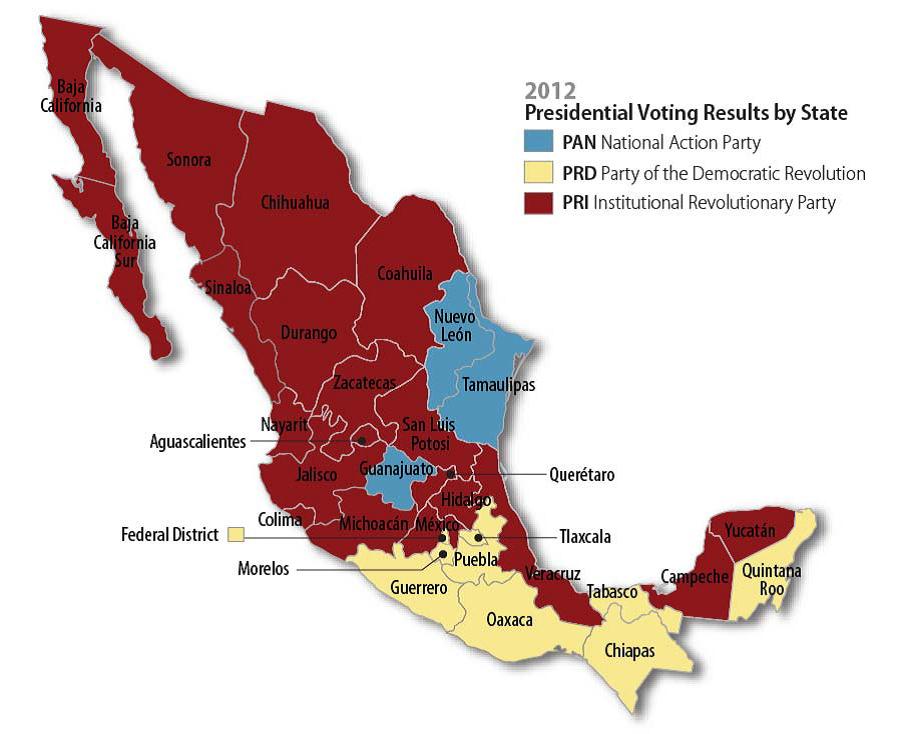
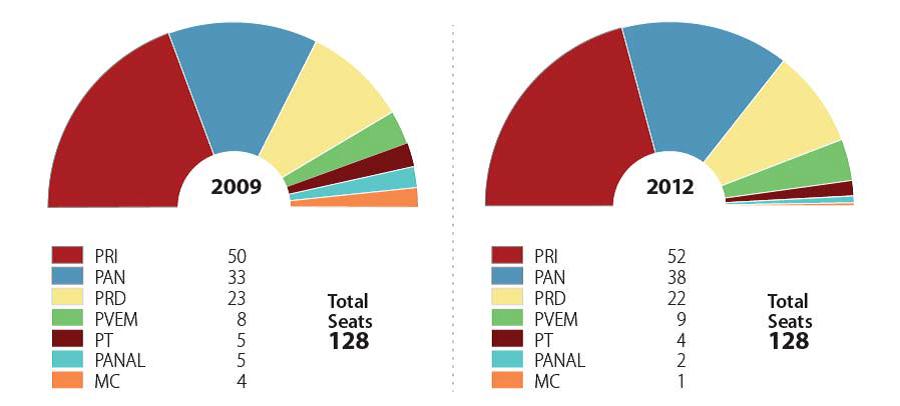
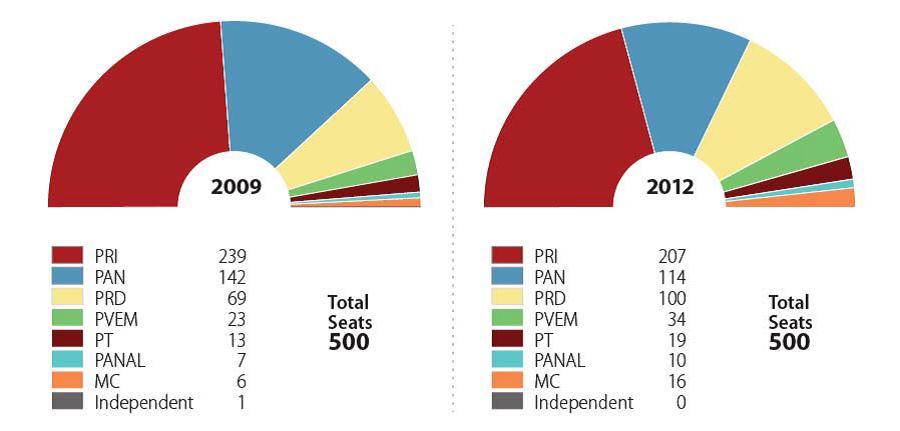
         The PRI is back in power. Enrique Peña Nieto of the Institutional Revolutionary Party (PRI) has won the Mexican presidential elections with a plurality of 38 percent of the vote, returning to power the party which ruled Mexico as an authoritarian one-party-state for decades. Peña Nieto defeated the left-of-center Andrés Manuel López Obrador of the Party of the Democratic Revolution (PRD) who got 32 percent of the vote and Josefina Vázquez Mota of the conservative National Action Party (PAN) who received about 26 percent. For the Mexican left, the election results are a stinging defeat not only at the presidential level, but also in the congressional elections.

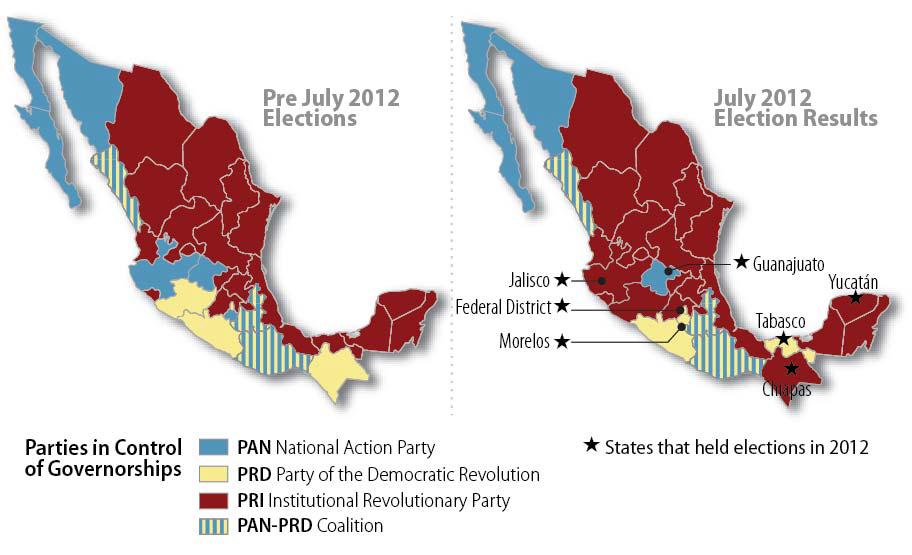
         López Obrador, who claims to have won the last election, has not accepted the election results either and is asking the electoral authorities to investigate. Thousands of his supporters marched through Mexico City the day after the election, claiming that their candidate had once again been defrauded of his victory. López Obrador claims that Peña Nieto and the PRI violated spending limits; he argues that through fraud they have stolen one million votes. The Mexican electoral authorities have agreed to recount more than half the ballot boxes because of irregularities found in vote tallies. Peña Nieto won the election by more than three million votes according to the authorities. The PRD, however, won again the mayoralty of Mexico City with 60 percent of the vote and won the governor’s elections in the States of Morelos and Tabasco. The PRD thus remains a political power in the country though it did not win the presidency and has a minority in the congress.

         While López Obrador attributes his loss to his opponents’ violations of election law and fraud, his own decisions no doubt also had an impact. In 2006 the Mexican election authorities reported that he had lost by a quarter of a million votes and many believe he actually won; this time he lost by more than three million votes and no one but his most ardent followers are asserting that he was the winner. Why did López Obrador lose in 2012? Perhaps it’s because he abandoned the more radical rhetoric of his 2006 campaign, which led the media to compare him to Hugo Chávez of Venezuela, and this time portrayed himself as a moderate reformer who would follow the example of Luiz Inácio “Lula” da Silva, the former president of Brazil. López Obrador sought this time around to win the confidence of the Mexican business establishment and of Mexico’s middle classes, while still holding on to his traditional base among working people, peasants and the poor. Did some of his potential voters lose confidence in a candidate who changed his identity from left to center? Perhaps. In any case, the move to the right clearly failed to improve on his 2006 performance.

    The Future: A PRI – PAN Alliance?

         The PRI in power under Peña Nieto will not for the foreseeable future be in a position to recreate the one-party state that it was in the past. While final statistics are not yet in, the PRI will likely have little more than 240 seats in the 500-seat lower house. The PRI will only be able to rule by making an alliance with the PAN with which it shares a common economic program, and the PRI and the PAN together will have just enough votes to make it impossible for the PRD to block their program. Mexico’s former Foreign Minister, Jorge Castañeda, believes the outcome of the election will lead to cooperation between the PRI and the PAN on the basis of their common economic agenda. Under a Peña Nieto presidency and a PRI-PAN alliance, Mexico’s neoliberal policies will continue and will expand, with the country likely to see continued piecemeal privatization of the petroleum industry and the passage of a labor law reform bill that would weaken unions. There is also, however, the possibility of political deadlock, an alternative that led to a fall in Mexican stock prices as the election results were reported.

    The Student Movement—Too Little Too Late

         Peña Nieto, who had the support of the powerful Televisa network and of the PRI’s powerful political machine, faced a rising challenge in the month before the election from a new student movement that criticized his links to the mass media and his record of political repression in Mexico State where he had been governor. The student movement expanded from the elite Ibero-American University, to the National Autonomous University of Mexico, and then to state university campuses throughout the country, raising its cry again money’s corrupting power in the media in ways similar to the American Occupy movement.

         But the student movement, known as “I am #132,” which grew rapidly and attracted attention from throughout the country, was still too little and too late to change the election victory for Peña Nieto and the PRI that had been predicted for months by the polls. The question now is, will the student movement that arose out of the 2012 presidential election be able to continue as a significant social movement once Peña Nieto takes power? Other student movements of the late 1960s and the mid-1980s had an important progressive impact on society at large, and this one may too if it can recover from the election hangover and tackle the society’s economic and social problems.

    The PRI’s Past

         The Institutional Revolutionary Party has its origins in the Mexican Revolution. It was created in 1929 by President Plutarco Elías Calles as the party of government functionaries and transformed by President Lázaro Cárdenas in the late-1930s into a mass party of workers and peasants. By the 1940s the PRI had become an authoritarian and corrupt party with a nationalist economic program; it oversaw the state banks and industries, encouraged private capital and used its control of the labor unions and peasant leagues to ensure labor peace. The “Mexican Miracle” of the 1950s and 60s was based on the PRI’s policy of keeping wages down, though providing workers with subsidized health care, housing, food, and fuel. By the 1980s, however, the PRI abandoned its nationalist economic program and adopted neoliberal policies to encourage foreign investment, open markets to free trade, cut the social budget, and weaken labor unions. Since the 1970s, the PRI had loosened its hold on the political process and by the 1980s there were growing political parties left and right.

         When the PRI turned right in the 1980s, the nationalist wing, led by Cuauhtémoc Cárdenas broke off forming the Democratic Current and then a National Democratic Front, which also included the former Mexican Communist Party and other left groups. Cárdenas ran as the Front’s candidate in 1988 and is widely believed to have won the election, but the PRI President Miguel de la Madrid and the electoral authorities declared Carlos Salinas de Gortaria the winner. Salinas then oversaw a vast privatization of industry that transformed Mexico’s political economy. In the election which just took place, Salinas supported Peña Nieto, and some argued that Salinas will be the power behind the throne.

    The PAN’s Failure

         In 2000 Vicente Fox, a Coca-Cola Company executive, businessman and rancher, ran as the National Action Party’s candidate for president and won, ending over 70 years of rule by the PRI. Fox had received votes from both the right and left, from all of those who wished to end the long rule of the PRI. Fox oversaw the emergence of multi-party political democracy, but did little to change the economic direction of the country. Many were surprised to see him maintain the alliance with the country’s corrupt official unions. When Fox retired, he left to his successor Felipe Calderón the country’s continuing economic difficulties and its fundamental social problems. In this election, Fox declined to support the candidate of his own party, Vázquez Mota, and instead endorsed the PRI’s Peña Nieto as the best option for voters.

         For the last six years, Felipe Calderón, also of the conservative PAN, has held office, pursuing a war against drug dealers that saw the deployment of 40,000 soldiers and thousands of police officers, widespread violations of human rights, almost 60,000 killed, 10,000 disappeared, and thousands forced to leave their homes for other states. He has also presided over an economic crisis that saw annual per capita growth of less than one percent throughout his term, with millions unemployed and a growing number of youth who could neither continue their education nor find jobs. Real GDP growth for the last dozen years has averaged 2.3 percent, low for a developing country. Some have argued that the terrible economic situation helped to drive tens of thousands of Mexicans to seek work in the illegal drug trafficking business. Calderón thus became tremendously unpopular with the Mexican people, making PAN candidate Vázquez Mota’s campaign an uphill battle. The people punished Calderón and the PAN by denying her their votes.

    The Left’s Future

         Mexico’s left, which invested so heavily in the rightward-moving López Obrador must ask itself whether it made a mistake and might not have done better pursuing some other alternative. Lacking confidence in the Party of the Democratic Revolution, López Obrador created his own campaign organization called MORENA (Movimiento para la Renovación Nacional or Movement for National Renovation). MORENA became an umbrella for a variety of social movements and small left political parties who stood under it or just outside of it, anxious to find a candidate who could advance the left. Speaking to the left, López Obrador said he wanted “real change,” and the revolutionary left interpreted this to their followers as “regime change” that would restore democracy and create a popular political economy. The appearance of the student movement “I am 132” encouraged the left to believe that their time had come. The Mexican left thus embraced a rightward moving populist, a strategy that in the wake of López Obador’s defeat leaves it disappointed and disoriented.

         What is new and exciting coming out of the election is the new student movement. On July 4 in Guadalajara, one of Mexico’s largest cities but also generally a conservative one where the largest demonstrations by social movements, unions and the left seldom exceed 500 people, students using social media organized a 7,000 person protest against Enrique Peña Nieto and the PRI. Something is happening among Mexico’s young people and they deserve to have options on the left besides populism; their demand for democracy and social justice needs to find expression in a revolutionary rejection of capitalism and a vision of democratic socialism. If the left is to offer it, it must critically examine its own illusions regarding the existing political system, its parties and its candidates.


    Dan La Botz is a Cincinnati-based teacher, writer and activist. He is the editor of Mexican Labor News & Analysis.

  • The People Rule

         What is democracy? Well, as most of us know, it comes from the Greek demos kratos—the people rule. But what form has that rule taken? Well, in the days of the ancient Athenians, free Greek men used to gather in the agora—the marketplace, to debate public policy and vote on it. Fast forward to the Magna Carta signed by King John of England at Runnymede, and it meant limiting the power the king had over his nobles. The serfs and townspeople were left out of the mix. Gradually, though, Parliament came into existence and developed in a more democratic direction over many years, helped along by Cromwell, the Glorious Revolution, the Diggers, the Levellers, the Chartists and others.
         In the meantime, in continental Europe, progress was slower, happening first in places like Holland, Switzerland and the Hanseatic League. Gradually, towndwellers—burghers, bourgeois, or folks more commonly perceived as merchants—gained incremental bits of a say over their communities' affairs. The Church as a major property and power holder held things back in continental Europe, as they also had in England. Very little progress in that direction was made until John Locke's ideas, partly brought into formation by the Protestant emphasis upon the individual, helped engender the American Revolution, along with resentment of the planters, bankers and merchants over tax policy. Then the French Revolution, helped along largely by the price of bread, but also by the ideas of Rousseau and Voltaire and the royal and noble impediments to their well-being perceived by French merchants and traders, brought liberte', egalite' et fraternite' to the fore. Then, once Napoleon set his troops to marching, those soldiers spread the ideas of the Revolution throughout Europe.
         Colonialism and imperialism meant the elites of Europe and America—the metropole—grew ever richer and more willing to share some power and resources with those who could help them rule, with a few crumbs of the crumbs wrested from the colonies granted by the elites to the rest of us. For the people in the hinterlands controlled by that metropole, it meant increasing misery and oppression, but also exposure to Western political and philosophical concepts which they adapted to their home turf.
         Filtered through Jean Meslier, Hegel and Feuerbach, democratic ideals were further extended by communist philosophy. This brought forth, thanks to Marx and Engels, wonderful ideas such as "the free development of each is the precondition for the free development of all." That concept, along with the socialist stage, "From each according to his ability, to each according to his work" and the communist stage, "From each according to his ability, to each according to his need," pretty well summed up the ideals of that movement, as embodied by a working class in revolt. The ever-growing power of the proletarians gradually pushed back the boundaries of suffrage, so that more and more men were able to vote. For women it came later. In some societies, much later. This despite the fact that Mary Wollstonecraft's Declaration of the Rights of Woman was written not long after the French Declaration of the Rights of Man and the Citizen and the Seneca Falls Convention, pushing women's rights, was held in the same year as the publication of the Communist Manifesto. Black people were finally freed from slavery in the United States, years after the first Black republic was fought into existence in Haiti, whose people took inspiration from the ideals and example of the French Revolution. Freedom for America's enslaved came some years after bondage was outlawed in the British Empire. Shortly before Blacks were freed here, peasants were released from serfdom in Russia. Immediately after the withdrawal of Union troops from the South, though, the vote and much of their freedom was taken away from African Americans by Jim Crow laws.
         The Communist movement sprang out of Social Democracy as a result of the latter's betrayal of European workers in World War I. Ordinary folk were emphasized in speeches, in political and popular literature as a result of the Communist movement. Real, democratic gains were made, especially by trade unionists, due to the dedicated leadership of Communist cadres. This started transpiring all over the world.
         The communist movement, along with Enlightenment ideals, inspired intellectuals and leaders in the hinterlands like Frantz Fanon, Kwame' Nkrumah, Amilcar Cabral, Agostinho Neto, Mao, Gandhi, Nehru, Ho, Che' Guevara and, in South Africa, Nelson Mandela, whose African National Congress-led revolt against apartheid inspired the world. The resultant Constitution of South Africa is among the world's most advanced and liberatory, even if neoliberal policies are followed by those now in power.
         But then in those countries where communist parties gained power, apparatchiki, nomenklatura, in other words, Party bureaucrats grasped more and more power. What little say over their own affairs working people had won was taken from them. It was taken back by them from 1989-'91, but soon lost again to apparatchiki turned capitalist. In our own country, the Civil Rights,antiwar, women's, GLBTQ, disabled and senior movements extended democracy beyond the suffrage finally won by women in 1920. Eighteen-year-olds won the right to vote.
         Already by the mid-'70s in our own country, a pushback had begun. "Too much" democracy was declared dangerous by rightwing intellectuals. Their theories were hearkening back to John Adams, Alexander Hamilton and others and their fears about "King Mob." An all-out assault was made on trade unions. Tens of millions of dollars flowed to conservative thinktanks, churches and the Republican party. Smaller, but still sizable contributions flowed, much of it from the financial world, to the Democratic party as well. The Republicans got more than their share from Wall Street. Elections became more and more expensive for candidates, making them increasingly dependent on massive infusions of cash from the corporate and financial worlds. Regulations in place since the Great Depression were relaxed or eliminated altogether. As a result, wild speculation became the order of the day and, with the collapse of major Wall Street players, we had something called the Great Recession. Millions of Americans were thrown out of work who had not already lost their jobs in the midst of the de-industrialization of America and the gravitation of those industries to low-wage, low-regulation countries. Many of the jobless lost their homes to foreclosure. Many older people lost their life savings, as the bottom fell out of their 401(k)s.
         As one consequence of this and the continuing attack on trade unions, a fightback developed among workers, students and other mostly young people. Madison, Wisconsin became the epicenter of a working-class resurgence. Zuccotti Park gave birth to Occupy Wall Street and the many Occupys which started spreading all over the country and the world, along with the Indignados of Spain and the people in revolt in Greece, Britain, Ireland and elsewhere. They were joined by millions of Middle Easterners in the Arab Spring, which developed a like-movement in Israel and had really begun in a non-Arab country, Iran. Working people in China, Vietnam and Thailand fought back against corporate and governmental repression. Popular movements got themselves elected into power in Brazil, Venezuela, Bolivia, Ecuador, Nicaragua, Argentina, Uruguay, El Salvador and, briefly, in Honduras and Chile.
         Democratic movements were on the rise. In the world of theory, in the meantime, post-Marxists, post-structuralists, postmodernists and their more recent manifestations helped along already-extant multi-culturalist movements and something called radical democracy, a major statement of which was Ernesto Laclau & Chantal Mouffe's Hegemony & Socialist Strategy. Following later on the heels of that was the horizontalism, the general assemblies, the human microphone and the consensus-seeking of the Occupy movement, thanks to anarchist impulses.
         With the threat of catastrophic climate change and the race not only to the bottom but perhaps even into extinction which has been developing parallel to all this, the 21st century's democratic impulses could not have come along at a more critical time. If popular movements all over the world can link up, which they can through their mobile phones, their iPADs, their text-messaging and their videos, recording flash mobs and other democratic impulses, we may well save the planet and the vast majority of its people yet. Demos kratos will have gone from being the purview of free Greek males to being everybody's purview.
     
    Greg King is a member of SEIU, Local 888

  • Cuba, Socialism and Democracy

         In January 2011, members of the Participatory and Democratic Socialism Movement proposed that the Cuban Communist Party adopt its "Proposals for the Advance of Socialism in Cuba." ("Socialism and the 'Citizens' Demand for Another Cuba," Pedro Campos, Havana Times, June 24, 2012)* These socialist critics of the Cuban regime offered a program of radical democratic proposals including full freedom of speech and press, freedom of association (including parties and unions), freeing of political prisoners and the like—while supporting the continued criminalization of receiving foreign "aid" that seeks to undermine the Cuban "constitutional order." Not surprisingly, the Cuban party congress—which approved massive lay-offs from the public sector—rejected these proposals.

         Many leftist defenders of the Cuban regime argue that such proposals reflect "perfectionism." ¬ They claim that socialists like those who support Havana Times (or New Politics) are engaged in a "Platonic" exercise of defining some sort of "ideal" socialist society¬ and condemning all deviations from that ideal. Is this the case?

         The critique of the absence of effective democratic workers power in the post-capitalist societies of the 20th century (and those that survived into the 21st century) is not a "deviation from the ideal," but an assessment of the structural root of the crisis and collapse of these societies. Most of us who have been critical of all of these societies, including Cuba, never argued that only a fully nationalized and planned economy where workers democratically make any and all economic decisions was the only acceptable form of socialism. Instead, we argued that the shifting boundary between planning and market mechanisms—which characterizes the transition to socialism—must be determined democratically as should all fundamental economic decisions. In order for working people to be able to determine both the boundary between market and plan and the fundamental goals of economic planning there must be, at the minimum, the right to form competing political parties/formations that put forward different proposals, free speech/press for all who do not take up arms against the regime, the ability to form independent trade unions and organizations of women, the racially oppressed, LGBT people, etc.

         Some have claimed that the repression in Cuba is justified by the demands of fighting the threat of counter-revolution. Since the early 1970s, however, one would be hard pressed to find examples of armed opposition to the Cuban regime that would justify its repression of non-violent political dissidents.

         Others cite such institutions as the Committees for the Defense of the Revolution (CDRs), the unions, and the elected popular assemblies in the neighborhoods and workplaces as examples of Cuba's revolutionary democracy. The CDRs are not open to all Cubans who seek to defend the revolution. Instead, they are much more limited in their membership and goals. Only those who are judged "ideologically integrated" by their local Communist Party organizations are permitted to join the CDRs. The main tasks of the CDRs is to root out those who are "ideologically suspect"—whether or not they are engaged in armed political activity—and to aid in the administration of rationing and other social and economic tasks. Many commentators have argued that the CDRs are simply extensions of Cuban State Security (the political police). In any case, participation in the CDRs declined sharply since the 1990s, especially in Havana, as more and more Cubans have had to work longer hours in official and unofficial jobs to make enough to subsist.

         The Cuban unions are almost identical to those that existed in the other dictatorial post-capitalist societies. The Cuban unions, like their Soviet, Eastern European and Chinese counterparts, are not allowed to strike or take other direct action in defense of workers' interests. The question of whether revolutionary socialists would advocate strike action in a democratic workers' state is an important one. However, unions that do not have the right to strike cannot act as an effective counterweight to the state managers and planners—the role that Lenin envisioned for independent unions during the debates with Trotsky (who advocated the bureaucratic "statization" of the unions) and the "Workers' Opposition" (who advocated trade union administration of the economy) in 1921. Instead, the Cuban unions act as "transmission belts" between the party and the workers—encouraging workers to fulfill production quotas, accept managerial authority and the like. Put simply, the Cuban unions function as an extension of the unaccountable and undemocratic party-state management in Cuban workplaces, not as independent voices of the workers.

         Finally, there are the elected popular assemblies created by the Cuban Constitution of 1976. Despite what some have claimed, these assemblies do not mark a radical departure from forms of popular participation that existed in the other post-capitalist societies. Like elected assemblies in the Soviet Union, Eastern Europe or China at various points in their history, the Cuban popular assemblies have extremely limited powers. At best, they have "input" into national economic and social decisions (production goals, boundary of market and plan). For the most part, they decide how to implement decisions made "from above" in unelected, unaccountable institutions. In sum, the popular assemblies allow millions of Cubans to participate but not control political and social life. The French students and workers in 1968 understood the difference in their slogan" "I participate, you participate, they profit." In the case of post-capitalist Cuba, the slogan could easily be modified to "I participate, you participate, they decide."

         Today, the website Havana Times is filled with stories of the repression of the most elemental forms of non-violent free speech and free association on the island. In late May, some sixty left-wing dissidents organized the sixth "National Critical Observatory Social Forum"—the independent Cuban social forum. Raising slogans like "Socialism Is Democracy," "Kick out the Bureaucracy," "Down with Capitalisms," "If You Think Like the Bourgeoisie, You'll Live Like a Slave," and "Let's Make Our Revolution," these dissidents discussed the looming destruction of guaranteed employment and the need for greater self-organization in Cuba. The authorities, after initially granting the use of state facilities, shut the meeting down early. ("Cuba Social Forum Successful, but Cut Short," Isabel Diaz, Havana Times, June 3, 2012). Access to the internet remains prohibitively expensive for most Cubans ("So Now We Have Internet Access in Cuba?" Daisy Valera, Havana Times, May 21, 2012).

         In the absence of such minimal democratic controls, what we got in the post-capitalist societies of the 20the century was a form of social production that was able to initiate extensive growth—the multiplication of means of production and labor based on the import of existing technology from the capitalist west. The result was a rapid quantitative increase in both producer and consumer goods. Extensive growth, combined with economic planning and attempts to shield the command economies from international competition, allowed the growth of popular living standards for a period of time, including extensive "welfare states" (guaranteed employment, inexpensive housing, free medical care, etc.)—the concrete gains workers made in these societies.

         While the unaccountable officials of the party and state were able to promote extensive economic growth, however, they were unable to translate this into intensive growth— the continuous growth of labor productivity through the introduction of new and more sophisticated means of production and the continuous improvement in the quality of producer and consumer goods. Bureaucratic privilege and secrecy systematically undermined the planning process, leading to massive waste of labor and resources and chronic problems of quality. Lacking either the discipline of the market (competition forces capitalist firms to lower costs through the introduction of labor saving technology) or the democratic control of the producers (workers' have a stake in reducing their labor time through the introduction of labor saving technique), these authoritarian command economies—including Cuba's—experienced economic stagnation beginning in the late 1960s and early 1970s. Hyper-centralism in economic planning combined with voluntarist calls for the masses to work harder and sacrifice consumption and working conditions for the "good of the revolution" in the mid-1960s (when Che shaped economic policy), the early 1970s (the "10 million ton" sugar harvest) and again in the late 1980s and early 1990s (the "exceptional period" after the collapse of the Soviet Unions) all failed to produce the sustained intensive growth necessary to support the growth of collective services in Cuba. Faced with a growing economic and social crisis, the officialdom was compelled to reintroduce market mechanisms—greater independence for factory managers in obtaining inputs and selling outputs, the ability of managers to keep "profits" which were often shared with their workers, greater openness to international capitalist investment, etc. These experiments in "market socialism" did little to solve the deepening crisis of these societies. On the one hand, "market reforms" did not bring new, intensive economic growth because individual factory managers were never faced with the possibility of bankruptcy if they failed to "turn a profit." On the other hand, the expansion of the market brought greater social and economic inequalities between the bureaucracy and the workers, between sectors of the economy and among different regions. Combined with continued political repression and the inability of workers to organize their own independent institutions, the "market reforms" set the stage for capitalist restoration in the late 1980s and early 1990s in the former Soviet Union, Eastern Europe and China. Today, the Cuban party-state regime is preparing to abolish one of the central popular gains of the revolution—guaranteed employment and income. While massive lay-offs in the state sector are looming, real wages are stagnant and the ration card—which guaranteed consumer goods like tobacco and personal hygiene items outside the marketplace—is slowly being abolished. The regime has begun charging for formerly free workplace-based child-care, and cafeterias are also massively underfunded, leading to a sharp decline in quality. ("The Cat Test," Daisy Valera, Havana Times, May 30, 2012).

         The absence of workers' democracy—the ability of the working class through formal democratic institutions to effectively control economic and social life—lay at the root of the crises of the bureaucratic post-capitalist societies. The suppression of democratic rights—the right to organize politically, free press, free speech, etc.—did not prevent capitalist restoration in the east. In fact, the repression of all political dissent, whatever its political and ideological complexion, undermined the ability of pro-working class and socialist forces to organize a democratic, socialist alternative. Instead, only pro-market—pro-capitalist—political forces appeared to be the consistent advocate of "democracy" in these societies. In all of these cases, a wing of the old Communist party officialdom—not pro-western dissident intellectuals—led the counter-revolution under the banner of "democracy" and the "market".

         For many of us, the evidence indicates that Cuba is proceeding along the same lines, toward a party-state led restoration of capitalism. In the past two decades, the party leadership has encouraged the private sector on the island, with the Cuban army (headed by Raul Castro) initiating joint-ventures with European, Canadian and Israeli transnational corporations in tourism, mining and agriculture. Not surprisingly, the Cuban press glorifies the Chinese model of "socialism"—a restoration of capitalism under the repressive leadership of the Communist Party. This reality has not been lost on the leading representatives of U.S. imperialism. In late 2010, Wikileaks revealed that the Obama-Clinton State Department—including the US interest section chief in Havana—had concluded that the pro-Miami exile dissidents on the island had little support and the best hope for capitalist restoration in Cuba was found in the Cuban Communist Party!

         Put simply, the absence of any minimal democratic rights in Cuba facilitates the restoration of capitalism, undermining the ability of working people on the island to organize against the Cuban party-state's steps to end guaranteed employment, free health care and open the Cuban economy to the ravages of the world market.


    * The Havana Times is not published in Cuba, where censorship of independent sources continues, but outside the island.

  • Mexicans Vote to Return the PRI to Power

         Enrique Peña Nieto of the Institutional Revolutionary Party (PRI) has won the Mexican presidential elections with a plurality of 37 percent of the vote, returning to power the party which ruled Mexico as an authoritarian one-party-state for decades. Peña Nieto defeated the left-of-center Andrés Manuel López Obrador of the Party of the Democratic Revolution (PRD) who got 31 percent of the vote and Josefina Vázquez Mota of the conservative National Action Party (PAN) who received about 26 percent.

         Peña Nieto, who had the tacit support of the powerful Televisa network and of the PRI’s powerful political machine, faced a rising challenge in the month before the election from a new student movement which criticized his links to the mass media and his record of political repression in Mexico State where he had been governor. But the student movement, known as “I am #132,” which grew rapidly and attracted attention from throughout the country, was still too little and too late to change the election victory for Peña Nieto and the PRI which had been predicted for months by the polls.

         Andrés Manuel López Obrador, who claimed to have won the presidential election in 2006, abandoned the more radical rhetoric of that campaign which led the media to compare him to Hugo Chávez of Venezuela, this time portraying himself as a moderate reformer who would follow the example of Luiz Inácio “Lula” da Silva, the former president of Brazil. López Obrador sought to win the confidence of the Mexican business establishment and of Mexico’s middle classes, as well as of his traditional base among working people, peasants and the poor. The move to the right clearly failed to improve on his 2006 performance.

         The Institutional Revolutionary Party has its origins in the Mexican Revolution, created in 1929 by President Plutarco Elías Calles as the party of government functionaries and transformed by President Lázaro Cárdenas in the 1930s into a mass party of workers and peasants. By the 1940s the PRI had become an authoritarian and corrupt party with a nationalist economic program; it oversaw the state banks and industries, encouraged private capital and used its control of the labor unions and peasant leagues to ensure labor peace. During the 1980s, however, the PRI abandoned its nationalist economic program and adopted neoliberal policies to encourage foreign investment, open markets to free trade, cut the social budget, and weaken labor unions. Since the 1970s, the PRI had loosened its hold on the political process and by the 1980s there were growing political parties left and right.

         In 2000 Vicente Fox, a Coca-Cola Company executive, businessman and rancher, ran as the National Action Party’s candidate for president and won, ending over 70 years of rule by the PRI. In terms of political program, Mexicans could find little difference between the PRI and the PAN. Presidential candidates Cuauhtémoc Cárdenas and López Obrador of the left-of-center Party of the Democratic Revolution offered an alternative, but the PRI and the PAN used their political power, corruption, and—many believe—electoral fraud to keep the leftist candidates from winning.

         For the last six years, Felipe Calderón, also of the conservative PAN, has held office, overseeing Mexico’s economic crisis and pursuing a war against drug dealers that saw the deployment of 40,000 soldiers and thousands of police officers, widespread violations of human rights, 50,000 killed, 10,000 disappeared, and thousands forced to leave their homes for other states. Tremendously unpopular with the Mexican people, PAN candidate Vázquez Mota faced an uphill battle in the attempt to represent her rightwing party, and she was ultimately defeated by the legacy of Calderón.

         With the PRI back in power, many Mexicans will be asking themselves is this a case of back to the future? Will Mexico become once again a one-party state ruled by an authoritarian party? Mexico’s left, which invested so heavily in the rightward-moving López Obrador must ask itself whether it made a mistake and might not have done better pursuing some other alternative. The Mexican right, the National Action Party, will find it hard to compete with the nearly equally conservative PRI and overcome the legacy of Calderon’s military policy. The question of the moment, for most Mexicans, is what will the PRI be able to do about the economic crisis and the drug war? The PRI may have its honeymoon period, but one suspects that the honeymoon will be short.

  • Blaming the public employee

             It has become fashionable, especially among conservatives, to portray public employees as lazy and inefficient, as compared to private sector workers who are touted as hard working, efficient, and cost effective. In this invective, all public sector workers are lumped together— teachers, police, firemen, welfare workers, Social Security workers, etc.

             This negative portrayal ignores the system where public employees work. Welfare workers, for example, are working for a system that encourages them to discourage applicants from applying, and hassles people after they are accepted for welfare. They get more credit for kicking people off the rolls than for accepting them on the rolls. The same is true for SSI workers. The system is set up to discourage people from applying. On the other hand, workers in the Social Security system generally don’t discourage people from applying. They are expected to deliver benefits efficiently. Public benefit systems reflect society’s and legislator’s priorities and values.

             Conservatives want everything to be privatized. Their bottom line is profits. When public services are privatized, as with welfare systems, the customer suffers because workers are fired and service is cut back.

             Public workers are often inefficient and overly bureaucratic, but that is more of a political problem than an individual problem. Some systems are designed to serve the public well, some are designed to discourage people from applying.

  • On the Eve of the Elections: The Impact of the New Student Movement

         As Mexicans prepare to vote on Sunday, July 1 in the national elections, two presidential candidates have pulled ahead and each claims that he will win. Enrique Peña Nieto, candidate of the Institutional Revolutionary Party (PRI) that ruled Mexico for over seventy years, is ahead in all of the polls, buoyed up by the PRI’s political machine and the corporate media. Andrés Manuel López Obrador, candidate of the Party of the Democratic Revolution (PRD) who pulled into second place and has been gaining on the leader, has the backing of the organization that he spent the last six years building, made up hundreds of committees and tens of thousands of supporters. Peña Nieto might be called the center right candidate who will continue the neoliberal polices of the last quarter century and López Obrador the center left candidate who advocates what could be called social liberalism, capitalism with a human face. (See La Botz, “Populist candidate López Obrador moves up in polls in Mexico as his Keynesian impulses give way to appeals to business.”)

         The latest opinion polls show Peña Nieto likely to win 42 percent of the electorate and López Obrador only 30 percent. But López Obrador says the polls are wrong and his understanding of the Mexican people tells him otherwise. “We are going to win again,” he says, alluding to his claim to have won the Mexican election in 2006 only to have it stolen by the sitting president Felipe Calderón. Calderón’s colleague, Josefina Vázquez Mota, the candidate of the National Action Party (PAN) who hoped to become Mexico’s first woman president, has been falling behind, now at only 24 percent in the polls, dragged down by all the problems of Calderón’s presidency: the violence of the drug war that has taken 50,000 lives, the economic crisis, the lack of opportunity for the country’s youth.

    The Impact of the New Student Movement

         During the last several weeks the sudden upsurge of the new student movement in Mexico known as “I am 132” has begun to throw itself into the balance, and things now begin to tilt a little toward López Obrador, though it is not yet clear that they tilt far enough and fast enough to bring him victory. The new movement began when a group of socially-conscious students at the elite, private, Jesuit Ibero-American University in Mexico City protested against Peña Nieto for his record of violent repression of social movements in the State of Mexico where he was governor.

         When Peña Nieto dismissed his youthful critics as a handful of 131 student protestors, others began to put their names and faces on the social media announcing, “I am 132.” Since then the movement has spread to Mexico public university system and now there are almost daily demonstrations throughout the country against the PRI candidate and the corporate media that back him. Marches in Mexico City have drawn tens of thousands and in other cities thousands, and they are marching everywhere and daily taking up new issues. The student protests have been fueled by the British Guardian newspaper’s reports that Televisa had been paid by Peña Nieto and other politicians to carry favorable coverage of their campaigns. (Links to the Guardian coverage can be found at the end of this article.)

    How Independent are the Students?

         The appearance of what is now a national student movement attacking the alliance between the PRI’s Peña Nieto and Televisa clearly helps López Obrador, though both he and the students deny that there is any relationship between his campaign and the movement. The Mexican students say simply that they do not want to return to the past of the authoritarian, corrupt and repressive government of the PRI. The students sometimes call their movement “The Mexican Spring,” alluding to the Arab Spring of a year ago, and they invoke the Spanish indignados and the Quebec student strikes and protests which are taking place at the same time. The students argue that it is time for change in Mexico, though their movement has not yet articulated the kind of change they seek.

         The PRI has accused López Obrador of using his organization and funds to manipulate the student movement, a charge denied by both López Obrador and the students who claim that they are completely independent.

         On June 11, a new “Generation MX” (MX for Mexico) video appeared on the internet, supposedly made by half-a-dozen students, which criticized “I am 132” for serving party interests and having no direction. The video proved to have been made, however, under the direction of Rodrigo Campo, an advisor to the president of COPARMEX, the Mexican Employers Association, though Campo claimed that no political party had had any hand in the creation of the video or the alleged other new student movement that it claimed to speak for. The “Generation MX” video appeared to have been a failed attempt by one of Mexico’s most conservative organizations to derail the new student movement.

    What Will Be the Impact?

         Despite it’s unlikely beginnings at the elite Ibero, “I am 132” has become a genuine national youth movement, spreading from the Ibero to the National Autonomous University of Mexico (UNAM) with its 300,000 students, and then to other public universities across the country. The new student movement’s presence on the public university campuses and its protests and mass marches have allowed it to begin to have an impact on the country’s “ninis”—those who, because they don’t have the economic resources, neither study nor work (ni/ni = neither nor). The new student movement has also joined with other social movements, such as those that fight for the rights of Central American immigrants who suffer from police violence and corruption.

         Whether or not this new movement is moving fast enough and becoming large and broad enough to help López Obardor’s campaign remains to be seen. If it survives the election, and his likely defeat, it could go on to have an impact on the society at large and possibly on the labor movement. Despite the massacre of hundreds at Tlatelolco, the Plaza of the Three Cultures, in October of 1968, many of the students of that generation went on to become activists in the labor unions and in other social movements; they joined left political parties and contributed to the struggles that finally ended the rule of the PRI in 2000. This generation of student activists, even if their activism doesn’t swing the election toward the populist López Obrador, may have a long term impact on Mexican society.


    British Guardian newspaper coverage of Televisa scandal.

    June 7, 2012

    June 8, 2012

    June 11, 2012

    June 12, 2012

  • Chicago teachers lead the way, again

    Teacher unionism was born more than a century ago, in Chicago. Teachers in Chicago are once again leading the way by authorizing a strike over the policies that are destroying public education in communities across this country – and the globe. In a letter to education activists, Pauline Lipman, a professor at University of Illinois, Chicago, describes the background to the strike and explains why Chicago teachers deserve support from anyone who wants good schools for all kids:
     "Chicago – a birthplace of the neoliberal corporate agenda for schools is now a focal point of the offensive against it. On Monday, June 11, the Chicago Teachers Union announced that 89.73% of its members voted to authorize a strike vote if contract negotiations with Chicago Public Schools fail… Last year, Stand for Children and other education privatizers and Chicago’s Mayor Rahm Emanuel engineered a state law requiring 75% of all eligible CTU members to vote yes to authorize a strike vote. Stand for Children leader, Jonah Edelman, bragged that the CTU 'will never be able to muster the votes to strike.' But the arrogant privatization billionaires behind the assault on teacher unions did not count on the profound anger of teachers, paraprofessionals, and clinicians that has been percolating beneath the surface and the courage of a progressive union to stand up. As CTU president Karen Lewis said, the vote was a resounding “indictment” of CPS policies. The vote was amazing: Total CTU voting membership 26,502:  23,780 voted “yes,” 482 voted “no,” and 2,240 did not vote or their votes were spoiled (all these were counted as “no” votes) (Chicago Teachers Union)."
     
    Wisely, the CTU has reached out to parents and community. Pauline Lipman exlains this background: "On June 9, parents and community organizations across the city allied with the CTU, also launched a campaign to end mayoral control and institute an elected representative school board. The battle in Chicago for reinvigorated public education is on and it’s strategic.  The billionaires behind Stand and other groups are pouring money and forces into Chicago against the CTU. The week of the vote the hedge fund-backed, pro-charter organization, “Education Reform Now,” spent $100,000 to flood Black radio stations with ads to turn parents against the union.  This is only the beginning. Meanwhile the union and community organizations are also gearing up a grassroots campaign to support the CTU in their courageous fight for the schools our children deserve
     
    The CTU is an example of what good teachers unions can do to push back on policies that are destroying educational opportunity for the vast majority of children in our nation's schools.  Chicago's teachers are no different from teachers in Philadelphia, Detroit, or Los Angeles. What's different is their union leadership, which has the courage and confidence to fight for what's right.  Imagine if Karen Lewis were AFT President!
     

  • Did organized money defeat organized labor?

    That appears to be the Democratic Party’s takeaway from its humbling defeat in the Wisconsin recall election. That and the ever familiar lament that workers no longer seem capable of voting consistently in their own financial interests, consistency in this case meaning in solidarity with embattled public sector workers and their unions. 38% of households with union members voted for the incumbent, as did a majority of non-college graduates. Walker carried the 10 poorest counties in the state by a 13% margin. The Wisconsin results paralleled voter approved public sector pension cuts in San Diego, an initiative of that city’s Democratic mayor, and San Jose.

    How did the labor movement find itself in this predicament? The mass protests in Wisconsin ended in March 2011, when Scott Walker signed Act 10, (“the Budget Repair Bill), turning Wisconsin’s public sector into an open shop. Trade union leaders told their membership to go back to work and shifted their focus to recalls and elections. Support groups such as United Wisconsin followed suit, thereby initiating a two-pronged strategy: to reclaim the Wisconsin Supreme Court in the hope that the bill might be declared unconsititioutional and to reclaim the state senate and remove the sitting governor. Union money and staff was diverted from training and organization building to the Democrats.

    The Republicans, nevertheless, outspent the Democrats 7 to 1, two-thirds of which was raised from out of state business donors who sought to turn this election into a test case for public sector union busting.

    But neither did Walker’s opponent, Tom Barrett, run on a progressive platform. He never mounted a robust case for union rights and, as mayor of Milwaukee was not above invoking Walker’s Act 10 collective bargaining restrictions to increase pension and health care contributions from city workers. It is also true that Barrett was not the first choice of the labor bureaucracy. Their choice was a candidate seen by the Democratic establishment as being too progressive for the state, despite her refusal to commit to a firm stance against budget cuts and concessionary contract negotiations with public workers. The Democrats were initially pushed from below into a confrontation they were reluctant to undertake by a labor bureaucracy more comfortable with doorbell ringing and manning phone banks than with the unpredictable prospects of mass street mobilization that could easily escape their control. And, all too predictably, pollsters, consultants, advertising campaigns and Democratic functionaries came to eclipse labor’s influence. For its part, the extent of the Obama commitment could be measured by a single tweet.

    After three rounds of elections, labor was been left virtually empty handed. Republicans captured the critical Wisconsin Supreme Court post in April 2011. Then in August, the GOP managed to retain four out of six senate recall seats. Even the senate majority they now captured is too little too late. There is no legislative session planned before January 2013, that is, after the November elections, when Democrats may likely lose the majority due to Republican gerrymandering, prior to ever having exercised it.

    American politics at the state level operate in a uniquely reactionary context. Incumbent governors campaign on their records of economic growth and job generation that their “polices” purportedly engender. But state governments have a very limited arsenal at their disposal. Their success crucially depends on their ability to woo business from other states by offers of more generous subsidies, tax rebates and every other imaginable means of financial inducement. Capital adroitly plays state against state in a competition for the most business-friendly playing field. The difference between Republicans and Democrats often boils down to this. Republicans offer capital a union-free environment; while Democrats reassure business that their traditional “friends of labor” reputation can be harvested to deliver labor docility.

    At the same time, most state budgets must, by law, be in balance. While socialists and progressives favor taxes on investment property over labor, the entire dynamic of state politics militates decisively against this. Consequently, working people are steamrolled by a budgetary process that picks their pockets at every turn. While 50 million homeowners are under water, they are squeezed even further by mounting real estate taxes; while hanging on to employment by a thread and without realistic hope for pay raises, they face burgeoning income taxes, as well a regressive sales taxes. Even cops are routinely unleashed to blitz working people on their way to and from work with traffic fines, not to enhance public safety, but to raise additional streams of revenue.

    It should have been obvious that the local electoral arena is extraordinarily toxic to labor solidarity. The system is rotten ripe with possibility for an alliance between business elites and private sector workers against the public sector. To deny that private sector workers are acting in their own immediate interests is to be blind. It is utterly irrelevant to dispute the contention that public sector employees’ compensation, including health and retirement benefits, are accurately depicted as excessive compared to their private sector counterparts. The continuity of government has provided public workers with a degree of job security that is the envy of the private sector, and that continuity and those benefits, whether excessive or not, are paid for by private sector working class taxes.

    And the Democrats did nothing to rewrite the playbook. Neither at the local level, where Barrett said little or nothing about raising state revenues by taxing the wealthy or corporations, nor at the national level. Obama, following in the footsteps of Bush, cemented the predicate for this top-down Republican alliance. He could have stimulated the economy and indirectly recapitalized the banks from the bottom up by bailing out state and local governments and by placing imperiled pension funds, public and private, on the Fed’s balance sheets. He could have expanded aggregate demand by an immediate moratorium on all federal payroll taxes. He could have devised a program of wide-scale mortgage relief. He could have spurred investment in new energy, infrastructure and education initiatives. He could have revived New Deal public works style projects.

    But Obama chose, instead, to continue the Bush bailout of bank shareholders and Wall Street investment firms, securing as its first priority the very epicenter of the financial quake that shook state and local governments to their foundations. He chose in effect to oversee a series of state and local budgetary crises that will be financed in no small part by asset stripping the public sphere. He threw none of the banksters in jail and exacted no meaningful concessions from a crimenogenic Wall Street, not even symbolic caps on executive compensation. The structures of the casino economy remain fundamentally unaltered, the economy one bubble away from a plunge down the abyss.

    In what world, then, should workers have entrusted the Democrats to deliver on the promise of elementary economic justice? In an every-man-for-himself context, why not go with the party that has an authentic claim to that message? If the Democrats cannot make government work for “us”, why not keep it as small as possible?

    Clearly, Obama and the Democrats picked their Wall Street benefactors over their working class base and the bewildered, panic-stricken labor bureaucracy picked the Democrats over mass action. Both marched over the cliff holding hands.

    What could have been done? In February 2011, thousands of university teaching assistants and striking public school teachers in Madison sparked an occupation of the capital after Walker unveiled plans to strip public-sector workers of collective bargaining rights and eliminate billions of dollars from public schools, higher education, health care, poverty and children’s programs. It sparked the imagination of tens of thousands of ordinary workers, students, young people, liberals and leftists—not only in Wisconsin, but nationally, foreshadowing the Occupy movement—precisely because it was a mass democratic uprising against the entrenched forces of austerity. Power was in the streets and the spirit of social resistance and fightback was palpable, electrifying and contagious. Talk of general strikes, sick-outs and rolling walkouts heated the atmosphere. This was clearly the only arena where concessions could have been extracted. The political arena, as it is presently constituted, is entirely stacked against labor and its allies. It is a democracy-proof bubble of elite consensus, swaddled by an ever-obliging corporate media. Only through the credible threat of crippling civil disobedience could the movement have inspired and emboldened private sector workers and other layers of society to act in a manner similarly commensurate with their own interests and to align their struggles with that of public workers. It is primarily through struggle and confrontation that movements cultivate an awareness of their own power and begin to break the spirit of servility that keeps its rank and file chained to a system that betrays and oppresses them.

    The Democrats, as is their wont, swarmed to the front offering to defuse the situation by negotiating givebacks in return for the maintenance of public sector collective bargaining rights. A grateful union bureaucracy fearing government retaliation from above and the loss of control to mass action from below and desperately seeking some way out eagerly seized this opening. But movements grow by taking risks and the increasingly moribund nature of the American trade union movement is ample testimony to the rampant risk aversion of its bureaucracy, of its alarmingly narrowed horizons. It has reduced labor to the level of special pleaders, of lobbyists often indistinguishable in the public eye from any number of other special interest groups. In Gallup’s annual poll on confidence in institutions, American unions now score close to the bottom of the list, barely above business and Health Management Organizations, but below banks.

    If there were a takeaway, it would be this. The more labor supports the Democrats, the more labor is treated by them with scorn and contempt. The less it supports them, the less it accommodates the status quo, the more it is respected and feared. Where labor’s loyalty is taken for granted, the capitalist parties close ranks to the right. Where labor resists, Democratic politicians find their dedication to bipartisanship to be suddenly conflicted. Labor’s response will, unfortunately, be to double down on Obama, as if endlessly pressing the reset button will change the outcome. The Democrats, in turn, will double down on corporate fundraising, leaving union concerns and social justice behind.

    For in the end, it is not organized money that defeated organized labor in Wisconsin. It was a long festering, self-inflicted wound called the Democratic Party.

  • Alternet's "New Economic Visions" Series

    Alternet has a new series on “New Economic Visions” that may be of interest to New Politics readers. Here’s the description from Alternet: 

    As our political system sputters, a wave of innovative thinking and bold experimentation is quietly sweeping away outmoded economic models. In New Economic Visions, a special five-part AlterNet series edited by economics editor Lynn Parramore in partnership with political economist Gar Alperovitz of the Democracy Collaborative, creative thinkers come together to explore the exciting ideas and projects that are shaping the philosophical and political vision of the movement that could take our economy back.

    You can read the five entries by clicking the links below: 

    “Capitalism Has Failed: 5 Bold Ways to Build a New World,” by Sara Robinson

    “Why Building Community Wealth is a Key Challenge to Corporate Power,” by Steve Dubb  

    “The Rise of the New Economy Movement,” by Gar Alperovitz

    “There Is a Way! Beyond the Big, Bad Corporation,” by Tara Lohan

    “Cooperative Banking, the Exciting Wave of the Future,” by Ellen Brown 


  • Some Lessons of 1989's East European Revolutions: Reflections of a U.S. Peace Activist

    [This article will appear in the forthcoming summer 2012 print issue of New Politics.]

    In the 1980s, the U.S.-based Campaign for Peace and Democracy/East and West was deeply involved in the struggle for "détente from below." CPD/EW collaborated with the European Nuclear Disarmament network to build solidarity and mutual support between, on the one hand, peace groups and progressive trade unionists in the West and, on the other hand, the democratic movements in Eastern Europe and the Soviet Union. As CPD/EW co-director I traveled frequently to East-bloc countries, Western Europe, and Latin America to promote grassroots solidarity across Cold War boundaries. Now, more than two decades later, I would like to look back at our experience and explore critically the role of activists, East and West, in the years leading up to 1989.

         I will try to answer the question of why the outcome of the 1989 upheavals, despite their undoubted benefit of consigning the old Communist regimes to the dustbin of history, was in many ways disappointing, and why they failed to realize the hopes of millions for a new era of peace, social justice, economic betterment, and meaningful democracy. I will also discuss some implications of the 1989 revolutions for the historic movements of the last few years, from the 2009 Iranian mass demonstrations to the Arab Spring, to popular protests in Greece, Spain, Portugal, and the rest of Europe—and to our own Occupy movement.

         In the 1980s here in the United States CPD/EW succeeded in enlisting leaders of many peace groups—including the War Resisters League, Fellowship of Reconciliation, American Friends Service Committee, and Sojourners—in defense of Polish Solidarnosc trade union leaders, Charter 77 members in Czechoslovakia, and independent peace activists throughout the Soviet bloc. This defense of East-bloc activists transcended the crippling binaries of Cold War thinking that could be summed up in the unfortunate slogan "The enemy of my enemy is my friend." One example of such CPD/EW work was a 1983 New York Times ad entitled "U.S. Peace and Labor Activists Support Polish Solidarity Leaders on Trial" signed by 78 individuals, including Ed Asner, Barbara Ehrenreich, Noam Chomsky, Daniel Ellsberg, Allen Ginsberg, Maggie Kuhn, Manning Marable, David McReynolds, Robert Meeropol, Holly Near, I.F. Stone, and Cornel West.

         Moreover, CPD/EW argued that solidarity wasn't a one-way street, and in addition to organizing initiatives like the one described above it also succeeded in promoting solidarity in the other direction by engaging East-bloc activists in campaigns to oppose anti-democratic U.S. policies in countries like Chile and Nicaragua. In that vein, the Campaign in 1986 took out another New York Times ad entitled "Independent Voices, East and West, Speak Out Against Reagan's Nicaragua Policy" with dozens of Western signers and a large number of signatures from dissidents and independent activists in Czechoslovakia, East Germany, Hungary, Poland, the USSR, and Yugoslavia.

         Though I wish we had been even more successful in our efforts, I am very proud of that record. Today we at the Campaign for Peace and Democracy (the name was shortened by dropping the "East and West" after the Cold War ended) continue to oppose war threats and imperial sanctions by our own government, while supporting the fight for democracy and social justice everywhere, whether it occurs in countries within the U.S. orbit like Egypt, Bahrain and Tunisia, or in countries to which the U.S. is hostile, like Iran.

    Critical Solidarity

    As we move forward, we need to think more about HOW we build international solidarity. Does solidarity mean automatic agreement with everything the leadership of a democratic movement says? A rubber stamp? I don't think so. There is a need for what Danny Postel, quoting Fred Halliday, called "critical solidarity" in his Summer 2010 New Politics article, ""Revolutionary Prefigurations: The Green Movement, Critical Solidarity and the Struggle for Iran's Future."

         In retrospect, I think we in CPD/EW could have been more critical in our solidarity work with East-bloc movements. While we did discuss and debate with East European activists about issues of peace and disarmament, and never concealed our own anti-capitalist perspective, we didn't talk as much as we should have about our view of what kind of society should replace Communism, nor did we discuss in any depth the disastrous consequences we believed would follow if their countries were to adopt the neoliberal prescriptions of privatization and slashing the social safety net. In thinking back, I believe one major explanation for this shortcoming was that while we were supporting struggling movements for democratic change in the Soviet bloc and on one level strongly believed in the possibility of their victory, it was nonetheless hard for many of us to really absorb the idea that East-bloc repressive governments, seemingly so invulnerable, would actually collapse within a very few years. Therefore it didn't seem so urgent to discuss future visions.

         When the Communist regimes in Eastern Europe fell, the new governments, virtually without exception, did not question the need for wholesale integration into the capitalist world economy and to one degree or another accepted the legitimacy of demands from the West that they undergo "shock therapy" to speedily achieve that integration. The result of that acquiescence has been that millions of people have suffered from unemployment, insecurity, and loss of social services that were provided by the old Communist governments. Moreover, many East European economies are further threatened by today's global economic and ecological crises.

         Within movements for democratic change in authoritarian societies there is powerful pressure not to pursue discussions of differences of opinion about long-term goals, given the imperative of fighting to end the rule of a terrible, repressive regime. But sidestepping those discussions comes at a high price—not only internally, within opposition circles, but more broadly because it means that ordinary people can't be aware of the debates, participate in them, and begin to think about and propose future alternatives themselves. Different political currents of course do need to unite in a broad movement against authoritarian governments—but there is also the need to explore and expose differences about agendas for the future.


    Why was it that East-bloc dissidents, mostly leftists in the 1960s and 1970s, failed to pose a left alternative by the time the system was coming apart in the 1980s? I am unsure of the answer to this question, but I will make a stab at an explanation.

         First of all, the decline of the global left was an important element in weakening the left in Eastern Europe. Despite the "Iron Curtain" there was historically a general awareness in the Soviet bloc of the existence of socialist ideas and movements elsewhere. Their appeal, however, was limited to the extent that the very idea of socialism was associated with pro-Communist elements of the left. For a time, in the 60s and 70s, the new Western independent left, especially the student movement, exerted an influence in the East. But as these left movements declined they had less standing in Soviet-bloc countries. Moreover, the failure, with some honorable exceptions, of what global left there was to actively and energetically support democratic movements in the East bloc tended to alienate people suffering from Communist repression. Finally, the advance of globalization made it even more difficult to mount a successful anti-capitalist struggle in a single country than it had been before, and this doubtless contributed to the feeling that trying to forge a socialist or left alternative would be doomed to defeat.

         I don't mean to argue that a better outcome would have been easy, much less automatic, had the dissident community maintained its leftwing politics into the years of Communist collapse. However, it's important to remember the great international moral and political power of the democratic upsurge of 1989. What if the democratic movements and new governments had made egalitarian demands on the world's political and economic leaders, rather than acquiescing with no programmatic resistance to the logic of capitalism and the nostrums of the IMF and the World Bank? Even if they had been forced to make concessions to the power of capitalism, if the new governments had resisted and challenged capitalism's legitimacy instead of embracing it they could likely have won at least some interim concessions for themselves while moving the terms of global debate to the left. This was a great opportunity lost.

    Implications for the Future

    What are the implications of the 1989 experience for the upheavals and revolutions of our time? It is clear that international solidarity is needed now more than ever, not only to defend labor, dissidents, student, ecological and women's rights activists, and religious, ethnic, and sexual minorities against state repression, but also, while respecting the rights of people within a country to determine their own destiny, to strengthen through grassroots solidarity left and liberatory currents such as socialists, greens, and feminists within broad anti-repression movements. Moreover, critical solidarity today ought not to be a one-way street. So, for example, democratic activists in Egypt or Iran should be encouraged to speak out against repression and inequality in the United States (as the Egyptians so wonderfully did when they sent pizzas to the protestors in Madison, Wisconsin) and also to express their views about debates within Occupy and other U.S. protest movements.

         There is ample reason to expect that the new governments in the Middle East will be under pressure from below to resist neoliberal prescriptions for their economic and social ills. An important contribution solidarity activists can offer to this resistance is to make it difficult, through public protests and campaigns, for wealthy countries and international financial institutions to impose their retrograde solutions.


    A major challenge grassroots movements everywhere face today is the absence of political parties that can champion their cause and offer progressive solutions to the larger society. In countries emerging from decades of authoritarianism one reason for the lack of left wing political parties is that they were illegal under the old governments, so left activists often have to start building parties almost from nothing. But the problem goes beyond this legacy. In the past year we have seen an explosion of protest in countries with more democratic liberties like Greece, Spain, and Portugal, as well as here in the United States with our Occupy movement—and these protests also have no electoral expression. All too often the consequence is that after massive demonstrations and inspiring protests the new governments that come to power are far to the right of the popular upsurge that propelled them to power, while the left remains politically disorganized.

         Notwithstanding technical obstacles to forming new parties, there is another, deeper explanation for why the contemporary left generally doesn't have parties of its own or the intention to form them, and that is the "anti-politics" sentiment of many of today's protestors—an outlook that incidentally was also shared by many of the East-bloc dissidents of the 1980s. This outlook is understandable given the terrible failure of existing parties to represent and defend popular aspirations, but it leaves protest movements at a political dead end. To paraphrase the old Greyhound bus ad, it "leaves the driving to them."

         We are entering an age of tremendous turmoil because of the failure of global capitalism to fulfill the economic, social and personal needs of ordinary people around the world, and because millions have asserted their claims to dignity and security and are inspiring millions more to do the same. We need to shake off the old Cold War "the enemy of my enemy must be my friend" way of thinking and build a truly international left that can honestly fight for the rights of people everywhere and connect their struggles—not in a sectarian way that counterposes the left to mass democratic movements, but as integral, independent participants in these movements. Those of us who are socialists face the challenge of rescuing the image of socialism from the bureaucratic authoritarianism of societies in the Soviet Union and Eastern Europe that assumed the name, but this rescue effort is worthwhile because its success will help people to see a way out, to see that, despite Margaret Thatcher's deadening assertion to the contrary, there is a democratic, radical, and egalitarian alternative to the grim realities of contemporary capitalism.—April 19, 2012

    Notes

    This essay is adapted from a talk given at the Campaign for Peace and Democracy panel on the lessons of 1989 on March 17, 2012 at the Left Forum in New York City.

    The Campaign for Peace and Democracy's papers are available at New York University's Tamiment Library and its current activities are posted on its website, www.cpdweb.org. For more on the "détente from below" perspective of European Nuclear Disarmament see E.P. Thompson's Beyond the Cold War: A New Approach to the Arms Race and Nuclear Annihilation, Merlin Press, 1982 and The Heavy Dancers, Merlin Press, 1985. For a similar post-Cold War view, see the incisive essay, "Solidarity and Its Discontents," from Raha Iranian Feminist Collective, Jadaliyya, Feb. 19, 2011 and visit the website of the new group Havaar: Iranian Initiative Against War, Sanctions and State Repression.

  • The Bipartisan Assault on Higher Education

         Obama and Romney agree that the Stafford loan program should be maintained at a 3.4% interest rate, rather than being allowed to double by this July. This, somehow, is seen as a great boon to students and evidence of a bipartisan commitment to the upcoming generation. Keeping interest rates low purportedly encourages prospective students to choose more education than they might otherwise aspire to, to select more expensive colleges than they could otherwise seek, and to finance this education through more debt than they would otherwise incur. The first is undoubtedly socially progressive.

         Taken together, however, this is a social train wreck, and not least for the left. The university as an institution has always been embedded in the larger society. It was always in the business of imbuing its pupils, in part, with a regimented curriculum reflecting to one degree or another the retrograde values of the existing social order. But the structure of student aid further corrupts the experience of education in more visceral ways. Student debt is not dischargeable in bankruptcy, an issue that is particularly painful in times of high unemployment. Therefore, saddling students with high debts at the beginning of work condemns them to a life of debt peonage. It relentlessly produces a more skilled labor force but drives that herd inexorably into the most lucrative, rather than the most socially useful, avenues of employment. It devalues even the minimal critical faculties of independent thought and creativity cultivated by a liberal education, thereby ever transforming the university system into a wholly-functioning capitalist subsidiary. It forces students, on pain of ruin, to leverage their accumulating financial liabilities into productive assets for capital. It redirects mountains of engineering students, mathematicians and physicists into finance, where creativity is expended self-servingly on fermenting novel means of hoovering income up the class pipeline. And in the end, it contributes ever less to the productive capacity or cultural enrichment of society that a radical movement could later liberate and socialize for the general betterment of humanity.

         The central contradiction of student life boils down to this. Students come to the university with the goal of leading humanly meaningful lives only to find themselves being programmed to be useful to capital. Students may well have realized they are being trained to prop up a decaying social order, but find themselves ever more powerless to resist it. The system of student aid, as it is presently constituted, chains them to the mentality of acquisitiveness, of competitiveness, to the celebration of inequality and habits of submission and conformity that enhance the prospects for employment needed to discharge debt.

         The Helpful Hannahs and Henrys of the Democratic Party do not, of course, question the desirability of this dynamic, but merely seek to rationalize it. Keeping interest rates relatively low is just one aspect of this. Senator Ron Wyden, for instance, recently introduced a bill that would have the government disseminate statistics about graduation rates, incomes, and debt levels so that students can better evaluate how their particular program of study measures up to the debt that they assume in pursuit of their degrees. New York Times columnist Frank Bruni would go even further, calling for “government and university incentives to steer students into fields of study that will serve them and society best. We use taxes to influence behavior,” he observes. “Why not student aid?”

         But system efficiency is now largely beside the point. The acute crisis of capitalism has thrown a wrench into the machinery of higher education. Students faced with the prospects of protracted unemployment, who – as they often say — have done “everything right,” now find themselves increasingly unable to assimilate norms that are so widely at variance with their actual social existence. They feel instinctively uneasy even though they have yet no clearly defined ideas of what is wrong with society, nor what an alternative and more fully human society could look like. The debts remain. But now they are coupled with a poisonous atmosphere of desperation, malaise and self-estrangement that together drive the impetus of the Occupy movement. Students find themselves ever more unable to identify their futures with the existing social system.

         This sense of resistance, no longer one of free-floating alienation that characterized student life in more prosperous times, means that their social opposition is also no longer abstract. It has pressing and concrete aspirations. This pulls the Occupy movement in two contradictory directions: an ambitious, but still amorphous desire to create alternative social structures that compete with existing institutions combined with explicit political demands on the state and the capitalist class that controls that state for redress of immediate grievances. To the extent that it is countercultural it tends toward the apolitical but to the extent that it also formulates demands that cannot be readily accommodated it suggests latent revolutionary impulses.

         As socialists, we do not believe that counterculutural institutions that threaten to supplant existing social structures will be ultimately tolerated, or that they can be successfully reproduced under capitalism. Neither do we believe that such structures could long retain mass appeal, even in the unlikely circumstance that they should survive, were they to become separate oases detached from broader social and political struggles. Still, socialists must make every effort to assimilate the authentically subversive impulses of the countercultural wing of Occupy into a broader political movement for change.

         This suggests that socialists can play a distinct role in the Occupy movement by, among other things, offering concrete demands relevant to students, while formulating these demands with an eye to arousing the thirst for a broader reorganization of society on a more life-affirming basis. We insist, for instance, that education is a universal right, not a privilege. In itself this demand has its roots in enlightenment liberalism. But where we depart from liberalism is in our insistence that transforming that demand into a reality means that the “right” to education itself must be decommodified, forcefully separated from the prevailing commercial nexus. It is not a question of negotiating better loan terms, or more generous student grants, or paying tuition on a sliding scale, or “pay as you earn” programs to cap monthly payments, but of a genuinely free, universal and open higher education system at the public level.

         It means pointing out that the entire student loan network is independently responsible for fomenting a self-sustaining dynamic of tuition inflation, which is, itself, a form of rationing and of working class family impoverishment. As the pool of available funds for higher education expands, whether initiated by the state and supplemented by the private banking system, the university complex is given a license equally to raise tuition fees, or to enlarge the pool of poor and working class students, in accordance with the rising nominal demand. The bias is clearly to the former. This allows even public universities to continue to increase tuition when individual state legislatures cut budgets.

         Tuition inflation is consequently three times the level of the general rate of inflation for commodities. This has occurred across the board, for public and private colleges and universities as well as junior colleges. (Medical inflation, by comparison, is twice the general rate of inflation.) As fees increase, the system is then prodded to further expand the availability of funds to encompass, in principle, the needs of more students. Eventually this back and forth reaches, if it has not already, a tipping point. The carrying charges on the one trillion dollars of loans eats up so much of the family proceeds that it prices out income layer after layer of potential enrollees. We may finally be reaching a point where the percentage of college graduates in the workforce is no longer expandable. This is, in critical ways, an extension and mirror of the larger bubble economy.

         Universal, subsidized public higher education is not possible at the individual state or local level. Funds must be distributed from the top down. Individual states and communities are revenue constrained by their tax bases. The federal government, in stark contrast, is the sole producer of the means of appropriation – money — and therefore bears no such intrinsic constraints. It uses taxes to neutralize private demand so that government spending does not push the economy beyond its capacity to produce, to discourage consumption of specific products and to redistribute access to markets. It does not use taxes to finance its operations. The capitalist parties nevertheless seek to suppress the appetites of the state to decommoditize chunks of the social surplus through innumerable legal encumbrances and budgetary ceilings. These provisions have the sole purpose of limiting incursions on capital accumulation caused by the siphoning of resources from the private sector.

         Insofar as any government is sovereign with respect to the issuance of currency, can pay its foreign debts in its own money and allow its exchange rate to float, it can never actually be held hostage to the bond market. Bonds do not represent government borrowing. Government spends by creating money and crediting this money to the accounts of the private sector. It then swaps the money it deposited, in a macro sense, with interest-bearing assets, bonds, on a dollar for dollar basis. The state thereby creates privately held government assets and credits interest payments on them in the same way it creates the means of payment — by computer keystrokes. There is, however, no overriding economic necessity for the issuance of bonds in general, or of their issuance on a one to one basis against spending in excess of taxes in particular. There is no fundamental necessity to issue treasury bills or bonds. This is simply a legislative legacy of the gold standard. The central banking system exploits the opportunity that these outmoded encumbrances of bond issuance present to regulate financial markets. It does so by selling bonds at targeted interest rates. But this is a political matter, not an operational imperative. The ruling class and its elected factotums either have no insight into how the system of fiat money operates or cynically manufacture a further spectrum of legal, budgetary – and propagandistic — restraints in the hope of triggering a Pavlovian response mimicking what would otherwise be triggered by the fear of a sovereign debt crisis. Either way, the entire mainstream debate conveniently overlooks the fact that such crises are only possible where states are not themselves the sovereign issuers of the means of appropriation (fiat currency), such as Greece, Spain, and, for that matter, California or New York City.

         The demand for universal access to free public education, when explained on this basis, explicitly exposes the utterly fraudulent claim of an impending fiscal crisis of the state. There is a crisis, a crisis of capital accumulation. There is a debt crisis, a private debt crisis of workers (including students) and overextended businesses whose debt-driven assets increased faster than incomes or profitability.

         What’s the alternative? We have no interest in taking responsibility for capitalism. Business debt is primarily incurred to the private financial sector. But we do have a specific interest in the cancellation of all student debt. To the extent that these debts are owed directly or indirectly to the federal government, their cancellation presents, as we have shown, no specific difficulties. To the extent that debts are owed to private banks and other financial intermediaries, this is a demand for the government to assume these obligations from the private sector. They can negotiate the terms of that swap. Either way we insist that the loss of revenues to the state has no impact on the ability of government to fund its other obligations. Social Security, Medicare/Medicaid and other federal programs are not threatened by this demand. We therefore reject as utterly unfounded any ruling class effort to use this debt repudiation as a pretext to play off one generation of working people against another or to short-change any other social program or to impose wage or benefit restrictions on government employees.

         These demands may be impertinent, but they are not unreasonable. They are demands for a massive downward redistribution of resources. Does this expansion of government mean that we are asking the system to live beyond its means, as the ruling class propaganda machine tirelessly insists? This is absurd. No society can be said to be living beyond its means if there are unemployed workers and unused factories and offices. If capital cannot make profitable use of what the working class created and it idled, then we need to demand this excess capacity be put into operation on an entirely different basis.

         As socialists, we believe these demands are both legitimate and actionable. But we must be prepared to explain our case. The state can fully finance free and universally accessible college and university education. It can cancel all existing student debts. It can do so without imposing painful alternatives on other beneficiaries of public provisions. But this would require not only an educational offensive to acquaint the public with how the state actually finances itself, but a mass mobilization of students, the Occupy movement, and broad layers of society’s rank and file. We also believe that the ruling class is likely to close ranks and resist any large-scale diversion of resources for public rather than investment purposes that the realization of these demands would entail, even if capital as it is presently constituted cannot employ them. Ruling class intransigence in the context of this protracted crisis is itself a frank indictment of the political and moral bankruptcy of the system. But any success such struggles attain would massively embolden the movement to ask even more fundamental questions about the current organizational framework of society.

         Can these demands be fully won? No answer is possible. But we can say this. Struggle around such demands is necessary to try because it moves political consciousness in the right direction.

  • Every Day Is Memorial Day

    (Written the Saturday and Sunday of Memorial Day weekend 2011,when I was my usual long-term unemployed due to only temporary service work available at that time.—GF, May 18, 2012)

    This coming Monday is
    Memorial Day,
    same as it is every year
    at this time.
    Whoop-de-doo!
    But I’m laid off right now,
    same as I usually am
    around Memorial Day,
    so this is no special
    holiday for me.
    No time for me to
    rest from work,
    because I’m not working,
    but wish I were.
    For me,
    every day is
    Memorial Day,
    a “holiday” that’s
    not really a holiday,
    just another day of
    the same old-same-old,
    nothing to do
    and all day
    to do it in.
    No hot dogs
    over the grill,
    no outdoor
    barbecue
    for me over
    Memorial Day,
    because I
    can’t afford them
    without a job.
    Someone once said
    of my time
    unemployed,
    “I wish I had
    your time for
    reading.”
    Little did he know
    that, while there’s
    some time for
    reading, perhaps,
    there’s also time
    that necessarily
    must be taken
    to figure out
    just exactly
    how to pay the bills
    and scrounge for
    needed cash.
    Time to just sit and
    wait to be called
    back to work,
    itching anxiously
    for that e-mail
    or phone call
    saying that there
    is work once again.
    Senator Orrin Hatch
    had the chutzpah
    to say we
    unemployed
    don’t want jobs,
    all we want is
    our unemployment
    checks,
    so that we can
    buy drugs and
    vacation in
    Acapulco.
    Little, little
    indeed
    does he know,
    stupid ass!
    Buy drugs,
    take expensive
    vacations?
    Hell, I’m lucky
    if I can afford
    to go out and
    have a beer!
    Vacation, hell!
    Do you call
    scrounging for
    work because
    you really need
    better employment
    some sort of vacation,
    Senator Hatch,
    you with your
    gold-plated
    seat in the
    Senate,
    where you
    disgrace the
    institution!
    Well, Happy,
    Happy, Happy
    Memorial Day,
    everyone!
    (Yeah, I really
    mean it!)
    But it’s just
    another day
    for me,
    except that,
    since the offices
    and banks
    are closed,
    I have to wait till
    the day after
    Memorial Day
    to get my
    unemployment
    check—
    just another
    long, long wait
    superadded to
    too many
    long, long
    waits already;
    another
    three-day
    weekend
    where even the
    two-day
    weekends
    are just like
    the weekdays,
    only usually
    without money
    by the time
    they roll around.
    Memorial Day,
    where we honor
    the veterans who
    died for the
    Land of the Free.
    Only it ain’t
    so free
    when you’re out
    of work.
    Ah, but it does
    no good to bitch
    too much,
    for life’s a bitch
    anyway.
    So I’ll live with
    it and wait for
    another day,
    a different day,
    a real Memorial Day
    for me, when there’s
    not a holiday,
    just a blessed day
    when I actually
    have to get up
    early in the
    morning,
    going eagerly
    back to work
    again.

  • Populist candidate Lopez Obrador moves up in polls in Mexico as his Keynesian impulses give way to appeals to business

         Mexico’s voters face an increasingly murky choice in the rapidly approaching July 1 national election between three conservative, pro-business candidates and a populist candidate who until recently offered Keynesian solutions to the country’s endemic problems of inadequate economic growth, huge economic and social disparities, and a political establishment dominated by and in the service of a handful of oligopolies. All of the candidates promise to address Mexico’s greatest problem, creating enough jobs for its citizens, three of them principally by freeing business from government, and one of them through greater government intervention. While all of the candidates support the capitalist system, Andrés Manuel López Obrador has spoken most directly to the needs of the country’s small businessmen, working class, farmers and the poor. For the last few months, however, he has striven to garner more support from business by adopting a more conservative economic program virtually indistinguishable from the others.

         López Obrador, the former mayor of Mexico City and the candidate who almost won the last presidential election in 2006, had at the beginning of the current race been running behind the two other leading contenders for the Mexican presidency. Now he has moved up into a tie for second place with an estimated 26 percent of the projected vote. Tied with him in second place, also with 26 percent of the vote, is Josefina Vázquez Mota, former cabinet minister in the government of President Felipe Calderón and standard bearer of the National Action Party (PAN). Enrique Peña Nieto, former governor of the State of Mexico and candidate of the Institutional Revolutionary Party (PRI) leads with 45 percent. Also in the race, Gabriel Quadri de la Torre, of the New Alliance Party (PANAL), a party created by the Mexican Teachers Union (el SNTE), trails far behind with only about 1 percent of the vote.

    Neoliberalism vs. Keynesianism

         López Obrador, a populist who until very recently espoused Keynesian positions, is running against three pro-business candidates with neoliberal programs, that is, conservative programs aiming to promote business. While PRI candidate Peña Nieto talks more than the other two pro-business candidates about a state with a sense of social responsibility, he, the PAN candidate Váquez Mota, and the PANAL candidate Quadri de la Torre all argue that Mexico’s problems will be solved by completing the economic reform carried out over the last twenty years in order to create a free market in which capitalism can flourish. In particular, these three candidates would all privatize the Mexican oil industry and the electric power industry, and while the PAN attacks Peña Nieto for having blocked labor law “reform,” all of these conservative candidates are committed to restricting and weakening the power of the labor unions. The labor law “reform” would among other things make it easier to fire workers, harder to organize unions or to change unions, and harder to strike.

         Quadri, the candidate of the Mexican Teachers Union’s political party, has adopted a surprisingly hardline, pro-business platform—or perhaps not so surprising given the checkered political history of the woman who gives him his marching orders, Elba Esther Gordillo head of the Teachers Union. Over the past few years she bounced back and forth between the PRI and PAN until she seemed to wear out her welcome with both parties, even though her million-member union represents a huge army of potential door-knockers. Vázquez Mota, the first woman candidate of one of the major parties, has descended in the polls, presumably because of her association with the current Calderón administration which has overseen the persistent economic crisis and the slaughter of 50,000 in the drug war, and will probably continue downward. In the next few weeks then, it is likely that this will be a contest between Enrique Peña Nieto of the Institutional Revolutionary (Party), the governor of the State of Mexico best remembered for his heavy-handed repression of the Atenco protestors a few years ago, and López Obrador. The key issue in Mexico, as in the United States and Europe these days, will be the economy.

    López Obrador Abandons his Keynesian Program

         While best known as mayor of Mexico City for his public works programs and his support for old-age pensions, it now seems that López Obrador’s candidate Keynesian impulses have been inhibited by his appeal to big business. Even in his days as mayor he worked closely with Mexico’s richest businessman, Carlos Slim Helu, on the renovation of the city’s historic center and the accompanying gentrification. Still, what distinguished him in Mexican politics was his populist rhetoric, his mass following among the poor, and his advocacy of government intervention in the economy. Among all the candidates, he is still the only one who opposes the privatization of the oil and energy industries and stands against the proposed labor law “reform.”

         In a recent article in the Mexico City daily El Universal, he described his program, in the traditional language of Mexican nationalism, as a tripartite development model, bringing together the state, the private sector, and the social sector. He wants in particular to support “national industry,” to develop the backward South of the country, to build more gasoline refineries in order to escape dependence on foreign energy corporations, and to improve agriculture. He opposes monopolies and puts forward an ideal of “free competition.” His specific platform planks for improving the economy and creating jobs, however, are strikingly conservative:

    • To respect the autonomy of the Banco de México, the country’s central bank.

    • To maintain macroeconomic policies aimed at keeping down inflation.

    • To reduce the current government budget by 15% by lowering salaries of high level officials and reducing waste.

    • To take on no further government debt.

    • To create no new taxes.

         López Obrador’s economic program is entirely utopian, hoping to find enough money for social programs and economic expansion simply by cutting the fat, taking away the politicos’ perks, enforcing the tax laws, and ending corruption. The plan to cut government by 15% through these measures is either incredibly naïve or simply a disguised austerity program. The idea that there will be no new taxes, that is, no taxes on Mexico’s billionaires, their corporations, and their profits means that the country’s enormous economic inequalities will continue, and condemns tens of millions to continued poverty.

         At times it seems that López Obrador has two faces and each one spouts a different economic plan, a populist and Keynesian plan for his base of working people and a conservative, pro-business plan for the media and the business community. The problem is that such duplicity only makes him appear unreliable to the elites and unfaithful to the people, and both are too smart to be fooled.

         How one wonders, can this be what is left of the Mexican left? Why is there no socialism in Mexico? After all, there once was . . . wasn’t there?

    The Legacy of a One-Party State

         The candidates and parties on the ballot in this election all have their roots in the Mexican Revolution of 1910-1940 and the state that it created. The Mexican Revolution of 1910 was fundamentally a revolt of peasants and workers against their conditions, but after the defeat of their movement led by Francisco “Pancho” Villa and Emiliano Zapata, it was the modernizing bourgeoisie led by Venustiano Carranza which founded the modern Mexican state. Following a political crisis and the assassination in 1928 of former president Álvaro Obregón, President Plutarco Elías Calles transformed the country’s revolutionary caudillos and political leaders into the Mexican Nationalist Party (PRN), founding the one-party state.

         The failure of Carranza, Obregón and Calles to solve the country’s social questions led eventually to a populist movement in the 1930s led by President Lázaro Cárdenas who finally distributed land to the peasants, recognized the labor unions, and nationalized the foreign oil companies. At the same time, Cárdenas completed the construction of the all-encompassing one-party state by incorporating peasants, workers, public employees and other popular sectors into the ruling party.

         Cárdenas changed the name of the party to the Party of the Mexican Revolution and adopted the slogan “For a Socialist Mexico.” The Mexican state that emerged from the thirty year revolutionary process was, however, a capitalist state with a mixed economy and predicated upon tariff barriers to protect the national market. During the following decades, the ruling party—now called the Institutional Revolutionary Party (PRI)—created a welfare state that provided education and health care and subsidized food, fuel and housing costs for low income people. The PRI’s authoritarian, capitalist, welfare state began to run into problems in the 1960s and 1970s, just like the rest of the capitalist world. In Mexico, the crisis took the form of a national debt that multiplied astronomically. While its booming petroleum industry allowed it to continue to expand into the early 1980s, by 1985 the old system failed when Mexico could no longer pay its foreign debt.

    The Rise of the PRI Technocrats

         The breakdown of the old system which had lasted for two generations, from 1940 to 1980, led to a division within the PRI over economic policy. A new group emerged as the leadership of the party, the technocrats, as they were called, led by Miguel de la Madrid. The new leaders, educated at Ivy League schools in the United States, and under pressure from the United States and from international financial institutions such as the International Monetary Fund (IMF) and the World Bank, abandoned Mexico’s nationalist model. Embracing the “Washington Consensus” as it was known, they aimed to liberalize Mexico’s economy and to bring the country into the world market.

         When the technocrats took over the PRI, Cuauhtémoc Cárdenas, son of the former president Lázaro Cárdenas, created the Democratic Current on the basis of the party’s old nationalist and social democratic political ideals. Cárdenas ran for president in 1988, but the election was almost surely stolen, and Carlos Salinas assumed the Eagle Throne. Under his presidency (1988-1994) Mexico sold off 1,000 state-owned industries and enterprise, permitted the sale of the collective land owned by peasant communities, and opened up the country to foreign investment. Salinas also ended the model of universal social security coverage, turning instead to a more limited program targeted at the most needy. Finally, Salinas negotiated with Canadian prime minister Brian Mulroney and with U.S. presidents George H.W. Bush and Bill Clinton, the North American Free Trade Agreement (NAFTA).

    The PAN in Power

         The Institutional Revolutionary Party, now led by the technocrats, continued to run the country until Vicente Fox, the businessman candidate of the National Action Party (PAN), won the presidential election in 2000. Fox received votes from many on the right and on the left who wanted to end the one-party state, but there was a striking continuity between the PRI technocrats and Fox’s PAN. The Mexican government not only continued its pro-business policies, but also reached a modus vivendi with the PRI’s labor unions, allowing them to continue to dominate the country’s workers movement so long as they carried on with their support for the government’s economic policies as they had done under the one-party state.

         Calderón continued the PANista’s economic counter-revolution while carrying out a war on two fronts. On the one hand, he virtually destroyed the Mexican Electrical Workers union which continues to fight for its life, and battled the Mexican Miners Union, and on the other hand he mobilized 40,000 troops and tens of thousands of Federal police in a frontal assault on the drug cartels, a war that has taken 50,000 lives, left 10,000 missing, and caused thousands of others to flee their homes.

    López Obrador—The Struggle Continued

         2006 saw a bitter election battle fraught with charges of violations of election law and fraud in which the incumbent president Felipe Calderón defeated Andrés Manuel López Obrador. López Obrador and his multitudes of followers filled the plazas and boulevards of Mexico City to protest the fraud, paralyzing the center of the city for days, but ultimately Calderón took office. López Obrador, however, refused to recognize the official decision of the election authorities and in a ceremony in the national plaza proclaimed himself the “legitimate president of Mexico.” He then spent six years traveling throughout the country and building organizations of his supporters in every state and virtually every significant city, town or village in the country. A few months ago he brought those followers together into his own organization, the Movement for National Renovation (MORENA), so that he did not have to rely upon the fractious and corrupt Party of the Democratic Revolution (PRD).

    A Country without a Socialist Alternative

         López Obrador then is the candidate of the left, but not a socialist candidate. While at one time far left socialist and communist parties appeared on the ballot in Mexico, those alternatives are no longer an option to Mexican voters. During the 1970s, Mexican Communists and other leftists created political parties that gradually gathered an increasing percentage of the vote, eventually amounting to about 15% in national elections. While the Unified Socialist Party of Mexico (PSUM), the former Communist Party, got most of the vote, the Trotskyist Revolutionary Workers Party did well when it ran the first woman, Rosario Ibarra de Piedra, for President in 1982. Within a few years, however, all of that was gone.

         When Cuauhtémoc Cárdenas left the PRI and founded the PRD in 1989, most Mexican leftists organizations of all stripes—pro-Soviet Communists, Maoists, Guevarists, Trotskyists and revolutionary nationalists—dissolved and joined the new organization. Other small leftist parties gradually lost their electoral support and finally their ballot status. The PRD subsequently evolved into a traditional electoral party, riddled with the factions of its founders, and corrupted by its involvement in the Mexican political system. Today López Obrador is the candidate of the PRD and two other political parties, the Workers Party (PT) of Maoist Origin, and the Citizens Movement (formerly the Convergence Party) with its roots in the PRI. He relies in large measure on MORENA to carry out his campaign.

         During the 2006 election, López Obrador, with his radical populist rhetoric and his mass following among working people, was branded by the corporate media as the Hugo Chávez of Mexico, and portrayed as a violent revolutionary who would bring havoc and chaos to the country. Burned by that experience, during this campaign he has moderated his rhetoric, reached out to the business class, and sought to placate the corporate commentators. Finally he jettisoned his Keynesian economic program, replacing it with the shibboleths of the global corporate elite.

    What’s Left of the Left

         Mexico actually still has a left made up of small Marxist parties, social movements, and radical labor union activists. Many of them, however, also signed on early to support López Obrador, believing that his political program and his social base of workers and peasants disillusioned with the establishment represented the best hope for the left. One wonders what they think now as their candidate wends his way to the right promising to reduce the federal budget, to take on no new debt, and not to raise taxes. Some outside left observers continue to be optimistic, but it is hard to see the basis for this. The rightward drift of López Obrador, carrying along his socialist supporters, represents a serious problem for the Mexican left. The problem will be even greater if he loses, which is likely unless things change rapidly in the next month and a half.

  • The Left and the U.S. Elections: A New Politics Symposium

    Image

         It is half a year from the national elections in the United States. The campaigns are well under way, and the debate on the left as to how to relate to the elections is under way as well. New Politics has invited leftists with a range of different views to comment on what position they think the left ought to take.

         All the contributors lament the state of electoral politics in the United States today and all understand the limits of the Democratic Party. They diverge, however, in the conclusions they draw from these limitations. For some, the task is to change the Democratic Party or push it to the left. For some, the priority is to develop alternative parties that can challenge the two-party duopoly. And for some, the electoral arena is at best a secondary arena of contestation.

         We invite further comments from readers.