
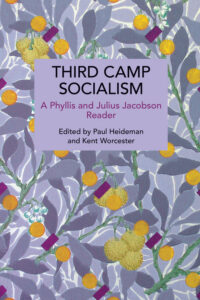
 A review of Third Camp Socialism: A Phyllis and Julius Jacobson Reader. Edited by Paul Heideman and Kent Worcester. Chicago: Haymarket Press, 570pp, $30
New Politics, to repeat a familiar adage, has seemed to be as much movement as magazine (or journal). In its original emanation, guided by the founders, it proved to be a goal also beyond reach, for many reasons. That this anthology, in the editors’ voice, appears shortly after From the Free Speech Movement to the Factory Floor, a Collective History of the International Socialists, is more than a coincidence. These two books offer a historical pondering of what a particular socialist movement sought to do, with a continuing suggestion for today’s readers of what it may do tomorrow.
Notwithstanding a nod to the more distant past, From the Free Speech Movement begins in the early 1960s. The writings of what came to be called Third Camp Socialism offer the reader a fuller past. We can be grateful to editors Heideman and Worcester for presenting it so clearly to readers. Their Preface guides the reader but also lets the Jacobsons speak for themselves.
New Politics happened to be launched only a year before the dramatic events in Berkeley set off a decade of campus unrest, enrolling tens and hundreds of thousands of young people in ways definitely not anticipated in any sector of the organized Left of 1960. ISers on the scene more than took part. I thrilled to hear IS luminary and Berkeley savant Hal Draper, in 1964, describe the FSM, during a visit to the University of Illinois. He had, after all, written the most important book on the subject. I listened intently, perhaps preparing myself to be the MC at the first major anti war demonstration on the campus, a year later.
The Jacobsons, by contrast, offer and themselves embody the history of a Left that was, despite some remarkable successes, almost never really at the center of things. They came of age and joined the Left eagerly, as Trotskyists struggled to move out of insularity and beyond small actual numbers. At a great moment of capitalist pessimism and socialistic optimism, they and their comrades felt themselves riding a wave of global revolutionary promise.
Several essays touch upon a crucial decision—they consider it an error—made at this moment. Outnumbered by a Communist Party with influence on ethnic, cultural and labor institutions far beyond ever-shifting membership, they famously entered the Socialist Party in 1936, at Trotsky’s urging, in a maneuver known as the “French Turn.” They soon rallied several thousand young socialists around a handful of vital contemporary issues, including the Spanish Civil War and the Moscow Trials. And then, apparently at Trotsky’s insistence, they schemed an exit in 1938, leaving themselves with a far smaller number than they had anticipated. Trotskyist influence would grow repeatedly in the US afterward, but actual membership numbers never increased beyond a few thousand.
The political move also left the Socialist Party a wreck, something which the Jacobsons properly mourn. More and more accommodated to the New Deal, the SP nevertheless still elected socialists to local offices and state legislatures, mainly where German-American skilled workers and a surrounding ethnic following remained a faithful constituency. As Phyllis Jacobson reflects, all this suggests a deep irony, because a section of Trotskyists led by Max Shachtman would later re-embed themselves in the same Socialist Party, by that time drastically shrunken, with still worse results.
Not that all this detracts from the leadership roles played in various movements at various times, or from the intellectual value of the Trotskyist publications.
Trotskyism in the US, it should be noted, would never attract the playwrights and actors, the screenwriters and stars, the folk singers, the creative interracial milieu, nor the famed individual novelists and essayists close to the Popular Front milieu that still cast light in American culture decades later. However defined, Trotskyism existed within a smaller world, often more persuasive in argument, yet heard by vastly fewer numbers.
Poignant pages of the book under review reflect upon the editors’ sometime leader, perfectly captured in Julius’ essay, “The Two Deaths of Max Shachtman.” The editorial pair had more than admired “Max” for twenty years. When Trotsky, in partnership with James P. Cannon, insisted that their movement must recognize the USSR as a “degenerated workers’ state,” he pointed the secessionists toward new horizons.
Shachtman and his comrades, notably including Dwight Macdonld and James Burnham, could be said to have won the political debate within Trotskyism—the USSR really was worse than a deformed socialism—and in the process came to pronounce their own movement the Third Camp. And yet, as Julius recalled, they did not win over the bulk of workers drawn to a Trotskyist version of socialist ideas. The optimism of the war years, when Workers Party members and supporters passed out millions of newspapers at factory gates, faded in the postwar years. Then what? The Cold War soon overcame everything in the Left, from the shattered Communist Party to its struggling opponents.
“The combined effects of McCarthyism and the demoralization that threatens any sect unable to break out of its isolation” (p.166), recalled Julius Jacobson, and in that circumstance, difficult choices only became more difficult. Shachtman, with all his energy and wit, shifted quietly rightward at first, more so than his longtime followers seemed to recognize. And then, openly. Maneuvering to place his section of the Left closer to liberalism and to a conservatizing labor leadership, he prepared a shift that stunned many. Turning the perceptions of Trotskyism upon their head he had by the time of his early death in 1972 overseen the emergence of perhaps the most conservative socialist body in US history. It was certainly the first to embrace the rightward edge of the mainstream via the Vietnam hawks and to make George Meany’s regressive bureaucracy, then fighting labor reformers tooth and nail, his home base.
Could this have been foreseen? Essays in the volume suggest so in various ways. Julius Jacobson lays out the case in his 1968 essay, “Union Conservatism: a Barrier to Racial Equality,” pondering the sharp rightward drift of Albert Shanker and the AFT leadership around the New York teachers’ strike of the previous year. Other pages of this book fairly fill in the blanks. Union leadership became part of the Democratic Party machine, with its adaptation to the promise of military production and jobs, and the security state, emphatically including the CIA.
Again and again, during the period of the late 1960s and early 1970s, the two editors wrote in defense of the young against what was swiftly becoming neoconservatism. That the very shift was carried out and articulated by some of Shactman’s new collaborators, offers the greatest of ironies. They had accepted Trotsky’s views on Russia, but drew hawkish, avidly pro-capitalist conclusions. A part of the Left and near Left had turned upon itself and its earlier hopes. The Jacobsons do not spend much time treating the role of Israel in all this, but in retrospect from 2026, the conclusion cannot be avoided. Happily, Emmaia Gelman’s stunning new book, The Anti-Defamation League and the Racial State, fills in the blanks.
“In Defense of the Young” (Julius J, 1970) laid out the case, characteristically in a polemic—against the embittered writings of Irving Howe. A former comrade and one of the most admired in Trotskyist ranks had now written widely to caricature Movement activists. Campus radicals and others viewed as nihilists, rich kids playing at revolution, perhaps above all refusing to accept the Democratic Party, with all its limitations, as the only way forward. Making Hubert Humphrey the “Man of the Year,” following the stacked and anti-peacenik Democratic Party convention of 1968, the self-described “democratic left” had “set itself the task of impeding and revering the radicalization of youth.” (53)
Phyllis J performed the polemical task repeatedly in only a slightly different way. She defended feminism against the attacks by Howe and other noted liberals, insisting that the ERA, the struggles of women against conservative union officials, and the cultural challenges. She insisted upon the usefulness of Kate Millet’s widely read feminist literary commentary. Midge Dector, famous for her attacks on feminists, seems to have assigned Irving Howe to go on the attack in the pages of Harpers, and attack he did, pleading for wives to understand their hard-pressed husbands, bitter that women might presume to have household mechanical skills, and haughty toward wives thinking they had more on their minds than their sex appeal to their husbands.
It was an outburst that Howe would himself come to regret, finally reconciled to bring women onto the editorial board of Dissent —I remember him jokingly rationalizing the decision as “not for Affirmative Action”—and genuinely eager to have them also join DSOC, then DSA. As in a number of other ways, definitely not all, he tried to do better. As the Jacobsons would have said, he could not wholly escape the assumptions of the past.
This limitation, for the reviewer, offers the anthology its weak point, not once but again and again. The Trotskysts of their youth seemed certain that they would win over millions of Americans inspired by hopes for a different society, through reasoned arguments, sharp prose, and pinpointed labor action. They could not compete with larger forces, and they remained eloquent outsiders. Probably to their own surprise, this experience repeated itself in some ways long after illusions about Russia and the following of the CPUSA had vanished. Former Communists, described in assorted essays here, remain guilty of not openly and totally renouncing their pasts. Worse, New Leftists seemingly repeat the errors. Ho Chi Minh could not possibly, for the Jacobsons, be a leader of a national liberation movement. Che was a scoundrel, not a romantic global hero. And so on. Rehearsing the grievances of the past, as if vindication might change past and future alike, they seemed to close in upon themselves.
They actually did better in their critique of backsliders from the 1960s New Left. Those erstwhile leaders, like Todd Gitlin, who had moved to support US global wars after spending a youth opposing them. Or Michael Walzer, never ambivalent about the virtues of Israeli warmaking, embracing the US assaults upon Afghanistan and Iraq, urging some kind of new Popular Front culture of hawks gathered around fresh wars in the Middle East.
One wonders whether the electoral victory of Zohran Mamdani in New York, a scattering of other socialists and semi-socialists around the country, or the remarkable growth of DSA, would comfort the Jacobsons that “socialism” under some definition has now stirred a new generation. Or not.
Third Camp Socialism is to be read, discussed, applauded or criticized in its own light. The work and the legacy of the Jacobsons remain alive today, not least in New Politics itself. Perhaps this old friend of New Politics —subscriber since 1966, occasional essayist since 1970—can suggest a reading, not in pursuit of fresh arguments but rather in seeking a fuller story of the Left role in the modern world.##
 If you’ve read this far, you were pretty interested, right? Isn’t that worth a few bucks -maybe more? Please
Leave a Reply