
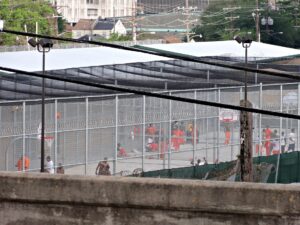
 In recent decades, two cold, hard realities have afflicted the northeastern United States: job loss and depopulation. For most of the people who live in what was once a humming industrial region, the story is the same: the factories have closed, the manufacturers have fled elsewhere for greener pastures, the old infrastructure and storefronts have decayed, and working people are left wondering how to pick up the pieces. In this context of capital flight and abandonment, it becomes more important than ever to ask the question, “why should working people tolerate capital?” The short answer is, they shouldn’t.
Many of the areas affected by job loss and depopulation have turned to prisons to try to revitalize their economies, thus amplifying mass incarceration and expanding the nationwide “carceral state.” The northernmost tip of New York State, affectionately dubbed “the North Country” by those who belong to it, is one such area; it forms part of the nationwide trend. Unlike Buffalo and Rochester in that it is not formally part of the Rust Belt, the North Country is roughly what remains of the state beyond Syracuse and Albany but before Canada. Between 1982 and 1998, around a dozen correctional facilities went into operation in the North Country, a remarkable sample size for an area with such a small population. Between 1982 and 2000, 38 new prisons opened across the state, more than doubling the number of prisons that had existed statewide prior to 1982.1
I argue that class contradictions are crucial to understanding this expansion of the prison system in the North Country and beyond. Elsewhere I have outlined the role of Upstate New York’s prisons in the suppression of the most politically advanced parts of the U.S. working class historically.2 In several ways that go beyond the outright suppression of political radicals, the new, post-1970s prison construction initiative has served capital in its war against working people.
Let us be clear, rural decline and increasing poverty in rural areas are symptoms of a capitalist disease. But after capital flees a community, accelerating decline, prison building is a (not wholly unsuccessful) sort of damage control. It benefits capital by allowing for
1. The temporary placation of (generally) white, immiserated working-class communities that were once rightfully angry and confused over their worsening economic prospects, through particular manifestations of false consciousness.
2. The incorporation of a considerable part of the rural working class into corrections, one of the more important coercive/repressive institutions of the state apparatus.
3. The extraction of low-paid or unpaid labor from convict work forces.
The rural prison-building initiative is in large part an attempt to postpone the explosion of class contradictions and maintain the structural subordination of U.S. labor to capital, regardless of whether capital’s individual representatives in the state apparatus consciously recognize this or not.
As the Marxist concept of “false consciousness” is the starting point for the first proposition, we would do well to define it. Though not explicitly theorized by either Marx or Engels (Engels only once used the term in passing, in a letter to Franz Mehring), the notion is implicit in their thought. For example, in The German Ideology they write that “the ideas of the ruling class are in every epoch the ruling ideas…the class which has the means of material production at its disposal, consequently also controls the means of mental production, so that the ideas of those who lack the means of mental production are on the whole subject to it.”3 This passage hints at the essence of false consciousness without revealing it outright.
Jost defines false consciousness as “the holding of false or inaccurate beliefs that are contrary to one’s own social interest and which thereby contribute to the maintenance of the disadvantaged position of the self or group.”4 Notably, this definition extends the use of the term beyond class horizons but remains essentially accurate. False consciousness is the sum of the ideas and beliefs present in the minds of the exploited that prevent them from recognizing their exploitation and actively struggling against their exploiters.
In proportion as the particular manifestations of false consciousness come to ensnare working people’s minds, they become so many interwoven barriers, a spiderweb of almost physical impediments to self-emancipation. I call the constituent parts of false consciousness “hegemonic illusions.” These ideas and beliefs are illusions in that they are false. They are hegemonic in that they perpetuate exploitative social relations and the dominance of certain groups of people over others (in this case, the dominance of the capitalist class over the working class). Hegemonic illusions can be impositions when they are introduced into the worldview of the oppressed from without by existing social structures, but as we will see, the term “imposition” can be limited in that it sometimes overlooks the agency of working people in reproducing false consciousness.
Antonio Gramsci believed that intellectuals articulate the worldview of particular social classes, homogenizing and guiding them. As Martha E. Gimenez notes, “while it is true, as it could not be otherwise, that all members of a given society are simultaneously located in a number of structures which…shape their experiences and opportunity structures, structural location does not necessarily entail awareness of being thus located or the automatic development of identities corresponding to those locations.”5 The influence of intellectual work on others can either aid or hinder the process of coming to identify oneself with a particular social class.
So, while ruling-class intellectuals perpetuate the existing order through the elaboration of their theories and through their practical activity, the role of working-class intellectuals is to challenge that order and to transform working-class identity into class consciousness—which implies not only recognition of one’s status as a laborer, but also of the irreconcilable antagonism between capital and labor and of humanity’s dire need to construct a new, more humane social order in which the majority of humankind is no longer alienated from decision-making processes.
How are working-class intellectuals to help realize this transformation? In part, by identifying, exposing, and undermining the hegemonic illusions that currently shackle proletarian minds.
With a theoretical framework presented, we can now proceed to our discussion of how rural prison construction births false consciousness. In his detailed study of two rural prison towns (Beeville, TX, and Florence, CO), Eric Williams identified a “prevailing myth” around the communities’ prison discourse. Emanating from the state and federal governments, “the myth is that the prisons have saved these communities from economic ruin and possibly extinction.… This myth seems to be taken as fact by many of my respondents, and the state and federal governments are dependent on this myth to continue to find communities that are willing to ‘give away the store’ to land a new prison facility.”6
To what extent have the various rural communities of Upstate New York swallowed Williams’s myth? Tracy Huling, among the leaders in rural prison research, offers a pair of examples: “In the all-out contest spurred by New York governor George Pataki’s 1996 proposal to build three new maximum-security state prisons, the rural town of Altamont set aside 100 acres of land to entice the state to locate a prison there. Antwerp, another small community in northern New York, applied for a $600,000 federal grant to rebuild their water supply system to increase their chances of winning a state prison.”7
What is so inaccurate about the idea that prisons save rural economies? Tracy Huling, Ryan King, and Marc Mauer have judged the tall tales told by the state against the realities of prison performance in the “economic savior” role. Singling out New York State’s government as being “among the leaders in rural prison construction,” they studied fourteen counties in New York State, seven with new (post-1970s) prisons and seven without them, and contrasted their economic well-being.8
They found, among other things, that counties with new prisons “did not gain significant employment advantages compared to counties without prisons,” that between 1988 and 1992 unemployment increased more in counties with prisons than in those without them, and that the “counties that hosted new prisons received no economic advantage as measured by per capita income.”9 Between North Country counties that hosted new prisons and those that did not, there was “no demonstrable pattern of differing economic performance.…”10
And we’ve not yet mentioned the fact that most new prison jobs don’t actually go to the people who live in the community. Instead, many commuters pick up new positions. The “higher paying management and correctional officer jobs in public prisons come with educational and experience requirements that many rural residents do not have…the distances people drive to work at prisons are quite great, in most cases nearly double the average commuter range.”11
As Huling states, “the 750 jobs that a state prison opened in 1999 brought to the tiny rural town of Malone, NY, went mostly to people outside the town.” Scarcely a hundred of those jobs went to native residents of Malone or people who live in the immediate vicinity of the town. Nor, I would argue, are correctional jobs desirable in the first place, as they stunt—not contribute to—the free and full development of human beings. These findings, considered collectively, dispel the notion that prisons are economic saviors of any sort.
Instead of being made to answer for the inability of the existing economic system to keep jobs in rural areas, politicians point to prisons as a solution for rural economic decline, thereby generating Williams’s “prevailing myth.” The myth is swallowed, the prisons are built, and as people come to believe that the new facilities have saved their communities, they are less likely to point out that, first, poverty still reigns, and, second, that they need not have lost their original industrial jobs in the first place. What is this myth identified by Williams if not a hegemonic illusion, a particular manifestation of false consciousness?
Socialism is a new, deeply democratic system in which ordinary people reclaim control of their decision-making power, their resources, their communities, and their lives. When working people control resources and production under socialism, the community itself will decide when and if certain jobs should be phased out—and members of the community won’t need to abide by the decisions of profit-chasing elites.
Though prisons do not benefit the community in any meaningful sense, one reason why the particular “economic savior” hegemonic illusion can take root in the first place is that prisons do offer some jobs to individuals—and at the end of the day, most people are just looking for stable work. Who wants to be exposed to the vicissitudes of the capitalist job market? The high wages, job stability, and solid benefits that are advertised as compensation for joining the repressive apparatus are all attractive lures to working people, but taking the bait comes with a cost.
As Engels and Lenin rightly acknowledge, the modern state is in large part a “‘special coercive force’ for the suppression of the proletariat by the bourgeoisie.”12 Joining the repressive wings of the state apparatus (police, military, corrections, etc.) and carrying out the repressive functions of these groups as members of them ultimately compromises the working-class people who enlist in such organizations. Hence, the manifold television shows, shooter video games, and war films that glorify the repressive professions, pumped out year after year by mass media companies. The air of respectability that surrounds police and military personnel plays a major role in winning over working-class recruits to these groups and is actively cultivated by the bourgeois media and state.
Veterans’ Day, which glorifies veterans without regard to personal merits or flaws, is an example of this. Such an approach necessarily eschews allocating praise or criticism based on case-by-case examinations of veterans’ individual conduct. Rather, present and former military personnel are presented as universally virtuous and worthy of respect. This perspective—the unconditional veneration of the military—has taken root culturally in the United States, principally to the benefit of ruling capitalist elites.
The illegal 2025 New York corrections officers’ strike illustrates that many officers feel cheated out of the comparatively easy living they are supposed to receive from their incorporation into the repressive apparatus. The socialist response to these grievances must be to point out that repressive personnel are mere tools for the established order, easily discarded, while discouraging such men and women from remaining long in their current profession, which is ultimately predicated on so much human suffering. Prisons are unhealthy for prisoners and guards alike. The effects they have on prisoners are well documented, but less frequently considered are the effects prisons have on the correctional officers, who begin to see in prisoners not human beings, but savages. Suggesting that these officers change careers might lead one to ask what they can do instead, a question I address below, which is also relevant due to certain yet-unmentioned historical developments.
Do North Country prisons employ prison labor? Yes. Convict labor has been employed in New York State “since the opening of Clinton State Prison at Dannemora in 1845,” and from that date on there has been an “extensive deployment of incarcerated workers on public works, conservation, and infrastructure projects in towns and villages across the North Country.”13 Prisoners have “built roads, blazed hiking trails, constructed ski runs, fought forest fires, controlled flooding, and renovated [many] public spaces including churches, libraries, schools, and government offices.”14
It should not be forgotten that the inmates in these facilities constitute something resembling a slave labor force, easily exploitable and made to work for laughable compensation (often less than a dollar an hour in wages). The conspicuous exception to the 13th Amendment, which abolished slavery “except as a punishment for crime whereof the party shall have been duly convicted,” is well known. New York State’s laws do not counteract this exception, nor do they impact it in any meaningful way. As of 2025, prison reform groups remained active in pushing for more humane conditions and real workers’ rights in New York prisons.15
We have thus far ignored the fact that many rural prisons, particularly those in Upstate New York, are now closing. Both the number of prisoners in these facilities and the corrections staff assigned to oversee them are trending down in number. Obviously, the socialist left should not support the efforts of rural communities to retain the prisons they already have. Such advocacy is unthinkable. Rather, socialist organizers should consider how the new wave of prison closures can be made to aid in the emergence of class, rather than false, consciousness.
People in rural America must look to the future, not the past, leaving the deeply problematic carceral system behind them. A key task of rural leftist organizers is to try to help mold what the future of these communities might look like. This means firmly rejecting not only prison expansion but also the array of already existing prisons, and being able to answer when asked, “but what will we do when they’re gone?” It means supplementing a negative critique of the prison system with new, positive alternatives for the future, with proposals for new jobs and unalienated forms of work.
In the North Country, some groups are already thinking about the impact of climate change and how new jobs might emerge from efforts to expand the area’s renewable energy capacity.16 Many climate-friendly avenues remain open to exploration and could bring sustainability and opportunity to rural regions in decline. Such undertakings will certainly be of increasing importance as the century progresses and as climate catastrophe draws ever nearer.
Committing more resources to local schools and healthcare instead of prisons would also greatly benefit the North Country population. In my view, the rejuvenation of the North Country might be achieved by placing emphasis on some combination of the three factors described above—but this is hardly possible under capitalism. Whatever the solutions to the region’s woes, the people of the North Country can (and must) find and realize them.
The “economic savior” myth that surrounds rural prisons is one of the hegemonic illusions that must be dispelled if we are to advance long-term social change.
Notes
1. Tracy Huling, Ryan S. King, and Marc Mauer. Big Prisons, Small Towns: Prison Economics in Rural America (The Sentencing Project, 2003), 4.
2. Samuel Barney, “Incarcerating Radicals: Dannemora Prison and the Class Struggle.” New Politics 20:4 (Winter 2026), 54–59.
3. Karl Marx and Friedrich Engels, The German Ideology, in Marx & Engels Collected Works, Vol. 5 (Lawrence & Wishart, 2010), 59.
4. John T. Jost, “Negative Illusions: Conceptual Clarification and Psychological Evidence concerning False Consciousness.” Political Psychology 16:2 (1995), 400.
5. Martha E. Gimenez. “Marxism, and Class, Gender, and Race: Rethinking the Trilogy.” Race, Gender & Class 8:2 (2001), 27.
6. Eric J. Williams, The Big House in a Small Town: Prisons, Communities, and Economics in Rural America (Praeger, 2011), 16.
7. Tracy Huling, “Building a Prison Economy in Rural America,” in Invisible Punishment: The Collateral Consequences of Mass Imprisonment, ed. Marc Mauer and Meda Chesney-Lind (The New Press, 2002), 200.
8. Tracy Huling, Ryan S. King, and Marc Mauer. Big Prisons, Small Towns: Prison Economics in Rural America (The Sentencing Project, 2003), 2.
9. Ibid., 2–3.
10. Ibid., 10.
11. Tracy Huling, 2002, 201.
12. Vladimir Lenin, The State and Revolution, in V.I. Lenin Collected Works, Vol. 25 (Progress Publishers, 1964), 397.
13. Clarence Jefferson Hall Jr., “Adirondack prison labor: The hidden role of incarcerated workers in conservation,” Adirondack Explorer, March 19, 2025.
14. Clarence Jefferson Hall Jr., A Prison in the Woods: Environment and Incarceration in New York’s North Country (University of Massachusetts Press, 2020), xii.
15. The Legal Aid Society, “Abolishing Slavery in New York.”
16. Mike Lynch, “Preparing the next generation of North Country workers.” adirondackexplorer.org, Oct. 30, 2025.
 If you’ve read this far, you were pretty interested, right? Isn’t that worth a few bucks -maybe more? Please
Leave a Reply