
 Ellen Schrecker is professor emerita of American history at Yeshiva University. Her scholarship has focused on the history of McCarthyism. Among her books are Many Are the Crimes: McCarthyism in America (1998), The Lost Soul of Higher Education: Corporatization, the Assault on Academic Freedom, and the End of the American University (2010), and The Lost Promise: American Universities in the 1960s (2025). From 1998 to 2002, she edited Academe, the journal of the American Association of University Professors. She spoke with Elizabeth Rapaport, a professor of law emerita at the University of New Mexico.
Elizabeth Rapaport: Could you share with our readers how you came to devote such a considerable part of your career to the history of McCarthyism?
Ellen Schrecker: Sure. I was originally a European diplomatic historian. And I believed in those pre-feminist days in the early 1960s that if somebody’s career gets priority, it’s the husband’s, and if we were going to go overseas to research our dissertations, we would go somewhere for my husband and not for me. I was married to a historian of China. So I had to find a thesis topic that involved the United States. And I selected the French debt to the United States after World War I, which was the only way I could write about the period I was interested in without having to know German. And by the time I finished the dissertation nearly thirteen years later—I realized I was no longer interested in European diplomatic history.
Instead, I got a job at Harvard teaching freshman composition—a course you could teach as a mini-seminar on any topic you wanted as long as you were assigning a lot of papers. So, I decided I’d teach about the United States in the 1950s. It was when I grew up. And I discovered there was nothing written about McCarthyism that I could assign to my students. Nothing. And so, after about a year of flailing around, I decided that I would work on McCarthyism. I got a fellowship and a book contract for what I hoped would be the general book on McCarthyism that I needed for my students. But it was too broad a subject, and I had to narrow it down. So, I focused on higher education. After years of research—over 100 interviews, dozens of archives, and more—I published No Ivory Tower: McCarthyism and the Universities in 1986. It won a prize and got a lot of attention. And then I started the bigger book on McCarthyism I had originally planned to write (Many Are the Crimes: McCarthyism in America, 1998).
By that point I was teaching at Yeshiva University when the World Trade Center was attacked. The Bush administration responded with repressive measures like the PATRIOT Act. And I began to be asked how that repression compared with McCarthyism. At about the same time, I also became the editor of the AAUP [American Association of University Professors] magazine, Academe. So, I was following both what was going on in higher education as well as political repression and wrote a book about it: The Lost Soul of Higher Education: Academic Freedom, Corporatization, and the Assault on the University, 2010.
ER: We will get to comparing McCarthyism with the present day. But first, we are long past the time when most Americans had a lived experience of the McCarthy era. As you make clear in your writings, McCarthyism was perhaps the apogee of the Second Red Scare, but only a portion or phase of the Second Red Scare on campuses or anywhere else. Can you situate McCarthy within the Second Red Scare and give us a picture of what it was all about?
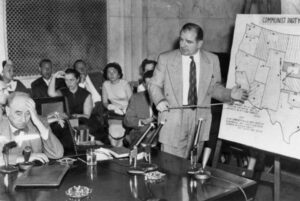
ES: Sure. The main thing about McCarthyism, and you’re quite right to call it the Second Red Scare, or what I would now call it, the Cold War Red Scare, is that it is misnamed. Actually, if you wanted to name it after any single individual, you would have to name it after J. Edgar Hoover, the head of the FBI. He was the main strategist who designed and then operated most of the machinery of the anti-Communist political repression of the late 1940s and 1950s. It’s important to realize that besides being misnamed, McCarthyism was already in existence by the time Joe McCarthy entered history waving around his ever-changing lists of supposed Communists in the State Department. It was not really a conscious attack on the left, though it ended up destroying much of the left. It was much more specifically focused on eliminating the influence within the United States of Communism and all the institutions, individuals, and ideas associated with it.
What’s important to understand here is that in the 1930s and 1940s the Communist Party (CP), despite its ultimately self-defeating support for the Soviet Union, was the most dynamic organization on the left. It wasn’t a paper organization, and its members were often the most committed and active individuals fighting for social justice and against fascism. They were involved in dozens of different causes and so-called front groups that dealt with single issues and were often led by people in or near the CP. The party, for example, was very active in creating the industrial union movement that became the CIO. It was the only non–civil rights organization that was promoting racial equality. It was very involved in anti-fascist activities. Because of its international connections, the party had the franchise on support for the Republican forces fighting Franco’s fascism in Spain. So, people who were concerned about fascism or who wanted to get involved with organizing labor unions, or were concerned with racial justice, turned to this broader movement, including many academics.
They faced a lot of opposition. And had ever since the party was founded right after World War I as the main American socialist organization supporting the Bolshevik Revolution. That opposition intensified during the 1930s in response to the social unrest of that period, especially the growth of the labor movement. Right-wing politicians, journalists, and reactionary business leaders latched onto anti-Communism as a way to undermine the social and economic reforms of the New Deal. By the mid-1930s, there were abortive state and federal investigations and other attempts to smear the Roosevelt administration as infiltrated by Communists. A rehearsal for McCarthyism, as some historians called it. But it petered out in the early 1940s, especially once the United States entered World War II and was allied with the Soviet Union.
After the war that alliance soured. And by 1947, the United States was involved in a Cold War against the Soviet Union. At the same time, on the home front, the Republican Party won the congressional elections of 1946. Because President Truman was afraid that this new Republican-controlled Congress might pass legislation that would undermine his administration in the name of protecting the government from Communist infiltration, he jumped the gun and created a loyalty security program to oust suspected Communists from the government. As a result, because of the Cold War, the anti-Communism that had originally begun as a partisan attack on the nation’s main left-wing movement became a matter of national security. And, when the federal government decided to purge Communists from its ranks, the rest of the country followed.
Though there had been Soviet espionage during the war, especially in the Manhattan Project, there was no serious Communist threat to the United States by the late 1940s. Most of the Party members who had been in the government were gone. They resumed their pre-war lives and began to leave the Party. They learned more about Stalin’s purges and realized that the CP was no longer an effective political organization. Even so, they and their former comrades became the main victims of the Cold War Red Scare. For, contrary to what many liberal opponents of McCarthyism believed at the time, it did not attack “innocent liberals,” but men and women who had, or, more commonly, once had, some kind of connection to the American Communist Party.
We need to realize that the CP was vulnerable to the political repression of McCarthyism for two reasons. One, obviously, was its tie to the Soviet Union. Its leaders did follow the line from Moscow, which was not always in sync with what a successful American left-wing movement might have required. The Party’s other problem was that, because it was unpopular in the United States, its members were told to keep their membership secret. That made Communism seem like a conspiracy. It created an aura of deceit and dishonesty, even though most of its members had done nothing wrong. But, it provided its enemies with the weapon of exposure.
Truman’s 1947 Loyalty-Security Program legitimated the Cold War Red Scare and can be considered the quasi-official start of McCarthyism. Because of the Party’s secrecy, identifying its members became central to Truman’s Program. And the FBI took on that task. It relied on its usual (and often illicit) methods of undercover informants, wiretaps, break-ins, and other sensitive operations. But it also relied on the fact that the Party expected its members to join its front organizations and so the people who belonged to those groups—which were officially listed by the attorney general—came under suspicion. “Guilt by association” it was called.
McCarthyism was a two-stage process in which the first stage was that of identification, of exposing someone as a Communist. That stage was usually handled by an official body like the FBI or a congressional investigating committee. The second stage was the application of sanctions, which could be some kind of criminal prosecution but was most often done by an employer. People lost their jobs. Thousands of them.
ER: There were Loyalty programs on campuses, too, and I know that States had them as well.
ES: Yes, employers throughout the country—at state and local governments, private corporations, universities, movie studios, hospitals, and more—all copied the federal government’s two-stage model. Sometimes with a lot of publicity; sometimes quietly.
The most prominent instruments of exposure were the congressional committees. There were three main ones: the House Un-American Activities Committee (HUAC), the Senate Internal Security Subcommittee of the Senate Judiciary Committee (SISS), and McCarthy’s own Senate Permanent Subcommittee on Investigations of the Committee on Government Operations.
HUAC had been formed in the 1930s to investigate fascism but was soon looking for Communists in the government. Even though it was regarded as something of a loose cannon, full of reactionary Southern segregationists, it was resuscitated at the end of the war. Because of the persistence of a smart young congressman named Richard Nixon, who joined the committee in 1947 and got help from the FBI, the committee was able to pursue charges against the former State Department official Alger Hiss for being a Soviet spy. That case made Nixon’s career—and HUAC’s as well. It had, we now know, uncovered some real Communist espionage.
The SISS, under Senators Pat McCarran and William Jenner, was a more reputable body but carried out similar investigations, while McCarthy’s erratic investigations through his Senate Permanent Subcommittee were ultimately to lead to his own downfall after he took on the Army—and so ran afoul of President Eisenhower.
But all three committees operated in the same way. They first questioned their witnesses in an executive session to see if they would cooperate. Those who did—either by convincing the committee that they were not Communists or else by naming the names of the people they had been in the party with—were usually excused from a public hearing. Those who refused to cooperate were invariably grilled in public. In the early days of McCarthyism, most of the unfriendly witnesses—like the so-called Hollywood 10—assumed that, even if they were prosecuted for contempt of Congress, the courts would acquit them on First Amendment grounds. Asking people about their political beliefs and activities was a violation of their freedom of speech and assembly, or so those witnesses thought. But they were wrong. Instead, the federal judiciary cited national security and sent a number of those recalcitrant witnesses to prison. By the early 1950s, the only way witnesses could avoid a contempt citation for refusing to cooperate with the committee was to invoke the Fifth Amendment’s privilege against testifying against themselves. But, taking the Fifth looked bad, as if the witnesses were hiding something. They were called “Fifth Amendment Communists” and, though they avoided prison, they were punished anyhow. They lost their jobs. Even in colleges and universities.
ER: On the campuses, was it purely a question of getting rid of some professors, were students targeted or others targeted?
ES: Not students, except for some graduate students. Though a few academics were called before the committees in the late 1940s, the investigators didn’t focus on higher education until they ran out of more attention-getting targets. It’s interesting, because today the Trump administration has been harassing the nation’s leading universities from the start. But that was not the case during McCarthyism.
The congressional committees were looking for publicity. Certainly, McCarthy himself was eager for attention. That’s how he made his career, with his lists of Communists in the government. Other investigators looked elsewhere. There was an Un-American Activities Committee in California, there was one in Ohio, and in some states, New Hampshire and Maryland, for example, local prosecutors, and government officials themselves, like state attorneys general would be ferreting out supposed Communists.
ER: And some states have full-blown loyalty programs. California comes to mind.
ES: Loyalty oaths were common, especially in higher education. State legislatures, after all, supported most public colleges and universities and many imposed loyalty oaths on their employees. They were usually tepid pledges to support their state and national constitutions. The most notorious one, requiring its signers to swear they did not belong to the Communist Party, was inflicted on the faculty of the University of California by its Regents in 1949. Before the California Supreme Court threw out that oath, the Regents had fired over thirty non-signers. None had ever been Communists.
Other states mounted anti-Communist investigations. The most important early one took place in Washington State in 1948 where a special legislative committee under a former sheriff named Albert Canwell called up about a dozen faculty members from the University of Washington. Three were fired. Two because they admitted that they were Communists and the third because he refused to cooperate with both the State and the university’s investigations.
That case was important because it made it clear that the defining characteristic of McCarthyism was its anti-Communism. The investigators were not looking for left-wingers. They were not looking for alcoholics. They were not looking for people who might have taught about Marxism in their classes. They were only looking for people who had some kind of association, affiliation with the Communist Party. But what was even more important was that once Canwell identified the supposed Communists, the university handled the second stage of McCarthyism and fired all three professors who the Canwell Committee had exposed.
ER: Was there pushback on the campuses?
ES: Not really.
ER: Defense of Academic Freedom? Freedom of Speech and Association?
ES: Absolutely not, no. I’ll get to that, because it’s interesting. Actually, most of the academic community did not collaborate with McCarthyism until the main national committees, like HUAC and the SISS, began to focus specifically on higher education in 1952 and 1953. Still, a number of faculty members had been questioned by the committees before then. Those who refused to cooperate with the investigators got fired. But they weren’t called up because of their academic positions.
There was one professor, for example, at NYU who was involved with a “front group,” called the Joint Anti-Fascist Refugee Committee. He was on its board of directors and along with the rest of that board refused to hand over its membership list to HUAC in 1946 and went to prison for contempt of Congress. And lost his job.
Another group of academics who were called up by HUAC were physicists.
As we now know (but the committee didn’t at the time), there were spies within the Manhattan Project. And there had been a contingent, a cohort of left-wing graduate students who were in or near the CP at Berkeley, many of them, students of Robert Oppenheimer. They had worked on the bomb at Los Alamos and in Berkeley’s Radiation Lab. Which was, of course, why HUAC questioned them. Most took the Fifth Amendment and lost their jobs. Oppenheimer, who had not defied any committee, was, in fact, one of the main victims of McCarthyism, but that occurred later, when the Atomic Energy Commission denied him a security clearance in 1954.
By the time the committees decided to take on higher education in 1952 and ’53, university leaders were willing to collaborate with the anti-Communist inquisition and purge the uncooperative witnesses from their faculties.
Universities were different from most other mainstream institutions. Private corporations, like TV networks or defense industries, could just fire people who took the Fifth or were secretly identified as affiliated with Communism by the FBI or a right-wing journalist. But universities claimed to support academic freedom. Its function was to protect higher education from outside intervention—usually from politicians and wealthy trustees. And in order to maintain that autonomy, academic freedom required the academic community to handle its problems by itself, ideally by independent faculty committees.
At least one hundred faculty members were fired or otherwise punished between the late 1940s and early 1960s—although because of the secrecy that surrounded so much of McCarthyism, there may have been many more cases that we don’t know about. Their treatment varied. Some institutions dispensed entirely with faculty reviews and fired unfriendly witnesses and other dissidents outright. At other schools, the tainted professors faced both an official investigation and a university one, both of which asked the same questions about these people’s past and present political activities. And, with almost no exceptions, all of them had to cooperate with both investigations if they were to keep their jobs. And even then, a few schools even fired witnesses who cooperated with all the investigators. At those institutions, trustees and top administrators were so afraid of bad publicity that they would not keep a former Communist who named names on their faculty. They didn’t want even the slightest whiff of Communism.
What happened at the University of Michigan reveals how deeply the universities were implicated in enforcing McCarthyism. HUAC did not get around to investigating that institution until 1954 when it called up five professors and a handful of present and former graduate students. The university’s president urged them all to cooperate. Three refused. Two, Clement Markert and Mark Nickerson, took the Fifth Amendment, the third invoked the First Amendment and went to prison for contempt of Congress.
He was Chandler Davis, a mathematician and an amazingly courageous dissenter. He viewed his appearance before HUAC as an opportunity to push the Supreme Court to reconsider its earlier failure to protect free speech and the First Amendment. He failed and served six months in Danbury Federal Penitentiary. Unlike Markert and Nickerson who did tell the University of Michigan what they wouldn’t tell HUAC, Davis defied the university’s faculty committees as well. He did so on the grounds that since Michigan’s committees were asking the same questions as the congressional one, it would be as if he was cooperating with that committee as well. And two faculty committees voted to let him go.
ER: I find it extremely interesting in terms of the way things are now that these committees and officials, whether state or federal, were not really interested in what people were doing in their classrooms. They were not interested in what people were doing in their research. They were not interested in the campuses. They were simply interested in….
ES: Yes. Current or prior membership in the Communist Party. “Are you now, or have you ever been a member of the Communist Party?” That was what they wanted, and by then it was choreographed. Everybody knew the script. The only variation was that a few professors were willing to talk about themselves, but not about others and managed to avoid prison. It wasn’t a sure thing, but by the mid-1950s, the federal judiciary had begun to find technical ways to acquit those people of contempt of Congress—but they still had to cooperate with their institutions.
ER: Right. And of course, it did cast a pall over everything on the left. Partly because Communists had been so prominent in left-wing causes that people who may have supported those causes without joining the Party felt—and often were—threatened by the witch hunt.
ES: Exactly, exactly. And, significantly, there was no effective pushback within the university. People always ask me, “What can we learn from the resistance against McCarthyism?” Now, I teach this stuff. And, when I get up to the Korean War, which took place between 1950 and 1953 and was just as unpopular as Vietnam, I ask my students, “What can you tell me about the anti-war movement against the Korean War?” And I get silence. And so, like a good teacher, I wait for somebody to speak, and, of course, nobody speaks, and I say, “Yep, that’s the right answer. There was no anti-war movement during the Korean War.” None.
ER: Talk about a chill. It was pretty thorough.
ES: Especially because there was a blacklist as well. Almost everybody who was fired for political reasons, especially if their cases were public, was unable to find a new job at a mainstream American college or university. So, professors, who had been targeted or were afraid they might be, refrained from political controversies.
Students also became apolitical. They were afraid. Often they were told by their faculty advisors, including faculty advisors on the left, don’t get involved in any kind of political activity to the left of the Democratic Party. Just don’t do it. The academy was not unique here.
Other advocacy groups like the NAACP did the same thing. They pruned their own ranks. They got rid of the people who they suspected were Communists.
ER: Oh.
ES: The ACLU did the same thing.
ER: Wow!
ES: And the AAUP did nothing between 1947 and 1956. Nothing. There were no AAUP investigations and censures of institutions that had violated their faculty members’ academic freedom. I got into the AAUP’s archives, and it was just shocking. People on campuses where there had been a case were desperate. I remember Temple University had fired a very popular full professor and didn’t even give him a hearing. His colleagues were writing to the AAUP, “When are you coming down to investigate? When are you going to censure Temple?” But it did nothing. Temple’s administrators had acted out of a combination of their own anti-Communism and the fear of being targeted themselves or facing some kind of state sanctions against the school—which never happened, by the way. The universities themselves were never punished, even though they thought something bad would happen to them, it never did. Nor, to my knowledge, were more than one or two professors fired for opposing the political dismissals of their colleagues—and they usually had other issues as well.
There were other sanctions besides dismissals. Some people lost passports and couldn’t go abroad for research or to take jobs. Some scientists were refused security clearances and couldn’t do certain types of research. One of the most important cases was that of Robert Oppenheimer who lost his role as a key advisor to the American government when his security clearance was withdrawn.
Another victim whose case had serious consequences, though he didn’t actually lose his job, was Owen Lattimore, a prominent China scholar at Johns Hopkins who had been falsely accused by McCarthy of being the country’s “top Russian espionage agent.” McCarthy’s charges were part of a broader campaign by the Republican Party and the supporters of the corrupt and incompetent Nationalist government of Chiang Kai-shek to smear the Truman administration for the so-called loss of China to the Communists in 1949. While McCarthy’s charges against Lattimore didn’t stick, he was targeted again, this time by the supposedly more respectable SISS when it investigated a scholarly organization called the Institute of Pacific Relations that Lattimore and a number of actual Communists were active in. Harassed by two completely unwarranted perjury indictments that were thrown out in court after several stressful years, Lattimore kept his job. But Hopkins abolished the center he headed, and he lost his influence as one of the country’s top China experts. He ultimately left the United States for Great Britain. And the field of China Studies took a major hit, as did the State Department, most of whose experienced China hands were fired for not supporting Chiang Kai-shek’s lost cause.
Since so much of what happened within the academic community during McCarthyism was secret, we’ll never have a full accounting of the damage it did. Nor will we ever know about all the theses that weren’t written, the research that wasn’t pursued, the job offers not made, the courses that weren’t taught, etc., etc.
But what has always amazed me is that McCarthyism occurred just as what has been called the “Golden Age of American Higher Education” was getting under way. Even as they were ousting their politically tainted faculty members, colleges and universities were expanding enormously to accommodate the expected tidal wave of baby boomers. Higher education was prestigious and popular—attracting new types of students, raising its standards, and, after Sputnik, getting increasing amounts of funding from the federal government—especially in science. And by the end of the 1950s—even though people were still being fired for their politics into the 1960s—McCarthyism was clearly running down. This is when John F. Kennedy brought dozens of “the best and the brightest” academics into the government. I was in graduate school at Harvard then and it felt as if our professors were running the country.
ER: Wow. So, this Golden Age, how long did it last? I know I personally benefited from this expansion of higher education.
ES: Oh, so did I! The government and the foundations were almost throwing money at people. They were so eager for future college teachers that, I remember one memo noted, they were even trying to recruit women!
ER: Ha!
ES: And that was the case.
ER: Yes, it was the case to an extent.
ES: Yes, they may not have treated us well, but they hired us.
ER: Yes, that’s true. So this Golden Age, how long did it last? Did it have much in the way of legs?
ES: Yes, because these schools expanded. Schools that up until the Second World War had been either small teachers’ colleges, or religious colleges, or flagship institutions that were essentially agricultural schools with football teams were transformed into liberal arts colleges and then into regional universities and then even serious Research I universities. And so schools are upgrading, they’re becoming more competitive, intellectually ambitious. You know, it’s no longer okay at top universities to get a gentleman’s C.
So by the early 1960s, the culture’s changing on American campuses. And we were definitely the beneficiaries of this. No other generation of academics ever had it so good before—nor did they have it so good after.
ER: One of your books is called The Lost Promise of Higher Education. What was the promise that was lost?
ES: The promise was the one that was behind this expansion, that the United States would be able to create a system of public higher education that would be readily accessible to anybody who wanted it and was qualified for it. That notion, it’s a very democratizing mission. And it was aborted for a whole bunch of reasons. The main, but not the only, one was a backlash against the reforms within higher education during the 1960s. Especially a backlash against the increased access to higher education by marginalized groups like previously excluded Black students. And a backlash against the anti-war movement, against the student movement.
It’s important to realize that a lot of what powered the social movements of the sixties—especially the civil rights movement, the Black Power movement, and the anti-war movement—began on American campuses. First there was the intensification of the civil rights movement with the sit-ins by students from HBCUs in 1960 in the Upper South. Then, there was the Free Speech Movement in 1964, which marked the beginning of the student movement at traditionally white institutions and was directed against the Berkeley administration, because Berkeley had given its students less political freedom than any comparable school in the country. There was an active civil rights movement in the Bay Area, and students were very involved in it, sitting in at businesses that didn’t hire Black workers and so forth. And the university, which was under pressure from local elites and politicians, was harassing the student activists for their off-campus protests.
So, by the 1960s, students began to demand more political freedom, a more democratic university. And, along with some faculty members, they began to realize that their own institutions had been anything but the bastions of freedom and democracy they claimed to be.
Now, here I need to stress that one of the main findings in my book on the sixties was how important the universities were to the origins of the anti-war movement. That was because they were full of scholars who knew how to do research about public issues. And in the 1950s and 1960s, just as the U.S. was beginning to intervene in Vietnam, Americans were essentially ignorant about that part of the world. It had been a French colony and there may have been a tiny handful of people, if that, in the United States who knew anything about Vietnam or could speak the language. It was really unknown. So, when Johnson escalated the war by bombing North Vietnam in the spring of 1965, which was right after the student movement began at Berkeley, a group of faculty members at Michigan planned to protest by canceling their classes and teaching about the war. But they ran into opposition to interfering with their classes from both the president of the university and the governor of Michigan, so they decided to hold what they called a “teach-in” at night instead. They boned up on Vietnam, brought in a few outside experts, and educated their students and colleagues about what was happening in Vietnam and why people should oppose it.
The idea caught on immediately. Though they contacted colleagues at other schools, the people who organized the original teach-in did not expect that the movement would spread as quickly as it did. At least a hundred such events took place that first spring. And they sparked all kinds of other anti-war activities—demonstrations, publications, and protests against the draft and the universities’ complicity with the war. And, as the war continued, some of these protests also involved nonviolent direct action—sit-ins and other disruptions of campus activities. Both students and faculty members were active in this movement. But it’s not by any means a majority. Most people on campuses were apolitical. But then, as Nixon escalated the war, the protests escalated, especially when academic administrators tried to suppress them by sending in the police and provoking more unrest. And in the aftermath of the killings at Kent State and Jackson State in particular, what happened is that Nixon realized that the unrest on American campuses was not going to end no matter how much police and public officials and universities tried to clamp down on it. That repression was not going to protect universities from disruption, unless the war ended. And so he began to end the war, he ended the draft, and he began to pull troops out of Vietnam.
ER: Wow.
ES: There are other things pushing Nixon to end the war. Congress is pushing back. But the interesting thing is that these campus disruptions, which we felt were ineffective if not counter-productive at the time with things like the revolutionary violence of the Weathermen, actually had a real impact on Nixon. As some recent scholarship as shown, he felt that he had to end the war in order to save the universities—much as he disliked most of what was happening on their campuses.
ER: And this is the way we tend to think that trouble on campus, activism on campus, takes place. Movements of students and faculty that start on some campuses and spread. And the McCarthy period looked nothing like that.
ES: No. There was almost no support for the victims of McCarthyism on their campuses. Many of the people I interviewed felt abandoned by their colleagues. Several talked about seeing old friends cross the street to avoid them. It was really unpleasant. And many of the faculty committees that the AAUP touted as necessary for academic freedom went along with the witch hunt.
ER: So we’ve talked about the Golden Age. And we’ve talked about the free speech movement which, you know, was much like so many other campus movements, even if they weren’t quite as dramatic or disruptive. Let’s turn our attention to the current scene.
ES: Okay.
ER: The pro-Palestinian movement has persistently been treated as outside the pale on campuses. This was well before the second Trump administration, or even the first Trump administration. But the second Trump administration, flying the banner of defending Jewish students against antisemitism and combating terrorism, has made suppressing the Palestinian movement the tip of the spear of an assault on the universities. Scrubbing signs of DEI, or wokeness, or mea culpas about antisemitism, seems to have just whetted their appetite for coming after the campuses. Trump II has threatened large public and private universities with catastrophic loss of funds. To give a couple of examples—UCLA, more than a billion dollars a year; Columbia, more than a billion dollars. Having done so much to bring us the history of the McCarthy period and of the universities after that period, how would you compare suppression in this period, particularly on the Israel-Palestine question with McCarthyism on campus?
ES: Okay. Well, I’m a historian, so let me begin by telling you how Trump’s assault on higher education developed. Because it just didn’t start with Mr. Trump. It didn’t even start in the twenty-first century. We can go back to the 1960s. As I’ve already pointed out, there was a backlash against the sixties.
Much of the public opposed the student movement. People had never seen that much student unrest before. And the media played it up big—especially when the police were called in to crack down on the students. State legislatures began to take measures against campus activists and reduce their previously generous financial support of their states’ public colleges and universities. Ambitious politicians like Ronald Reagan took advantage of the backlash. At the same time wealthy businesspeople and reactionary intellectual elites, who were pushing a neoliberal agenda that sought to shrink the state and reward the private sector, also turned against American higher education, which they claimed was indoctrinating the future leaders of the U.S. with left-wing ideas.
It’s important to realize that this backlash against higher education is happening at exactly the same time as the American economy is being transformed. There’s inflation, there’s an oil embargo by the Arab countries, and the United States is facing new competition within the world economy. Competition from Germany and Japan is encouraging American corporations to move their factories out of the United States. It’s the beginning of the deindustrialization of the American economy. The kinds of jobs that once had made it possible for one breadwinner to support an entire family are disappearing. Unionized blue collar jobs are being shipped overseas to save money.
And all of this impacts higher education. Why? Because it seems as if it’s necessary to get a college education in order to afford a middle-class style of life. And so, colleges and universities are playing a bigger role in American society as the vehicle not just for upward mobility, but also for the economic stability of the middle classes. By the 1970s higher education has become increasingly more important in people’s lives—even as its traditional state support is declining. Whereas once state legislatures had accounted for maybe 40 percent of their colleges’ operating budgets, it’s now down to single digits at some schools.
ER: Wow.
ES: So, how do the institutions make up for that? They raise tuitions. And they also rely much more heavily on the federal government, both for the student loans that pay those tuitions (and create today’s $1.8 trillion of student debt) as well as the money that covers the university’s scientific research. And that research is not cheap. I was just writing a piece about the growth of the government’s role in higher education and I realized how much of that change has to do with the increasing cost of scientific research. New fields, in electronics, biomedical science.
ER: Even if you take your dog or cat to the veterinarian today, the veterinarian has remarkable equipment.
ES: Yes! And not just the veterinarian. Because universities have a bigger role in American society, attacking them as elitist—especially for conservative politicians who won’t challenge the economic status quo—is a way to appeal to ordinary people who are having trouble making ends meet. There’s also a network of right-wing activists and billionaires, like the Koch brothers, who helped sell neoliberalism to American political elites and has been pouring millions of dollars into a massive propaganda campaign against mainstream universities and mainstream academic knowledge. It’s a campaign that relies on counter-institutions—think tanks, subsidized programs and professors, as a sort of counter-intelligentsia. It promoted the culture wars of the 1980s and 1990s that attacked so-called tenured radicals for indoctrinating their students with Marxism and “political correctness.” Although that demonized portrayal of the nation’s faculties was wildly exaggerated, the universities did not respond to it. As a result, fifty years of unrebutted propaganda has convinced much of the public that American higher education is run by extreme leftists and weak-willed administrators who capitulate to the demands of the “snowflake” students, even though today’s snowflakes are more likely to be conservatives who complain about their professors’ treating gender as a fluid term.
By the end of Trump’s first term in office, the Republican Party had adopted the campaign against higher education as one of its main programs. Red State legislatures pushed measures to ban teaching about racism, sexism, or the truth about the less-than-perfect American past. They’re also purging DEI from the universities, as well as creating a moral panic about trans students. And on another front, there’s a simultaneous attack on campus support for Palestine coming from the politically powerful Zionist movement that views all criticism of Israel as antisemitism. That so-called Palestine Exception had been roiling some campuses since the early twenty-first century, but it really took off after the Hamas attack of October 7, 2023, and Israel’s genocidal war on Gaza. Trump and his MAGA warriors simply added the right-wing Zionists’ unfounded charges of antisemitism to their campaign against higher education and withheld millions of dollars in federal funding from major universities.
So, what you’re currently seeing is a convergence of a number of forces all directed against higher education. And the leaders of the academic community—administrators and trustees—are not seriously pushing back against them.
Those leaders are, in part, responsible for their current dilemma. They responded to the loss of state funding and the diminution of their public support by adopting the competitive values of the business community that was largely responsible for imposing neoliberalism’s austerity on their campuses in the first place. They prioritized growth rather than the quality of their students’ educations. And they centralized decision-making, increasingly excluding faculties from control over their own work. And in the process, they undermined their own institutions’ ability to resist the current assault on their autonomy.
Probably the most deleterious effect of the university’s feeble response to the challenges it faced is the transformation of the faculty from one that was staffed almost entirely by full-time tenured and tenure-track professors to one where about 70 percent of all instruction is in the hands of insecure and often poorly paid people who are either part-time or temporary employees.
ER: Contingent faculty.
ES: Contingent faculty, yes. They are gig workers who are so economically insecure that they essentially have no academic freedom. Given that they can be fired for almost anything unless they have a strong union contract, how can they resist the mandates of a state law that requires them to give both sides on every controversial issue? What do you do with the Holocaust? What do you do with climate change? And how do you teach about slavery? All-too-many administrators, facing the prospect of political interventions, are already engaging in what we call “anticipatory obedience” and enforcing those outrageous measures even before they become laws. It’s no wonder that self-censorship flourishes. Just as it did during McCarthyism.
And fear.
ER: When I was a college student at City College in the early and mid-1960s, except for a few very young professors, the social sciences in particular were devoid of any sense of there ever being any conflict in the United States of America.
And what you are describing sounds like it’s in some ways, very like that.
ES: Yes. In certain places.
ER: The free speech and other 60s campus movements emerged on very quiet campuses.
ES: Yes, I think so, but there was also a very quick change. That’s what the Golden Age facilitated—there was economic security within academia, and the civil rights movement brought people into universities who weren’t afraid to be much more politically active. It was a sellers’ market and they weren’t risking as much as they would have in the fifties.
ER: I think you’ve laid the groundwork for this next question already, but let’s bring it to a head. Many people have described the current scene as the new McCarthyism. You have said that it is worse than McCarthyism. So perhaps you could elaborate on why you came to that conclusion?
ES: Of course. Well, the one thing that people don’t realize about McCarthyism and universities is that it never dealt with people’s teaching and research. People were not asked what they did in class. The president of the University of Washington, who ousted three tenured professors in the first big academic freedom case of the Cold War Red Scare, said about the people he fired something on the order of, “Well, we’re not going to ask them about their teaching and research, because we know it’s fine.”
Today, one of the biggest differences is that people are being asked about their teaching; they’re being videotaped by their right-wing students and their syllabi are being censored. States are now dictating curricula, censoring library books, meddling in just about everything. Another big change is that the most serious attacks are now coming from Washington. The federal government is playing a much bigger role in higher education than it had in the 1950s. When the Soviet Union beat the United States into outer space in 1957, it jump-started a lot of the federal spending on higher education that now funds most of the country’s scientific research. Those are the two biggest changes. But one thing that hasn’t changed is the capitulation of the universities. They did not stand up against McCarthyism and they aren’t standing up against what’s happening today either.
The academy has been completely blindsided. Colleges and universities are dropping their DEI programs, often before they’re ordered to. They’re getting rid of trans students in their athletic programs. They’re firing people, simply because they’ve criticized Israel on their social media. And they’re redoing their disciplinary codes to crack down on the student movement and its legitimate protests against what’s happening in Gaza.
And, as in the 1950s, with the exception of the encampments in the spring of 2024, the campuses are quiet.
ER: Was there pro-Palestinian activity at Yeshiva to be involved in?
ES: No, no, no. Yeshiva’s institutional culture is religious Zionism. Its AAUP chapter had to dissolve itself after October 7, 2023, because it couldn’t find three people to serve as its officers as the AAUP required.
ER: Oy. Let me ask you one more thing about pro-Palestinian campus activism or teaching. Or simply being pro-Palestinian and the charge of antisemitism, which the Trump people have latched onto. I guess what I want to ask you is what is that about? I mean, I think it’s becoming clearer, but it may be much less than clear, especially in mainstream media, how riven Jews in the United States are on Gaza, about settlements, about Israeli expansion, about Netanyahu’s government. About Zionism itself. And yet antisemitism seems to be the charge of choice by the Trump administration. Even when dealing with Jewish college presidents! So, you know, what’s that all about? Why have they latched onto this?
ES: Because I was at Yeshiva, I did not get involved with Palestinian issues until recently. Now, of course, I’m retired and active in the AAUP and cannot avoid becoming concerned about Palestine. Palestine is what’s fueling the main violations of academic freedom today. Faculty members get into trouble and may lose their jobs because they criticize Israel on their social media or simply go to a peaceful demonstration. Students are also being repressed. And what we’re seeing is an almost obscene desire to punish dissenters, especially kids.
Foreign students are particularly vulnerable, not only because of their politics but also because banning them is a way for the government to punish universities economically, because many schools have relied heavily on the tuitions of wealthy foreign students who pay the full freight.
ER: The final topic I wanted to ask you about is student and faculty pushback in light of your long association with the AAUP, not to mention being on campuses. What about pushback now?
ES: There is pushback now. I’m always asked to compare McCarthyism to today. What’s interesting is that in the 1950s, when we were in the middle of McCarthyism, not only was there no student protest, but we never heard anything about earlier student activism, although it had existed. People now know about the civil rights movement, the anti-[Vietnam] war movement, the anti-apartheid movement, even if they don’t really know much about them, even the successful ones. The drive for divestment from South Africa, for example, eventually influenced universities and major corporations to pull back. So campus student movements can work. They don’t always. It can take years. And there can be repression, as there is today.
What we’ve seen recently, however, is that the attacks on student activism are worse than in the 1960s. Yes, in the 1960s they would bring in the police if the students took over a building. That happened, but most student protests were much quieter. Today, although the situation is worse, there’s much less activism. People are scared, foreign students in particular. Campuses are quieter. There are more security guards, more surveillance, and beefed-up regulations against gatherings.
But—and this is important—for the first time, there’s a considerable amount of faculty opposition against the government and against the institution’s administrators. Scientists are protesting the cancellation of their grants, and they’re organizing against it. As are other academics. Unlike in the 1950s, professors are pushing back, organizing. The AAUP is growing. Two years ago it had about 40,000 members, now it’s up to 55,000. And the AAUP isn’t just getting bigger, it’s also organizing new chapters and becoming more active, and more democratic.
And, as we’re seeing today, the more outrageously an administration behaves the more it inspires faculty members to collective action, and that’s one thing we’re seeing a lot of. Professors are also organizing unions and organizing coalitions of unions. There’s a group called HELU—Higher Education Labor United—that is trying to bring together all the unions on a single campus with the goal of creating one big movement within higher education.
Even alumni are organizing. Last year was my sixty-fifth reunion at Harvard, and I thought I’d go, so I poked around, and sure enough: there was a group of alumni just forming called Crimson Courage. And they were already reaching out to other schools and now have similar groups at sixteen or seventeen schools, mostly big-name Research I and Ivy League schools. The Harvard group, it turns out, was originally sparked by former activists from the classes of ’68, ’69. But now they’re alumni, and they can go in a group and meet with Harvard’s president, Alan Garber.
Did their actions encourage Garber to say “no” to Trump? Who knows. But that action was incredibly important. That had never happened before. Before Harvard said “no,” the only college president who spoke out, besides Patricia McGuire, the feisty president of the small, minority-serving Trinity-Washington University in the District of Columbia, was Michael Roth of Wesleyan, and he was quoted all the time because he was the only one at an elite institution refusing to capitulate to Trump.
ER: And doesn’t have a vast scientific suite of labs to support.
ES: Yes, exactly. But last fall Trump proposed a Compact for Academic Excellence in Higher Education under which you would sign away your first-born son, and then his Majesty might consider not taking all your money. And seven out of the nine schools that were invited said “no” right away. So there is pushback. It’s not great, and it takes time. But I think about the anti-war movement in the 1960s. It began with the teach-ins in 1965, when most schools and most students and most of the country supported the war. And within two years, that had already changed.
When I was researching my book about the sixties, I ran across a document in the Harvard archives in the papers of a leading conservative professor. It was a letter to Lyndon Johnson that had been written in the summer of 1967, but not publicized, by about ten incredibly eminent professors, Nobel Prize winners, major economists, and scientists. And what it said—and I’m paraphrasing it, enormously—”We are extremely eminent professors and have never taken a public stand on the war in Vietnam. And now we would like to help as you withdraw from the war.” What that meant was that the most elite of the elite within the academic community, who were very conservative about these things and had supported the war in the beginning, had turned against it after two years—even if they weren’t going to do so in public.
And then Nixon—I talked about this earlier—just decides that the war has to end because otherwise the colleges are going to blow up. And somehow he feels that is insupportable.
ER: And would hurt him, presumably?
ES: Exactly, exactly.
ER: Do you see any other signs of resistance?
ES: Well, it’s now April 2026 and things are happening so fast that it’s impossible for anybody except our current president to predict the future.
ER: We’ll see.
ES: We’ll see. The Trump administration’s attack on democratic higher education was so sudden, so severe, so beyond anybody’s wildest expectations that nobody could have prepared for it. Especially since so many major institutions of American life— including the Supreme Court, Congress, the mainstream media, the big law firms, and the universities facilitate whatever Trump does. So, it’s not necessarily the case that we can claw back our democracy. You know, up through the 1960s, you could say the system worked. Nixon was forced out of the government after Watergate. And there were even some positive reforms. Can that happen today? Not without major changes. But things are so unsettled these days, who knows? Maybe there will be major changes.…
 If you’ve read this far, you were pretty interested, right? Isn’t that worth a few bucks -maybe more? Please
Leave a Reply