
 [
[Since I have lived in Ecuador, I receive prayer chains. In my circle, there are mothers of friends, elderly ladies whose contacts I have by chance, who send me “God bless you” stickers every morning. In those ladies there is a monastic loneliness and in their gesture a kind of affection that I welcome into my atheist heart.
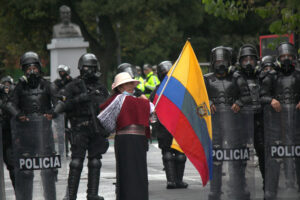
When the national strike began in Ecuador, on September 22, I started receiving more prayers than usual and decided to read them. One of them read: “Lord, I beg you to help President Daniel Noboa cleanse Ecuador of narcos, criminals, terrorists, the corrupt, and social resentfuls, so that we can once again be a country of peace.”
Two days after the Confederation of Indigenous Nationalities of Ecuador (CONAIE) declared a national strike against Executive Decree 126 — which eliminates the diesel subsidy — President Daniel Noboa said in a public event for the delivery of bonuses in the province of Imbabura:
“They want to walk and protest against us, we’ll do it first; they want to say they expel us from their territories, then we’ll expel them from the whole country. But coming here with that story that they are sovereign, that they are the representatives of the people, and then in an election they get 3%, that stupidity we will never believe again.”
“They,” those of the strike, are the peoples and nationalities of Ecuador, the artists, the queer organizations, the students of public universities, the leftists, the unions. They are the social resentfuls that the lady who sent me the prayer speaks of, and those whom Daniel Noboa, barely as the protest days began, called terrorists — and whom “justice” began to prosecute under that charge.
In The Origins of Totalitarianism (1951), Hannah Arendt warns how totalitarian regimes make people expendable, destroying their political humanity.
Arendt argues: “Totalitarian domination strives to organize the infinite plurality and differentiation of human beings as if all humanity were just one individual,” as if there were a “them” and an “us,” in Noboa’s words. In that work, Arendt analyzes the phenomenon of fascism.
Later, in 1963, she wrote Eichmann in Jerusalem, focusing on the “banality of evil,” a concept that deals with how evil is not the conscious hatred of some subjects toward others, but indifference, that gradual dehumanization that feeds on routine and obedience.
There are countless authors who talk about domination, but I focus on the ancient and Western Arendt because she spoke on the edge of World War II — but above all, because she spoke of fascism in its purest state.
We fear fascism. We are terrified by the image of Auschwitz, of bodies entering the gas chambers, thin and malnourished bodies. We are terrified by those white bodies dying by the millions, but we are not terrified enough by the fascism we live today embodied in less white bodies, in Palestinian bodies. What may happen to Indigenous, Latin American, or non-Western bodies becomes increasingly blurred by the shock effect, à la Naomi Klein, in which we remain after a global pandemic or under the communicational smoke cloud in which the right-wing rises. Evil becomes increasingly banal, subtle, everyday in the Arendtian sense — and it articulates itself from social media and political propaganda (which now blurs with commercial advertising) up to power itself: Trump, Milei, Noboa, Bukele — all inhabit the same logic.
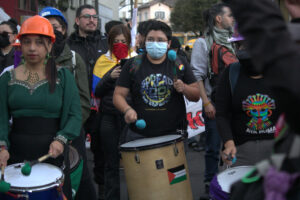
We must speak of fascism to understand the strike in Ecuador, not only because during the passage of an allegedly humanitarian convoy, the Otavalo community member Efraín Fuérez was shot at point-blank range by the army and his friend who tried to help him was beaten until he was left dying. We must speak of fascism because, as the conquerors did when they arrived in Abya Yala, many community members had their braids— symbols of dignity and identity in the Andean worldview — cut off as a sign of domination, or because as soon as the president knew there would be protests, he declared a state of emergency due to severe internal commotion in seven provinces of the country.
States of emergency are a common tool of political reaction for neoliberal governments in Ecuador (Lenin Moreno decreed 18, Guillermo Lasso 11, with three renewals, and Daniel Noboa already more than 7). It consists of the militarization of public space and the elimination of the right to assembly or protest. It is common in Noboa’s administration to use the “legitimate monopoly of state violence” for the fight against drug trafficking and organized crime — which is no minor issue in Ecuador — but in the process, it sweeps away every citizen right in the name of pacification.
Black Mirror Ecuador
Returning to the phenomenon of the rise of fascism — which I will call the “black mirror” effect, as a nod to the well-known British series that portrays technological and political dystopias — in the case of the strike in Ecuador it became clearer than ever the government’s ability to manipulate reality, investing millions in publicity. It is outrageous that, as I write this article, very few Ecuadorian media outlets address the national strike without justifying the violence of repressive forces or without stigmatizing protesters as terrorists.
The construction of reality is such that it has been proven, through citizen complaints and the nonexistence of any aid delivered, that under the pretext of being a humanitarian convoy to help those affected by the protests, the government sent several war convoys that delivered bullets, tear gas, and death to the communities. In the midst of the national strike, Noboa reported two attacks: one allegedly against his false convoy and another by poisoning — neither of which has been proven.
But if we speak of dystopias, the explosion of a car bomb in the Mall del Sol in Guayaquil on October 14 is alarming. Ecuadorian lawyer Pedro Granja points out that several explosions in recent months have been politically motivated, and that in the case of Mall del Sol: “There is no mention in the prosecutor’s file of the Porsche Cayenne, license plate GRY 3452, owned by Industrial Molinera (a company linked to Daniel Noboa’s family).”
It’s like a script in which a crisis is created over pre-existing conditions, thousands of dollars are invested in advertising so that people become aware — to omit or distort realities — and the president “saves” the situation through measures that dig into citizens’ and the State’s pockets or reduce political rights. For example, after the declaration of an internal armed conflict on January 9, 2024, due to a series of simultaneous attacks by organized criminal groups, including the takeover of TC Television in Guayaquil during a live broadcast, the president managed to raise the VAT to 15% in order to “fight violence.”
Since then, death has become nothing but ordinary. In the first half of 2025, there were 4,619 intentional homicides, a 47% increase compared to the same period in 2024, representing the highest figure in the country’s recent history. By September 2025, there had been 6,797 violent deaths, and if the trend continues, it is estimated that by the end of the year there will be more than 9,000 homicides — a rate above 50 per 100,000 inhabitants, according to the Ecuadorian outlet Primicias.
Meanwhile, in 2024, the government executed only 54% of the Annual Investment Plan, leaving sectors like health out in the open, which received USD 1.249 billion less than in previous periods. By July 2025, the government had executed only 11.8% of the budget allocated to the health sector, leading the system to collapse: 12 newborns died in Guayaquil because of it, and dialysis patients continue to protest as their treatments are being reduced, for example. But there is a budget to deploy the 5,000 military troops who repressed the protesters, and to triple the acquisition of military equipment in 2024 — with Israeli weapons.
Since his appointment as President of the Republic in April 2025, Daniel Noboa has promoted a series of laws regressing rights and concentrating power. For instance, in June 2025 the National Security Law was approved, which allows him to declare the existence of an internal armed conflict, granting repressive forces the authority to use lethal force and conduct raids without a judicial order. Subsequently, the Intelligence Law was enacted, regulating the functions of the National Intelligence System and expanding the State’s powers in security matters. That law has generated controversy due to potential violations of privacy and fundamental rights.
Another law approved during his term was the Law on Credit Strengthening and Sustainability, paving the way for a possible privatization of the Ecuadorian Social Security Institute (IESS). However, the call for a referendum and popular consultation on November 16, 2025, represents Daniel Noboa’s most controversial and radical intervention in the Ecuadorian State, since if it passes, a new constitution would be approved under his government.
“The 2008 Constitution (known as Montecristi’s Constitution) marked a new era in Ecuadorian constitutionalism: it modified the State’s institutional structure with five branches, strengthened the Executive, enshrined direct citizen participation, was based on the guarantee principle over the broadest individual, social, labor, collective, and nature rights, strengthened state capacities, guided the economy with a national and highly social vision, established a redistributive tax system of wealth, prioritized the social and solidarity economy, and particularly devoted Title VI to the ‘Development Regime’ and Title VII to the ‘Good Living Regime,’ which are fundamental axes for building a different society,” explains historian Juan J. Paz-y-Miño Cepeda in a text published in Rebelión magazine.
Daniel Noboa put his hands in Ecuadorians’ pockets to militarize the country and reduce the right to protest. The Malvinas case, in which the army murdered and disappeared four poor Black children, is an example of how such militarization only helps centralize violence in marginalized bodies, by the hand of the State — just as Arendt points out. However, he went further: as explained earlier, he ensured laws that institutionalize citizen surveillance and the privatization of health and retirement insurance for workers.
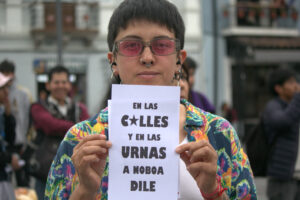
Through the referendum, the president of Ecuador seeks: the establishment of foreign military bases on national territory to increase U.S. and Israeli presence; the elimination of political party financing so that access to power is limited to the economic elite; and the reduction of the number of assembly members while his party holds a majority and monopolizes all branches of government. In those hands, stained with the blood of poor children and protesters, in the hands of the author of the greatest regression of rights in Ecuador’s history, will fall the task of drafting and approving a new constitution.
The Cost of the Dystopia
In a text I recently published in the Mexican magazine Ojalá, I stated that Ecuador is not a country that tolerates dictators. Ecuadorians have overthrown governments such as those of Abdalá Bucaram (1997), Jamil Mahuad (2000), or Lucio Gutiérrez (2005). In 2018, with Lenín Moreno, the neoliberal cycle came to power, and since then there have been three national strikes (2019, 2022, and 2025) to defend the fuel subsidy.
The national strike of 2025 was officially lifted on October 22, one month after it began. However, some Indigenous organizations, among them the Union of Indigenous and Peasant Organizations of Cotacachi (UNORCAC), reject that decision and continue in resistance. For social organizations, the strike was a process that led to the fight for a NO vote in the referendum of next November 16 — and that NO is also in the name of those who fell during the protests and against the authoritarianism of Daniel Noboa’s government.
As of October 18, 2025, the 27th day of the strike, there had been 117 recorded cases of repression, including three alleged extrajudicial executions, 38 injuries, and 57 incidents of detentions, according to the violence-monitoring platform Persecución Ecuador.
State repression manifested itself through financial harassment by freezing the accounts of social leaders; attacks on journalists; Internet signal inhibition during episodes of state violence; arbitrary detentions; live ammunition and massive tear gas use causing the death of an elderly person; intimidation and closure of media outlets; entering medical centers to prevent care for the wounded; and the militarization of the Central University of Ecuador (UCE), among others.
Mapping of resistance reports that by October 15, 2025, there had been 547 collective actions, including vigils, symbolic actions, marches, roadblocks, sit-ins, assemblies, and pot-banging protests (cacerolazos).
Ecuadorian civil society reached the national strike weakened. Although it is a social muscle with memory that knows how to organize itself, the neoliberal cycle has left scars: a left divided between correísmo and anti-correísmo, a labor movement increasingly less unionized due to the impossibility of creating sectoral unions, an Indigenous movement eroded by three strikes in a short time and by internal divisions in its leadership, and a series of social movements increasingly aligned with corporate interests. Nonetheless, the strike generated new alliances among peoples, nationalities, and dissident groups, and the voices for a NO in Daniel Noboa’s referendum are already being heard.
On November 16, the fate of Ecuador will be decided, and I hope that the ladies who send me prayers will be consistent with their Christian faith at the polls. As I recently told one of them: “Those resentful and terrorist people they talk about are the poor ones to whom their hero, Jesus, spoke first — and as their Bible says, it is easier for a camel to pass through the eye of a needle than for a rich man to enter the kingdom of heaven. May their God protect Ecuador from fascism”.
Paro Nacional 2025 o Black Mirror Ecuador
Texto y Fotos: Lisbeth Moya González.
Desde que vivo en Ecuador me llegan cadenas de oraciones. Hay en mi círculo, madres de amigos, señoras mayores cuyos contactos tengo por azar, que me mandan stickers de “Dios te bendiga” cada mañana. Hay en esas señoras una soledad monacal y en su gesto un cariño que acojo en mi corazón de atea.
Cuando comenzó el paro nacional en Ecuador, el pasado 22 de septiembre, comencé a recibir más oraciones que de costumbre y me dispuse a leerlas. Una de ellas versaba: “Señor, te suplico ayudar al presidente, Daniel Noboa, a limpiar el Ecuador de los narcos, delincuentes, terroristas, corruptos y resentidos sociales, para que volvamos a ser un país de paz”.
Dos días después de que la Confederación de Nacionalidades Indígenas del Ecuador (CONAIE) se declarase en paro nacional contra el Decreto Ejecutivo 126- que elimina el subsidio al diésel-, el presidente Daniel Noboa dijo en un acto público de entrega de bonos en la provincia de Imbabura:
“Ellos quieren caminar y hacer una protesta contra nosotros, nosotros la hacemos primero; ellos quieren decir que nos expulsan de sus territorios, nosotros los expulsamos de todo el país entonces, pero ya venir con ese cuento de que ellos son soberanos, de que ellos son los representantes del pueblo y después en una elección sacan el 3 %, esa estupidez no la vamos a creer nunca más”.
Ellos, los del paro, son los pueblos y nacionalidades del Ecuador, los artistas, las organizaciones queer, los estudiantes de la universidad pública, las izquierdas, los sindicatos. Ellos son los resentidos sociales de los que habla la señora que me envió la oración y a los que Daniel Noboa apenas comenzó la jornada de protestas llamó terroristas y la “justicia” comenzó a procesar bajo ese cargo.
En “Los orígenes del totalitarismo” (1951), Hanna Arendt advierte cómo los regímenes totalitarios convierten a las personas en prescindibles, destruyendo su humanidad política.
Arendt argumenta: “La dominación totalitaria intenta organizar la infinita pluralidad de los seres humanos como si toda la humanidad fuera un solo individuo”, como si hubiera un “ellos” y un “nosotros” en palabras de Noboa. Arendt analiza en esta obra el fenómeno del fascismo.
Posteriormente, en 1963, escribe “Eichmann in Jerusalem” y se centra en la “banalidad del mal”, concepto que aborda cómo el mal no es el conjunto del odio consciente de unos sujetos hacia otros, sino de la indiferencia y de esa deshumanización que de a poco se alimenta de la rutina y la obediencia.
Existe un sinniúmero de autores que hablan de la dominación, pero me centro en la tan antigua y occidental Arendt, porque hablaba al filo de la segunda guerra mundial, pero sobre todo, porque hablaba del fascismo en su estado más puro.
Le tememos al fascismo. Nos aterra la imagen de Auschwitz, de los cuerpos entrando a la cámara de gas, cuerpos delgados y desnutridos. Nos aterran esos cuerpos blancos muriendo por millones, pero no nos está aterrando lo suficiente el fascismo que vivimos hoy encarnado en cuerpos menos blancos, en cuerpos palestinos. Lo que pueda sucederle a cuerpos indígenas, latinoamericanos o no occidentales se matiza cada vez más con el efecto de shock a lo Naomi Klein en que permanecemos tras una pandemia global o tras la nube de humo comunicacional en que ascienden las derechas. El mal se vuelve cada vez más banal, sutil, cotidiano en el sentido arendtiano y se articula desde las redes sociales y la propaganda política -que ya se confunde con la publicidad comercial- hasta el poder: Trump, Milei, Noboa, Bukele, todos habitan en la misma lógica.
Hay que hablar de fascismo para entender el paro en Ecuador, no solo porque durante el paso de un convoy dizque humanitario al comunero otavaleño, Efraín Fuérez le disparó el ejército a quemarropa y a su amigo que intentó ayudarle lo golperaron hasta dejarlo moribundo. Hay que hablar de fascismo, porque a muchos comuneros, como hacían los conquistadores al llegar al Abya Yala, les cortaron las trenzas– símbolo de dignidad e identidad en la cosmovisión andina- en señal de dominación o porque a penas el presidente supo que habrían protestas declaró estado de excepción por grave connmoción interna en siete provincias del país.
Los estados de excepción son una herramienta común de reacción política de los gobiernos neoliberales en el Ecuador (Lenin Moreno decretó 18, Guillermo Lasso 11, con tres renovaciones y Daniel Noboa ya va por más de 7). Se trata de la militarización del espacio público y la eliminación del derecho a reunión o protesta. Es común en la gestión de Noboa el uso del “monopolio legítimo de la violencia estatal” para la lucha contra el narcotráfico y el crimen organizado, que no es menor en el Ecuador, pero que en el proceso arrasa con todo derecho ciudadano en nombre de la pacificación.
Black Mirror Ecuador
Volviendo al fenómeno del ascenso del fascsimo, al que llamaré efecto “black mirror”, en un guiño a la tan conocida serie británica que aborda distopías tecnológicas y políticas, en el caso del paro en Ecuador quedó más claro que nunca la capacidad de manipulación de la realidad de un gobierno que invierte millones en pauta. Resulta escandaloso que mientras escribo este artículo muy pocos medios ecuatorianos aborden el paro nacional sin justificar la violencia de los cuerpos represivos o sin estigmatizar a los manifestantes como terroristas.
La construcción de la realidad es tal, que está comprobado por la denuncia ciudadana y por la inexistencia de donaciones entregadas, etc, que bajo la excusa de ser un convoy humanitario para ayudar a los afectados por las protestas, el gobierno envió varios convoys de guerra que entregaron bala, gas y muerte a las comunidades. En medio del paro nacional Noboa denunció dos atentados: uno por un supuesto ataque a su falso convoy y otro por envenenamiento, ninguno de los dos han sido probados.
Pero si de distopías hablamos, la explosión de un coche bomba en el Mall del Sol en Guayaquil el 14 de octubre es alarmante. El abogado ecuatoriano, Pedro Granja, señala que diversas explosiones en los últimos meses han estado motivadas por razones políticas y que en el caso del Mall del Sol: “No consta en el expediente fiscal ninguna alusión al Porsche Cayenne de placas GRY 3452 de propiedad de Industrial Molinera (empresa vinculada a la familia de Daniel Noboa)”.
Es como un guion en que se crea una crisis sobre condiciones pre existentes, se invierten miles de dólares en pauta para que la gente se entere, para omitir o para tergiversar realidades y el presidente salva la situación mediante medidas que meten la mano en el bolsillo de la ciudadanía y el Estado, o reducen los derechos políticos. Por ejemplo, tras la declaración de un conflicto interno armado, el 9 de enero de 2024, por una serie de ataques simultáneos de grupos delincuenciales organizados, incluyendo la toma del canal TC Televisión en Guayaquil en una transmisión en vivo, el presidente logró subir el IVA al 15% para luchar contra la violencia.
Desde entonces, la muerte no ha hecho más quevolverse común. En el primer semestre de 2025 se registraron 4.619 homicidios intencionales, un aumento del 47% respecto al mismo periodo en 2024, lo que representa la cifra más alta en la historia reciente del país. Hasta septiembre de 2025, se contabilizaron 6.797 muertes violentas, y si la tendencia continúa, se estima que al final del año se superarán los 9.000 homicidios, con una tasa superior a 50 por cada 100.000 habitantes, explica el medio ecuatoriano Primicias.
Mientras, en 2024, el gobierno ejecutó solo el 54% del Plan Anual de Inversiones, dejando a la intemperie sectores como la salud, que recibió USD 1.249 millones menos que en periodos anteriores. Hasta julio de 2025, el gobierno había ejecutado solo el 11,8% del presupuesto destinado al sector salud, lo que ha llevado al sistema al colapso: murieron por esa causa 12 recién nacidos en Guayaquil y los pacientes de diálisis no paran de protestar porque les están reduciendo los tratamientos, por ejemplo. Pero sí hay presupuesto para desplegar a los 5000 efectivos militares que reprimieron a los manifestantes y para triplicar la adquisición de equipamiento militar en 2024 con arsenal israelí.
Desde su nombramiento como presidente de la República en abril de 2025, Daniel Noboa ha impulsado una serie de leyes de regresión de derechos y de acumulación de poder. Por ejemplo, en junio de 2025 se aprobó la Ley de seguridad nacional que le permite declarar la existencia de un conflicto armado interno, otorgando a los cuerpos represivos facultades para emplear fuerza letal y realizar allanamientos sin orden judicial. Posteriormente, se dio paso a la Ley de inteligencia, que regula las funciones del Sistema Nacional de Inteligencia, ampliando las competencias del Estado en materia de seguridad. Dicha ley ha generado controversia por posibles afectaciones a la privacidad y derechos fundamentales.
Otra de las leyes aprobadas en su mandato fue la de Fortalecimiento y Sostenibilidad Crediticia que da paso a una posible privatización del Instituto Ecuatoriano de Seguridad Social (IESS). No obstante, la convocatoria a un referéndum y consulta popular para el 16 de noviembre de 2025 resulta la intervención más polémica y radical de Daniel Noboa en el Estado ecuatoriano, ya que si gana, bajo su gobierno se aprobaría una nueva constitución.
“La Constitución de 2008 (llamada de Montecristi), marcó una nueva época en el constitucionalismo ecuatoriano: modificó la institucionalidad del Estado con cinco funciones, fortaleció al Ejecutivo, consagró la participación ciudadana directa, se fundamentó en el principio garantista sobre los más amplios derechos individuales, sociales, laborales, colectivos y de la naturaleza, robusteció las capacidades estatales, orientó la economía con criterio nacional y muy social, determinó un sistema tributario redistributivo de la riqueza, privilegió la economía social y solidaria, y particularmente dedicó el título VI al «Régimen de Desarrollo» y el VII al «Régimen del Buen Vivir» que son ejes fundamentales para la construcción de una sociedad distinta”, así explica en un texto publicado en la revista Rebelión, el doctor en historia Juan J. Paz-y-Miño Cepeda.
Daniel Noboa metió sus manos en el bolsillo de los ecuatorianos para militarizar el país y reducir el derecho a la protesta. El caso Malvinas en que el ejército asesinó y desapareció a cuatro niños negros y pobres, es un ejemplo de como esa militarización solo contribuye a centralizar la violencia en corporalidades excluidas de mano del Estado, tal y como señala Arendt. No obstante, llegó más allá, como se explica anteriormente, aseguró en leyes la vigilancia de la ciudadanía y la privatización del seguro de salud y jubilación de las y los trabajadores.
Con la consulta, el presidente de Ecuador, pretende: la instauración de bases militares extranjeras en territorio nacional, para dar mayor entrada a EEUU e Israel; la eliminación del financiamiento a partidos políticos, para que el acceso al poder se reduzca a la élite económica; la reducción del número de asambleístas mientras su partido es mayoría y acapara todos los poderes del Estado. En esas manos manchadas de sangre de niños pobres y manifestantes, en manos del autor de la regresión de derechos más grande de la historia del Ecuador, caerá el peso de que se elabore y apruebe una nueva constitución.
El costo de la distopía
En un texto que publiqué recientemente en la revista mecicana Ojalá afirmé que Ecuador no es un país que tolere a dictadores. Las y los ecuatorianos han derrocado gobiernos como el de Abdalá Bucaram (1997), JamilMahuad (2000) o Lucio Gutiérrez (2005). En 2018 llegó con Lenin Moreno el ciclo neoliberal al poder y se han sucedido desde entonces tres paros nacionales (2019, 2022 y 2025) para cuidar el subsidio a los combustibles.
El paro nacional de 2025 fue oficialmente levantado el 22 de octubre, un mes después de que empezó. No obstante, algunas organizaciones indígenas, entre ellas la Unión de Organizaciones Indígenas y Campesinas de Cotacachi (UNORCAC) desconocen esa decisión y continúan en resistencia. Para las organizaciones sociales el paro fue un proceso que condujo a la lucha por el NO en la consulta del próximo 16 de noviembre y ese NO es también en nombre de los caídos durante las protestas y contra el autoritarismo del gobierno de Daniel Noboa.
Hasta el 18 de octubre de 2025, el día 27 del paro, se habían registrado 117 casos de represión, entre ellos tres presuntas ejecuciones extrajudiciales, 38 lesiones y 57 eventos de detenciones, según la plataforma de monitoreo de violencias Persecución Ecuador.
La represión estatal se manifestó en el acoso financiero mediante el bloqueo dehttps://persecucionecuador.org/mapa-resistencia/ cuentas a líderes sociales; los ataques a periodistas; la inhibición de señal de Internet durante episodios de violencia estatal; las detenciones arbitrarias; los disparos de bala y empleo de gas lacrimógeno en grandes cantidades causando la muerte de una persona de la tercera edad; la intimidación y cierre de medios de comunicación, el ingreso a centros médicos para impedir la atención de los heridos, y la militarización de la Universidad Central del Ecuador (UCE), entre otras.
El mapeo de la resistencia informa que hasta el 15 de octubre de 2025, se han contabilizado 547 acciones colectivas, entre ellas vigilias, acciones simbólicas, marchas, cierres de vías, plantones, asambleas y cacerolazos.
La sociedad civil ecuatoriana llegó al paro nacional debilitada. Si bien es un músculo social que tiene memoria y sabe cómo organizarse, el ciclo neoliberal ha dejado secuelas: una izquierda dividida entre el correísmo y el anticorreísmo, un movimiento obrero cada vez menos sindicalizado por la imposibilidad de creación de sindicatos por rama, un movimiento indígena erosionado por tres paros en corto tiempo y por divisiones internas en sus liderazgos y una serie de movimientos sociales cada vez más alineados a intereses corporativos. No obstante, el paro generó nuevas alianzas entre los pueblos, nacionalidades y disidencias; y las voces por el no en la consulta de Daniel Noboa ya se hacen sentir.
El 16 de noviembre se decide el destino del Ecuador y espero que las señoras que me mandan oraciones sean consecuentes con su fe cristiana en las urnas. Así le dije recientemente a una de ellas: “Esos resentidos y terroristas de los que habla son los pobres a quienes habló su héroe, Jesús, en primer lugar y como dice su biblia, primero pasa un camello por el hueco de una aguja, que va un rico al reino de los cielos. Que su dios ampare a Ecuador del fascismo”.
 If you’ve read this far, you were pretty interested, right? Isn’t that worth a few bucks -maybe more? Please
Leave a Reply