Place: Syria

ImageThe siege of Kobani by Islamic State (ISIS) brought worldwide attention to the Syrian Kurdish PYD (Partiya Yekîtiya Demokrat, Democratic Union Party), the leading force in the Kurdish-majority areas in northern Syria. The PYD calls this region Rojava—literally meaning “land of the sunset” but also translated as “West Kurdistan.” 
Image

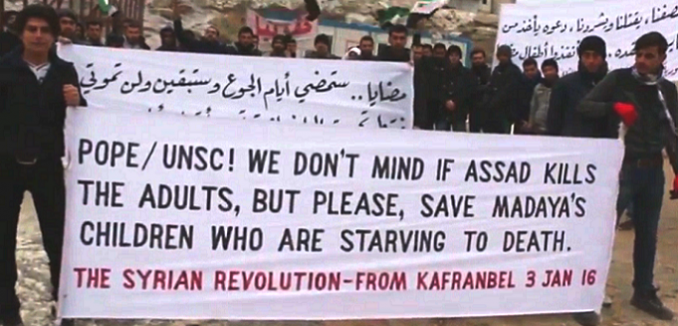
Throughout the world, people have been shocked by the scenes of starving people in the Madaya concentration camp in southern Syria, besieged by the Assad regime and its allied death-squad Hezbollah (which has invaded Syria from Lebanon). Some 40,000 people are trapped, besieged and starved as a weapon of war by the dictatorship which has used every conceivable means to maintain its power over the last five years; people are reported to be eating grass, insects and cats and dogs.

Yet it appears that the main task confronting leftists – i.e., opponents of exploitation, oppression and injustice, advocates of a “another world is possible” – is once again to find whatever excuses, whatever obfuscation, whatever mitigation they can on behalf of the tyrannical fascist regime responsible.
Image

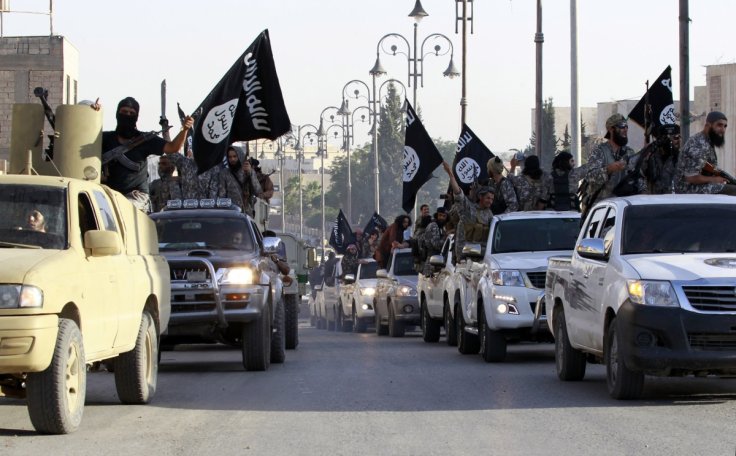
Militant Islamic State fighters parade on military vehicles along the streets of Raqqa (Reuters)

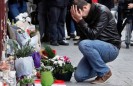
In the wake of the murderous massacres in Paris, the demand for violent retaliation against Islamic State (IS) is gaining momentum. David Cameron now plans a renewed bid to secure parliamentary approval for UK air strikes against IS in Syria.

At one level, this is an understandable reaction to the fascist-like tyranny and brutality of IS. But understandable reactions and effective reactions are often two different things. The desire for retribution, no matter how seemingly justifiable in response to the slaughter of so many innocents, is not a sound basis on which to frame political and military policy.

Image

The despicable ISIS attacks on Paris and elsewhere have unleashed intensified war and imperialist machinations over Syria and Iraq, as well as repression of immigrants and renewed Islamophobia. Can the left oppose the carnage on all sides without losing sight of its emancipatory aims?

Image

After approximately four and a half months of fighting, Kurdish forces have successfully pushed the Islamic State of Iraq and the Levant (known as ISIS or ISIL) out of Kobanî. The coalition of ground forces most notably included the People’s Defense Units (YPG) , Women’s Defense Units (YPJ) , and the Peshmerga from the Kurdish Regional Government (KRG).At the same time, through the air, a U.S. led-coalition made 700 airstrikes against ISIS. On February 6 it was reported  “fourteen more villages and some strategically important points have been liberated.” In an October 2014 article for Naked Capitalism Claude Salhani noted the strategic importance of the region. Salhani stated “victory for” ISIS in the region “would give the group prestige among the dozens of groups lined up in the fight against Syrian President Bashar Assad. It would also secure the terror organization’s flow of oil to a lucrative market.”

As we write on Sunday, October 19, it appears that ISIS [Islamic State] forces have begun to retreat from their vicious assault on the Kurds in Kobanê. We hope that this is a resounding defeat for ISIS, and that it inspires a wave of grassroots resistance to ISIS throughout Syria and Iraq. 

Yassin Al Haj Saleh is one of Syria’s leading political dissidents. He spent from 1980-1996 in Syrian prisons and became one of the key intellectual voices of the 2011 Syrian uprising. He spent 21 months in hiding within Syria, eventually escaping to Istanbul. He was interviewed via email by New Politics co-editor Stephen R. Shalom in early November 2014.


Joseph Daher is a member of the Revolutionary Left Current in Syria. He is the writer and editor of Syria Freedom Forever, syriafreedomforever.wordpress.com, a blog dedicated to the struggle of the Syrian people in their uprising to overthrow the Assad authoritarian regime and to build a democratic, secular, socialist, anti-imperialist, and pro-resistance Syria. A Ph.D. student in Development, he works as an assistant at the University of Lausanne in Switzerland. He was interviewed in Geneva on October 22, 2014, by New Politics board member Riad Azar, with some email updates. For additional questions on Kobanê and Turkey, see the New Politics website here

An extended interview with Joseph Daher, a member of the Revolutionary Left Current in Syria, living in Switzerland, will be published in the forthcoming Winter 2015 issue of New Politics. Here we just post the questions dealing with Kobanê and Turkey.

In what many outside of the territory are referring to as the Rojava Revolution, a major shift in political philosophy and political programmatics has taken place in Kurdistan. Yet, this shift is not limited to the region of Rojava, or what many call Syrian or Western Kurdistan – a region where the Democratic Union Party (PYD) has taken an active part in this change. In “Turkish,” or rather Northern Kurdistan, the Kurdistan Workers' Party (PKK) has been the foremost leader.

I will never forget when I first met Ali Mustafa. It was September 2012, during my first year at York and just before I joined Students Against Israeli Apartheid (Ali was a former member), where he did a talk on his visit to Egypt. After he was done, he asked the audience for comments. Seeing no takers, I chimed in. Not knowing who I was, he was very impressed with my comments, and that was the beginning of our friendship.

Pressured by the British Parliament's historic rejection of military action against Syria and by the great opposition of most of the American people to getting involved in yet another bloody war in the Middle East, President Obama has been forced to take his plan to attack Syria to Congress. At the moment, Congress appears to be sharply divided over whether or not to support the President, with many still undecided, and it is therefore imperative to take advantage of widespread antiwar opinion to make the case now against U.S. military intervention in Syria.

Skepticism is always warranted in the face of government claims, but some folks seem unable to apply the same level of skepticism to claims by Syria's dictator as they do to those of the U.S. government. This will not help us in waging a sustained effective campaign against U.S. military action against Syria; to rest our case on acceptance of Assad's claims weakens our argument. We need to explain why a U.S.-led war on Syria is not the solution, whether or not Assad is responsible for the horrific chemical weapons attack in the Ghouta suburbs of Damascus.

The Campaign for Peace and Democracy has posted an interesting symposium on Syria. It was mostly written before the August 21 chemical weapons attack and the resulting war threat from Washington. None of the symposium participants favors U.S. military action, but the symposium provides useful background on the Syrian uprising that helps us make sense of the current situation.

     During the past two years, the Campaign for Peace and Democracy has released official statements in broad support of the Syrian revolution: CPD Salutes Syria’s Courageous Democratic Movement and Message of Condolence and Solidarity from U.S. Peace Activists to the Syrian People. What follows, however, is not an official position but rather a personal statement by CPD’s co-directors about the current situation.