Place: Brazil
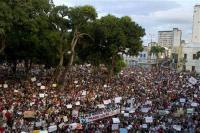
A little more than year ago, Brazil was paralyzed by the enormous popular protests of the June Days of 2013 as, according to a highly regarded poling agency IBOPE, some 8.5 million people joined demonstrations in 400 cities and 22 state capitals, first against high transportation costs and then against just about everything else that had to do with government policies. IBOPE found that 72 percent of the population approved of the demonstraitons and that 89 percent had no faith in the political parties.
The World Cup is the most widely viewed sporting event around the world. Millions of viewers will tune in Sunday to watch the broadcast of the upcoming final match and cheer on their favorite teams as they battle for the golden trophy. In the United States, the event has become a much anticipated and celebrated source of entertainment – an opportunity for people to show support for their country and an excuse to grab a drink and watch the game with friends at a local bar.
Brazil went to the streets in June this year with crowds never before seen in the history of the country. There were young workers and students who were demonstrating for the first time, but also sectors of the middle class and union members as well as social movement and left party activists who protested about a wide diversity of issues.
[Mass protests have been taking place in all the major cities of Brazil for the past week, beginning with a demand to reduce bus fares and expanding into a mass movement that demands improvements in all public services, health, education, and working peoples’ rights.
 Our country was at the forefront of social and political struggles in the 1980s, and succeeded in preventing the introduction of neoliberalism in Brazil, so that Latin America’s “lost decade” was, for social movements and popular politicians in our country, exactly the opposite.
Workers in Brazil—in heavy industry, services, the public sector, and agriculture—are involved in a series of strikes and mass protests such as the country hasn’t seen in decades. . Driving the new labor upsurge is the strength of the country’s economy, the powerful position of unions in the society, and the rising inflation. In 2007 and 2008, Brazil’s economy grew at a rate of 5%, and though in the depths of the crisis in 2009 it shrunk by .02%, last year the economy grew again at a rate of 10%.
- « Newer Posts
- 1
- 2
- 3