
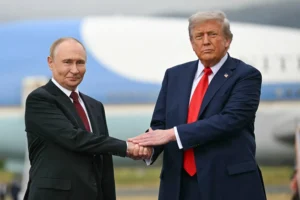
 Donald Trump’s idea for ending Russia’s war on Ukraine “within 24 hours,” as he promised at least 53 times while campaigning for the presidency, has always been to force Ukraine to surrender to Russia’s demands for more territory, “denazification” (regime change), and “demilitarization” (Russian military occupation).
The problem for Trump has been Ukraine’s refusal to surrender. The frontlines have been basically frozen since the beginning of 2023, with Ukraine regaining more territory in 2026 (120 square miles) than at any time since its successful counter-offensives in the Kharkiv and Kherson oblasts in the Fall of 2002.
Trump’s commitment to Russia’s victory should have been clear early in his administration. Trump immediately ended U.S. military and economic aid to Ukraine. On February 19, 2025, one month after he was inaugurated and after a meeting between Russian and American officials in Saudi Arabia about Ukraine without Ukraine, Trump denigrated the Ukrainian president Volodymyr Zelensky as a “modestly successful comedian” and a “Dictator without Elections” who “has done a terrible job.”
Nine days later on February 28, Trump and Vice-President JD Vance publicly attacked Zelensky in the Oval Office with Vance saying Zelensky was “disrespectful” and demanding again and again that he thank Trump and Trump telling Zelensky “You don’t have the cards.” It was probably the most blatant case of public imperialist bullying ever recorded. Trump concluded the meeting with the boast that “This is going to be great television.”
The Oval Office shakedown did extort Ukraine into signing a so-called “minerals deal” allowing the U.S. to plunder Ukraine’s natural resources, particularly oil and gas. Zelensky also agreed to Trump’s proposal for an immediate ceasefire while peace settlement negotiations were undertaken, a position Ukraine has maintained to this day. The Russian side has stuck to its position that there can be no ceasefire until a final settlement in concluded.
Over the course of 2026, Ukraine won back some territory on the frontline and conducted an effective mid-range air campaign against Russian military assets and logistics in the Russian-occupied territories and a long-range air campaign against Russian oil and gas refineries and export facilities. At the NATO summit in Türkiye on July 8, as ever wanting to be seen as on the winning side, Trump said that Zelensky “had done an amazing job.” He said that he had approved Ukraine’s request to manufacture Patriot missile systems, the only effective defense against incoming Russian ballistic missiles. This announcement came as news to Raytheon and Lockheed Martin, who hold the proprietary and manufacturing rights to the Patriot systems.
Many observers were now saying Trump had come around to supporting Ukraine against Russia’s evasion. But on July 31, Trump stated that he had not agreed to granting Ukraine a license to manufacture Patriot missile systems.
Meanwhile, as Russian military forces continued to fail to make substantial territorial gains along the frontlines despite suffering record numbers of casualties in their assaults, Russia escalated its air campaign against civilian targets in cities far from the frontlines. Ukraine’s air defenses were depleted. Patriot missiles in the pipeline for Ukraine were diverted to the U.S./Israeli war on Iran. Ukraine’s drone interceptors, which had been effective against Shahed drones imported from Iran, were not fast enough to stop Russia’s new high-speed Geran 5 drones powered by imported Chinese-made turbojets.
Russian Bombing Campaign to Make Cities Uninhabitable
Russia’s military strategy now seems to be to render Ukrainian cities uninhabitable through massive bombardment and to break Ukrainians’ will to resist the Russian invasion. Russian air strikes target apartment blocks and civilian infrastructure, including hospitals, schools, shopping malls, warehouses, data centers, public trains and busses, and especially energy infrastructure in a quest to cripple Ukraine’s power, heating, water, and sewage systems.
Living without power and tap water is a heavy hardship with the weather already cooling toward the sub-freezing temperatures of a Ukrainian winter. But it is worse than that. Russia’s air campaign is playing Russian roulette with Ukraine’s 19 nuclear reactors by targeting the substations that feed power into the cooling systems that prevent nuclear meltdowns in the reactor cores and spent fuel storage pools. The six reactors at Zaporizhzhia are under Russian occupation, where Ukrainian staff have been brutalized by forced Russification, torture, deaths, and show trials and imprisonment on trumped-up charges of treason against Russia. On February 14, 2025, a Russian drone blasted a 15-square-meter breach through the containment structure covering Chornobyl Unit 4 and the radioactive core debris its meltdown left behind. The other nine reactors have provided 80 percent of Ukraine’s total power after Russian air strikes and sabotage have destroyed most of Ukraine’s coal, gas, and hydropower plants. They are now the target of the Russian campaign to turn off all power in Ukraine.
Ukrainians have suffered through four winters of increasingly frequent power blackouts that affected power, heating, and electric-power-pump dependent water systems. The damage to the sewage systems of even greater blackouts would create a humanitarian and public health crisis in Ukrainian cities whose water and sewage systems depend entirely on electric-powered pumps dependent on the central energy grid. Russia has repeatedly targeted Kyiv’s only sewage plant. Without a working sewage system, the population will be vulnerable to epidemics of deadly water-borne diseases including cholera, typhoid, and dysentery, especially when hospitals and clinics will also be without power, heat, and water.
Genocide in the Russian-Occupied Territories
Life for Ukrainians in the Russian-occupied territories is also dire. Forced Russification is the policy of the Russian occupation authorities. Ukrainians must take Russian passports if they want access to schools, health care, or any public services or any private services like banks, and to prevent expropriation of their homes, farms, and businesses for lacking proper Russian titles to ownership. People are punished for speaking Ukrainian in public, from physical abuse in schools to intimidation in public spaces by police and other occupation authorities. Refusal or defiance marks a person as pro-Ukrainian, leading to closer surveillance and often detention, charges, incarceration, torture, and murder. Rape is routinely used by the Russian occupiers to intimidate and demoralize Ukrainians under occupation.
The ban on Ukrainian speech in public operates alongside the physical destruction of Ukrainian culture. Russian forces have systematically raided local schools and public libraries to confiscate and burn tens of thousands of Ukrainian-language books, replacing them entirely with Russian state literature and wartime propaganda. Book markets, warehouses, and publishers in free Ukraine have also been systematically targeted by Russian air strikes. The Russia occupiers have also pursued cultural erasure by looting Ukrainian museums and destroying Ukrainian historical buildings and monuments.
Russia is engaged in demographic engineering to change the ethnic composition of the occupied territories by abducting tens of thousands of Ukrainian children for Russification and militarized re-education, forcibly transferring hundreds of thousands of other Ukrainians to Russia, and promoting settler-colonialism by five million Russian immigrants by 2030. In 2023, the International Criminal Court issued arrest warrants for Russian President Vladimir Putin and Russia’s Commissioner for Children’s Rights Maria Lvova-Belova for war crimes in their role in these state-sanctioned child abductions. Human rights monitors estimate that between 900,000 and 1.6 million Ukrainian citizens have been interrogated, detained, and forcibly deported to the Russian Federation through systematic filtration camps. Ukrainian authorities say more than 16,000 Ukrainian civilians are imprisoned in Russia.
The 2026 Freedom House index of political rights and civil liberties ranks the Russian-occupied territories of Ukraine as the most repressive in the world, worse than other occupied territories like the Gaza Strip, Tibet, and Western Sahara as well as extremely repressive countries like Afghanistan, North Korea, and Sudan. The Russian-occupied territories were given the only negative score in the index because the Russian authorities are “deliberately changing the ethnic composition of a country or territory so as to destroy a culture.”
Famine in Oleshky
In all of the occupied territories, civilians suffer from failing power and water systems, a shortage of medical services, and depopulation.
In two communities in Kherson oblast, Oleshky and Hola Prystan, civilians have been under siege since late 2025 and are suffering from famine. The Russian authorities have prevented food and medical supplies from getting into these communities. The roads out are mined. People are eating grass now that the produce from their gardens has been consumed. Ukraine has sent drones in to drop freeze-dried food relief, but the Russians try to shoot down these drones and confiscate the supplies that reach the ground. Ukrainians caught with this food have been detained as “enemy collaborators.”
Russian drone operators are embedded and being trained in these communities. They practice their drone operations on “human safaris” that target civilians across the Dnipro River with First Person View drones where they can see the civilians they are trying to murder. The Ukrainian civilians in Oleshky and Hola Prystan function as human shields because the Ukrainian military will not fire drones at Russia drone operators embedded in Ukrainian residential neighborhoods.
On October 16, his third day after surgery for lung cancer, Pope Leo called Putin seeking a humanitarian ceasefire to get relief into Oleshky and a safe corridor for residents to leave for free Ukraine. The Pope also called Zelensky, who agreed to the Pope’s proposal. Putin, however, said he was open to food relief for Oleshky, but not a ceasefire or humanitarian corridor out. At the time of this writing (October 22), no food relief has reached Oleshky.
Targeted bombing of civilians and civilian infrastructure and forced starvation are crimes of genocide under the UN’s 1948 Genocide Convention. Systematic cultural erasure is a crime against humanity under the Rome Statute of the International Criminal Court. The International Criminal Court has issued arrest warrants for four top Russian military commanders for the war crimes and crimes against humanity of targeting civilians and civilian infrastructure in Ukraine. The Ukrainian Prosecutor General’s Office has recorded over 200,000 alleged war crimes committed by Russian forces against Ukrainians since the start of the full-scale invasion
Trump’s October War Offensive Against Ukraine
While all of this military aggression and these war crimes have been perpetrated by Russia, Donald Trump has had next to nothing to say against it.
Speaking to reporters on October 19, Trump said, “Russia, frankly, has been fine on Ukraine. They haven’t been doing much.” Then he condemned Ukraine, “We’ve given a lot to Ukraine. They’ve given nothing to us. Remember that.”
While many commentators have been taken in by Trump’s occasional suggestions that he might do more to support Ukraine, Trump has never followed through. The general pattern has been to say Putin wants peace and Zelensky is the obstacle.
But outside of Trump’s childish make-believe world, the facts are that throughout Trump’s second term in office Zelensky has supported a ceasefire and negotiations and proposed a compromise settlement based on a freeze at the current frontline and Ukraine forgoing NATO membership if other security guarantees can be arranged. Ukrainian public opinion has consistently supported this perspective of difficult compromises as long as there are international security guarantees, but continuing to resist Russia’s invasion if these conditions are not met.
Putin continues to insist that there can be no ceasefire until a final settlement is negotiated. Putin says such a settlement must include Ukraine surrendering the territory it controls in the oblasts that Russia claims to have annexed, reducing the size of its military and forgoing any military alliances that would guarantee its security (“demilitarization”), and new elections to change Ukraine’s government (“denazification”).
In the last two weeks, Trump has openly sided with Putin in support of his war on Ukraine.
Friday, October 9 – Trump-Putin Diesel Deal
A delegation of Ukrainians and Europeans met in Miami with Steve Witkoff and Jared Kushner ostensibly to discuss peace proposals. While this meeting was being held, Trump called Putin and, after their 90-minute call, announced a “diesel deal” with Russia:
- The U.S. will purchase 13.5 million barrels of Russian diesel by the end of 2026.
- The U.S. will lift its sanctions on Russian diesel imports through April 1, 2027.
- The U.S. will purchase a large quantity of Russian fertilizer.
- Ukraine will stop air strikes on Russia diesel refineries.
Trump heralded the diesel deal as a way to lower sky-high U.S. domestic diesel prices, which he blamed on Ukraine’s air strikes on Russian diesel refineries instead of his war on Iran that led to blockage of oil exports through the Strait of Hormuz. In fact, with U.S. domestic diesel consumption at 3 million barrels a day, the 13.5-million-barrel diesel deal will cover only 4.5 days of U.S. consumption over the next three months, which will not significantly lower the domestic cost of diesel.
The Ukrainian and European delegation was blindsided by the simultaneous call to Putin and the announcement of the diesel deal. Kushner told the stunned Ukrainians and Europeans that U.S. intelligence about incoming Russian air strikes could be cut off if Ukraine did not stop its airstrikes on Russian diesel refineries.
The angry Ukrainian and European delegation then left the meeting. Zelensky condemned the deal for funding Russia’s war machine. Yuri Ushakov, an aide to Vladimir Putin, said that the Russian leader rejected the prospect of peace talks in his phone call with Trump that day and declared that Russia will continue fighting until it has achieved “all its objectives.”
Saturday, October 10 – Trump blames Zelensky for high diesel prices.
Trump told reporters before leaving for a campaign tally in Tennessee that Zelensky “wants to make problems for the world. He wants to make problems for our farmers, our ranchers, with diesel fuel. I suggest they get a new leader who can make a deal because he could have made many deals and for some reason he never does.” Elon Musk added his voice to Trump’s with an X post saying it is time for Zelensky to go.
Sunday, October 11: Trump declares Energy Ceasefire
On his Truth Social platform, Trump declared, “Effective immediately, there is an ENERGY CEASEFIRE in the War between Russia and Ukraine. Both parties have agreed. Do not break it!”
Taking a more confrontational stance against Trump than in the past, Zelensky said that Trump had not consulted him and called it a “backroom deal.” He said the deal was “absolutely terrible” and “not fair and not honest.” He said, “It plays into Russia’s hands – allowing it to kill more, wage war for longer, have even less respect for America, and inflict even greater losses and damage on the world.”
Zelensky also said he was willing to stop attacks on Russian oil refineries if Russia stopped attacks on Ukraine’s power infrastructure in return. Responding to Trump’s demand that Ukraine “get a new leader,” Zelensky told ABC News on This Week that he would organize elections if Putin would agree to a 60-day full ceasefire.
Kremlin spokesperson Dmitry Peskov and foreign minister Sergei Lavrov rejected the ceasefire, with Lavrov saying, “I don’t think he [Zelensky] deserves a respite.”
Sunday-Thursday, October 11-14: One-Sided Energy Ceasefire
Ukraine paused its strikes on Russian oil refineries for three days. Russia continued to bombard Ukraine’s energy infrastructure.
The Trump administration said on Sunday, October 11 that its “energy ceasefire” applied only to oil refineries, giving permission to Russia to keep striking Ukrainian power plants and grid infrastructure. Ukraine doesn’t have an operational oil refinery. Russia has repeatedly attacked and disabled Ukraine’s last one.
Monday, October 12: U.S. Stops Intelligence Warnings of Incoming Russian Missiles
Ukraine finds that the United States stopped satellite intelligence warnings of incoming air strikes. Russian missiles and high-speed Geran-5 drones strike Ukrainian cities before air raid sirens can alert people to seek bomb shelters. U.S. officials deny they cut off this intelligence.
Wednesday, October 14: U.S. Cuts Ukraine’s Access to Starlink
Elon Musk’s Starlink satellite communications network — as well as its military counterpart, Starshield — are throttled, limiting Ukraine’s ability to defend itself from Russian ballistic missile and high-speed drone attacks as well as conduct air strikes on Russian military assets and logistics in the Russian-occupied territories. Ukrainian drones lose connectivity when they get to speeds above 100 miles per hour, which makes them useless for intercepting high-speed Russian drones and for air strikes on Russia military targets in the occupied territories. Ukraine’s Starlink/Starshield capacities have always been geo-fenced to prevent Ukraine from using them for strikes on Russian territory.
Media reports relying on anonymous sources have variously reported this decision was Elon Musk’s or Donald Trump’s, or that Trump and Musk agreed to the decision. Both deny responsibility. Members of Congress call for investigations to get to the bottom of it. It seems hard to believe that Musk and Trump are not on the same page on this decision.
Thursday, October 15: Ukraine resumes air strikes on Russia oil refineries
After pausing strikes on Russia oil and diesel refineries for three days while Russia continued to bombard Ukrainian energy infrastructure, Ukraine resumed its air campaign against Russia’s oil industry. Zelensky said, “The block [on attacking refineries] is out. We’re done.” Ukraine launched a massive wave of over 1,000 drones targeting western Russia and St. Petersburg, hitting a major oil terminal, a large data center, and a key bridge in the city.
Friday, October 16: Trump Ends Oil Sanctions on Russia
Trump issues an executive order waiving sanctions against Russia and stopping new tariffs on major buyers of Russia oil and gas that would have gone into effect under the Graham sanctions bill he signed in September. He goes on Newsmax to rail against Zelensky, saying “I’m not a big fan of Zelensky. I find Zelensky to be more difficult to deal with than Putin.”
Sunday, Oct. 18: Zelensky says Ukraine will lose if U.S. joins Russia’s war
Asked about the recent U.S. moves against Ukraine on NBC’s “Meet the Press,” Zelensky said, “I mean it’s unbelievable. It’s tragedy. It’s historic mistake. And big tragedy. That’s why I think that, uh, I don’t want to live in illusions. But I think that we have to be pragmatic. If United States will take officially, will take the side of Russia—of course, if these two countries will be together, of course, of course we will not prevail. And we will not be able to stand. It’s understandable.”
Trump posts on Truth Social, “”Frankly, with all of the money that Europe is famously giving him, and that crooked Joe Biden gave him in the past, he doesn’t want to end this war, and probably never did.”
Monday, October 19: U.S blocks Patriot air defense missiles for Ukraine
The United States holds up the transfer of Patriot air defense missiles that European countries have purchased on behalf of Ukraine under the Prioritized Ukraine Requirements List, a joint U.S. and NATO procurement system to finance the delivery of American-manufactured weapons to Ukraine.
Trump tells reporters at the White House, “Zelensky is not helping matters much. I think he doesn’t want to stop it. I think it’s time for somebody else to negotiate on behalf of Ukraine.”
Zelensky writes on Telegram, “Once again, there was a Russian ballistic missile attack in several waves overnight, and once again, there was no warning from our partners. We have welcomed literally EVERY attempt by our partners to end this war with dignity. It is very important to call things by their proper names. We must call the aggressor an aggressor and help Ukraine protect lives. When deliveries of missiles for Ukraine’s air defense are blocked, while Russia receives sanctions relief or delays, this is, unfortunately, a denial of reality on the part of our partners.”
Tuesday, October 20: Witkoff meets Zelensky in Oslo
In a tense meeting in Oslo, Steve Witkoff and (via teleconference) Jared Kushner scolded Zelensky for criticizing Trump and pressed for territorial concessions from Ukraine to secure a peace deal with Russia. Although details were not released, Witkoff headed out for a meeting with Putin the next day in St. Peterburg with new proposals for a peace deal. The Oslo meeting also called for three-way talks between Ukraine, Russia, and the United States.
Wednesday, October 21: Witkoff calls Putin and Trump “humanitarians” in St. Petersburg
Witkoff met with Putin in St. Petersburg, Russia, to discuss the war in Ukraine. After the three-hour meeting, Kremlin foreign policy adviser Yuri Ushakov dismissed the new proposals brought from the Oslo summit as having “little of real value.” Putin did agree “in principle” to resume trilateral talks involving Russia, Ukraine, and the United States next month.
Russia released Stephen Hubbard, an American retired teacher who had been living in Izyum in eastern Ukraine when the full-scale invasion began. The Russians charged the 70-year-old retired school teacher with being a mercenary and sentenced him to seven years in prison. Speaking about the release of Hubbard before the cameras, Witkoff told Putin, “You talk so much about my president, President Trump, being a humanitarian. You are a humanitarian also, sir, and I salute that. I commend you, and I thank you again.”
A few hours after Witkoff met with the “humanitarian” Putin, Russia launched a massive barrage of 21 ballistic missiles and over 200 drones against Kyiv and other Ukrainian regions. Three of the incoming ballistic missiles carried cluster munitions. These warheads are engineered to detonate in mid-air and scatter scores of smaller “bomblets” designed to kill people across a 400-meter radius. The Russian strikes hit residential apartment buildings, shopping malls, businesses, energy infrastructure, a railway station, and the Kyiv subway system. One missile landed in the historic Pechersk district near the Kyiv-Pechersk Lavra and the Holy Presentation Monastery, the cradle of Eastern Orthodox Christianity and vital spiritual, historical, and cultural symbols of Ukrainian identity.
Ukrainian Resistance Persists
The Wall Street Journal reported today, October 22, that Trump had called Musk to restore Starlink capacities to Ukraine. Ukrainian military officials said Starlink was working better in some places but not back to normal functioning across the battlefield.
Ukrainians are angry at Trump’s recent actions and statements. They have rallied around Zelensky. A survey by the Kyiv International Institute of Sociology (KIIS) released on October 20 found that between October 8 and 9 43% of Ukrainians trusted Zelensky, while 52% did not. After Trump announced the diesel deal on October 9 and proceeded to attack Zelensky, cut intelligence about incoming missiles, disabled Starlink capacities, and lifted oil sanctions on Russia, Zelensky’s trust rating shot up to 57%, while the share of those who distrusted him fell to 39%.
Frequent KIIS surveys from the start of the full-scale invasion up to this month show that strong majorities of Ukrainians support Zelensky’s compromise proposal for a ceasefire at the current frontline provided Ukraine gets international security guarantees against further Russian aggression. In the meantime, Ukrainians support continued resistance to Russia’s invasion.
Meanwhile, the international Ukraine solidarity movement continues to press their governments for more humanitarian, economic, and military aid to Ukraine. With Trump in power in the United States, the Ukraine Solidarity Network (US) is focused on direct people-to-people material aid to Ukrainians. It is joining with trade unions and social movements across Europe and the Americas in supporting an International Solidarity Convoy to Ukraine. The convoy will traverse Europe from three routes starting in Norway from the north, Ireland from the west, and Spain and Italy from the south. It will conduct rallies and teach-ins for Ukraine along the way and converge in Warsaw, Poland. From there it will proceed to Ukraine with generators, medical supplies, and other aid to be delivered in Lviv in the western Ukraine, Kyiv in central Ukraine, and then on to frontline communities in eastern Ukraine. The convoy will take place in late November and asks for financial and volunteer support.
 If you’ve read this far, you were pretty interested, right? Isn’t that worth a few bucks -maybe more? Please

Leave a Reply