
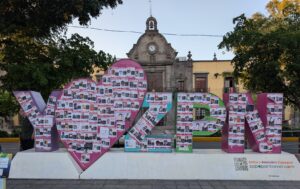
For many years I’ve written articles and books about Mexico, historical studies and political analyses. This is neither. This is merely a reflection on my impressions after having spent a few days in Guadalajara and a week in Mexico City, talking with old friends. While these are just impressions, I bring an experienced eye.
I began my observation of Mexico when I was eleven years old, back in 1956. I grew up in a California town that bordered Tijuana and I crossed the border every week or two with my grandfather to get haircuts, to fill up his car with gasoline, and to buy meat and Coca Cola (all cheaper than on our side of the border.) Some of my fellow high school students lived in Tijuana. My visits to Tijuana continued through my high school and college years when I went to the bars and discovered the leftist bookstore El Día.
In 1971, a friend and I traveled to Mexico City, just a couple of days after the Corpus Christi or Halconazo massacre that killed dozens of students and left hundreds wounded. We went to the university, UNAM, but found it occupied by the military, but we also found there an advertisement for a meeting of the electrical workers union and the Democratic Tendency in the unions, and we went to the somber meeting. On that trip I also went to El Sótano bookstore and picked up Adolfo Gilly’s great Marxist history of the Mexican Revolution. I began to study and write about Mexico in the 1980s, traveling throughout the country to do research and eventually visiting every state, In the late 1990s, I and my family lived in Mexico City, while I also visited the Zapatista rebels in Chiapas. All of that, of course, was a long time ago.
Back in Mexico
Now I’m just back from a visit, my first in several years, seeing and talking with old friends of various views, left, right, and center. I spoke informally with about ten friends in Guadalajara and Mexico City: a couple of labor organizers, a person who works as a writer and translator for the Morena party, a historian of Mexico, a retired occupational health physician, an employee of the Mexico City transit system, a small businessman, and a former leftist who is now a politician of the conservative National Action Party (PAN). Some would call themselves revolutionary socialists, some progressives, and one has clearly become conservative. And all are concerned about what’s going on: the threats from Trump and the United States, the drug cartels continuing violence, and while none liked the old order of the Institutional Revolutionary Party (PRI) or the PAN, several have doubts about the ruling party, Morena.
Mexico City was as beautiful as I remembered it: the Historic Center with the National Palace and the Cathedral on the Zócalo. The La Condesa neighborhood, Parque México and Parque España. I marveled at billionaire Carlos Slim Hélu’s impressive Soumaya Museum and saw around it what one friend called “the Slim empire,” that is, the surrounding high-rise office and apartment buildings. When Andrés Manuel López Obrador, the founder of the Morena party and the predecessor of President Claudia Sheinbaum, was mayor of Mexico City, he and Slim formed a partnership to modernize the city. Slim, for years the richest man in the world before Elon Musk took the title from him, was an important AMLO ally when he was president. And Slim is now a powerful and influential Sheinbaum supporter.
As I was gazing in wonder at the Slim real estate empire that had so transformed the Polanco neighborhood, new developments were taking place. U.S. President Donald Trump was threatening a military invasion of Mexico, supposedly to fight the cartels. Mexican President Claudia Sheinbaum’s administration was being accused of harboring drug cartels, and in the state of Tamaulipas on August 6, Ernesto Vásquez Reyna, a representative of the Attorney General’s Office was murdered by a cartel. He is just the latest victim, there are others every day, with 400,000 killed and 100,000 disappeared since the drug war began almost 20 years ago in 2006. And the cartels’ business and its murders have continued with virtually no change under former Morena president Andrés Manuel López Obrador and not enough change under Claudia Sheinbaum.
A U.S. Invasion of Mexico?
Trump says he may send U.S. troops to Mexico. He’s out to reassert U.S. domination of the Americas, from Greenland to Panama to Brazil. Sheinbaum says she won’t permit it. “The United States is not going to come to Mexico with the military. We cooperate, we collaborate, but there is not going to be an invasion. That is ruled out, absolutely ruled out,” she said. Her vehemence is understandable. The United States invaded and made war on Mexico from 1846-48 and took half of the country’s territory. During the Mexican Revolution, the U.S. sent the navy into the Port of Veracruz in 1914 and in 1916 sent General Pershing with an expeditionary army into Chihuahua. And throughout the twentieth century the United States exerted enormous economic and political influence in Mexico. As I’m writing this on August 8, The New York Times published this: “President Trump has secretly signed a directive to the Pentagon to begin using military force against certain Latin American drug cartels that his administration has deemed terrorist organizations…” I have a grandnephew in the U.S. Marines; could he be going to kill or die in a war in Mexico?
Reading the newspapers, it appears that Sheinbaum’s government may be compromised by the fact that senator, Adán Augusto López Hernández, a former interior minister and governor of Tabasco State, a member of her Morena party and close associate of former President Andrés Manuel López Obrador, is accused of ties to the drug cartels. He says he has no such connections, but neither Mexico’s House of Representatives (Cámara de Diputados) nor the media is satisfied. My old friend, now in the PAN, says, “When the PRI was in power, the party leadership reached an agreement with the cartels, that set the limits of their activity. Ironically when democracy came and López Obrador became president, that top-down centralized control of the cartels was ended and every politician from municipal president to governor to congressperson could make their own deals.” Another friend, a long-time leftist intellectual, agrees that the cartels now have influence from top to bottom. My friend the historian, a progressive, says, “We citizens know the government is tied to the cartels.”
Will Morena Be the New PRI?
I had the impression even before this visit, that López Obrador and Sheinbaum were reconstructing the Institutional Revolutionary Party (PRI) that ruled Mexico from 1929 to 2000 and then for a couple of terms afterward under Felipe Calderon and Enrique Peña Nieto. The PRI in its heyday controlled virtually every political office, the labor and peasant organizations, and the army, and also forged alliances with business. Mexico was a one-party state, something like the Soviet Union, only with a capitalist economy and state rather than one with a bureaucratic ruling class. While there was more freedom of the press and latitude for protest, still the state-party dominated all.
Similarly, Morena controls the executive, legislative and now also the judicial branch of government. Under AMLO’s presidency (2018-2024), wages increased and there was a labor law reform that was adopted in 2019, and the “labor chapter” of the U.S.-Mexico-Canada (USMCA) trade agreement, which included a “Labor Rapid Response Mechanism.” Napoleón Gómez Urrutia, president of the Mexican Miners Union, became a Morena senator, and other union leaders became congress people, tying the unions to the new party. Yet labor organizers that I spoke to on this trip, one an old friend and the other a new acquaintance, say that workers still don’t universally have the right to unions of their own choosing, that is, to join independent unions not controlled by the employers or the government. Getting an independent union remains a big fight that may not be successful
One of my friends says that Morena is divided between the institutional and the reform factions, and predicts a conflict in the near future. Some compare Andrés Manuel López Obrador to Plutarco Elías Calles, Mexico’s president from 1924 to 1928, the man who created the PRI and the power behind the throne during the terms of three other presidents. AMLO, they suggest, though no longer president still really runs the country, because of the cabinet he bequeathed to Sheinbaum and through his control of the congress. Morena may not yet be the new PRI, but it may be on its way.
Well, it was interesting to visit Mexico again, but as so often in the past it was also disturbing. While the clusters of modern high-rise buildings in various parts of the city are impressive, still one-third of the country’s people are poor, working poor. The informal economy amounts to a quarter of the total. The president of my country, Donald Trump, talks of taking military action in Mexico. CIA drones already fly over Mexican territory looking for drug cartels that are active and powerful in several states. Many of those I talked to have no confidence in their president, Sheinbaum. No one that I spoke to expressed much hope at the moment in social or labor movements, even those who work in them. AMLO’s Morena absorbed or substituted for the old left. What I think of as the left, social movements demanding radical change, doesn’t seem to be very significant now. Yet, as we know, new movements will arise in Mexico, as they always have, to challenge the status quo and to demand democracy and justice.
 If you’ve read this far, you were pretty interested, right? Isn’t that worth a few bucks -maybe more? Please
Leave a Reply