
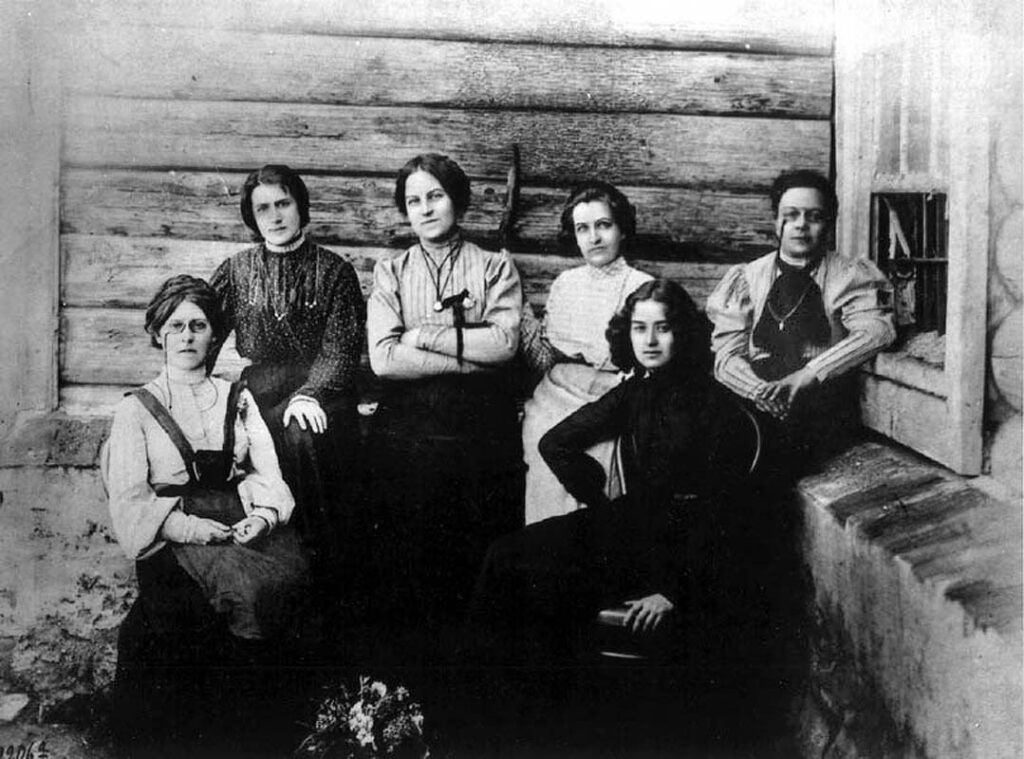
Formally speaking, Imperial Russia ended when the socio-political revolution of February 1917—inspired by the preceding, abortive uprising of 1905—succeeded in deposing Tsar Nicholas II. Although Great-Russian imperialism persisted in the Union of Soviet Socialist Republics (USSR) and in the post-Soviet State—especially as reflected in the genocidal assaults on Chechnya, Syria, and Ukraine ordered by Vladimir Putin—the overthrow of three centuries of despotic rule by the Romanov dynasty was tremendously progressive. This world-historical opening allowed peasants to launch a “Black Repartition” of the land until then owned by the feudal lords. In parallel, soldiers and urban workers self-organized in councils known as soviets.
Beyond the subsequent transitions toward a Provisional Government and Bolshevik dictatorship in the political realm, such vital social aspects of what the Russian-Jewish anarchist Vsevolod Eikhenbaum (Voline) calls the “Unknown Revolution” would not have been possible under Tsarist domination, which banned trade unions up until the 1905 Revolution, and systematically crushed agrarian revolt.1 Indeed, Boris Mazurin, founder of the “Life and Labor” Commune (1921–1936), which followed the Christian anarchism of artist Lev Tolstoy, writes that “the powerful stimulus to the formation of independent agricultural communes [… was] the February Revolution.”2 Tragically, however, within a decade, these horticultural communes, based on mutual aid, had either been crushed by security forces or forcibly integrated into the State as kolkhozy (collective farms).
Still, even before Joseph Stalin notoriously defeated his rival Lev Trotsky and took the reins of the Communist Party of the Soviet Union after their leader Vladimir Lenin’s death in 1924, the Bolsheviks in power had nullified the autonomy of the soviets (or workers’ councils),repressed the urban anarchist movement, crushed the radical mutineers at the Kronstadt naval base, and destroyed the peasant-anarchists of the Revolutionary Insurgent Army of Ukraine, led by Nestor Makhno. This is not to mention the Red Army’s counter-insurgent war against Muslims of Central Asia (so-called Basmachi), waged in alliance with Russian settler-colonists starting in 1918, much less its reoccupation of newly independent Georgia in 1921, or its subsequent disarticulation of the Georgian Democratic Republic, led by rival Mensheviks. 3
In this sense, the fall of the Romanovs arguably set off a three-way fight involving anarchists, autonomists, and Populists (Narodniki) against Marxist-Leninist pseudo-revolutionaries and Tsarist-sympathizing reactionaries that persisted through the Russian Civil War (1918–1920) and the rest of the Soviet period (until 1991), though greatly dampened by Stalin’s Terror (1936–1938). 4 In effect, the model of the three-way fight demonstrates that political struggle is three-dimensional: it is not only waged between either the left and the State or the left and the extra-parliamentary right, and the State can both help and hinder the cause of the right.
Accordingly, in this essay, I provide a historical spin on Matthew Lyons’s concept of the three-way fight for Russia’s immediate post-revolutionary period, whereby anarchists represent leftists; Leninists, and especially Stalinists, are the newfound “Sov-bourg” (Soviet bourgeoisie)denounced by the Spanish anarcho-syndicalist Vilkens; and the “Whites” symbolize the insurgent far-right. 6 My approach will focus mostly on the struggle between the left and the State, both in Tsarist and Soviet times, as on competition between anarchists and Marxists, both before and after the Russian Revolution, over who would spearhead the left (see figure 1 below).

The tragedy of the Russian Revolution—to ossify into a state-capitalist nightmare—repeats the pattern established by Karl Marx’s expulsion of leading anarchists from the International Workingmen’s Association (IWMA), or First International, in 1872 (see figure 2 on page 114). It also hearkens back to the eclipse of Russian Populism (Narodnichestvo) by Marxism at the turn of the twentieth century, due to the tireless efforts of Georgii Plekhanov and his protégé Lenin (until their own 1903 split). This Freudian repetition compulsion calls out for recognition that Marxism is “part of the very problem of domination,” and that the cause of liberation “necessarily entails a movement against Marx,” in the words of political scientist Isaac Balbus. 6 Rather than fetishize capitalism and the State “dialectically,” as Marxist theory does, Russian Populists (Narodniki)in the nineteenth and twentieth centuries proposed that the intelligentsia organize the peasantry against the ruling class and State, with the aim of creating a free-socialist society based on the principles of the peasant commune (mir,or obshchina). 7

Therefore, in this chapter, I seek to outline the theoretical and historical differences between Marxism and anarcho-Populism (or anarchism), in the context of Imperial and post-revolutionary Russia. Through an in-depth historical account, I will contrast anarcho-Populism from Marxism and Marxism-Leninism in theory, and discuss the intimately related tragedies of the First International and of the Russian Revolution. My guiding hypothesis is that, due to their anti-statist stance, anarchism and anarcho-Populism provide more liberatory frameworks than Marxism and its authoritarian, state-capitalist derivatives—including Leninism, Trotskyism, and Stalinism. Before concluding in the spirit of a critical anarchism, I will consider some objections to my hypothesis, acknowledging that anarchists are in no way exempt from affirming right-wing politics, and connect the argument to a critique of left-wing authoritarianism today, especially over such pressing questions as the Syrian and Rojava Revolutions, the Russo-Ukrainian War, and Israel’s war on Gaza.
Admittedly, some self-described Marxists may balk at my framing here, which accuses their tradition of authoritarianism and conservatism. By contrast, most Marxist-Leninists would not deny such charges. Rather, they openly seek to mobilize domination in the interest of socio-political and economic transformations directed by themselves. Accordingly, in Figures 1–2 in this chapter, the term “Non-State Right” should by no means be taken as suggesting that the corresponding groups advocate anti-statist or anti-authoritarian politics. Instead, this term merely means that the groups in question are relatively more conservative than their leftist counterparts, and not in State power.
Anarcho-Populism vs. Marxism in the Russian Revolution and First International
Historically speaking, the political and strategic tensions between Marxists and anarchists have played out numerous times, yet perhaps never more significantly than during the struggles that raged between them in the First International (1864–1872) and the Russian Revolution. In both cases, with reference to the framing of the three-way fight in the pre-revolutionary context, anarchists functioned as the left and Marxists as the right, as long as capitalism or Tsarism dominated (see figures 1–2 above and below). Anarchists still served as the left after the October 1917 Revolution, when the Bolsheviks seized State power.
In his theoretical critique of the Marxist proposal for a “People’s State” (Volks-Staat), made in the 1870’s, Bakunin declares this idea to be nonsense: an “(imaginary) emancipation of the proletariat by means of the State.” This is so, his argument goes, because all States are based on the domination of a small minority over everyone else. As bureaucracies and pyramidal organizations, they seek “self-perpetuation” and the indefinite future reproduction of the “slavery” of their subjects.8 Likewise, in his final manuscript, “On Socialism” (1910), Tolstoy criticized Marxian statism and economic determinism, instead avowing Kantian-Christian moral law.9 Thus, due to their anti-authoritarian prescience, these thinkers can be likened to Cassandras of the Russian anarchist movement. After all, Marx cynically dismissed Bakunin’s misgivings about using the State to effect social change, and even expelled him and his Swiss comrade James Guillaume from the First International over this disagreement. Marx called these two “rotten” and “feeble-minded elements” who needed to be excluded—even “excommunicated”—from the movement, while Engels defended their decision to keep the International “pure and unadulterated.”10
Such contempt for other radicals, involving the mobilization of lies and a rejection of pluralism, prepared the ground for purges in the First International and after the Bolshevik takeover of the Russian Revolution.11 Indeed, Lenin’s Communists imprisoned and executed numerous Tolstoyan conscientious objectors during the Russian Civil War.12 Given how closely the Bolshevik leaders mimicked their master’s example, the anarchist critic Alan Carter charges Marx with responsibility for the catastrophic outcome of the Russian Revolution.13 In a similar vein, the Christian anarchist Nikolai Berdyaev believes the USSR to have amounted to “the third [historical] appearance of Russian autocratic imperialism,” thus mimicking Russia’s Muscovite and Tsarist rulers, who themselves had succeeded the Roman, Byzantine, and Mongol Empires.14 In this vein, Lenin wrote in April 1921 that the Communists should “learn from the Germans how to run state capitalism, […] doing [so] at an even more rapid pace than the one followed by Peter the First in Westernizing barbarous Russia.”15
Along these lines, the Bolsheviks’ fetishization of political centralism, discursive privileging of the proletariat, and rejection of workers’ control over production should be understood as severe reactions to the decentralism, humanism, and class inclusiveness of Russian Populism.16 Lenin’s dual rejection of utopian socialism and Populism—positions that proved instrumental in the ruthless replacement of the Narodnik emphasis on freedom and ethics with statist brutalism—was “remarkably consistent” throughout his career.17 Tellingly, in this sense, Lenin slandered the authentically revolutionary Kronstadt mutineers, whose Petropavlovsk program (1921) was remarkably anarcho-Populist, as counter-revolutionary White agents.18
In reality, what mattered to Marx and Lenin was to defeat one’s competitors by any means necessary, including slander and hatred. This would clear the way to taking power. As the fate of the Kronstadt Commune proved, Marxists converge with the Tsarist “administrative utopia” in proposing and celebrating societies that are “disciplined, united,” and organized “vertically […] by a central authority.”19 Stalin thus merely took Marx and Lenin’s critiques of utopianism and anarchism to a higher level through his totalitarian assaults on equality, metaphysical speculation, and social experimentation. After all, the Soviet General Secretary dismissed egalitarian calls for social leveling as “leftish chatter” and “reactionary petty-bourgeois nonsense”—leading to a “fantasectomy” of the collective radical imagination, and the global Communist movement.20 In this sense, the atrocities involved in Stalin’s reign built on the Tsarist inheritance and the pre-existing cults to Lenin and Marx. After all, Bolsheviks principally differentiated themselves from Mensheviks through their pledging of allegiance to Lenin, not to mention their less-consistent commitment to democracy.21 Although such sadomasochistic political dynamics would prove highly detrimental to the fate of the Russian Revolution, they served Lenin’s authoritarian goal of Party domination over State and society.
In fact, just two months after the Bolshevik seizure of power in October 1917, the loyalist Council of People’s Commissars raised a political police force known as the All-Russian Extraordinary Commission, or CheKa. The CheKa was first based in the headquarters of the Tsarist Okhrana, the successor of Nicholas I’s Third Section, or secret police.22 Rather than be designed for accountability to the peasant, worker, or soldier soviets that emerged in the Revolution, the CheKa and its successor organizations—namely, the (O)GPU, NKVD, and KGB—were wielded by Red authorities to consolidate power and eliminate adversaries. 23 Grimly, during the suppression of the Kronstadt Commune, Chekists worked closely with rearguard “Blocking Detachments” to ensure that Red Army soldiers carried out their fratricidal orders—and to swiftly execute anyone who might refuse.24 Such dystopian scenes highlight the extreme risks involved in pursuing the Marxist goal of political domination, which is to be achieved by strengthening “[State] power above society.” 25
Marxism, Anarchism, and Left-Wing Authoritarianism, Past and Present
Both implicitly and explicitly, the argument made throughout this chapter has highlighted the intimate overlap between Marxism and left-wing authoritarianism. Fatefully, Marx and Engels preached an authoritarian-centralist strategy for confronting capitalism. As Bakunin and Tolstoy foresaw, and as Carter recognized, Marx’s highly instrumental and amoral attitude toward workers and fellow radicals was readily mobilized by state capitalists and “Red hangmen” like Lenin, Trotsky, and Stalin. 26 Wolfgang Eckhardt adds that Marxian centralism became reality only in 1919 with the founding of the Soviet-sponsored Communist International, which would outcompete the anarcho-syndicalist International Workers’ Association (IWA, founded in 1922) for two decades.27 It follows that so many Marxist believers fervently defended the USSR while it existed, and that publications like Monthly Review, Jacobin,and The International Marxist-Humanist still champion the Bolsheviks to this day. By so identifying with the despotic authority of the Red State, the editors of these journals continue to illuminate the primary contradiction of Marxist theory, which is to sell out the working classes.
In parallel, it has been neo-Stalinists who have spearheaded the legitimization of neo-fascist “anti-imperialist” States—including Syria, Russia, Iran, and China—in the wake of the catastrophic U.S.-led invasion and occupation of Iraq in 2003. In the U.S., Workers’ World (WW), the Party for Socialism and Liberation (PSL), and their various front-groups and allies have poisoned the well of left-wing internationalism by establishing an orthodox “left” approach which sacrifices our common humanity in the name of “anti-imperialism.” Simply put, WW and PSL function primarily to critique U.S. foreign policy and defend genocidal regimes abroad through dominating the anti-war protest movement and aggressively reproducing gross disinformation about, and inciting racist dehumanization against, those whom many leftists consider “unworthy victims.”28
Socialist writer Rohini Hensman calls such “supporters of Assad and Putin” pseudo-anti-imperialists, for they present as trenchant critics of Western imperialism but in reality function to legitimize Russian expansionism and assert “the right [of ‘anti-imperialists’] to practice mass murder in the name of the principle of sovereignty under international law.” 29 This same propaganda model has been adopted not only by opportunistic pseudo-radical outlets like The GrayZone and Multipolarista, but also by Donald Trump and his neo-fascist, isolationist, COVID-denialist followers and congressional minions. What unites these seemingly disparate elements is a common disregard for the truth; a strong aversion to egalitarianism, humanism, and internationalism; and a fetish for violence.
Hence, this phenomenon of the “red-brown alliance” represents yet another instance of left-wing authoritarianism, also known by Jürgen Habermas’s formulation of “Left fascism.”30 Such a noxious alliance corresponds to Marx’s conservatism and naïveté about the State, the related failure to come to terms with Soviet atrocities carried out in the name of Communism, and the denial of present-day genocide perpetrated in Syria and Ukraine by Russia. Yet, to echo the discussions from the introduction and the previous section, while anarchists are generally less susceptible to pseudo-anti-imperialist and left-wing authoritarian traps, they are not exempt from authoritarian tendencies, and have unfortunately not always provided adequate alternatives to the status quo.
For instance, although Sorel was no anarchist, a degree of Sorelian bloodlust against liberals is evident in parts of the anarchist movement, as “insurrection envy” over Trump’s failed January 6, 2021, coup attempt has revealed.31 Plus, in confronting COVID-19, anarchists have responded well with mutual aid, but have drawn less attention to the pandemic’s eugenicist tendencies toward “social murder,” and not prioritized resistance to the capitalist compulsion to return to “normal.”32 That being said, thanks in part to intersectional theory and burgeoning resistance to white supremacy, anarchists have improved on certain archaic forms of discrimination, including sexism, racism, and heteronormativity. Still, the movement’s horizon is very far from the rationalist optimism expressed during the late nineteenth and early twentieth centuries, as explained below.
Since 2012, Western anarchists have strongly supported the Rojava Revolution, led by the local affiliate of the formerly Stalinist Kurdistan Workers’ Party (PKK) in northern Syria, but have sympathized considerably less with the Syrian Revolution against the Ba’athist regime of Bashar al-Assad (see figure 3 below). This is likely due to a number of factors: for one, pseudo-anti-imperialist loyalties, in light of Assad’s place within the pantheon of “resistance” to Western imperialism33; the prevalence of anti-humanist and anti-Muslim attitudes; and stark ignorance of the reality of Syrian anarchism, from the activist Omar Aziz, martyr of the Assad regime, to the Local Coordinating Committees (LCC’s). Such a puzzling lapse—accentuated, in turn, by most Western anarchists’ sympathies for Palestinians—is arguably anticipated in the Mennonite-Makhnovist conflict in Ukraine a century ago, when “a movement […] massacred innocents in the name of liberty and justice.” 34 This racist dehumanization and exclusion is also sadly consistent with the enthusiasm evinced by some historical anarchists for eugenics.35

Moreover, many Euro-American and Eastern European anarchists boldly denied the threat posed by Putin’s massing of troops on the Ukrainian border before the launching of Russia’s “special military operation” in February 2022.36 Subsequently, a week after Russia’s full-scale invasion commenced, the Serbian Anarcho-Syndicalist Initiative (an IWA affiliate) regurgitated Putinist disinformation about the Ukrainian government being an “undoubtedly nazified regime” that came to power through a “coup.” 37 By contrast, Ukrainian Holocaust survivors have belied such distortions. 38 In fact, while Ukrainian anarchists like those in Solidarity Collectives organize humanitarian relief and support for anti-authoritarian and internationalist fighters on the ground, too many Western anarchists overlook Ukrainians’ rights to independence, self-defense, and self-determination39—apparently, because Western governments are supporting Ukraine, and whatever these governments are doing, leftists and anarchists must reflexively oppose.
That being said, Israel’s genocidal assault on Gaza (October 2023–present), which has been entirely facilitated by Western States—the Biden administration, second to none—lends a great deal of credence to such instincts. After all, many leftists, including anarchists, have sought to save face for their lukewarm or even non-existent support for Ukrainians confronting Russia’s genocidal attack by not only centering the similarly genocidal suffering and mass-death of Gazan Palestinians at the hands of Israel (and, indirectly, the U.S.), but also calling for an immediate ceasefire. In parallel, Russia has aimed at rehabilitating its reputation on the international stage by opportunistically championing the Palestinian cause, even as it intensifies its war on Ukraine.40
In turn, after having provided tens of billions of dollars to Ukraine’s defense since February 2022, the U.S. has failed to pass legislation to authorize any additional military aid to Ukraine for several months by the time of this writing. This is due to obstruction by the new Trumpist Speaker of the House. Such delays in critically-needed funding have had dire consequences for the Ukrainian Armed Forces, which were forced to withdraw from the city of Avdiivka in Donetsk in February 2024 due to a lack of ammunition—presaging a possible general defeat by Russia.41 This outcome would not only entail doom for Ukrainians, but also greatly escalate the overall risks to humanity by lowering the threshold to World War III and nuclear war.
Conclusion
In this chapter, I have discussed the major theoretical and historical differences between Marxism and anarcho-Populism in detail, while considering Lyons’s framework of a three-way fight among leftists, the State, and the right during the First International and Russia’s late Imperial and post-revolutionary periods. I have shown that anarchist and anarcho-Populist programs are generally more profound and progressive than Marxism’s bureaucratic, authoritarian, and state-capitalist prescriptions. They are, in other words, more consistent with human emancipation.42
Although anarchism is a uniquely promising approach for resisting the worldwide onslaught of reaction, authoritarianism, and counter-revolution, we cannot overlook the serious contradictions posed by the prejudices and violence perpetrated and re-entrenched by some of the tradition’s most-revered figures and movements, historical or contemporary. To reiterate, by contrast, the equivalent contradictions are much deeper, and likely irreconcilable, for Marxism and Marxism-Leninism. The case of Makhnovists attacking Mennonites, together with the apparent pseudo-anti-imperialist tendencies of many anarchists, underscores the ongoing need for a serious “struggle against authoritarian political relations within a[ll] genuinely revolutionary transformation[s]” and movements. 43
In turn, one of the most important lessons of the First International and of the Russian, Syrian, and Rojava Revolutions is to recognize the imperative need for autonomy and dissent to be respected, even and especially in organizations fighting for collective liberation. 44 Another major lesson in this vein, acutely reinforced by the Russo-Ukrainian and Israel-Hamas Wars, is to acknowledge the importance of international solidarity in defending the cause of humanity. Following the anarcha-feminist writer Ursula Le Guin, this ever-vigilant commitment to rooting out domination and promoting participatory decentralization across the globe would be a critical anarchism, or “an ambiguous [anarchist] utopian[ism].” 45
From “Three-Way Fights: From the First International and the Russian Revolution to Today” by Javier Sethness Castro, from Authoritarianism in All its Guises: Perspectives on Right, Left, and Center, edited by Daniel Burston and Kurt Jacobsen. 1–23. Copyright 2025 by Routledge. Reproduced by permission of Taylor & Francis Group.
notes
1. Voline, The Unknown Revolution (Montreal: Black Rose Books, 1975); Leo Tolstoy, The Kingdom of God Is Within You and Peace Essays, trans. Aylmer Maude (London: Oxford Univ. Press, 1960).
2. Boris Mazurin, “The Life and Labor Commune: A History and Some Reflections,” Memoirs of Peasant Tolstoyans in Soviet Russia,trans. William Edgerton (Bloomington, IN: Indiana Univ. Press, 1993), 70.
3. Michael Rywkin, Moscow’s Muslim Challenge: Soviet Central Asia (Armonk, NY: M.E. Sharpe. 1990); Eric Lee, The Experiment: Georgia’s Forgotten Revolution, 1918–1921 (London, Zed Books, 2017).
4. Matthew N. Lyons, Insurgent Supremacists: The U.S. Far Right’s Challenge to State and Empire (Oakland: PM Press, 2018).
5. Vilkens, “On Women,” Anarchist Encounters: Russia in Revolution, ed. AW Zurbrugg (London: Merlin Press, 2017), 36.
6. Isaac Balbus, Marxism and Domination (Princeton: Princeton Univ. Press, 1982), 4.
7. Karl Marx, Capital, Volume I: A Critique of Political Economy, trans. Ben Fowkes (London: Penguin Books, 1976); Isaiah Berlin, Russian Thinkers (London: Penguin, 1978), 210; Natalia Mamonova, “Vladimir Putin and the rural roots of authoritarian populism in Russia,” Open Democracy,April 3, 2018.
8. Mikhail Bakunin, The Political Philosophy of Bakunin: Scientific Anarchism, ed. G. P. Maximoff (London: Free Press of Glencoe, 1953), 286–8.
9. Richard F. Gustafson, Leo Tolstoy: Resident and Stranger (Princeton: Princeton Univ. Press, 1986), 393.
10. A. W. Zurbrugg, “Revisiting Marxism and Anarchism,” Science & Society (vol. 80, no. 3, 2016), 399 (emphasis in original); Wolfgang Eckhardt, The First Socialist Schism: Bakunin vs. Marx in the International Working Men’s Association, trans. Robert M. Homsi et al. (Oakland: PM Press, 2016), 408; René Berthier, Social Democracy and Anarchism in the International Workers’ Association, 1864–1877, trans. A.W. Zurbrugg (London: Merlin Press, 2016), 9.
11. Eckhardt 418–20.
12. Rosamund Bartlett, Tolstoy: A Russian Life (New York: Houghton Mifflin 2011), 431–37.
13. Alan Carter, Marx: A Radical Critique (Boulder, CO: Westview Press, 1988), 204–18.
14. Nicolas Berdyaev, The Origin of Russian Communism (Ann Arbor: Univ. of Michigan Press, 1966), 120.
15. V. I. Lenin, “The Tax in Kind” (1921), trans. Yuri Sdobnikov (translation modified).
16. Voline 1975; Orlando Figes and Boris Kolonitskii, Interpreting the Russian Revolution: The Language and Symbols of 1917 (New Haven: Yale Univ. Press, 1999), 114–16; Tom Wetzel, Overcoming Capitalism: Strategy for the Working Class in the 21st Century (Chico, CA: AK Press, 2022).
17. Simon Frank, “The Ethic of Nihilism: A Characterization of the Russian Intelligentsia’s Moral Outlook,” Vekhi: Landmarks, trans. Marshall E. Shatz and Judith E. Zimmerman (New York: Routledge, 1994), 154.
18. Paul Avrich, Kronstadt 1921 (Princeton: Princeton Univ. Press, 1970), 96, 171.
19. Georges Sorel, Reflections on Violence,trans. T. E. Hulme and J. Roth (Mineola, NY: Dover, 2004), 135; Richard Stites, Revolutionary Dreams: Utopian Vision and Experimental Life in the Russian Revolution (Oxford: Oxford Univ. Press, 1989); Axel Honneth, The Idea of Socialism,trans. Joseph Ganahl (Cambridge, UK: Polity, 2017), 80; Dmitry Shlapentokh, “Marx, the ‘Asiatic Mode of Production,’ and ‘Oriental Despotism’ as ‘True’ Socialism,” Comparative Sociology (Vol. 18, 2019).
20. Stites 45, 232–6.
21. Figes and Kolonitskii 100–1.
22. Iain McKay, “The State and Revolution: Theory and Practice,” Bloodstained: One Hundred Years of Leninist Counterrevolution, eds. Friends of Aron Baron (Chico, CA: AK Press, 2017).
23. G. P. Maximoff, The Guillotine at Work: The Leninist Counter-Revolution (Chicago: Globus Printing, 1940) 57–8; Dimitry Morgachëv, “My Life,” Memoirs of Peasant Tolstoyans in Soviet Russia, trans. William Edgerton (Bloomington, IN: Indiana Univ. Press, 1993), 109–80.
24. Neil Croll, “The role of M. N. Tukhachevskii in the suppression of the Kronstadt Rebellion,” Revolutionary Russia (Vol. 17, no. 2, 2004).
25. Balbus 326; Carter 187.
26. Alexandre Skirda, Nestor Makhno: Anarchy’s Cossack (Oakland: AK Press, 2004), 389.
27. Eckhardt 419; Jason Garner, Goals and Means: Anarchism, Syndicalism, and Internationalism in the Origins of the Federación Anarquista Ibérica (Chico, CA: AK Press, 2016).
28. Noam Chomsky and Edward S. Herman, Manufacturing Consent (London: Vintage, 1995).
29. Rohini Hensman, Indefensible: Democracy, Counterrevolution, and the Rhetoric of Anti-Imperialism (Chicago: Haymarket Books, 2018), 10–19; Max Horkheimer and Theodor W. Adorno, Dialectic of Enlightenment, trans. Edmund Jephcott (Redwood City: Stanford Univ. Press, 2002), 414.
30. Samir Gandesha, “The ‘Authoritarian Personality’ Reconsidered: the Phantom of ‘Left Fascism.’” American Journal of Psychoanalysis (vol. 79, no. 4, 2019).
31. Edward Helmore, “‘I’m deadly serious’: why film-maker Michael Moore is confident of a Democratic midterm win,” Guardian, Oct. 23, 2022.
32. Raia Small, “Why Has the Left Deprioritized COVID?” Midnight Sun,Sept. 14, 2022.
33. Hensman.
34. Sean Patterson, Makhno and Memory: Anarchist and Mennonite Narratives of Ukraine’s Civil War, 1917–1921 (Winnipeg: Univ. of Manitoba Press, 2020), 3.
35 See Richard Cleminson, Anarchism and Eugenics: An Unlikely Convergence, 1890-1940 (Manchester: Univ. of Manchester Press, 2019).
36. Javier Sethness, “Assembly, a Ukrainian Anarchist Magazine, on Politics and a Possible Russo-Ukrainian War,” The Commoner, Jan. 27 2022.
37. Anarcho-Syndicalist Initiative, “Let’s turn capitalist wars into a workers’ revolution!” IWA-AIT,March 5, 2022.
38. AFP, “Ukraine is ‘not Nazi’, Holocaust survivors tell Putin,” France 24,Sept. 25, 2022.
39. Wayne Price, “Anarchists Support Self-Determination for Ukraine,” Anarkismo, May 28, 2023.
40. Patrick Wintour, “The new world disorder: how the Gaza war disrupted international relations,” Guardian, April, 6, 2024.
41. Ivan U. Klyszcz, “Ukraine Could Lose the War. The U.S. and Europe Aren’t Doing Enough,” The Moscow Times, Feb. 23, 2024.
42. Balbus 84–125.
43.Balbus326.
44. Jean-Christophe Angaut, “Le conflit Marx-Bakounine dans l’internationale: une confrontation des pratiques politiques,” Actuel Marx (vol. 41, no. 1., 2007), 15, 18.
45.Angaut 3; Ursula Le Guin, The Dispossessed: An Ambiguous Utopia (New York: HarperCollins, 1999).
 If you’ve read this far, you were pretty interested, right? Isn’t that worth a few bucks -maybe more? Please
Leave a Reply