
“Who can sleep at night any more
with the crisis coming on
and only backs in bed?”i
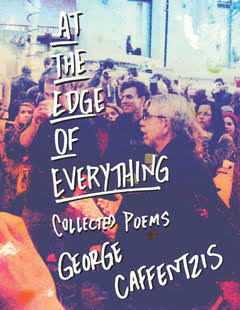
In 1975, George Caffentzis awakens in darkness one evening, rises from bed and scribbles a poem in one of his active notebooks. Born with the first name Constantine eighty years ago this past winter the noted class-warrior, philosopher of money and work/energy, is now a published poet.
Released by Common Notions on his birthday in February 2025, At the Edge of Everything: Collected Poems assembles George’s poetic output from 1961, when he published a short poem in the literary publication of the Brooklyn Technical High School, to the present. Actually, this is the only poem to be published previously and until recently they simply adorned the margins and corners of his notebooks, part of his individual and collective thinking over the past few decades.
The Crisis Coming On
“Who can sleep at night any more,” which also serves as the poem’s title, doesn’t refer to the New York City fiscal crisis, nuclear meltdown, repression of social movement forces, or firing of unionized academic faculty in the City University of New York. George was an active and vocal member of the Brooklyn College local, who fought against imposing tuition upon working-class students with the demand Wages for Schoolwork. “[A]nd only backs in bed” signifies a personal crisis, and a different kind of experience common to many of us.
For those who have encountered George’s work previously—collectively written communiqués from Midnight Notes or recent essay compendia In Letters of Blood and Fire: Work, Machines, and the Crisis of and No Blood for Oil!: Essays on Energy, Class Struggle, and War 1998-2016—one would correctly assume he is a poet.
“[A]ccording to our decoding, through the noise of the apocalypse, we must see in the oil caverns, in the wisps of natural gas curling in subterranean abysses, something more familiar: the class struggle.”ii Decoding, noise, wisps —this “finds,” George, “at the apex of his powers. Using multifarious language, he decodes the magic of the market and the energy crisis of the late 1970s. Amongst a wide range of concerns—the state of the antiwar movement, increased imposition of unwaged work on women, the shifting technological composition of capital, theory of machines—he offers two particular cogent insights, amongst many: first, capital transforms value from low sectors (unwaged, service, factory, and farm work) to high sectors (finance, energy); and second, not unrelated, capital seeks ‘low entropy workers,” I offered in a review following the 2012 publication of In Letters of Blood and Fire.iii
Initially appearing in November 1980, written under their collective moniker as a single essay for Midnight Notes titled “The Work/Energy Crisis and the Apocalypse.”iv For George and his comrades in Midnight Notes, the “manifold of work,” or what fellow Zerowork collective member Harry Cleaver in line with his Italian workerist and autonomist comrades refers to as the “imposition in work,” of the “planetary work machine” are metaphors used to describe the machinic nature of the global capitalist order. v
Through the Noise of the Apocalypse
At the Edge of Everything uses the chronology of George’s life as its organizing principle, breaking poems into decades-chapters and then the long-2000s as the final chapter.
George was constantly in motion—across the Northeast, teaching in Nigeria then Maine, traveling to his life partner and comrade-philosopher Silvia Federici’s ancestral home in Parma, Italy—and the poems reflect this as well.vi . Only a fragment addresses his numerous visits to Zapatista territories in Chiapas, Mexico, one of which was the result of an invitation from Subcomandante Marcos in 2014. The collection contains personal reflections on the “End of Zerowork,” fleeing to Nigeria as American social movement entered a dark period in the 1980s, discovering the importance of class struggle and commons in Africa, tales of memory and forgetting, the loss of his mother and a love poem for Silvia, who compiled Collected Poems along with George and Malav Kanuga, and “Springtime in Maine,” as one of the poems is titled. In the “End of Zerowork in 1978 he writes, “As we rise in / the nightmare / of dawn.”vii After the end of Zerowork came Midnight Notes.
The 1992 issue of Midnight Notes was titled The New Enclosures based on collective members’ observations on how Karl Marx’s conception of primitive accumulation continued throughout the history of capitalism into the present across the planet in Africa, the Middle East, South America, and appeared two years prior to the Ejército Zapatista de Liberación Nacional, known colloquially as Zapatistas, emerging from the Lacandon Jungle. Prophetically, the back cover reprinted a “poem” from their first issue boldly declaring:
“MIDNIGHT
NO LIGHT
NO TIME
NO WORK
MIDNIGHT
SECRET
SURPRISE
POWER
MIDNIGHT”viii
“No Time, No Work” illustrates the contradictory nature of work under capitalism, either workers have no time and endless work or no work and hence few ways to obtain wages needed to purchase the means of survival. “Surprise, Power” explores the endless possibilities of class struggle and forging a new common life for humanity.
Upon reading The New Enclosures in the contemporary moment, one is reminded that these are unfolding and unending processes of capitalist accumulation. Nevertheless, there are articles therein that suggest a particular moment. “The Struggle Against Enclosures in Jay, Maine: An Account of the 1987-1988 Strike Against International Paper” was contributed by filmmaker David Riker, who also directed The Many Faces of Paper documentary in 1988. It illustrates how the working-class fought against oblivion in the 1980s.
Workers and militants stood against oblivion during the dark years of union decline and class struggle with the working-class on the losing end. “A key objective of the [Midnight Notes Collective’s] founding group was to carry our political knowledge through a long period of counter-revolution, enabling us to cross over to a new phase of anti-capitalist struggle,” George would reflect during the thirtieth anniversary celebrations of the Collectives first issue.ix One wonders if that is what we are doing now, and all that we are required to do to stand against oblivion, again.
A Poet’s Notes
“To the Cube Steak
place of many encounters.”x
Between the 1930s and about the time New York City was told to “Drop Dead” in the mid-1970s, George’s father and family ran a Greek diner in Park Slope Brooklyn on 9th Street at 5th Avenue.
The Cube Steak, as the family diner was called, was essential for those who worked on the docks just west, along the Gowanus Bay at the Red Hook and South Brooklyn Marine Terminals. Silvia must have been in the neighborhood previously, as to scout locations and the surrounding community. On November 15, 1975, the New York Committee of the International Wages for Housework Campaign, celebrated with a street fair and declared with a banner flying above 5th Avenue, a major artery in Brooklyn: “We Demand: / Wages for Housework / From the Government.”xi
As part of their strategy to imbed themselves in the community, Silvia and the Campaign opened a storefront at 288 B 8th Street, just off 5th Avenue, between 5th and 6th Avenues. The Cube Steak was around the block, George and Silvia met in Brooklyn, first as roommates then as comrades, in 1973. Silvia shared in April 2025, “I did not know about the diner before I met George,”xii a testament to the layered and complexity of our lives and how we experience our communities.
A Philosopher’s Notes
During the 1979 and 1980 school years, George taught at Millersville State College and served as a faculty advisor for the schools Anti-Nuclear Alliance.xiii As a dedicated anti-nuke activist he was the appropriate choice, forming a similar group in Brooklyn and following the development of the northeast-based Clamshell Alliance. Then, at 4:00AM on Wednesday March 28, 1979, a series of cascading errors lead to the partial meltdown of the reactor core at Three Mile Island in Pennsylvania. As part of the state system Millersville was only forty minutes away by automobile from a particular isle in the Susquehanna River, at the time an emergency zone.
Strange Victories: The Anti-Nuclear Movement in the U.S. and Europe, the first issue of Midnight Notes appeared less than a month later on April 26, 1979. “It was published right after the Three Mile Island nuclear accident in Pennsylvania,” George reflected in a 2001 interview, “We were able to come out quickly after the accident because we had been working on the issue in the months before. Part of the idea of the issue was to begin to be more coherent about work and capitalist accumulation both theoretically and practically. The anti-nuclear power movement was the place where it naturally began at the time.”xiv
After a short stint in Pennsylvania, George taught at a private business college on the outskirts of Boston as five subsequent issues of Midnight Notes were published. Posthumous Notes appeared in May 1983 and began “There is a spectre haunting…” Notably this issue suggests that readers contact the Committee Against Repression in Italy, an effort the collectives’ members were supporting to aid Italian workerist and autonomist comrades who were facing brutal state repression. With the sorry state of U.S., Italian, and other working-class movements and fear of constant repression from the state, George left for Africa, where he lectured at University of Calabar from 1983 to 1987. Between 1984 and 1986 Silvia as well taught courses at the university of Port-Harcourt.
Later they would cofound the Committee for Academic Freedom in Africa and edit its Bulletin. An immensely productive period for them both, it was in Africa that they would find the commons. Sometime after arriving, George penned the poem “Going to Nigeria (for John)” in 1984:
“On a hot May night
you too tense to study the Law
and I too sick with Posthumous Notes
we walked by Jamaica Pond,
firefly fragrant in the lamppost light,
trying to breathe a calm
off the black water. […]
We are all now citizens in Murder.
Another spring is passed.
The burning smell
of Harmattan begins.
The fear lingers”xv
We may presume he was writing in December 1983 or January-February 1984, as Harmattan—the dry, dusty wind of the north African coast—begins in December, often dissipating by the end of February.
By the fall semester of 1987 George would find himself on other shores, “And finally by the sea in Maine” as he reflects some years later in “Osiris Among the Dragonflies,” another poem in the collection.xvi After a decade of being an itinerant academic, he became a winter resident of Maine during the school year. The Jay, Maine paperworkers’ strike was well underway, starting in the early hours of June 15, 1987. George, along with David Riker, would join the strikers on the picket line and at mass meetings.
It was told to me that the idea for The New Enclosures came to George while walking on the beaches in Peaks Island in Maine, and then I was told this wasn’t true. Living on Peaks Island required George to take a ferry, seventeen minutes each way, weaving though the Casco Bay, past Navy ships tendered off the Portland peninsula and terminals where oil tankers were moored. “Back to the sight of oil, guns and money, In Portland bay,” he reflected in “War Poem” he penned on “Peaks Island March 10, 1991.”xvii
Nonetheless walking on the shores on Peaks Island and Old Orchard, well after the tourists fled the encroaching winter, was a daily activity for George. Silvia would join him on her visits too. In July of 2024, Silvia remembered that these beach walks were “healing for George after losing his mother,” and she noted it was healing for her when she would return to the U.S. after caring for her mother in Parma. “I’d walk from one end of the beach to the other,” she shared.xviii Apparently, he had visited these beaches some years earlier writing in the poem “My Art” that “only the purest ice / piled in huge pieces / on a Maine beach” in 1979.xix
As I write this it is “Springtime in Maine,” to which George reflected in the poem: “The spring machine is here / And this poem / In protest must be penned.”xx As I fear that poems and protest are no longer enough.
At the Edge of Everything
What George decoded in the global capitalist order was the possibilities of life itself, of life in, against, and beyond capitalism. This is what makes At the Edge of Everything so insightful, the joy present in these poems, in the possibilities of class-struggle, of the “invading socialist society,” of the “last jubilee” are profound. George “show[s] an impellent need to find other forms of expression and other moments of ruptures of the daily routines,” Silvia wrote in the preface reflecting upon the collection.xxi
Escaping to its corners of the American and European “Empires,” as the poem is designated:
“In an obscure corner of the empire
With a dusty floor and malarial thoughts
The past comes to haunt me.”xxii
The past as haunting, “A Tale of Memory and Forgetting,” as this final poem is called, is woven through his collective efforts, through the edges of the collection, through the partnership between George and Silvia. He humbly asks, “Through all this can you see / this is a love poem for Silvia?”xxiii This collection is her love poem for him.
“I now watch the waves
off Mt. Desert Isle
through the spindrift
of thousand fragments
of memory.”xxiv
i George Caffentzis, At the Edge of Everything: Collected Poems (Brooklyn, NY and Philadelphia, PA: Common Notions, 2024), 13; https://www.commonnotions.org/buy/at-the-edge-of-everything-collected-poems (accessed June 24, 2025).
ii Most recently published as George Caffentzis, “The Work/Energy Crisis and the Apocalypse” in In Letters of Blood and Fire: Work, Machines, and the Crisis of Capitalism (Oakland, CA: PM Press and Brooklyn, NY: Common Notions, 2013), 16.
iii Kevin Van Meter, “Refusing the Planetary Work Machine” in Perspectives on Anarchist Theory, 27 (2014).
iv Midnight Notes, “The Work/Energy Crisis and the Apocalypse” in Midnight Notes Vol. 2, No. 1 (1980).
v Harry Cleaver, “Work is Still the Central Issue!” in Ana C. Dinerstein and Michael Neary (eds), The Labour Debate: An Investigation into the Theory and Reality of Capitalist Work (Hampshire: Ashgate, 2002), 135-148.
vi Interestingly only one poem even directly references his nearly yearly excursions to Greece
vii Caffentzis, At the Edge of Everything, 23.
viii Midnight Notes Collective, The New Enclosures, Midnight Notes, 10(Brooklyn, NY: Autonomedia, Fall 1990), Back Cover.
ix George Caffentzis, “Two Themes of Midnight Notes: Work/Refusal of Work and Enclosure/Commons” in Craig Hughes (Ed.), Toward the Last Jubilee: Midnight Notes at Thirty Years (Brooklyn, NY: Autonomedia and Washington, DC: Perry Editions, March 2010), 27.
x Caffentzis, At the Edge of Everything, 7.
xi Silvia Federici and Arlen Austin (Eds.), The New York Wages for Housework Committee 1972-1977: History, Theory, and Documents (Brooklyn, NY: Autonomedia. 2017), 87.
xii In conversation with the author, April 14, 2025.
xiii https://millersville.tind.io/record/1265/files/MVS_0145ab-5.pdf
xiv “TPTG’s conversation with George Caffentzis,” English Trans. (May 2002): https://libcom.org/library/interview-george-caffentzis (Accessed April 28, 2025); Ta Paidia tis Galarias, 9 (Athens: November, 2001): https://www.tapaidiatisgalarias.org/wp-content/uploads/2009/11/caffentzis_interview.pdf (Accessed April 28, 2025).
xv Caffentzis, At the Edge of Everything, 37.
xvi Caffentzis, At the Edge of Everything, 52.
xvii Caffentzis, At the Edge of Everything, 53.
xviii In conversation with the author, July 6, 2024.
xix Caffentzis, At the Edge of Everything, 27.
xx Caffentzis, At the Edge of Everything, 54.
xxi Silvia Federici, “Preface” in Caffentzis, At the Edge of Everything, 1.
xxii Caffentzis, At the Edge of Everything, 35.
xxiii Caffentzis, At the Edge of Everything, 45.
xxiv Caffentzis, At the Edge of Everything, 68.
 If you’ve read this far, you were pretty interested, right? Isn’t that worth a few bucks -maybe more? Please
Leave a Reply