Doubling Down
 In my sharply critical review of the first edition of this book, I concluded that its failures in addressing the war in Ukraine consisted “in giving no answers, or dreadfully wrong ones, to what ‘ordinary Americans or Europeans’ should be trying to do about it, and refusing meaningful solidarity to what ordinary Ukrainians are actually doing. A peace movement worthy of the name, and capable of facing the enormous challenges that confront us in a world of intensifying imperialist rivalries, is going to have to do better than that.”1
On the fourth anniversary of the full-scale annexationist Russian invasion, what do the authors have to say now? As co-author Nicolas Davies recounted at a forum this past fall in suburban Detroit, the publisher assigned the writers a rushed two months to produce the first edition of the book in response to the full-scale Russian invasion of February 24, 2022.
The new edition, landing in 2025, coincided with the escalation of Russia’s missile and drone terror attacks on Ukraine’s infrastructure and civilian targets, as well as assaults on the ground that have made hundreds of thousands of Russia’s soldiers cannon fodder for the sake of capturing modest square kilometers of devastated Ukrainian territory.
This was also a year when Donald Trump’s intention to sacrifice Ukraine on the altar of great-power art-of-the-deal-making became unmistakably clear.
The Benjamin and Davies book has had significant influence in sectors of the U.S. peace and antiwar movements, which is certainly why the publisher commissioned the new edition. In light of the ceaseless horrors of the war and the time the authors had to prepare it, it’s reasonable to examine whether and how the book updates their initial assertions. In particular:
1. Do Benjamin and Davies reconsider their highly one-sided account of the chaotic events of 2014 and lead-up to them, particularly the narrative that these were overwhelmingly products of U.S. and NATO manipulation?
2. Do they take seriously what Russia’s president-for-life Vladimir Putin has said about what Russia is fighting for, and the war’s “root causes”?
3. To what extent have they used the intervening time to consult the actual voices of Ukrainians and, for that matter, antiwar Russians?
4. Do they state a clear position, as they didn’t in the first edition (and as Medea Benjamin repeatedly refused to do when asked directly), on whether Ukraine is a nation with the rights of independence and self-determination, and the right to fight for them?
Because the last of these questions is the most fundamental, I’ll take it up first. And here’s pretty much what our authors have to say about it:
[W]e felt that recounting the history of three years of war and outlining the early stages of the peace process, with all its ups and downs, would be of value to readers who want to understand why and how these negotiations offer the best hope for the future of all the people of Ukraine, from Lviv to Luhansk, and Kyiv to Sebastopol, including those who no longer consider themselves Ukrainians. (226–7)
What’s meant by “those who no longer consider themselves Ukrainians” is not specified, but it’s difficult to shake the suspicion that it references people now living under Russian occupation, forced to assume Russian status and passports whether or not they choose to do so, and that “these negotiations” will normalize the bloody amputation of Ukraine’s territory.
Sympathy with the victims of war is entirely proper and necessary of course, but not as a cover for evading basic issues of principle. That’s especially the case when the principle of Ukraine’s right to exist is precisely the disputed issue behind the reality, as the authors ought to know. “These negotiations” over Ukraine are proceeding at about the same pace as the purported “negotiations” over Israel’s genocide in Gaza. Just as the mass slaughter and ethnic cleansing in Palestine continues under the cover of Trump’s “peace plan,” so Russia targets Ukraine’s energy grid in a freezing winter while the pretense of negotiations drags on.
That’s a point I want to develop a bit further below. But moving backward through my list of questions, it’s distressing to have to reiterate what I noted in my earlier review, that the only Ukrainian voice the authors actually cite is a lone antiwar pacifist Yurii Sheliazhenko. (236)
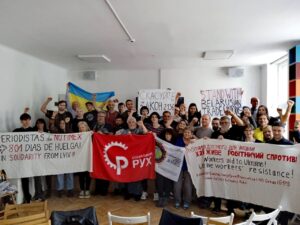
There is no mention of left-wing Ukrainians fighting in the war for their country while also organizing against the anti-labor and neoliberal capitalist policies of the Zelenskyy government. That includes members of the democratic socialist organization Sotsialnyi Rukh, whom you can find on “‘Sotsialnyi Rukh’: who we are?”2
The leftwingers also include Ukrainians with pacifist beliefs who joined the Ukrainian military, like Roman Ratushnyi and Pavlo Petrychenko, who died in combat in 2022 and 2025, respectively. If you relied on Benjamin and Davies, you’d never know that such people existed, or why.
As for Russian voices, “[w]e have been moved by the courage of Russian feminists who opposed the war.” (236) But it would be nice to know who they are, what they’ve said, and above all why? And there are Russian scholars now abroad—like Ilya Budraitskis and Ilya Matveev, to name just two—who have discussed in detail the nature and trajectory of the Russian regime—which they have described as “fascist”—that underlie its choice to wage an annexationist war.
You wouldn’t write a book on the Gaza catastrophe without the voices of Palestinians and Israeli resisters. Why a book on “making sense of a senseless conflict” in Ukraine where Ukrainian and antiwar Russian voices are effectively silenced? But there’s more that needs to be said about that.
Root Causes
In that hypothetical book about Gaza, something else that wouldn’t be omitted are the actual views of Israeli and Zionist movement leaders—in particular, their denial of the Palestinian people’s rights to independence and self-determination, or of Palestinians’ very existence as a people in the first place. The denial of their rights and of their existence as a people is the cover for Israeli propagandists’ justification for Israel’s intended final ethnic cleansing and mass expulsion of the populations of Gaza and the West Bank, and disenfranchisement and eventual removal of much of the Palestinian population with citizenship inside Israel.
But in the case of the Ukraine war, that’s exactly why it’s absolutely necessary to pay attention to Putin’s own pronouncements on what he’s fighting for. Andriy Movchan has provided a detailed analysis.3 Or you can find Putin’s interview with fellow far-right Christian-nationalist ideologue Tucker Carlson on YouTube.4
Putin may have angry grievances about NATO and its promises against eastward expansion in the wake of the dissolution of the Soviet Union. But by his own account in “On the Historical Unity of Russians and Ukrainians” (July 12, 2021, on the kremlin.ru website), the independent existence of Ukraine is the real affront to Russia and the “root cause” of the conflict that can be resolved only by reincorporating its people into the embrace of their natural motherland.
In fact, Putin accuses Vladimir Lenin of the historic crime of recognizing Ukraine’s right of self-determination at the foundation of the Soviet Union in 1922. For Putin, as Andriy Movchan puts it, “the Ukrainian nation and its statehood are artificial—a historic accident, an awkward mistake that it is now time to correct.”
If Putin is not reticent about presenting this view openly to the world and western public, and frankly getting a lot of sympathy from J.D. Vance and Donald Trump, why do Benjamin and Davies obscure it? Indeed, Putin’s Russian idée fixe explains why the authors’ hope of “these negotiations” offering survival “for all the people of Ukraine” is hardly viable.
Facing this situation as it really is, readers are free to reach their own conclusions. You may decide, like those of us in the Ukraine Solidarity Network (U.S.), that Ukraine is entitled to all the political, material, and military support it needs to resist until Putin and/or those around him recognize that the goal of conquering, subjugating, and “denazifying” (that is, murderously purging) Ukraine is not attainable.
Alternatively, you might decide along the lines of “realist” authors like Professor John Mearsheimer that Ukraine’s military disadvantages, casualties, and real threat of demographic collapse dictate that it must accept not only territorial losses but some form of semicolonial status to be agreed among Russia, the USA, and European states with whatever security commitments the West might offer.
Or you might decide like Donald Trump that any “solution” is acceptable, so long as it provides U.S. access to Ukraine’s mineral resources and fabulous investment opportunities in Russia for his family and friends.
But whatever you might conclude, the decision must reside with Ukraine and its people who have already fought and sacrificed so much.
How It Happened
The authors state their appeal this way: “Tragically and unjustly, it was Ukrainians, as well as Russian soldiers, who paid the ultimate price for the folly of Russian and Western leaders.… Embroiled in arguments about the culpability of the different sides, activists were left unable to build strong popular support for peace negotiations.” (7)
But “peace negotiations” for what end?
Unlike some left “campists” who support Russian victory in the name of “anti-imperialism,” Benjamin and Davies are not supporters of Russia’s war. They cite Noam Chomsky’s statement about “criminality and stupidity on the Kremlin side, severe provocation on the U.S. side.” (231) And they write:
“Russia’s invasion was illegal on many counts. It was not an act of self-defense and it was certainly not authorized by the United Nations. Under international law, including the Kellogg-Briand Pact and the UN charter, the invasion was an illegal crime of aggression. But it was not ‘unprovoked,’ as U.S. officials repeatedly claimed.” (72)
But we’ve seen that the invasion was actually “provoked,” first and foremost, by Ukraine’s independent existence. And the events of 2014, which touched off Russia’s first military intervention, erupted when a majority of Ukrainians across a complex political spectrum—right, center and left, nationalist and European-oriented, and many variations of all the above—violently resisted a peremptory government dictate to switch from a pending economic agreement with the European Union to a Russian-dominated one.
If the Benjamin-Davies narrative is severely warped by the failure to deal with deeply rooted Russian annexationism, the indisputable fact is that there was U.S. and NATO provocation and interventionism all along—beginning of course with the run-amok “shock therapy” of post-Soviet privatization that generated a massively wealthy oligarchy, a desperately impoverished population, and politics that expanded on the cynical corruption that already pervaded the Soviet Union.
If you’re looking for a primer on the machinations of NATO and the massive scale of the military buildup in its expanded area, and can set aside the authors’ one-sided portrayal of the road to war and ruin, the relevant chapters of this book are useful. I won’t repeat here what I wrote in my previous review.
The central problem to be emphasized is that the people of Ukraine are treated as objects of sympathy, rather than the necessary agents of their own future. This is particularly tragic at a moment when U.S. imperialism is asserting its domination over the peoples and nations of “our” hemisphere, telling Putin and Xi Jinping to rule their “own” parts of the globe as they like, and when genocide and ethnic cleansing in Palestine has almost vanished from mainstream media headlines.
Once again, we need a global peace and anti-imperialist movement of solidarity, not just sympathy for the suffering. That means something better than what Benjamin and Davies are offering.
Notes
1. “Making Sense of a Senseless Conflict in Ukraine?” Counterpunch, Dec. 23, 2022. See also the review of the first edition by Carl Mirra in New Politics: “The War in Ukraine: Making Sense of a Senseless Book,” Summer 2023 (Vol. XIX, No. 3, Whole Number 75).
2. Vitalii Dudin, “‘Sotsialnyi Rukh’: who we are?”, March 12, 2019
3. Andriy Movchan, “The Russian Idée Fixe,” Counterpunch, Jan. 1, 2026.
4. “Exclusive: Tucker Carlson Interviews Vladimir Putin,” Feb. 6, 2024. A transcript in all its glory is available here.