Review: Debates in the DSA
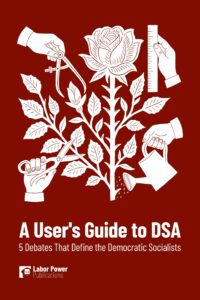
Edited by Stephan Kimmerle, Philip Locker, and Brandon Madsen
Labor Power Publications, 2025
In the lead up to the 2025 Democratic Socialists of America (DSA) Convention, members of the DSA caucus Reform and Revolution (R&R)1 published an edited reader, A User’s Guide to DSA: 5 Debates that Define the Democratic Socialists. The book sets out to familiarize uninitiated DSA members with the terms of political debates that are in play nearly ten years after the organization’s resurgence in 2016. Contributions are written by DSA leaders and partisans, either as original essays or reprints of essays that are scattered across the internet. For this effort, the book should be recognized as a democratic contribution to the DSA: information is critical for meaningful democracy.
Disclaimer: the editors invited another comrade and I from the Tempest Collective to contribute to this book as commentators from outside the DSA. I wrote exhaustively on DSA when I was a member from 2017-2022. For several reasons, we declined to be part of this book. This review is at the request of New Politics.
Overview
The editors organize the sections according to five debates, which they define as:
- How to Fight Trump and Defend Working-Class and Oppressed People (70 pages)
- Electoral Strategy and the Democratic Party (100 pages)
- Labor Organizing and the Role of Socialists in the Workers’ Movement (40 pages)
- How to Change the World? (i.e. reform or revolution?) (50 pages)
- What is Socialist Internationalism? (90 pages)
These debates are book-ended by an introductory section (“Setting the Stage: What is DSA?”, 50 pages) and some comparative international politics (“Looking Outside: The Experience of New Left Formations Internationally”, 30 pages).
The space dedicated to each section gives us a sense of the relative weight placed on these issues. As might be expected, electoral politics make up the plurality of the book. Internationalism receives the next most discussion, largely a debate regarding “campism” or “anti-imperialism”, though it should be noted that the essays in this section are almost entirely a debate between Red Star caucus and Reform and Revolution2; Dan La Botz of Solidarity is the only contributor representing the perspective on “anti-campism” (historically Third Camp). Perspectives from the center or right groups are therefore absent, which may obscure more than it reveals for the average DSA reader.
Understanding DSA
Since A User’s Guide is aimed at DSA members, I think it makes sense to start with evaluating it as a guide. The book begins with an introduction from Kimmerle, Locker, and Madsen, who are all members of R&R. A User’s Guide lays out some of the questions that will frame the book and front loads their caucus’ positions on various questions. The introduction attempts to guide the reader into the debates while also inserting R&R’s perspectives.
A User’s Guide then gives the editors’ overview of existing caucuses in DSA, grouped according to where they lie in DSA’s political spectrum. R&R defines these as the “Moderate Wing” and the “Left Wing”. This is a curious construction. Two wings: one left and one…middle wing? Both “wings” are made up of factions that have representation on the present national leadership, the National Political Committee (NPC), and it reads as though the editors are pulling their punches for the sake of internal politics. For some reason, they avoid calling this group the “right” wing and use the less agitational term “moderate” (even though that confuses the metaphor). The remaining caucuses listed as “other caucuses on the left” are not represented on the leadership.
Regarding caucuses in DSA, the editors posit:
“Some argue caucuses are divisive and lead to sectarian conflict. It is true that sharp political differences can cause such problems. But regardless of whether there are organized caucuses, there will be different political viewpoints within any healthy organization. The real question is, will these differences be expressed openly, and in a transparent fashion that allows members to democratically consider and decide between the different options?”
It’s the correct point, but the reader is expected to take it as an article of faith that these differences are clear and transparent to the members of DSA. That a book like A User’s Guide is needed tells us that this is not the case. DSA’s publications don’t play this role, so most debates are not in direct dialog but are scattered across social media, caucus websites, and held between leaders in chapters or the national organization. R&R’s greatest contribution has been organizing online panels that frame questions directly and bring in speakers from assorted factions to clarify these positions.
Information about the organization, let alone the positions of its caucuses, is not generally accessible to members unless they are part of a caucus that provides it to them. While organized caucuses are important for a multi-tendency organization, it is not a given that they enhance member democracy. A real tension exists between democratic potential and the actuality of backroom dealing between factions.
History and Conjuncture
The first collection of essays (“Setting the Stage: What is DSA?”) are not presented as a debate the way the rest of the book is but they situate the reader on the history and contemporary operations of DSA.
An interview with Megan Romer, former DSA National Co-Chair and member of Red Star Communist Caucus, is a useful overview of how DSA conceives of itself and an honest balance sheet from a top leader. The first word on DSA is about its size and that it is a “big tent”. Romer says candidly of endorsed elected officials, “We’re not great at holding them accountable.” (34)
The interview expresses contradictions of leadership in DSA, but Kimmerle as interviewer does not really tease this out. For example, Romer explains that on the one hand “we are really committed to doing democracy” (30), but then when asked why DSA doesn’t purposefully move towards breaking with the Democratic Party, Romer responds “A lot in DSA runs on momentum, and things happen because people are there doing them. It’s a little bit of a ‘do-ocracy’. Whoever shows up ready to do the work, that’s the work that gets done.” (40) Later, speaking of the International Committee’s orientation on immigrant rights, she likewise says, “I wish that decision had just been made collectively. It was actually the right decision, and it happened organically.” (40)
This is a key insight when evaluating the democracy of DSA. Members may vote on their national representatives, but the elected leadership acknowledges that this is not where the power lies. When asked about whether the “left” majority elected in 2023 was able to enact its priorities, Romer responds, “I don’t think things have moved as fast or as far as we would want them to, but it’s a big ship that we aimed to turn around. Before I got elected, I would’ve said ‘change everything’. Well, it’s actually hard to change the direction of things…” (41).
Bryan Watson’s essay, “A Bridge to a Mass Socialist Force”, analyzes the strengths and weaknesses of DSA. The essay is a sober accounting of DSA’s better and worse characteristics: it’s got thousands of people; it’s a membership organization that is “relatively democratic” (60); it’s the starting place for many young activists today. At the same time, Watson does not hold back in pointing out that “Much of DSA mistakenly believes that elections are the main way to change society” (61), and that “Unfortunately, the Red Star, [Marxist Unity Group (MUG)], and [Bread and Roses (B&R)]-led majority on the National Political Committee from 2022 to 2025…only very superficially changed DSA’s electoral approach.” (65)
Laura Wadlin of B&R, one of the self-described Marxist caucuses, gives the sole account of DSA’s history. This is a significant weakness of the book. Wadlin’s narrative expresses the common sense of the DSA leadership layers, and without any critical engagement the book tacitly endorses her perspective.
Wadlin deploys a great man, “Bernie”-centric history of DSA: “there are fundamentally two DSAs: pre-Bernie DSA (1982-2014) and post-Bernie DSA (2015-present).” (48) Wadlin maps the history of the “pre-Bernie” period onto the personal achievements of Michael Harrington and various “high profile leftist[s]” (49) such as Barbara Ehrenreich and Cornel West. The organization is largely dormant through the 1990s and 2000s until new, great individuals shaped the DSA of today. Wadlin names Maria Svart (National Director of DSA from 2011-2024) and Bhaskar Sunkara (founder of Jacobin magazine and—since 2022—president of The Nation magazine) as the two key figures that prefigure the “rebirth” of DSA. There are a few nods to movements like #Occupy, but these are freestanding acknowledgements that don’t relate back to Wadlin’s essay about DSA.
There’s plenty to pick apart in this narrative, but I would direct the reader to two significant omissions. First, because the narrative is essentially a liberal one, it does not analyze how crises and capitalism had any role in DSA’s “rebirth”. The crisis of 2007 is not mentioned, which is critical for understanding the change in class politics in the 21st century and the ensuing crisis of the political center. This would be basic Marxist analysis.
The problem with using a subjective explanation is that it doesn’t answer any of the underlying questions: why was there suddenly an audience for left politics? If the right people had been around in the 1990s, would the same growth have been possible for DSA? Obviously not, but that highlights the problem with the analysis for more recent history.
The second item we have to point out is the complete omission of the “Bowman Affair”, which was the most profound crisis that the DSA faced post-2016. In short, DSA endorsed Jamaal Bowman when he ran for Congress in 2020. Strategically, this was part of DSA’s turn towards Biden’s “Build Back Better” and “Green New Deal for Schools”. Bowman, however, was a liberal Zionist who bucked DSA’s Boycott, Divest, and Sanctions (BDS) Working Group when he was elected to the House of Representatives.
In 2021, Bowman voted in favor of arming the Iron Dome (Israeli missile defense system) and then took a propaganda tour of Israel with top officials of the settler state. This led to a call to expel Bowman from DSA in the fall of 2021, which the NPC rejected. Instead, it suspended members of DSA’s BDS Working Group. Thousands of members quit DSA during the controversy. While DSA leaders played down the significance of the affair, it would be an important prelude to the renewed attacks on Gaza in 2023 and the campus protests across the United States. This is entirely written out of A User’s Guide.
Yesterday’s Debates
There’s plenty more one could say about the sections on electoral politics, labor, strategy, and oppression. Instead, I think it’s more helpful to point out that to the extent the book presents debate, they appear more about degree rather than kind. There’s effectively no debate any more about running democratic socialists in the Democratic Party3; long-time DSA leader David Duhalde’s “dirty stay” position is the common sense in DSA. Duhalde defines the “dirty stay” as,
“…an observation that, despite DSA’s stated desire to become a political party, its members and activists largely balk at opportunities to do so, and instead continue to use the Democratic Party as an area of struggle instead of other options.” (173)
As much as we might disagree with the embrace of the “dirty stay”, we can at least appreciate that it does not hide what its about: “I especially want us to stop pretending we are building a third-party when a better and more honest orientation already exists, one in which we are fostering a left-wing faction within the Democratic Party, the party which most members will gravitate toward anyway.” (175-176) The essays in A User’s Guide that continue to press for the “dirty break” thus represent a minority current at best, or a delusion about DSA’s activity at worst.
I would argue that A User’s Guide therefore represents the results of earlier debates but does not capture the debates within DSA currently.
The central debate at this point is about what kind of organization DSA aims to be. There has historically been tension in DSA has been between its activist layer, about ten percent of the membership and the majority paper membership. Since 2016, DSA’s strategy, articulated in the document Resistance Rising: Socialist Strategy in the Age of Political Revolution4, attempted to fuse electoral politics with extra parliamentary organizing. With the election of Zohran Mamdani, the influx of new DSA members who joined through the extensive canvassing effort increased the tension and led to debates about the bounds of membership in DSA.
This does not appear as a debate as such in A User’s Guide, but it is acknowledged by Ty Moore, another R&R member, when he agrees with Eric Blanc’s call that DSA should essentially just be a Berniecrat organization. Moore says of Blanc, “This is an excellent proposal for how to concretely engage Zohran’s huge base… Yet the reaction on Twitter from a number of radical left activists in DSA was to oppose this as somehow a contradiction to building DSA. This is a textbook example of sectarian thinking that must be overcome.” (201) Notwithstanding the quality of debate from Twitter/X, it seems like just the kind of debate that should be fostered to clarify its terms.
Notes
- The editors explain in their overview of DSA caucuses that they are members of Reform and Revolution (R&R), but they are now in a minority current that disagrees with the direction the caucus has gone. Labor Power Publications therefore does not appear to be directly related to R&R.
- Reform and Revolution attempt to position themselves somewhere between anti-imperialist “campism” and “anti-campism”, reflecting their heritage as a group descended from the Militant tradition and a Socialist Alternative (US) breakaway.
- https://tempestmag.org/2021/06/strange-alchemy/
- https://www.dsausa.org/strategy/resistance_rising_socialist_strategy_in_the_age_of_political_revolution/