The Gaza Genocide in World-Historical Perspective
 [editors’ note: A book launch was held on November 10, 2025, at the School of Oriental and African Studies (SOAS), University of London, for Gilbert Achcar’s new book, The Gaza Catastrophe: The Genocide in World-Historical Perspective, published by the University of California Press (2025). What follows is the text of the talk he gave,1 which he edited for publication.]
The first point I want to make is that the genocide in Gaza has become very widely acknowledged from a lot of sources. And just to be clear, I want to remind you of the definition of genocide upon which those legal scholars and organizations that affirm that what has been going on in Gaza is a genocide base themselves. The key sentence of the definition refers to “acts committed with intent to destroy in whole or in part”—thus, not a matter of number but primarily of intent to destroy—“a national, ethnical, racial, or religious group as such.” That’s the definition on the basis of which people affirmed that a genocide has been ongoing in Gaza.
At the beginning, there was huge outrage at the use of this term. It was even labeled with the ubiquitous accusation of antisemitism hurled at any criticism of Israel. When South Africa started its action at the International Court of Justice, two months into the war, at the end of 2023, use of the term was met with outrage, especially from western sources and western governments. However, over the long period since then, the nature of the discussion has changed from one dominated by those denouncing vehemently the acknowledgment of the genocide into what I would today describe as a new case of genocide denial. Every genocide has produced some form of denial: best known is Holocaust denial but there are others, like the official denial of the Armenian genocide by the Turkish state. Every genocide finds a public for denial, usually among those belonging to the state or nation that has perpetrated the genocide. We are now in that kind of discussion about Israel’s genocide in Gaza: those who still refuse to acknowledge the fact are engaging in genocide denial.
Over the two years and the continuous killing and destruction that have been taking place in Gaza, increasing numbers of people and organizations have used the term “genocide” and acknowledged its occurrence. Toward the end of the first year of Israel’s onslaught, the two major global human rights organizations—Amnesty International and Human Rights Watch—both produced reports acknowledging the genocide. This past summer, two key Israeli human rights organization did likewise. The best known of them is B’Tselem, which published a report with a remarkable and very courageous title for an Israeli organization: “Our Genocide.”2
And then acknowledgment of the fact has kept progressing among public opinion, including in the United States and among Jews. A recent poll has shown that close to 40 percent of American Jews consider that Israel has committed a genocide.3 Forty percent! If you add the 10 percent who say they don’t know, that makes one half, which is similar to the proportion of people who acknowledge this genocide in the American population as a whole.4 This says a lot.
The Spanish prime minister has himself used the term recently, affirming that a genocide is happening in Gaza. This was the second EU government after the Irish one that referred to this fact. Most European governments are still in denial, however. For what is at stake in this regard is not a semantic or dictionary debate, or a historical one. It bears very clear consequences. If a government were to acknowledge the genocidal character of the war that Israel has been waging in Gaza since October 2023, it wouldn’t be able to maintain relations with that state, especially military relations, without being officially complicit in the crime against humanity. Britain for instance maintains military relations with Israel—trade and cooperation. There is the EU–Israel Association Agreement, part of which was supposed to get frozen before the announcement of the “Trump peace plan,” which practically nipped the initiative in the bud. The debate about genocide thus entails immediate consequences.
The figures for the death toll in Gaza are absolutely abhorrent and appalling. There have been until now close to 70,000 direct deaths from bombing, to which you should add, according to an estimate made by physicians early on, at least four times this figure for the indirect deaths—people dying because of the destruction of medical and health infrastructure in Gaza and other circumstances, including the very orchestrated hunger that is part of the genocidal means. When it becomes possible to draw a real balance sheet of this awful massacre, it may well show that some 10 percent of Gaza’s population were killed as a result of Israel’s onslaught. But as I already mentioned, genocide is not a matter of number.
The definition of genocide is about “intent to destroy in whole or in part.” So it’s not a valid argument to put the bar at the level of the Nazi genocide of six million European Jews, which was an almost total extermination, and then say that anything below that is no genocide. The same Western governments that deny the fact of genocide in Gaza were very much insisting on using the label for Bosnia, for instance, where both in absolute and relative terms, the massacre was clearly less than what has happened in Gaza.
Then comes the issue of intent, which is also used in denying Israel’s genocide in Gaza. I would say in this regard that the genocidal character of Israel’s onslaught was actually clearly identifiable from the very start. Three days into the onslaught, on October 10, 2023, I described what had started as a genocidal war in my weekly column in Arabic. 5 More importantly, because it was written in English and much more visible, six days into the war—on the 13th of October—Raz Segal, an Israeli-American scholar of Holocaust and Genocide Studies based in the United States, published in the American publication Jewish Currents an article about the onslaught strikingly titled “A Textbook Case of Genocide.”6
These early acknowledgments of the nature of what was going on indicate that the intent was identifiable from the start and at various levels. The primary level is that Israel’s onslaught started with a blatantly open violation of international humanitarian law, i.e., the law of war, in targeting the civilian population. You surely remember the infamous statement by Israel’s war minister, the so-called defense minister, Yoav Galant, on October 9. It attracted a lot of attention at the time. He said, “I have ordered a complete siege on the Gaza Strip. There will be no electricity, no food, no water, no fuel, everything is closed.… We are fighting human animals and we are acting accordingly.”7 This was about shutting off a whole territory and its entire civilian population without any distinction. Here was already a blatant violation of the law of war, one key pillar of which is the distinction between combatants and non-combatants. Here was a whole civilian population being targeted and punished for an attack by a few thousands of armed men.
Then there was the stated immediate goal of the war, which was the eradication of Hamas. This is a genocidal goal indeed. Why? First of all, it makes no distinction between the organization’s armed wing that carried out October 7 and the rest of the organization. The armed wing is called the Izz al-Din al-Qassam Brigades, whereas Hamas is a mass organization of over 100,000 members that has been ruling the Gaza Strip since 2007 and developed therefore an entire civilian administration. Thus, the goal of eradicating the whole of Hamas, an important component of the Gazan society, is in itself genocidal. So that was the stated intent.
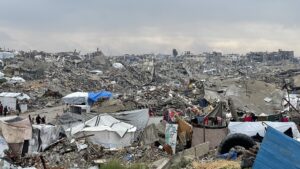
Then there’s the means, which is also quite clear in this regard. Very early on, it was apparent that Israel had started the destruction of the Gaza Strip. The violence and intensity of the bombing from the very beginning was absolutely terrible. And mind you, Gaza is one of the most densely populated territories on earth. It has a very high demographic density, with 44 percent of the population children under 15. And yet Israel started bombing, destroying, flattening out whole parts of that territory, including the use of huge 2,000 lb. and 1,000 lb. bombs, which are not designed to be used in urban settings because of their potentially terrible impact on civilians. No discrimination among targets is possible when such bombs are dropped on a civilian urban concentration. As a result of all that, it has been estimated that 70 percent of those killed—and this refers only to the direct victims of the bombing—are children and women. I specify women because there are no women combatants in Hamas. The ideological nature of Hamas does not allow for the recruitment of women as combatants.
So, however one looks at it, there has been an obvious violation of all laws of war, with the clearly intentional killing of a large part of the Gazan population and the destruction of most of its dwellings with the obvious goal of pushing the survivors to leave. It’s a genocide perpetrated in order to implement ethnic cleansing. Israel, of course, had no intent to destroy all of the Gazans, but it clearly intended to kill a sizable proportion of them and destroy their habitat as a way to push the survivors to leave the territory. That intent too was very clear. A document was leaked early on from the Israeli Ministry of Intelligence explaining that the best scenario would be to push the Gazans into Egyptian territory.8 Those who try to defend the Israeli point of view on this in denying the genocide will tell you that it has been the most moral war ever, because Israel’s armed forces have warned the population to leave each area they were preparing to bomb. Well, when you look at the size of the territory, a very small territory, and you know that not all the population can leave at once or on short notice any part of it, you understand how hypocritical this is.
And it gets even more hypocritical when combined with the excuse that Hamas is hiding behind human shields. First of all, imagine that a group has taken a large number of hostages, and the police intervene, shoot everybody, and then say, “we had to, because the bad guys had taken the hostages as human shields.” This would be met with a huge outcry. So, the excuse that Hamas has been using civilians as human shields and that it is the reason why Israel has been killing so many civilians is just incredibly hypocritical. It is even more blatantly so because Israel knows full well that Hamas fighters don’t need human shields since they have tunnels—they built more tunnels than the London underground. They built a whole network of tunnels for their own use, not for the civilian population, and they hid there. That’s why you can be sure that the vast majority of the 30 percent of direct victims who were male adults were non-combatants.
This genocide is no accident: it is rooted in a history that makes it a foreseeable outcome of what happened on October 7. I describe October 7 in the book as “the most catastrophic miscalculation ever in the history of anticolonial struggle.” It was a huge miscalculation indeed: I can’t believe that anyone would do it in full knowledge of what would happen. That is why I argue that it was a catastrophic miscalculation and explain why, but a miscalculation that must be placed in the history to which it truly belongs, which is not the history of Europe, Nazism, and the Holocaust. October 7 should not be understood as “the worst massacre of Jews since the Holocaust” or any such description that aims at putting what happened on that day in a historical sequence that would make it a continuation of Nazism. This, it was absolutely not. You can be sure that had their oppressors been Buddhist, or Protestants, or belonged to any other religion, the Palestinians’ response would have been the same. The issue was not about Jews as such, and it is not “antisemitism” that motivated those who attacked on October 7. Theirs was a reaction to the colonial oppression perpetrated by Israel.
And the history of anticolonial struggle has indeed seen other October 7s. In the book, I describe a similar event that took place in Angola in 1961. Read its description, and you will see how striking the parallel between the two cases is: the same type of attack with similarly catastrophic consequences. The fact remains, however, that October 7 was but a pretext. The attack was seized by the Israeli state and government as an opportunity to launch an onslaught that has been out of all proportion with October 7. The principle of proportionality is central to the laws of war. Thus, even if we took it for granted that an occupier has a right to self-defense against the exercise by the occupied of their right to resist occupation, the occupier would still need to adhere to the legal limits imposed by proportionality. And very obviously from the very start, it was clear that Israel’s response was hugely disproportionate.
Incidentally, everybody has heard about the 1,200 victims on the Israeli side of October 7. Many fewer people know about the 1,600 Palestinians who died in this operation. That is, from the start there were more Palestinians killed among the five to six thousand who crossed the fence surrounding Gaza than they killed Israelis. Israel’s relentless killing of Palestinians beyond that point was therefore disproportionate from the very start, another illustration of the genocidal intent. And even if some still believed after one month that Israel was exercising a right to self-defense, two years into the onslaught, no one can deny that Israel is committing massive war crimes. Denial of the Gaza genocide has become just that: a new instance of genocide denial.
It is my contention moreover that there was a genocidal potential inherent in the very nature of the Israeli state. Not because it is Jewish, of course, but because it is colonial. Colonialism entails a genocidal potential in and of itself. Colonial enterprises, and even more so settler-colonial enterprises, entail a genocidal potential. Think of North America or Australasia, to take two famous historical cases of settler colonialism. Colonialism committed genocides until well into the twentieth century. Even after the defeat of Nazism, the French state, led by those who had been fighting the Nazis, perpetrated a huge massacre in Algeria in 1945, and two years later, a second one in Madagascar, with tens of thousands of people killed.
The history of colonialism is indeed riddled with genocidal massacres. However, the closer you get to contemporary times, the more it takes a special kind of political force for this genocidal potential to be realized, in the sense that the openly racist worldview that was seen as normal in the nineteenth century was no longer normal in the second half of the twentieth century. Some progress was made in that regard.
Here we come to another potential inherent in the very nature of the state of Israel, which is the drift to the right. Israel’s original colonial condition was aggravated by its combination with direct open occupation. To the ethnic cleansing that took place in 1948 was added the direct occupation of new territories and subjugation of their large Palestinian population since 1967. These conditions were to lead inevitably to a drift to the right. This was predicted from the start by many critics of Zionism—in particular, Jewish critics of Zionism who emphasized this potential. Such prognoses were made despite the fact that the Israeli state was widely perceived in Europe as a beacon of socialism during its first two or three decades. Zionist social democracy—the social-democratic wing of the Zionist movement—presided over the founding of the state and ruled it for close to three decades. But the far right of the Zionist movement came to power in 1977, less than thirty years after the founding of the state and ten years after the 1967 occupation of the West Bank and Gaza.
This far right is represented by the Likud party, which is heir to the Zionist movement’s original far right, a tradition whose founder, Vladimir Jabotinsky, was an admirer of Mussolini and Italian fascism. These people won Israel’s parliamentary elections for the first time in 1977 and out of the forty-eight years that elapsed since then, Likud has been in power for thirty-five. It has become the dominant party in the Israeli state, while Labor Zionism has shrunk to a very small force. And the drift continued. At some point Ariel Sharon—who had been the commander of Israel’s invasion and occupation of Lebanon in 1982, the man associated with the massacres of Sabra and Shatila, who had been prosecuted in Israel for his responsibility in those massacres—this man organized an openly anti-Muslim provocation in Jerusalem in September 2000 and used the uprising that he triggered to win the Israeli election in February 2001. He then launched the most brutal onslaught on the 1967 occupied territories since their occupation, the most brutal until the present genocide in Gaza, and the persecution of the population of the West Bank.
This drift to the right was also accompanied by a revision of the military doctrine of the Israeli army, which used to hypocritically claim—and still claims—that it is “the most moral” of all armies. After its fiasco in Lebanon, which it had to leave in the year 2000 after eighteen years of occupation without securing its goals, the Israeli military designed a new doctrine whereby the civilian environment of the enemy would be destroyed in response to an attack in order to deter this enemy from undertaking any further action against Israel. This military doctrine openly violated the laws of war. It was practiced for the first time in 2006 in Lebanon itself. Israel took revenge on Hezbollah after a commando group had crossed the border from Lebanon, killed three soldiers and abducted two. The Israeli army killed over one thousand Lebanese civilians and destroyed large civilian areas where Hezbollah is politically dominant, including urban concentrations south of Beirut.
The same drift to the right brought Netanyahu to power after he had built himself up as a right-wing challenger of Sharon within Likud. When, under the pressure of the military, Sharon ordered the Israeli withdrawal from Gaza in 2005, Netanyahu stood vehemently against it. He ended up heading Likud, from which Sharon had to split, came back to power in 2009, and remained prime minister for twelve years, until 2021, beating the Israeli record for longevity in this position. He then came back as prime minister at the end of 2022 with a coalition that included two groups described as neo-Nazis in the Israeli newspaper Haaretz by another Israeli scholar of genocide. The label is no exaggeration indeed. They really are neo-Nazis, very openly racist, very openly advocating ethnic cleansing, extremely right-wing, and prone to violence. The two groups are often designated as being far right, but they actually are ultraright, to the right of the far-right Likud. One of the two groups is the heir to a current that was banned for terrorism in Israel itself in 1994, and likewise in several western countries: the Kach group, whose leader was Meir Kahane. These guys are now ruling Israel in coalition with Netanyahu. Such are the political conditions that made possible the perpetration of the Gaza genocide, this realization of a potential inherent in the very nature of the colonial enterprise of which Israel is the outcome.
Finally, a few words about the subtitle of this book, which presents the Gaza genocide as a watershed in world history. We are obviously at a very alarming moment in history. It is commonly acknowledged in the media that we are seeing the demise of the so-called rules-based international order, the liberal concept of which goes back to a liberal U.S. president, Franklin Delano Roosevelt. His vision, expressed in the 1941 Atlantic Charter, translated into post–World War II institutions such as the United Nations; the International Court of Justice; the 1948 Universal Declaration of Human Rights; the Genocide Convention, from which I quoted; the 1949 Geneva Convention, the new international humanitarian law. A whole set of institutions came into being, but the rules-based order did not function during the next decades due to the Cold War, which started very early on after Roosevelt’s death in 1945 and his replacement by the rabidly anti-communist Harry Truman. Soon after, the latter greenlighted the atomic bombing of Hiroshima and Nagasaki. Five years later, he engaged in the Korean War. The rules-based order got de facto suspended.
With the end of the Cold War, manifested by the unification of Germany in 1990, then-president George H. W. Bush, Bush senior, proclaimed a New World Order—a phrase that became very famous at the time. He described it as a world order in which the rule of law will be dominant and the weak vindicated against the strong. The International Criminal Court was created, followed by the adoption by the UN General Assembly of the resolution on the Responsibility to Protect (R2P). The idea was that the international community cannot let a government massacre its own population in the name of respecting its sovereignty. There was even talk of a new “cosmopolitan” order.
But all these illusions were quickly dispelled in turn. The 1990s were years of transition to a new Cold War. In my previous book, titled The New Cold War, I describe how the world moved from the old Cold War to the new, and how the latter developed until the war in Ukraine. But the rules were once again quickly violated by those who were pretending to champion them. The 1999 Kosovo war was carried out circumventing the UN Security Council, which is the only body that can legitimize a war other than a war of self-defense according to international law. In 2002 the United States withdrew its signature from the Rome Statute of the International Criminal Court, just two years after having signed. That was when the Bush Junior administration was preparing the 2003 invasion of Iraq, an even more blatant and serious violation of international law.
The illusion of a rules-based order was maintained nevertheless because western liberals could still blame the conservatives; some U.S. Democrats could lay the blame on the Republicans. George W. Bush was succeeded by Barack Obama who boasted about his early opposition to the invasion of Iraq—an invasion that was likewise opposed by the liberal governments of France and Germany. So, the illusion and pretense of liberal sticking to principles was maintained. The liberal pretense then reached a peak with the Russian invasion of Ukraine. This war was portrayed as opposing liberalism to authoritarianism, with the West confronting a Russia that has taken on the mantle of the former Soviet Union. This renewed Cold War discourse was promoted by Joe Biden under whose watch Russia’s invasion of Ukraine started. He even convened “summits for democracy” with the participation of U.S.–friendly authoritarians, very much in Cold War fashion.
Gaza put an end to that. Of course, it’s not Gaza alone. The genocide is the culmination of a series of events, but it is a very significant turning point nonetheless because the double standard, the hypocrisy, became obvious to everyone. Not only were the attitudes toward Russia’s invasion of Ukraine and Israel’s invasion of Gaza radically different, but Gaza has even been, as I maintain in the book, the first joint U.S.–Israeli war ever. None of the wars waged by Israel before Gaza could be fully described as such. The United States supported some of Israel’s previous wars, but only up to some point after which it pulled the brake. In the case of Gaza, Washington fully supported Israel’s genocidal war by providing thousands of 2,000 lb. and 1,000 lb. bombs and other weapons; providing a military cover for Israel to deter regional powers from intervening; and fully adopting the stated war goals to the point of systematically rejecting calls to ceasefire during several months, and inciting other western governments to reject them likewise.
The huge contradiction between the positions on Gaza and Ukraine has been obvious to everybody. The International Criminal Court indicted both Putin and Netanyahu, but its warrants elicited very different attitudes from the United States and Europe. This opportunistic behavior led to the final discrediting of the liberal pretense of abiding by a rules-based international order. It clearly revealed itself as pure hypocrisy, and this betrayal of liberal values, this discredit of the liberal discourse, fueled the global rise of the far right. Neofascism has been on the rise for quite a few years. Its progression accelerated after the 2008 economic crisis and the influx of refugees from Syria and elsewhere. So, the increase in migration, particularly political migration of refugees, against a background of economic crisis fueled the growth of neofascist forces, while the betrayal by the so-called liberals of their own values and principles facilitated their growth. In a very direct way, Joe Biden facilitated the “second coming” of Donald Trump. Kamala Harris herself recently acknowledged that Biden’s incapacity to show any empathy for the Gazan people played a significant role in her defeat. It had a major impact on her campaign, especially since she didn’t dare openly take her distance from Biden’s attitude.
Another and final element in the contribution by self-proclaimed liberals to the rise of the far right is their complicity in its banalization and the whitewashing of its antisemitism. Gaza has been intensively used for that. In the name of a joint repudiation of antisemitism after October 7, a demonstration was organized in France with the participation of the far-right antisemitic movement of Marine Le Pen, along with the Socialist Party and the “centrist” Macron. Israel’s far-right government, arguably the furthest to the right of all elected governments in the world, has become a magnet for the global far right, recently organizing an international conference attended by key neofascist figures. The western far right—including the German AfD (Alternative für Deutschland) and the Austrian FPÖ (Freiheitliche Partei Österreichs) that are directly rooted in historical Nazism—have become the staunchest supporters of the Israeli state. In the name of repudiating antisemitism, what we are witnessing is in fact a convergence on the present-day equivalent of antisemitism, which is Islamophobia. That is indeed what the Israeli far-right government and all western far-right forces have in common: anti-Muslim racism is their common ideological leitmotiv.
Thus, in that sense as well, Gaza has become a focal point in the global struggle against neofascism. Hence the battle for the defense of freedom of expression on the Gaza genocide in solidarity with the Palestinian people, a freedom that has been increasingly under threat and severely repressed. In the United States most spectacularly, where students and faculty standing in solidarity with the Gazan people have been viciously persecuted under the present neofascist administration, the second Trump administration. This is another illustration of the world-historical significance of Gaza.
Notes
1. The recording is available here.
2. B’Tselem, “Our Genocide.”
3. “Many American Jews sharply critical of Israel on Gaza, Post poll finds,” Washington Post, October 6, 2025.
4. Quinnipiac University Poll, 27 August 2025.
5. Gilbert Achcar, طوفان الأقصى» ينذر بأن يجرف غزة», October 10, 2023.
6. Raz Segal, “A Textbook Case of Genocide,” Jewish Currents, October 13, 2023.
7. Emanuel Fabian, “Defense minister announces ‘complete siege’ of Gaza: No power, food or fuel,” the Times of Israel, October 9, 2023
8. Amy Teibel, “Intelligence Ministry ‘concept paper’ proposes transferring Gaza’s to Egypt’s Sinai,” the Times of Israel, October 31, 2023