Victor Serge: Unruly Revolutionary
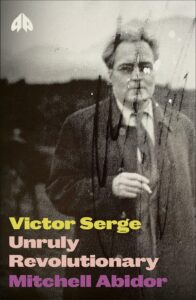
Victor Serge: Unruly Revolutionary
By: Mitchell Abidor
Pluto Press, 2025
Victor Serge died almost penniless in the back of a taxicab in Mexico City in 1947. He was not yet revered as one of the world’s greatest writers, but he had known some acclaim as an author and activist.
Excerpts from Serge’s account of his political journey from anarchism via Bolshevism to anti-Stalinism, Memoirs of a Revolutionary (NYRB, 2012), had appeared in English already by 1944. (Wallace Stevens quoted from them in his poem, “Esthétique du Mal.”) And his prominence in French literary circles sparked a ferocious battle after his second arrest in five years in the Soviet Union in 1933. The so-called “L’affaire Victor Serge” ended only with the author’s release from an “isolator” colony near the Ural River and emigration in 1936.
Yet Serge’s actual achievement took decades to be recognized. An abridged version of Memoirs finally appeared in English in 1963. Much of his work was published (or brought back into print) years later. This effort was spearheaded in the English-speaking world by Richard Greeman, who has translated a number of the Serge’s essential works.
The self-portrait fashioned by Serge in Memoirs was so compelling that it stood in place of a comprehensive biography in English for many years. Susan Weissman’s pioneering Victor Serge: The Course is Set on Hope (Verso, 2001) skillfully explored Serge’s entanglements in the dense and brutal thicket of Stalinist intrigues in France in the 1930s, but was thin on his early years and his Mexican exile, both of which have attracted increasing attention.
Mitchell Abidor’s new biography, Unruly Revolutionary (Pluto Press) excited fresh hopes of something more comprehensive. It was begun as a joint project with Greeman, who provided Abidor with his research notes to see the project through to the finish. It also benefits greatly from the author’s significant contributions to Serge scholarship: co-editor with Greeman on Notebooks 1936-1947 (NYRB, 2019) and translator of early Serge writings: Anarchists Never Surrender: Essays, Polemics and Correspondence on Anarchism: 1908-1938 (PM Press, 2015).
Unruly Revolutionary elaborates upon (and vigorously challenges) long-accepted accounts of key relationships and episodes in Serge’s life. Yet I found it to be surprisingly unsatisfactory. Abidor’s ambivalence about Serge and his intellectual trajectory is woven deep into the book’s narrative. And while the author does sweat the details, vital context often is omitted, elided, or ignored as his arguments march forward.
These two qualities converge quickly at the beginning, where Abidor offers a meaty account of Serge’s strident anarchism in his formative years as a political journalist—as well as his departure from the ranks. A thread of Serge as a turncoat or betrayer eventually broadens into the spine of the biography as Abidor tackles Serge’s time in Spain, his successes in the Soviet Union, and the self-wound that Bolshevist governance inflicted upon itself at Kronstadt. By the book’s end, the biographer’s discontent with Serge’s path has veered into near certitude about his inevitable apostasy had he lived past that fatal taxicab ride.
An even deeper problem with Unruly Revolutionary is Abidor’s blunt refusal to bring Serge’s fiction and poetry meaningfully into his biography. It is a bold and faulty gambit that falls predictably flat.
The biographer’s rationale for doing so is relegated to small type in an introduction to an appendix. While Serge “considered himself above all to be a writer” with works of “artistic importance,” Abidor chooses instead merely to mine his novels “as sources of biographical information.”
Serge’s vivid poetry (which tells us so much about his life) remains entirely untouched, save for a squib in the appendix. This is a shame bordering on malpractice, since James Brook’s translation of the poems, A Blaze in the Desert (PM Press, 2017) is utterly sublime.
Tackling the life of one of the 20th Century’s greatest writers in such an intentionally circumscribed fashion is baffling. How did making this art shape Victor Serge’s life? Worse still is that Abidor explores only one of Serge’s major works of fiction – an early novel, Conquered City (NYRB, 2011; translation by Greeman) – in any significant biographical depth whatsoever.
Manufacturing artificial silos for Serge’s life and art is perhaps why Abidor sounds such an epiphanic klaxon to trumpet the author’s fervent embrace of the philosophy of Personalism—and his correspondence with one of its prominent and controversial French proponents. We know already that Serge’s Personalism was articulated publicly many years before World War II in an open letter published in France in 1933. (The author told us.)
Yet past biography, anyone who reads Serge’s later works closely not only feels – but knows – that Personalism’s centering of human liberty and dignity is there from the 1930s onward. The key question in each of these books is clear: How do human beings of conviction and conscience navigate the charnel house of totalitarianism, war, and exile?
For a writer of Serge’s stature, it seems impossible to explore his life in this fashion.
Unruly Revolutionary is most compelling when it fills in large existing gaps in Serge’s story with Abidor’s accomplished research. Anarchists Never Surrender is essential reading for anyone seeking to know the early Serge. It also sharply interrogates the Memoirs’ version of his proximity and entanglement in the “violence as praxis” activities of the anarchist Bonnot Gang’s crime spree in 1911 and 1913.
The new account of Serge’s exile in Mexico in Abidor’s biography also possesses a ringing depth and clarity. After all, the Notebooks pose a similar problem to Memoirs. Their dazzlingly rich documentation of Serge’s intellectual life and activities (philosophical reflections, pen portraits, short essays, and reports on works-in-progress) is conveyed entirely from Serge’s point of view. And the Notebooks leave readers with a tantalizing question: why did this extraordinary effluence peter out so spectacularly after July 1945—more than two years before Serge’s death.
Unruly Revolutionary finds powerful answers in the deepening crises which Serge faced in exile: failing health, the attempted suicide of his third wife, Laurette Sejourné, the growing divide in a close relationship he had enjoyed with his son, Vlady, as well as the increasing penury he suffered as outlets for his freelance articles shrank precipitously.
Abidor also lays out new details about an even more destructive incident in Serge’s final years: a ferocious battle with exile novelist Jean Malaquais in October 1945 that rocked the anti-Stalinist left in Mexico City. The ripples from the catastrophe eventually left Serge deeply isolated in his already-unhappy exile. His tight band of former allies literally cut ties with him.
Serge played a large part in engineering his fate through his own powerful intransigence and impolitic unwillingness to let things go. Yet he was also strangely oblivious to the fact that in the tiny but ferocious tempests of any exile community, it hardly matters if one is “right.”
Serge was good at being right. His sharp pen rips at Malaquais’ callowness and lack of intellectual rigor in the Notebooks even before the bust-up. (Exhibit A in “Victor Serge, First Rate Literary Critic.”) Yet in this case, being right was wrong. There is a palpable sense of devastation as the reader watches Serge obstinately pursue new inquests and refuse arbitration. A giant is laid low by others—and by himself.
These particular strengths of Unruly Revolutionary do inevitably sharpen the disappointment of discovering where the biography falls short.
Consider Memoirs of a Revolutionary again. Abidor identifies the core of his enterprise as sorting out the facts of Serge’s life from the embellishments, omissions, or even falsehoods (not so many of those, however) in Memoirs. No argument with that at all. His revelations about Serge’s family history and his depiction of the Bonnot Gang alone are necessary corrections to the overall picture.
Yet Memoirs is also one of the great autobiographies of the 20th Century. As such, its value lies in much more than its retelling of Serge’s life. It is a mesmerizing masterpiece that captures the essence of a fascinating (and epochal) world. A work of memory and meditation. Not a curriculum vitae.
Serge’s succinct and vivid pen portraits of figures both monumental and minor in Memoirs have been much remarked upon. Yet his depiction of the agonies of humans as political systems and societies engulfed in terror come apart at the seams is just as masterful. In one passage from the Memoirs, he relates the atmosphere within the doomed resistance to Stalin in the late 1920s:
Our social tea-gatherings were divided into two parts. From eight to ten at night conversation was conventional and directly inspired by the newspaper editorials: official admiration, official enthusiasm, etc. Between ten and midnight, after a few glasses of vodka had been drunk, a kind of hysteria surfaced, and conversations—now diametrically at odds—were sometimes punctuated by fits of anger or weeping. Face-to-face, no more official speak, but instead an alert critical intelligence, a tragic sorrow, a Soviet patriotism coming from souls being flayed alive.
As we have seen in the Malaquais episode, Serge possessed character flaws. This is precisely why leveling the silos between life and art is so essential. Serge’s writing is brilliant and principled and humane, but painting him as a secular saint is neither useful nor true.
The chapter that Abidor devotes to the tragic life of Serge’s second wife, Liuba Russakova, is long overdue. It also cannot help but darken our picture of his character. His portrait of the author’s third wife, Laurette Sejourné, offers a muddier picture streaked with an unseemly glee in the telling.
Readers are offered a gratuitously prurient look inside Serge and Sejourné’s fraught and fumbling courtship. Abidor even presents an insinuation from Serge’s son that Sejourné may have had something to do with the author’s death. The irony, of course, is that the world would not have Serge’s Notebooks if she had not saved them. Life and art all tangled up again. Sejourné was no saint. But the evidence actually on offer at present suggests a wildly mismatched April/November couple simmering in deep unhappiness.
Yet it is Abidor’s projection of Serge’s future anti-communist apostasy that is perhaps the most problematic part of the biography. My impression of this was confirmed as I read “ Victor Serge, Turncoat Radical?” —an interview that Abidor gave to Protean Magazine in December 2025. (NB: the title punctuation proves unnecessary.)
The biographer pushes more deeply into the hunt to find malignancy in Serge’s anti-communism here than he does in the book itself. “I can’t say for sure where he was going,” quips Abidor at one point, “but I’ll say for sure that he was not headed in a good direction.”
A number of other scholars have weighed significant elements of the evidence offered by Abidor here. They have come to different conclusions. The biographer would no doubt reply that he has added greatly to the evidentiary record, which makes his enthusiasm for an essay by Alan Wald ( “Victor Serge and the anti-Stalinist Left in New York”), which was published in Critique in 2009 so puzzling. In the Protean interview, Abidor states:
[Serge] wanted to be a New York Intellectual. At the end of his life, if he could have been anything in the world, he would have been a New York Jewish intellectual. He missed his calling. He married a Jew, it didn’t turn him into one. So many of his ideas are the same kind of disabused Trotskyism and anti-communism. Alan Wald’s article about Serge and the New York intellectuals is absolutely spot-on.
Read Wald’s essay, however, and one finds significantly less certainty. Wald certainly does tote up a series of troublesome events and connections in Serge’s later years, laying them out in a litany at the end of his piece. But he also offers this blunt caution:
The political evolution of Victor Serge in the 1940s is not testimony to his personal weakness, but to the weight of adverse pressures during the Cold War – pressures intensified by the continuing horrors of Stalinism and the inability of Trotskyism to offer a credible alternative. Anyone who lightly dismisses the change of views of former revolutionaries such as Serge as “sellouts,” naively misjudges the seriousness of the problems confronted by his generation.
The connection between biography and lived experience seems crucial—especially for a writer such as Serge. So to offer a scrutiny close enough to poke holes in narrative points in Serge’s Memoirs, and yet underplay the book’s sweeping account of Stalin’s devastating purges is to ignore the forest as one gnaws the bark off a tree. Serge witnessed the imprisonment and death of hundreds of friends and colleagues. He experienced the Terror first hand.
It seems so obvious—and yet so imperative—to say it again: we cannot know what Victor Serge would have done in 1948 or 1952. Let’s say he had been allowed to emigrate to the United States, and that he had tumbled into McCarthyism or its vicinity. If this had actually happened, we simply would not be reading Serge today. We would be pestered only with the occasional monograph about his doomed path to the dark side, or an exploration of his early works that seeks out the unhappy crossroads of his betrayal of ideals and apostasy.
I would argue that the Victor Serge who wrote this passage in an essay about the poets of the French Resistance who turned a blind eye before the war as Russian writers were murdered likely would have rejected the snares of Tail Gunner Joe and Roy Cohn:
“What is truth?” asked Pontius Pilate of the condemned man. Thousands of men formed by the intellectual disciplines of scientific thought—it seems—reply in fact: “It is the command of the Leader of my party.” This is the death of intelligence, the death of ethics.
Reading Unruly Revolutionary was a vexing enterprise. Its significant advances are embedded in a framework of hectoring disapproval. It is a narrative of betrayal and failure. Not a story of change, adaptation, and survival.
One can choose to see things in that former sense. But it hardly aligns with the greatness of Serge’s writing. Or lived experience, for that matter. Humans move through space in time. They err. They learn. They abandon things no longer useful. They cut their cloth when things get tricky. They can be brave and foolish simultaneously. Flawed and principled.
I revisit Serge’s Notebooks often. As a dramatist who traffics deeply in questions of history, I return to one devastating passage again and again, detailing his difficulty in finishing his novel about the fall of France— Last Times (NYRB, 2022)—amidst failing health in Mexico City:
It’s not just the physical breathlessness and the lack of a favorable environment. It’s more that for me a novel must have an inner justification, internal to its characters and its atmosphere, and that in reality all the people I have attempted to bring to life seem to me condemned men walking through a fog. They need a solution. I need a solution for them—and there isn’t one. History can only impose its solutions by walking over their dead bodies.
When I reflect upon Serge’s sickness and penury in Mexico, the familial fractures, the bitter squabbles, and, at the end, his profound isolation and sadness, I remain astonished that he pulled a book as brilliant as Memoirs of a Revolutionary from inside himself in that moment. (And did so with so many of his papers lost in the Soviet Union and France!)
Then I remember that in this state of profound disenchantment and peril, Serge also wrote The Case of Comrade Tulayev (NYRB, 2004), Last Days, and Unforgiving Years (NYRB, 2008): three major novels of sustained formal innovation and fluency, suffused with penetrating insights into the politics and culture of an embattled moment.
This is beyond heroic. A flawed man doing something staggeringly brilliant and brave.
Anyone interested in Victor Serge will want to read Unruly Revolutionary. Our thirst for more information about his life is that sharp. But one must observe also that there are many grains of salt around the rim of this biography. And those grains are what hit the tongue first.
This review originally appeared at the Zona Motel website and is reproduced here by permission of the author and the editors.