The Origin of the Australian Working Class: Convicts and Free Workers Unite
This is an interview with Michael Quinlan, Emeritus Professor of Industrial Relations, University of New South Wales done on January 20, 2026 as he drove me and my wife Sherry Baron through northwestern Tasmania. – DL

DL – When we were in the Woolmer’s Estate UNESCO Convict site in Northern Tasmania we came to an exhibit where you actually appeared in a video speaking about convict labor. You were explaining the convict laborers’ extraordinary rates of conflict and you said to me, “That’s forty years of work,” meaning 40 years of your work and that of Hamish Maxwell-Stewart. So, in those forty years—of research and writing on convict labor, what were you searching for and what did you discover?
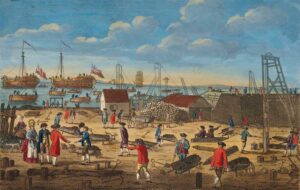
MQ – I started a project on the origins of worker organization in Australia from 1788 to 1900 back in 1982. I wanted to identify every worker organization, union, and informal alliance, political or industrial and put them into a large database. I then started working with Hamish Maxwell-Stewart, a professor of digital history at University of New England in New South Wales who was working on another large database on all convicts transported to Tasmania. With both databases we had a lot of quantitative information on convict workers and we also collected and analyze a lot of qualitative information. I didn’t include convicts initially in my database, but then I did because there were 165,000 convicts who were transported to Australia between 1788 and 1868, and they made up the bulk of the country’s workforce up until about 1840.
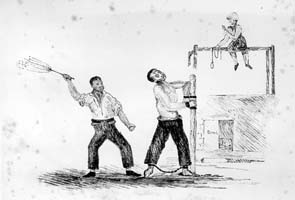
After serving their sentences some convicts became small landholders but many shifted to wage labor. Around 60 percent of convicts were assigned to private employers; this usually occurred shortly after they arrived. They could remain assigned until they served out their sentence or received a ‘ticket of leave’. Transportation was typically for 7 or 14 years or life, though few returned. If assigned convicts committed offences punishments included being sent to a jail, road gang or penal station. A shorter sentence meant the convict could be returned to their master unless the master specified, they didn’t want them back. Masters tended to hang on to highly skilled convicts.
DL – And did these conflicts involve both men and women?
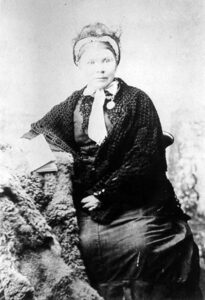
MQ – Yes, both men and women, though predominantly men, but among the women, if anything, their levels of dissent, such as absconding, were much higher.
My colleague Hamish had a database of every convict transported to Tasmania, about 78,000, so that is about half the total that were transported to Australia. Unlike slaves, while convicts were unfree workers they remained controlled by the state. While over half were lent out to private employers, their private employers could not directly punish them for offences but had to prosecute them before a court. And his database had all the details, all the times they were bought before the courts.
DL – And what did you learn from those records.
MQ – What we found was that convicts were charged on numerous occasions, usually at least four times each on average. The workers with higher skills got charged less. Those offences were largely work-related dissent. About two-thirds of those charges were for dissent at work, for refusing to work, for go-slows, all that sort of stuff.
There were hundreds of thousands of cases where convicts were tried for work-related dissent in both Tasmania and New South Wales, which were the two early colonies. So, then we started to count them. We went through the bench books, that is, the magistrates court’s records. Because they were not slaves, they had to be brought before a court. But even better than those records, in one sense, were the conduct records.
The convict system was run by an enormous bureaucracy and they had an archive in Tasmania called CON-31, which was a summary file for every transported convict, every time they’d been brought up before the courts, before they either died
or were freed. So even when the court records had disappeared, the CON-31 records contained a summary of the case. So, the incredible bureaucracy had everything recorded in double or triplicate, a wonderful resource for historical research.
So, we went through all the bench books and CON-31 records, and what we found was that convicts were being brought up and tried for work-related dissent at virtually every district bench on a daily basis, including collective action. That is, convicts taking action, and being charged with insolence (i.e., talking back to their masters), striking or engaging in a go-slow or setting fire to a barn. All of this was happening on a really regular basis, and even really small things ended up in the courts.
The latest count we have is that there were over 11,000 instances of collective action by convicts between 1788 and 1883 and including over 1,700 strikes involving about 50,000 convicts.
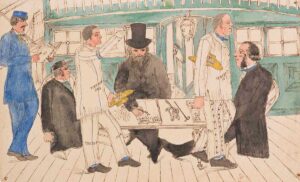
DL – So you’ve discovered this tremendous number of convicts acts of resistance from absences from work to outright rebellion.
MQ- Yep. And there were more violent ones than people had ever realized.
DL – What do you mean by a violent rebellion?
MQ – Well, open revolts where they went out and basically plundered estates or tried to actively resist colonial authority. The biggest single one was in 1804 when about a third of the convict population revolted near Sydney in New South Wales.
DL – Did you then publish your findings?
MQ – Yes. We put all that together and wrote a book called Unfree Workers, which was just on the convict resistance. [Unfree Workers: Insubordination and Resistance in Convict Australia, 1788-1860 (Palgrave Macmillan, 2022).] And this research also forms the basis for “Unshackled: The True Convict Story” which has been exhibited in various places and is now housed at the Woolmers Estate Museum.
DL – And so what was new or important about your research? What did you add to the field of labor studies?
MQ – I think our research alters our understanding of both Australian history and labor history more generally. In terms of Australian labor history, it shows that you can’t understand what happened with free workers unless you look at convicts and semi-free workers. In fact, the first major crisis of worker control in Australia was not in the 1890s when the big maritime and pastoral strikes on the sheep stations occurred, but rather in 1833 to 34 when convicts revolted against the system at a massive scale.
There were over 600 instances of collective action in that one year. And so that was one thing that actually broke the convict system. The convicts early on had been paid, that is up until the early 1820s, but then in 1824 authorities tried to treat them like slaves and convict resistance grew, driving up the price of labor and peaking in 1833-34.
Australia’s first major exports were whale oil and wool. Fine wool was exported to the textile mills of Europe. At that time, you needed products that weren’t perishable, given the distance, and wool was valuable. So, convicts really provided the workforce for the pastoral industry. They also built all the infrastructure, the roads, the bridges, the public buildings, a lot of private buildings, port facilities, all that sort of stuff that actually made capitalism grow very rapidly.
In addition, because they got paid initially, convicts were important consumers. And this is why Australia didn’t turn into a gulag like some other convict penal settlements.
Most of the convicts were transported for petty property crimes, but a significant minority of them were political dissidents and industrial activists. Some 4,000 to 5,000 of them were actually industrial activists or political rebels. This made it possible for the convict laborers to join forces with the free immigrant laborers to create a working-class movement. Together, ex-convicts and free emigrants formed a very effective labor movement, which in the 1850s has secured the eight-hour day and also won political representation that was on a par with the United States.
The alliance that was formed between the workers the free and the ex-convict working class—and this is a very important thing—there was no division. It didn’t matter whether you were transported or had arrived free. There were no divisions within the labor movement on that score. And it was really part of the democratic push in Australia.
There was a revolt by miners at Ballarat in Victoria in1854, where the potential of breaking into open revolution was such that the colonial authorities caved in and Australia got representative government. There was an attempt to create the equivalent of a house of lords in New South Wales which was labeled the “bunyip aristocracy,”
William Charles Wentworth, one of the wealthiest colonists, proposed to establish a hereditary peerage, an Upper House of lords, in the Colony of New South Wales, Daniel Denihay, a politician and the son of a convict, ridiculed the idea, calling it the “bunyip aristocracy,” The bunyip was a legendary, frightening creature of Australian Aboriginal folklore that lurked in swamps and billabongs to take small children.
Denihay talked about the bunyip aristocracy, all these lords on acres that were actually just jumped-up squirts, basically, of no consequence. And then went back to the early corruption of the colonial period and suggested one landholding family (the Macarthurs) should have a coat of arms consisting of two rum kegs because they’ve been associated with the Rum Core, a corrupt group of military officials who had usurped power in the early colony and used rum as currency. The popular satire of a bunyip aristocracy lampooned the idea of a heredity aristocracy out of existence. So therefore, no House of Lords was established. There are no unelected upper houses in Australia. You’ve got elected representatives in upper houses where the election system wasn’t very good, but that’s true of many countries. But we never got a completely unelected body. We never got a peerage in Australia.
DL – What was there any relationship between these convict labors and the indigenous Australians?
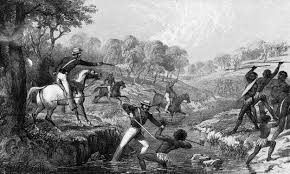
MQ – That is a tortuous story. There were no alliances like you might have seen with slaves with native populations in other countries. But there were tensions because the convict communities were very gender-imbalanced societies. Some convicts on remote estates stole aboriginal women, which led to problems. And so there was payback. In Tasmania, most Aborigines today, the great bulk of them, are descended from families where the women were kidnapped by seal hunters.
Then too, the convicts were used by the big landholders to exterminate the native population. And, on the other hand, on occasion, the threat of aboriginal payback caused the convicts not to want to work in conflictive areas or to demand higher wages to work there. So generally, it’s not a good story.
The biggest state owners did attempt to stop that practice of kidnapping the women from the indigenous people only to the extent that it was causing problems with the Aboriginals themselves. In Tasmania, the Aborigines only started to resist quite actively in the 1820s, but by then it’s too late. There were not enough of them left. And the Europeans got very good at harassing them until they tribal groups collapsed.
On the biggest estates in the Hunter Valley in New South Wales, the Aboriginals were hired to track escape convicts running away. So there were no alliances really formed between the convicts and the Aboriginals.
And unlike some colonial societies, the indigenous population wasn’t an important workforce except as domestics and pastoral workers in remote areas.
DL – You’ve told us a lot about the content of your study of convicts. But what’s important in terms of methodology? When we talked earlier, you said that you were critical of contemporary labor history methodology. What is different and important about your methodology?
MQ – Well, I see myself very much in a Thompsonian tradition of bottom -up history. E.P. Thompson, the British labor historian, wanted to look at all worker organization. He talked about the importance of recovering lost ideas and small groups from history, those that were no longer seen to matter. But actually, they had an influence and it’s important to look at all those individuals and groups.
The great thing about a database is that you can actually include every single individual or organization in that database and it means that every bit of data you pull out leaves a little imprint of that group. But more than that, you can recover those groups because there’s qualitative information on them in the data base. You can talk about those groups in detail and you can discover networks as Monika Schwarz, Hamish, I and others have been doing. You can use the court records in relation to, say, particular convict gangs to find out through the pattern of who’s been in every instance of collective action, who the ringleaders are what are the networks you know these are things that people never thought they’d ever be able to recover.
The problem with a lot of history today, in my view, is it’s been affected by neoliberalism. It has become too individualized. Collectivities are important as agents of resistance and change, particularly formal collectivities, though informal collectivities are also important. And one thing my database enables you to do is to systematically look at both informal collectivities like a temporary association of workers with unions and political parties that are more formal. And so you can get to see that relationship systematically. And that’s what the database shows. There’s a substitution effect over time from informal to formal organization, though informal organization never disappears.
There are today people looking at the slave experience and the convict experience. Well, that’s all interesting and worthwhile. But it’s the collective action that actually changes things. It’s the networks that change history, not the experience of individuals. And what these databases enable you to do is recognize the networks. We’re labeled digital technocrats or numbers-driven by cultural historians but more so than narrative historians when we pick an example, we know that it’s representative.
We also know the limits of our data, so we say in our book on convicts, we say well mostly it comes from court records and police reports, and there are lots reporting collective action. But there is a bias to instances where convicts are defeated. We don’t know the number of instances where they made successful demands because many such victories never went to court. We know victories were more common because of indirect reporting of it. But we don’t know all the instances where they won. There’s no record.
And so, we admit there are limits. But at least when we pick cases or examples to illustrate a point or describe something in detail, we can pick ones we know are representative. When a qualitative historian goes through it, they’ll take an example. But they rarely really explain why it’s typical or how it’s typical. They just select it. Now, I’m not criticizing qualitative history. We use it. Our work is not just statistical. We integrate it with qualitative analysis to flesh things out. This allows us, for example, to describe what happens to a particular road gang like Notman’s road gang near Launceston.
Robert (Bobbie) Notman was the superintendent of a northern road gang near Launceston that acted as a mobile penal station in the period of the early 1830s when one major penal station in Tasmania, namely Macquarie Harbor, had closed and its ultimate replacement Port Arthur was yet to operate. Notman was harsh as were the punishments the magistrates inflicted and notoriously the gang was named after him. Road gangs typically had 100-200 convicts and Notmans was typical in this respect but not in terms of the level of punishment which exceeded all penal stations including Macquarie Harbor which was worse than the better known Port Arthur.
We used both quantitative and qualitative information to explain why that road gang’s dissent eventually changed the system. The impact of the gang on authorities came out of narrative records. But we were only aware that that road gang was the most really active road gang in Australia through statistical research, and before that it was unknown to other historians. Australia has a very important role for convict labor but is convict labor typical of many societies. There were convicts and slaves here; and in the Caribbean you had convicts and slaves; and in America you had indentured workers, slaves and transported convicts,
DL – As well as enslaved Indians.
MQ – Yes, and you need to look at all of them. And so that’s one lesson that Australia is a particularly well documented position on convicts, but we’re also looking in other categories of labor, like indentured workers and free workers, who were also heavily subordinated. But the lessons from our research isn’t just about convicts. It might also be tried more systematically with slaves. We know slaves resisted and rebelled. Mary Turner’s work [Mary Turner, ed. From Chattel Slaves to Wage Slaves: The Dynamics of Labour Bargaining in the Americas, (Bloomington, Indiana University Press, 1995).] was really excellent on that and both from the stage of absconding or running away through to strikes and open revolts. But just like the convicts, we don’t know the scale of that we don’t know now it’ll be harder because the slaves did not have to be brought before the court to be punished but there are records, absconding notices, the estate record, the plantation records. What we need is people systematically using those records to try and construct that experience.
And that means all resistance. Some historians argue, that when people strike that’s resistance, but when they’re bargaining, that’s not resistance. But bargaining is resistance because basically you’re trying to change the terms of the conditions under which you’re employed. Making a demand is resistance. Simply going up and saying, “we want this” is resistance and organization.
So, we need a broader understanding of that and a more systematic study to be able to see both things in the database. I’ve got in worker organization and convicts. Hamish’s database has been integrated, which is what we’re trying to do now and put them on an open platform where everybody can use them into the future long after we’re gone. So common access to these huge databases, because they take an age to construct, but also be templates for other countries to build similar ones. And we’d be able to build a much richer and more comprehensive understanding of the history.
You know, the history of the labor movement in the United States is not simply the history of unions alone. It’s the history of all categories of labor and the levels of resistance. they put up and we needed integrated story. The big explosion in 1833
-34 in Australia, involved free workers. There is a spike in free worker resistance as they form unions too, but the bulk of the spike was due to the convicts.
So, and it doesn’t matter at the end of the day. Free and convict workers reshaped Australian society. When free labor was arriving in large numbers, they’ were arriving into a society that’s was already riddled with decades of industrial conflict.