
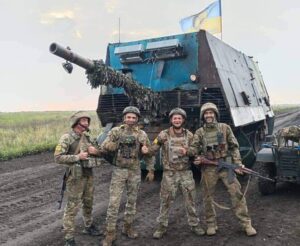
 This short memoir charts the path of a forty-year-old Ukrainian writer and journalist who volunteers for military service days after Russia invades on February 24, 2022. He reaches this decision much to his own surprise while fleeing Kiev with his wife and children. The author describes himself at the time of the invasion as a pacifist, a leftist, a feminist, and a man deeply attached to his children. Artem had been the stay-at-home father of his seven- and nine-year-old sons. I would add to this description that Artem is a moralist committed to being as honest as possible with himself and his readers about the choice he makes to join the army and its impact on how he understands himself and his country.
Artem is a patriot who regards the Russian invasion as a monstrous war crime. He is also something of a romantic nationalist. Artem idealizes and feels great compassion for and guilt toward “real” Ukrainians, the peasants and manual workers, the salt of the Ukrainian earth. The American equivalent would perhaps be respect and affection for “the heartland.” He contrasts these real Ukrainians with his own caste or class, professional and commercial city dwellers. Artem is proud to be a volunteer and proud that leftists of his class were more likely to volunteer than centrists. He is shamed by the fact that the majority of volunteers are working class. Working-class men also fill the ranks of the military because they are drafted—at increasing rates as the war drags on—while middle-class men can readily evade. Artem comes to regard the decision to serve for men like him who have a choice as the test of manhood.
No American generation has faced the choice between serving and avoiding military service since the draft ended after the Vietnam War. But thousands of Americans who feel some pull toward joining up face this choice each year. With his country under brutal attack, Artem sees this choice as primal, existential, for himself as a man. He is of course aware that women volunteer; but it is men who face the choice between joining or shirking while other men go into the army. For women it is a supererogatory choice: No one expects women to serve. Artem discovers that for him the shame of shirking is unbearable while the risks of war and the price of separation from his family can be borne. It is striking that early in the timeline of this memoir Artem resists judging other men’s choices, but after soldiering for two years he renders judgment on the men of his class solely on the basis of whether they volunteer.
Artem is ill prepared for the national and personal crisis caused by the invasion. Despite the Russian armies massed on three sides of his country and eight years of fighting and occupation in the east, Artem was persuaded that a land war in twenty-first-century Europe was “inconceivable”—until bombs fell on Kiev. Something like this attachment to the idea of social evolution or progress, this cognitive dissonance, the idea that a reactionary overthrow is not really possible, infects a good deal of elite liberal thinking in the United States today. The little thought Artem had given to that possibility of invasion led him to expect that he would flee in keeping with his pacifist outlook. Yet within two or three days he decides to enlist. When he tells his wife he finds that she had already understood that he would join the army.
Artem’s decision to enlist is precipitated by the experience of “Spanish shame.” “Spanish shame” is the literal translation of a Ukrainian idiom with no English equivalent. On the first night of their journey west Artem’s family stops in a village where he witnesses a middle-aged villager called back to military service. That man’s son is passing through town on his own flight west. Knowing of his father’s recall, the twenty-something middle-class son skulks and hides and continues his flight. “Spanish shame” is “the feeling you get when someone else does something shame-worthy, but you’re the one who feels ashamed” (18). Artem sees the father uncomplainingly go back into the military while the son takes advantage of the ease with which middle-class as opposed to working-class men can avoid service.
Middle-class advantage derives in part from greater resources. The Ukrainian draft system also advantages the middle class. A man registers at the place of his birth, his official domicile. The bureaucracy loses track of the mobile middle classes, people like Artem and the villager’s son. They don’t live in their birthplaces. When Artem sees the father show up and the son hide, he is overcome with Spanish shame, shame for the action of another. The son allows another man, his father in this case, to go as it were in his place; he evades danger and hardship because other men go.
Artem likens his choice of whether to leave his family or join the army to the seminal Sartrian fable of the youth who must decide between joining the French resistance or caring for his aged mother. The analogy is far from exact. As much as his children need their father, they have Artem’s admirable and competent wife to care for them. His pain at separation from his sons is the hardest thing Artem endures in the military. Artem subscribes to Existentialism. Like Sartre he believes, and his account of two years in the military accordingly documents, that you become the choices you make; they shape your character and outlook. Artem scrupulously and at some length examines his decision to join. He distinguishes his choice from that of others who in his estimation deserve more honor, display more courage. For example, men who come back from abroad to join or men who unlike Artem are in combat units. For men who have faced this choice or can imagine facing it, these moral vignettes may be acutely evocative.
For other readers the memoir would likely be of most interest because of what it reveals about Ukrainian society and its army. Ukrainian military volunteers skew older than in typical militaries. Many volunteers are men forty to sixty years of age, fathers and grandfathers. Their bodies and their frames of references are not those of younger men we expect to find under arms. Their backs ache. They pass around pictures of their children and grandchildren, not their girlfriends. Military life also reveals the class fissures in Ukrainian society. The peasants and manual workers volunteer and suffer the draft, the middle classes may choose to volunteer; the plutocrats and their children are nowhere to be seen.
When the invasion starts, Artem is filled with love for every Ukrainian and every blade of Ukrainian grass. After two years in the army he loves only his comrades in arms. Eerily, after the first few months of the war, it becomes possible to live a fairly normal civilian life in Kiev, despite civilian casualties and forays to bomb shelters. Coming to Kiev on leave as a seasoned soldier, Artem cannot tolerate the normal rhythms of the city and the enjoyment of small luxuries around him. He has developed as much contempt for men who “fight on the economic front” or “the cultural front” as for those who fled the country. Nor can he bear the memories of his own pre-war life sparked by his return to the city. He cuts his leave short to return to his unit. He is comfortable only with his comrades.
His feminism is also tested. Before the war he had easy answers: Equality of the sexes. At the beginning of the war, he is careful to acknowledge the contribution of women caring for children on their own while sending money and supplies to aid the military effort. After two years in the army, he is struck by the persistence of sex roles in war. Men go off to fight while women stay with the children. This is as true in his own pre-war progressive circle of friends as it is for Ukrainians of all classes. He is unsure where his revisionist thinking will lead him and hesitates to express it. He notes but does not elaborate on the presence of many feminists among the female volunteers. Nor does he elaborate on the bitter remark, “If being killed or disabled in a war is the ‘price of male privilege’ it is a high price to pay” (98).
Artem is still in the army at the close of this memoir. He is a very different man in many ways, although still very much a self-examining moralist. He is a soldier, albeit one who desperately misses his children.
 If you’ve read this far, you were pretty interested, right? Isn’t that worth a few bucks -maybe more? Please
Leave a Reply