The Bund: A Committed History
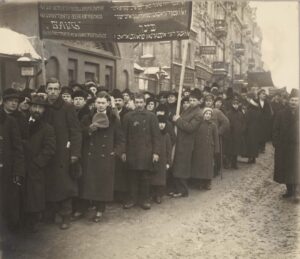 The rave reception for Molly Crabapple’s Here Where We Live Is Our Country is a breakthrough for Jewish radicals. After decades of Zionist hegemony within U.S. Jewish communities, including on the left, suddenly Crabapple’s avowedly, even fiercely anti-Zionist book is on the New York Times bestseller list. What’s more, the Times review calls the book a “terrific” history of “a Jewish political movement that opposed ethnic nationalism of all stripes” and specifically “fought the Zionists.”1 Nor is the Times alone.2
This breakthrough clearly reflects the strength of the movement, including among young Jews, against the Israeli genocide in Gaza and in Palestine more generally. Over the course of sixty years, the image of Israel for left-wing Jews has shifted from an overblown idealization of kibbutzim (though Black Power advocates and anti-imperialist activists rarely bought into that) to a picture in which the ethnic cleansing of Palestine (the Nakba) in 1947–49 rightly takes center stage.
The reasons are obvious. The devastation of Gaza since 2023 and the parallel settler violence on the West Bank are a perfect illustration of what Palestinians have long called the “ongoing Nakba.” In fact, the scale of the killing since 2023 exceeds the violence of the original Nakba in 1947–49. Although the repression of Palestinians inside and outside Israel’s internationally recognized borders (the Green Line) has worsened qualitatively, decade by decade, since 1967, what is most striking to radicals in solidarity with Palestine today is the underlying continuity in Zionist ideology and policy. It is hard to imagine that the image of Zionism on the left will ever recover.
Young Jews in solidarity with Palestine, to the extent they identify as Jews, therefore need a different conception of Jewish identity. Crabapple’s history of the Bund is tailored to give them this new identity. This is visible in the praise that Jewish Voice for Peace, the main organizational U.S. expression of progressive anti-Zionism, has lavished on Here Where We Live Is Our Country on its Facebook page.
Much of the praise the book has received is richly deserved. While it draws on earlier histories of the Bund,3 Crabapple’s work is far more accessible and livelier than her predecessors’. It is also explicitly informed by her own activist background. She makes clear how her radical commitment goes back to her activism in Occupy fifteen years ago. She illuminates some Bundists’ hybrid identity with her own (Puerto Rican/Jewish). When she describes the poverty and claustrophobic debates of exiled Bundists outside the tsarist empire, she draws vivid parallels with the Syrian refugees she wrote about as a journalist in Istanbul.
Anti-Zionist and Anti-Religious
The Bund’s fierce opposition to Zionism—which it called “the most evil enemy of the organized Jewish proletariat” and “a Siamese twin of antisemitism”—speaks directly to the anti-Zionism of solidarity activists today. The Bundists knew what they were talking about. Crabapple cites Bundist leader Viktor Alter’s reports from Palestine in 1924: his accounts of anti-Palestinian discrimination practiced in Labor Zionist unions and settlements prefigure later anti-Palestinian discrimination in Israel. So do interwar Zionists’ “conquest of land,” sealed in Crabapple’s words when they “brutally expelled farmers who had lived there for generations.”
The Bundists’ predictions of what Zionism in power would become were farsighted and chilling. In the words of Bundist leader Henryk Erlich, “If a Jewish state should arise in Palestine, its spiritual climate will be: eternal fear of the external enemy (Arabs)…the climate in which reaction and chauvinism ordinarily flourish.”
Crabapple acknowledges the Bund’s mix of constant rivalry and occasional cooperation with their fellow Jewish Marxists of Left Poalei Zion (Labor Zionists). As she writes, “A young person looking for pride, purpose and community could easily go either way; many switched between groups.” The Bund and Left Poalei Zion both initially tried, unsuccessfully, to gain admission to the Communist International. As Crabapple notes, they ultimately fought side by side in the 1943 Warsaw Ghetto Uprising. Although she tends to grant the Bund a monopoly on the spirit of doikayt (“hereness”), Left Poalei Zion tried to combine “hereness” with an orientation toward Palestine, and persistently organized in Yiddish.4
After the Holocaust, however, Zionists in European displaced persons’ camps returned the Bundists’ earlier hostility manyfold. “Bundists were marginalized, intimidated, or simply erased,” living “like hidden Jews in the days of the Spanish Inquisition.” In March 1948 Zionist leader David Ben-Gurion approved a military draft for Jewish refugees in Europe, including anti-Zionist Bundists, and “levied fines, threw [resisters] out of apartments, and denied them their meager supplemental rations,” subjecting them to “night raids and mob beatings.” Thus was the new Israeli army built. And when former Bundist Warsaw Ghetto uprising leader Marek Edelman was invited to speak at the Polish commemoration of the revolt’s fiftieth anniversary, the Israeli prime minister did not wish to appear on the same platform.5
Along with anti-Zionism, Bundists had a strong preference for Yiddish (the everyday language of most Jews in the tsarist empire) over Hebrew (the language of religious liturgy and Zionism), Russian, or Polish (the languages of the bourgeoisie). Initially this was a practical matter of reaching Jews in the language they were most comfortable speaking and reading. Later Bundists developed into fervent advocates of Yiddish literature and culture.
This was not the original Bundist position. Crabapple recognizes the preeminent role of Vladimir Medem as a theorist of “national cultural autonomy,” whose affinity Enzo Traverso has noted with the Austro-Marxist Otto Bauer. But her account of the Bund’s fierce debates on these issues neglects Medem’s original “neutralist” position: as long as Yiddish speakers were granted equal rights and facilities, he refused to predict whether Jews would remain a distinct Yiddish-speaking community or end up assimilating.6 Crabapple, by contrast, seems to share young U.S. Jewish radicals’ attachment to Yiddish today, though this is more sentimental than practical.
Crabapple may not be as much in tune with young Jewish radicals today when she describes Bundists’ hostility to religion, however. Sympathetic accounts of pro-Palestinian encampments at U.S. universities have described the space given to Jewish religious rituals and holidays (alongside and in harmony with Muslim rituals and holidays). By Crabapple’s account, the old Bundists would have been unpleasantly surprised.
In general, Bundists and rabbis shared a strong mutual antagonism. The Warsaw Bundist newspaper Folkstsaytung, for example, was delivered on the Jewish Sabbath, leading to the excommunication of its entire staff by the Warsaw rabbinate. For Bundists, “the synagogue was only an edifice on which to slap up posters,” specifically on the Sabbath, secure in the knowledge that Orthodox Jews would feel unable to tear the posters down until Saturday at sunset, Crabapple writes. “At a Bundist gathering, the pastries might be fried in pig fat, just to make a point.”
The Bund as Faction
Crabapple is in general a loyal defender of the Bund’s positions within the Russian socialist movement. Sometimes she fails to do full justice to other currents in the Russian Social Democratic Labor Party (RSDLP), of which the Bund, together with the Bolsheviks and Mensheviks, was an integral part for most of the years until 1917. Since the Bund tended before 1917 to side with the Mensheviks, Here Where We Live Is Our Country loads the dice against the Bolsheviks, sometimes in ways that are in tension with its politics.
Crabapple chides the Bund, for example, for walking out of the 1903 RSDLP congress instead of staying to back the Mensheviks against the Bolsheviks, even though the congress was rigged against the Bund with the Mensheviks’ connivance. (Though they made up a majority of Russian socialists at the time, Bundists were given only five delegates.)
Increasingly aligned with the Mensheviks in 1905–17, the Bund was divided along the same lines as the Mensheviks. In these debates, Crabapple usually sides with the Menshevik-Internationalists around Julius Martov, an ally of Bundist Raphael Abramovich, rather than the right-wing Mensheviks allied with the Bundist Mark Liber. For example, she supports Martov’s and Abramovich’s opposition in 1917 to Russia’s continuing participation in the First World War. “These former radicals…postponed their old promises of world peace…to an ever more distant tomorrow,” she writes.
Yet despite her anti-war stance, she approves of the Bundists’ and Mensheviks’ commitment to unity in a single organization of both pro- and anti-war socialists. Although Lenin tried to win over left-wingers like Martov, Crabapple sides with those who rejected any unity with the Bolsheviks. She argues that the best outcome would have been a broad coalition government of all the socialist parties, though surely a coalition of pro- and anti-war socialists would have been doomed to paralysis.
She justifies her anti-Bolshevik attitude with some questionable arguments. She sees Bolshevism as a reflection of Lenin’s “few scruples,” and Stalinism as the culmination of Leninism. Critical sympathizers of Bolshevism like Samuel Farber7 have agreed with her in condemning the Bolsheviks’ repression of the nonviolent soviet opposition, such as the Menshevik-Internationalists and their Bundist allies, during and after the civil war. In her account of the pre-1917 RSDLP, however, Crabapple exaggerates both Lenin’s autocracy and Bundists’ advocacy of “a decentralized coalition of autonomous groups.”
Like other Central and Eastern European socialists, the Bund followed the German model of a congress that decided on policy and a central committee that determined tactics. As for Lenin’s practice, Crabapple is too inclined to draw “a straight line” from 1903 petty factional divides to “a mass grave” under Stalinism. She ignores the balanced picture painted by observers like Victor Serge and Marcel Liebman,8 who described Bolshevism’s open, democratic side.
There is no room in her indictment for the Lenin who tolerated open opposition by other Bolsheviks after 1905 to his call for participation in elections to the Duma, and even in November 1917 by his close lieutenants Zinoviev and Kamenev to the seizure of power. In reality, neither the Bolsheviks nor the Bundists imposed monolithic unity across the board. But for the Bolsheviks, unlike the Bund, questions of war and peace were a red line.
Crabapple does give credit to the Bolsheviks (as well as Nestor Makhno’s anarchists) for trying to stop antisemitic pogroms carried out during the civil war by the Red Army as well as the Whites. Still, “Everyone killed Jews,” she writes—about 200,000 of them in 1918–21. Antisemitic violence by Red Army units is an undeniable and shameful fact. But she acknowledges the reality that Lenin condemned the pogroms, that the soviet government “imprisoned or shot instigators,” and that the killing of Jews was mostly the work of Whites. This was a crucial factor in the majority decision by the Bund in April 1920 to dissolve their organization and join the Communist Party (Bolsheviks).
The Bund and the Yevtsektsia
Nevertheless, hostility to the October Revolution results in a one-sided tilt in the second half of Here Where We Live Is Our Country. Crabapple celebrates the Bund’s accomplishments in independent Ukraine in 1918–20 in the face of bloody pogroms and in interwar Poland despite overwhelming state-backed antisemitism. By 1938 the Bund was by far the most popular Jewish party in Poland, where it built a strong array of institutions, from schools to sanitoriums, in the large Jewish community. As late as 1939, there were more Jews in Warsaw alone than in all of Palestine.
But Crabapple almost completely ignores the even more impressive achievements of the Belarusian and Ukrainian soviet republics in the 1920s—largely the work of the Communist Yevsektsia (Jewish Section), mostly composed of and led by former Bundists. Although Crabapple occasionally cites Zvi Gitelman’s books on this period, she barely mentions his account of the Yevsektsia’s work, his main focus. Even worse is her complete omission, from her narrative and even her bibliography, of Elissa Bemporad’s excellent book Becoming Soviet Jews.9
As Bemporad recounts, before the Yevsektsia was dissolved under Stalin in 1931 and (in Crabapple’s words) “Bundists-turned-Communists ended up in mass graves” in the late 1930s, Belorussia and its capital, Minsk, were a showcase of secular Yiddish culture. The Communists formally decided in 1919 to favor Yiddish as a modern, working-class Jewish language, and made it one of the Belarusian SSR’s four official languages, alongside Belarusian, Russian, and Polish.
Yiddish was a language not only of newspaper and book publishing, but also of theater, radio, film, the post office, election materials and even a Central Jewish Court. Writers like Sholem Aleichem were celebrated as Soviet Jewish heroes. Minsk had a public Yiddish-language school system, from kindergarten to the Yiddish-language section of the university.
Yiddish was also spoken at citywide Communist Party meetings. Much of this was in continuity with the work of the pre-revolutionary Bund. For example, the main Yiddish-language newspaper in Minsk was the former Bundist newspaper. Despite Polish Bundists’ valiant efforts against daunting odds, they could never equal these Soviet achievements. Whatever Crabapple’s reasons for opposing it, only the October Revolution made possible these triumphs of secular Yiddish culture.
Where We Live Is Our Country is a much-needed, moving, at times brilliant portrait of the world of interwar Yiddish-language socialism. It eloquently shows the tragedy of this world’s destruction by Nazism, Stalinism, and, in the end, by Zionism. It fully merits the praise it has received. It is to be hoped that the story Crabapple tells can eventually be integrated into a more complete history of pre-Holocaust Jewish revolutionary socialism.
Notes
1. Max Strasser, “What Does Judaism Look Like Without Zionism?,” New York Times, April 6, 2026.
2. For other positive reviews in the liberal media, see: Sam Adler-Bell, “‘For Leftist Jews, the Bund is a Model’: The Radical History Behind one of Europe’s Biggest Socialist Movements,” Guardian, April 7, 2026; Adam Hochschild, “A Dream of a Socialist Commonwealth,” New York Review of Books, May 28, 2026, pp. 35-36.
3. Notably Henry J. Tobias, The Jewish Bund in Russia from Its Origins to 1905, Stanford University Press, 1972, and Bernard K. Johnpoll, The Politics of Futility: The General Jewish Workers Bund of Poland, 1917–-43, Cornell University Press, 1967. Crabapple also acknowledges the help of veteran Bundist historian Jack Jacobs; see his book Bundist Counterculture in Interwar Poland, Syracuse University Press, 2009, and his edited volume, Jewish Politics in Eastern Europe: The Bund at 100, NYU Press, 2001.
4. Samuel D. Kassow, Who Will Write Our History: Rediscovering a Hidden Archive from the Warsaw Ghetto, New York: Vintage Books, 2007, p. 28.
5. Idith Zertal, “The Sacrificed and the Sanctified: The Construction of a National Martyrology,” Zemanim 12.48 (1994), cited in Daniel Boyarin, Unheroic Conduct: The Rise of Heterosexuality and the Invention of the Jewish Man, Berkeley: University of California Press, 1997, p. 306 n. 109.
6. Enzo Traverso, The Jewish Question: History of a Marxist Debate, Leiden/Chicago: Brill/Haymarket, 2019, chap. 4.
7. Samuel Farber, Before Stalinism: The Rise and Fall of Soviet Democracy, London: Verso, 1990.
8. Victor Serge, From Lenin to Stalin, New York: Pathfinder, 2005; Marcel Liebman, Leninism under Lenin, Chicago: Haymarket, 2017.
9. Becoming Soviet Jews: The Bolshevik Experiment in Minsk, Bloomington: Indiana University Press, 2013, reviewed by me for New Politics: “Bolshevism in Yiddish,” New Politics 56 (Winter 2014).