Palestine in Context
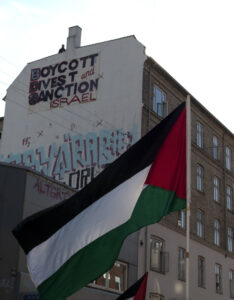
The genocidal Israeli assault on Gaza since October 7, 2023, is the latest development in the ongoing process of dispossession and erasure aimed at Palestinians since the Nakba of 1947–48. People around the world have mobilized in solidarity with Palestine to demand an end to these horrors, including campaigns for boycott, divestment, and sanctions in response to a call to action by over 170 Palestinian civil society organizations in 2005. This book is an essential toolkit for this global movement, mapping out the global power relations that sustain Israeli settler colonialism in a way that offers a compass to those navigating the complexities of building effective resistance.
Adam Hanieh, Rob Knox, and Rafeef Ziadah have written an engaging book that provides a sophisticated marxist analysis of the ongoing Israeli regime of erasure and dispossession directed against Palestinians. This book uses an anti-racist, anti-colonial, and ecological marxist lens to examine the centrality of oil-centered capitalist development to the politics and economics of the Middle East and the foundational role of racialized settler colonialism in the Israeli project. The book is engagingly written and intentionally brief, clearly designed to reach activists and help them develop the analysis they need to mobilize sustainable movements founded on strong connections of solidarity. “Real solidarity,” they write, “comes from understanding the systems that create injustice, and building against those systems in ways that strengthen us all” (p. 85).
Oil-Centered Capitalist Development
One of the challenges facing activists mobilizing in solidarity with Palestine is to understand how Israel gets away with this ongoing campaign of genocidal erasure. The governments of the United States, Canada, Britain, and other Western powers not only ignore Israeli violence against Palestinians, but actively support it through extensive aid, the provision of diplomatic cover, and the suppression of domestic solidarity movements. Activists sometimes see Israeli impunity as the result of pressure applied to governments by a pro-Israel lobby. Of course, there are pro-Israel advocacy organizations at work, but fundamentally the orientation of Western governments toward Israel reflects their own stakes in the system of racialized and colonial global power relations oriented around oil-centered capitalist development.
The book maps out the process that made Israel such a valuable partner as the United States sealed its place as the dominant imperial power and capitalist economies were increasingly fueled by oil and its by-products. The period after World War II saw a major reconfiguration of global relations in fossil capitalism. Oil overtook coal as the most important source of fossil fuel in the most industrialized economies, though coal use remained high. The rise of oil, and with it the proliferation of petroleum-based plastic technologies, was associated with extensive economic restructuring, transforming the ways things were made and distributed, as well as global supply chains. The oil reserves and geographic location of the Middle East made it a crucial player in oil-centered capitalist development.
The postwar world also saw a major reconfiguration of global capitalist power relations, with a decline in the role of the older imperialist powers such as Britain and France and the rise of the United States, which emerged as “the most dynamic force in global capitalism, rivalled only by the Soviet Union and its allied bloc” (p. 20). The emerging imperial power of the United States and its allies was challenged by a global wave of anticolonial uprising. In the Middle East, oil production was controlled by a small number of big Western firms. This control was brought into question by national liberation struggles in the region connected to the postwar wave of anticolonial revolt. Gamal Abdel Nasser, who in 1952 overthrew the regime of British-supported King Farouk in Egypt, argued that oil was “an unalienable Arab right” (p. 23).
The key place of the Middle East in oil-centered capitalist development meant that the United States and its allies needed to try to shape the politics of the region over the long term. One fundamental element of their strategy in the region was to secure their relationship with a regional power that was not susceptible to domestic popular uprisings or national liberation politics. Israel, founded on a racialized settler colonialism that buffered it against these mobilizations, proved to be an ever more important partner.
Racialized Settler Colonialism
The book provides a specifically marxist account of the role of racialized settler colonialism in establishing Israel’s place in regional and global power relations. The Israeli state is based on a system of settler superiority organized around specific racial hierarchies that are “part of a longer history of colonial expansion and imperial domination” (p. 65). The settler-colonial project involves very specific forms of racialized class formation, prioritizing settler labor, and deploying or excluding the labor of Palestinians in specific ways, varying with the political priorities of the moment. This system of settler superiority can only be sustained through a relentless and brutal regime of dispossession and erasure directed at Palestinians.
The racialized dehumanization of Palestinians renders them “legitimate targets of violence” (64). Meanwhile, the settler population is cast as the unique bearer of European standards of civilization in the Middle East, making Israeli a reliable ally for Western powers. As Hanieh, Knox, and Ziadah argue, “Israeli settler-colonial capitalism functions through its racialization of Palestinians; and it is this process of racialization that produces anti-Palestinian racism” (p. 64).
The Israeli state uses this racialization to routinely categorize Palestinian political expression as terrorism. The book shows how the Israeli states’s everyday violence against Palestinians and its dehumanizing administrative regime of surveillance and control is justified as “security.” This racialized and Islamophobic conception of terror and security has been generalized globally, so that the expression of solidarity with Palestinians has frequently been cast as support for terrorism requiring a security response that attempts to stifle mobilization.
One important contribution of this book was to demonstrate the way this set of racialized relations, with its specific conception of civilization and the threat of terror, is expressed in international law. In the early twentieth century, as Britain issued the Balfour Declaration to establish a Jewish homeland in Palestine, the Palestinians who already lived there were seen as insufficiently productive (according to specifically capitalist criteria) to warrant full political and legal rights, and therefore “they were entitled to be dispossessed of their lands and ‘civilized’ by the advanced Europeans” (p. 68). With the establishment of the Israeli state in 1948, this racial logic expressed through international law included a conception of Palestinians as an ongoing threat, warranting military targeting and killing as “self-defense.”
Palestinian Resistance
Palestinians have mobilized to resist this racialized settler-colonial project. The book shows that one of the key challenges for Palestinian resistance has been to overcome the fragmentation caused by the ethnic cleansing of the 1947–48 Nakba. Many Palestinians ended up as refugees, now constituting the largest refugee population in the world (p. 35). Those remaining were divided between those who stayed in Israel and attained citizenship and those who lived in the West Bank and Gaza, occupied by Israel since 1967.
The three basic demands of the movement for boycott, divestment, and sanctions reflect the historic goal of the Palestinian resistance to build a unified movement that addresses the situation of all Palestinians. First, end the occupation of the West Bank and Gaza. Second, grant full rights to Palestinian citizens of Israel. Third, recognize the right to return of Palestinian refugees driven from their homes, their land, and their communities. Overcoming fragmentation has been at the core of the Palestinian politics of resistance.
The book examines one of the crucial moments in this history of resistance, the popular uprising of the First Intifada beginning in December 1987. Palestinians mobilized in ways that infuse the activity of meeting basic needs for life-making (food, housing, health care, culture, childcare, and education) with active resistance and struggles for liberation. This deliberately short and tightly argued book unfortunately does not have the space to delve into the rich and multifaceted history of this uprising to provide readers with a sense of the transformative power of the Palestinian resistance at that time, but no single source can do everything.
The Israeli response to this uprising was ultimately threefold. First, the Israeli state mobilized violence; killing, injuring and imprisoning large numbers of activists. Second, the Israelis deployed new administrative measures to regulate and further fragment the Palestinian population, including passes, checkpoints, and curfews. Finally, the Israelis worked toward normalization, partnering with layers of the Palestinian leadership to craft the Oslo accords in 1993, which launched a very limited form of self-government—the Palestinian Authority. This book richly examines this politics of normalization, showing how it served to “present a Palestinian face to the occupation” (p. 39) while opening up new possibilities for Israeli integration into the regional economy of the Middle East.
The United States is fully committed to this strategy of normalization, “integrating Israel more fully into the broader regional order by deepening its political and economic ties with Arab states, especially Saudi Arabia and the other Gulf monarchies” (p. 89). As I write this review, we are getting news of the current planning by the United States and Israel for the future of Gaza, which aims to deepen this normalizing integration. The book identifies the effort to eliminate the United Nations Relief and Work Agency (UNRWA) as one important dimension of this normalization strategy, “an attempt to redefine millions of Palestinian refugees as so-called economic migrants, stripping them of their right to return, and recasting the challenge facing them as one of ‘absorption’ into neighboring countries” (pp. 93–4). This book offers crucial resources to help activists mobilize effectively to defeat this genocidal normalization, guided by a rich understanding of the power relations we are challenging and the potential lines of solidarity to build the power from below.