
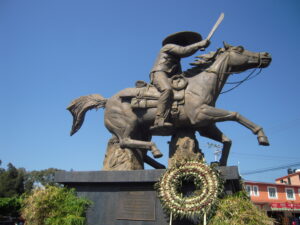
 Latin America historian Greg Grandin, always aware of the subtexts of events and processes, combines a literary and cultural flair that makes America América: A New History of the New World both readable and enjoyable. His book is a carefully documented and choreographed study of the Western Hemisphere from Patagonia to Alaska. Grandin divides his 700-page tome into fifty chapters with seductive titles, often ironic and humorous, that keep the reader engaged, surging forward with continuous interest. Yet it is a dense book meant to be read slowly while evaluating its themes.
Rarely do historians of South America have the breadth to study Latin America and North America in depth as Grandin does. He gives us a history that continually parallels developments in South and North America as well as continually considering the impact of European politics into and through World Wars I and II. The author is confident that his book will be a dramatic departure from past histories of the Americas. He believes it is more than a history of the Western Hemisphere, but rather a study that connects the global order through the present conjuncture. It does.
Grandin shows how our present-day North America necessarily turned out as it has because of the changing twists and turns among British, French, Spanish, and U.S. interests. Grandin shares the view of Venezuelan Francisco de Miranda, who fought in the U.S. War of Independence, the French Revolution, and the Latin American wars of independence, that the U.S. upper-class business and political elites were provincial and pedestrian. When Jefferson and Adams spoke of America they were referring to the United States. When Miranda and Simón Bolívar used the word América they meant all the Americas, north and south.
The introduction itself is a dense forecasting of the book’s novel interpretation of the historical development of the Western Hemisphere. Grandin rightly gives much space to the powerful critique by the theologian Bartolomé de las Casas of the dehumanization of the indigenous Americans in his early- to mid-sixteenth century appraisals of the Spanish conquest. He saw the Native Americans as very human and the equal of their enslavers. Grandin quotes las Casas as writing, “The Spanish came like starving wolves, tigers, and lions, and for four decades have done nothing other than commit outrages, slay, afflict, torment, and destroy.” The massacre of indigenous peoples represented, “the greatest genocide in history,” wrote historian Tzvetan Todorov. It is estimated that the indigenous population was decimated by 85 to 90 percent in a hundred and fifty years, upwards of 56 million people perishing by the mid-seventeenth century. Las Casas believed the entire conquest as “unjust, iniquitous, tyrannical, and worthy of the fires of hell.” But Las Casas lost the debate on his defense of indigenous people to other Catholic theologians who saw the conquest as just and believed that the Spanish monarchs had both the spiritual and temporal power of sovereignty over the world’s people, both believers and heathens.
Grandin then turns his attention to the Puritan settlements of North America. As in Spanish America, the English plundered, destroyed, and, above all, killed and drove out the indigenous peoples. In fact, the English considered the land as being an empty place—vacuum domicilium—that could be pacified and settled at will. As opposed to the Spanish religious debates about the role of Latin American indigenous peoples, in North America there were no theological misgivings about the terrors unleashed in New England.
Grandin gives important space to John Locke’s Two Treaties of Government as one of the bedrock theories of government that saw in the new settlements of North America an application of his theory of 1689 as applicable to the creation of a civil society that existed prior to politics and money. Locke’s views were based on the belief that this “New World” was pristine, inhabited by “artless peoples whose simplicity offered a window back in time to what Europe was like before written records and political society.” As the colonists decimated the original inhabitants of North America, they soon embarked on the importation of slaves to build the new society.
Grandin turns his attention again to Latin America where the break with Spain was led by the privileged criollos but the passion for independence came from below—from the truly oppressed and dispossessed. Simón Bolívar made clear the connection to the United States. In his first public speech on the thirty-fifth anniversary of the Fourth of July (1811), he spoke of the need to break the “ancient chains.” Crucially, Grandin makes clear the marked differences of the first South American constitutions from those of the United States as they asserted social rights prior to the rights of “life, liberty, property and other natural rights.” By 1819, Bolívar led a unified revolt that helped found Gran Colombia, uniting what are now Venezuela, Colombia, Ecuador, Panama, northern Peru, and western Guyana. Mexico achieved its independence in 1821. Subsequently, in Latin America, there were continental crises and disunity.
In the United States, European powers were removed and the rights of Native Americans were swept away. While in North America many Native Americans were exterminated or perished from disease, with the survivors confined to reservations, in South America, indigenous peoples, be they Mapuches or Mayans or others, were permitted to remain in their historical lands based on uti possidetis, the rights of possession, defined by legal demarcations as derived from Roman law.
Latin America’s later confederations did not achieve their aspirations, despite the Panama Congress of 1826, which did not eventuate in unity but in splintered republics. The United Provinces of Central America broke into Guatemala, El Salvador, Nicaragua, and Costa Rica, and war between Brazil and Argentina led to the creation of the Republic of Uruguay. The death knell of a Latin American confederation was evident and so noted by Bolívar’s last letter to a friend in which he commented that after two decades of endless warfare, he was certain of only a few things: America is ungovernable, to serve the revolution is as futile as plowing the sea, and history is running in reverse; America is heading toward “primitive chaos.”
The two Americas were clearly divergent by the nineteenth century. The separateness among the South American countries no doubt led to the establishment of the Monroe Doctrine of 1823, which warned the European powers against further attempts at intervention in Latin America. Though the European possessions in the Caribbean remained, Mexico, Chile, Gran Colombia, and Argentina were to be free of European colonization. The United States’ sense of universal ideals was mixed with westward expansion at the expense of Native Americans and Mexicans. In Latin America there tended to be less race war than class war against the landed barons. Grandin writes that in nineteenth-century Latin American countries such as Brazil, racial frontier violence was never as central a component of national identity as it was for the United States.
By the mid-nineteenth century, the Latin Americans began to distinguish themselves from the Anglo-Saxons of the North and not in benign terms. Slowly, by the end of the nineteenth century, increasingly after the Spanish-American War, the North Americans were censured as Yankee imperialists. Carlos Calvo and José Martí more and more criticized the Northern behemoth. With the United States’ growing imperial taste for intervention in Latin America, Carlos Calvo, an Argentine jurist, published what became known as the Calvo Doctrine, which held that foreigners in Latin America were owed the rights of national citizens but were not awarded additional rights, like calling on their government to intervene politically or militarily on their behalf. José Martí had warned that a U.S. war with Spain would not be to free Cuba but to take Cuba. Cuba did manage to maintain its nominal independence, saddled as it was by the Platt Amendment, but the United States began to be seen as a New Empire in the making. Marines landed in Cuba, Guatemala, Mexico, and Honduras for short periods and occupied Nicaragua, Haiti, and the Dominican Republic for decades.
In essence, the first major rebuttal against U.S. dominance in the Western Hemisphere was the Mexican Revolution, which began in 1910. As Grandin writes, “It was a revolt by a poor country not just against Anglo-Saxon capitalism but also against its justificatory myths and enabling laws.” The United States had billions of dollars invested in Mexico in mines, utilities, agricultural land, ports, and factories, and North Americans living in Mexico owned half of all Mexican property value. Francisco Madero, the leader of the uprising against Porfirio Diaz’s dictatorship, was with the complicity of U.S. ambassador Henry Lane Wilson removed from office and later assassinated by Victoriano Huerta, leader of the military coup. The death of Madero unleashed another rebellion that led to years of bloody struggle led by the historic figures of Emiliáno Zapata, Pancho Villa, and Venustiano Carranza opposing the Huerta regime. The struggles pitted “los de abajo,” the underdogs, against the landed and capital interests and caused the death of more than a fifth of Mexico’s people. Woodrow Wilson, as Grandin writes, “drifted left” and aligned with the mass uprising representing the Mexican peasants, workers, nationalists, and socialists. Mexicans, Wilson was quoted as saying to journalist Walter Lippmann, have the “sacred right of Revolution.” And he proved as much by landing marines in the port of Veracruz ostensibly because Mexican officials failed to salute the U.S. flag on a docked ship; U.S. firepower inflicted hundreds of deaths on the Huerta military garrison.
The revolutionary forces who defeated Huerta then split, with the Conventionists of Zapata and Villa fighting against Carranza’s Constitutionalists. With the assassinations of Zapata and Villa, the more moderate leaders of the Mexican Revolution—Carranza and Álvaro Obregón—won the revolution and wrote the radical Constitution of 1917, a document of historical significance.
The Mexican Revolution culminated in the world’s first democratic-socialist constitution. The constitution’s Article 123 gave the state preeminent powers as well as social and labor rights for its citizens unknown elsewhere. It provided a guaranteed minimum wage, equal pay for men and women, and welfare, education, and health care provisions. It also protected the right to unionize, strike, and receive social security upon retirement.
Article 27 was a centerpiece of progressive legislation. Land and water belonged to the nation and couldn’t be alienated, and the new legislation provided the resources for the societal benefits of the Mexican people. One of the article’s most advanced provisions gave the state the right to confiscate private property to distribute to landless peasants in agrarian communes known as ejidos. It allowed the Mexican government the right to regulate private property on behalf of the public interest, what could be considered an early form of eminent domain.
Finally, Article 3 provided that the state would provide free, secular, and mandatory education through high school.
The 1917 Mexican Constitution preceded the first Soviet Constitution of 1924. So when Luis Cabrera, an intellectual close to president Carranza, was asked if Bolshevism was a problem in Mexico, Cabrera answered that Mexico had nothing to fear from Bolshevism because its “best part” had already been “incorporated” into Mexico’s Constitution.
In the United States in the 1930s, FDR established the “Good Neighbor” policy, initially related to the world but subsequently directed at the Western Hemisphere, that is, giving up the right of intervention. This sentiment was well intentioned but was followed by contradictory U.S. policies after World War II. Importantly, Grandin reminds his readers that fascism stalled and political liberalism and social welfare reforms took place not because of a socialist or labor party. FDR’s “New Deal” made significant changes in working-class lives as his multiracial and multiclass coalition swelled.
Under FDR, the United States was largely successful in creating an anti-fascist majority, as was progressive Mexican president Lázaro Cárdenas, who called the largest protest march in Mexican history, condemning Germany’s persecution of the Jews as well as providing two million dollars to aid the Spanish republicans, 40,000 of whom went to Mexico after Franco’s victory. Again Grandin demonstrates his capacity to connect Latin America not only to the United States but to the world at large. As a poignant reflection, Grandin writes of the ideological and heroic commitment of socialist Salvador Allende, health minister in Chile’s popular front government during World War II, and Communist poet Pablo Neruda in saving Spanish exiles and Jewish refugees entering Chile.
On the U.S. front, Vice President Henry Wallace, a staunch progressive close to FDR and head of the Board of Economic Warfare in 1941, saw the future for Latin America was to help win the war but to “win the peace later on.” In 1943, Wallace sought to broaden the New Deal in Latin America to keep conservatives in check, traveling eleven thousand miles, visiting factories, mines, and plantations. Received by enthusiastic crowds, he told a rally, “We are of the New World, we North and South Americans.” Elsewhere he gave the message, “The working population of the continent is the strongest and the only safeguard of democracy against fascism.” As many readers will know, the tour hastened Wallace’s marginalization and paved the way for the red-baiting Senator Harry Truman to replaced him on the Roosevelt ticket in 1945, affecting the ending and aftermath of World War II.
Interestingly, Latin American nations, perhaps because of the impact of the Mexican Constitution, approached the United Nations meetings with their focus on political, social, and economic rights, including the right to work, to organize labor unions, to enjoy rest, leisure time, and adequate pay, and to have access to basic needs of food, housing, health care, and education. Most of these proposals became part of the Universal Declaration of Human Rights. Twenty of the fifty nations that signed the Charter of the United Nations in 1945, bringing the organization into existence, were from Latin America. Latin America also had a significant impact on the post–World War II military alliances. In 1947, the United States became a member of the Rio Pact, a hemispheric mutual defense treaty. In 1949, as the Cold War emerged, NATO was established modeled on the Rio Pact. In 1954, SEATO was formed, also based on the Rio Pact. John Foster Dulles, an early stalwart of the Cold War, said, “there would have been no NATO, no SEATO, no Rio Pact without the contribution of Latin America,” while Churchill said, “There would have been nothing,” but for Latin America.
Grandin then turns to a theme that has always intrigued economists the world over. It was Latin Americans, mainly economists, reacting to the U.S. and international lending organizations and the various policies that were aligned with them and others, that departed from the classic economic principles of international trade. I would emphasize that the debates revolved around the uneven terms of trade between the United States’ high value-added exports and the lower-priced raw materials and agricultural exports of Latin America. For the Latin American economies, the ascendancy of the U.S. economy and its multilateral dominance became the problem. Raúl Prebisch, founder of Argentina’s Central Bank, became critical to this debate. Prebisch contended that there was a structural imbalance between the manufacturing and raw material–exporting countries. Again I would add that Prebisch argued that binational trade locked lesser-developed countries into continual underdevelopment. Prebisch’s most famous proposition regarded the need for Latin American economies to embark on import substitution industrialization. The Latin American economies had to grow inward and industrialize.
The assassination of Jorge Gaitán, a very popular progressive candidate for the presidency of Colombia in 1948, was a major watershed event in Latin America and had its roots in the past and its impact going forward. The elimination of this popular anti-establishment leader led to the Bogotazo uprising that destroyed much of central Bogota and put oligarchic Latin American governments into the crosshairs of future reformers and revolutionaries. His death resulted in years of struggles between liberals and conservatives known as La Violencia. It has always been significant for me that at the time of Gaitán’s murder Fidel Castro was in Bogota as part of a contingent of activist students. Its impact on Fidel Castro could be measured in that in only five years he began the successful 26th of July movement that ousted Fulgencio Batista, military dictator of Cuba.
Grandin notes that at the same time, the Bogotazo fell in famously with the deepening Cold War in which the United States was engaged in a global anti-communist campaign. With the support of many Latin American dictators in the 1950s, namely, Batista, Trujillo in the Dominican Republic, Duvalier in Haiti, Stroessner in Paraguay, Odría in Peru, Pérez Jiménez in Venezuela, and Somoza in Nicaragua among others, the United States began a far-flung counterinsurgency campaign against worker and peasant mobilizations in Latin America. So Latin America became one sphere for the deepening of the Soviet versus U.S. struggle for world domination. One of the most blatant cases of U.S. imperial intervention was the 1954 overthrow of the progressive Guatemalan president Jacobo Árbenz by a cabal made up of the CIA and the United Fruit Company because Árbenz’s land reform program threatened to distribute land to peasants working the banana plantations. Árbenz was ousted and Castillo Armas was installed as president by the CIA after a military-backed invasion from Honduras. Grandin writes of the reversal of Árbenz’s policies: the execution of activists, imprisonment of peasants, and the resulting decades-long civil war. I would add that Fidel Castro was in Mexico at the time of the ouster of Arbenz preparing for the rebellion against the Batista dictatorship.
Patterned after the U.S. involvement in Guatemala, the Eisenhower government followed by JFK’s government thought the interventionist model could be repeated. In Cuba, Fidel Castro’s policies of land reform via the expropriation of landed estates, and nationalization of utilities and U.S. industrial interests gave rise to U.S. government fears. When U.S. oil companies in Cuba refused to process oil the Soviet Union was sending to Cuba, Castro nationalized the refineries and Eisenhower cut Cuba’s sugar quota, which led to more confiscation of U.S. property. The Cuban Revolution of 1959 resulted, this time, in the U.S.–supported Bay of Pigs invasion of Cuba in 1961 (a notorious failure). But U.S.-backed coups were successful in the 1960s in other Latin American countries such as the Dominican Republic, Guatemala (again), Honduras, and even in the much larger country of Brazil in 1964.
Grandin writes that by the end of World War II, Latin America had influenced the great powers, at least theoretically, to recognize the sovereign equality of all nations and abrogate the doctrine of conquest and it provided a model for a world system of mutual interests and respect. I would argue that in practice Latin American governments, though achieving independence early in the nineteenth century, have largely had no answer to U.S. imperial dominance in the Hemisphere, as Grandin himself explains. Grandin could also have spelled out the important intellectual dependency writers who have made a major contribution to political economy theory adopted worldwide. Writers such as Andre Gunder Frank, Fernando Cardoso, and Enrique Faletto whose works in the 1960s and 1970s were very impactful in their critiques of the modernization theory promoted by W.W. Rostow. Rostow had written of the lock-step five stages of modernity from traditional economies, preconditions for takeoff, drive to maturity, and high mass consumption. Dependency theorists argued that this theory ignored the contexts of Latin American dependent, colonial structures and uneven terms of trade. Grandin later in this chapter writes that Fidel Castro took positions against the orthodoxy of Soviet Union communism becoming too «ecclesiastic.» I believe there is much evidence that it was rather Che Guevara who made the major critique of the Soviets as supporting national interests and coexistence. This has been corroborated by Castro›s creation of a Cuban Communist Party structure similar to that of the Soviet Union, Cuba›s principal benefactor.
In Grandin’s final chapter, he writes of the destruction of Chilean socialism by the Augusto Pinochet coup of 1973 and the economic shock theory emanating from Milton Friedman’s so-called Chicago Boys at the University of Chicago who proposed deregulation, privatization, and austerity. I would add that the ending of the Allende experiment with democratic socialism reverberated around Latin America and was furthered by coups in Argentina and Uruguay with the radical restructuring of their economies and the triumph of liberalism and, later, neo-liberalism.
Greg Grandin finishes his massive tome with an epilogue, not a conclusion, perhaps rightly since his book is an important epic, a dramatic and studious rendition of the two Americas. In his final commentaries, he necessarily has to turn to a deepening of a unilateral U.S. interventionism not confined to Latin America but globally as well. While in the United States itself, a financialized, deindustrialized economy has led with the rise of Walmart and Amazon to the end of Main Street. The United States ramped up its police and military spending, in a sense occupying its own country, magnified, of course, in Donald Trump’s second administration, that would back-end Grandin’s book. I believe Grandin is a bit too sanguine that Latin America continues to hold the authoritarian right at bay with a coherent social-democratic agenda. Yes, this is true for Mexico under Claudia Sheinbaum, Brazil under Lula da Silva, and Colombia under Gustavo Petro, and others, but there are serious outliers like Javier Milei of Argentina, Nicolás Maduro of Venezuela, Daniel Ortega of Nicaragua, and many others. But Grandin adds an important perspective in which he eulogizes Latin America for being that part of the world where the left most continues its “fidelity to universal humanism.” He adds that Latin America today is the most peaceful continent in terms of state-to-state relations, and its social-democratic heritage is often led by indigenous-led social movements and political parties. The second proposition would face many counter arguments I suspect.
Grandin in his epilogue writes that Latin America’s commitment to a social-democratic left and its progressive gender, race, and sexuality equality outlook is because of its struggle against Spain that combined independence with emancipation from subsequent governmental repression. This seems too optimistic a historical view given that it has in the two centuries often experienced oligarchic rule and civil society repression as Grandin so well describes. His more convincing conclusion notes the difference between Latin America humanism and North America’s long history of denials of indigenous and Black rights and its later oppressions within civil society. Grandin closes his magnum opus with a positive take on a promising social-democratic Latin America with a negative regression worldwide led by the United States but including, among others, the authoritarian nationalisms of Russia, China, and Israel.
 If you’ve read this far, you were pretty interested, right? Isn’t that worth a few bucks -maybe more? Please
Leave a Reply