Ariella Aïsha Azoulay, The Jewelers of the Ummah: A Potential History of the Jewish Muslim World
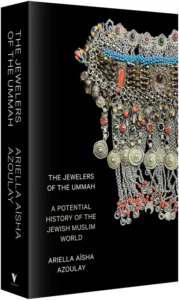 What if the stories of the people, their possibilities, the world they shared with others, their crafts and skills have been buried under the rubble of imperialism? Then our task would be to remove the rubble and try to find and save what exists underneath. But what if those who destroyed these worlds also removed the rubble, created new worlds and everything now appears clean? The book The Jewelers of the Ummah: A Potential History of the Jewish Muslim World aims to tell the story of a common Jewish Muslim that used to exist in the Ummah, and was destroyed by French colonialism. The author’s aim is to bring in conversation about the colonization of Algeria and the colonization of Arab Jews in order to claim that even though this world is destroyed the destruction can still be refused and the common world can still be reclaimed and revived. In this deeply personal book Azoulay explores empire, family, identity, assimilation, and conversion in order to explore how Jewish and Muslim people were constructed as the enemy of each other in order to serve the invented histories of colonialism and the Judeo-Christian tradition.
As the title states, this is a book of a potential history of the Jewish Muslim world and not the history of this world. This might make the readers wonder if this book is about a hypothetical scenario of what might have happened, or the author’s wishful thinking of what should have happened, or whether it is an entirely fictionalized version contrary to the “rea” history of this world. For this reason, it is important first to engage with the notion of the potential as it is developed in Azoulay’s work in order to understand the kind of history the author narrates in the book. Throughout the book, Azoulay effectively explains what it means to think in terms of potential history and how we can practice potential history. If there is an ‘imagine if’ in her narrative of these events, Azoulay says, it should not be perceived as the arbitrary thinking of a single creative mind. Rather, practicing potential history through the reconstruction of concrete events is a thoughtful, careful, and often painful process of recovering suppressed facts and possibilities that have been erased by the imperial version of history of what happened to colonized peoples and their shared world.
It is worth mentioning here, albeit for an audience unfamiliar with her work, that the notion of a potential history is introduced in her previous work Potential History: Unlearning Imperialism wherein Azoulay argues that the world as we know it today is the product of imperial violence. Azoulay, nonetheless, does not only point to the violence inflicted by colonialism and the plunder of other’s worlds but shows how the violence is maintained and reproduced by imperial institutions and practices such as archives, museums, universities, photography, and concepts of human rights and citizenship. These institutions, she writes, were formed to normalize the plunder of these worlds. And as she reminds us elsewhere, “the imperial nature is not only of the institution—it is also of the many disciplines taught within it.” The discipline of history which she targets in this book erases colonial violence and presents the imperial and colonial version of the destruction of diverse worlds as “neutral” presentation of facts. This is why in The Jewelers of the Ummah: A Potential History of the Jewish Muslim World, the author interrogates the Jewish Muslim world in the Ummah and powerfully rejects the narrative that tells us that that this world is over. To refuse to accept that this world only existed in the past is to practice potential history—thus to refuse colonialism and its material and discursive violence that allow the reproduction of the violence.
Azoulay has written the entire book in the form of letters addressed to her kin such as her father, great-grandmothers, mother, and children and also those she calls her elected kin such as Franz Fanon, Hannah Arendt, Benjamin Stora, Ghassan Kanafani, and Sylvia Wynter among others. The epistolary genre she employs, however, is not just a discursive exercise as she argues in the book, but an embodied effort to revive the lost Jewish Muslim world in the company of others who also rejected the destruction of the Jewish Muslim world. Although there is a long history of the practice of the epistolary genre, these letters are not unidirectional in which the author takes on the task of teaching another something about the world. The effort is rather, Azoulay tells us, to explore an anticolonial language and to inhabit in the space of the letters the Jewish Muslim world that is declared “lost.” Moreover, and precisely because she engages with diverse people from scholars to family members, concepts, objects, and space she transcends the language of expertise in which one teaches another, and rather the effort in her work is collective by bringing forward the people who refused yesterday and the people who are refusing today but also the people, like her mother, who accepted their colonial transformation and how she did not recognize or refuse to recognize the fabricated stories she was made to believe were hers.
The book begins with a poignant letter she writes to her father, and I have chosen to discuss here the example of the transformation of the central square of Algiers to an aesthetic that fit the French urban syntax. In the letter she considers sixty to seventy postcards and drawings to discuss Djâama el-Jedid mosque in Algiers. Azoulay considers these postcards and drawings to imagine the space not as it appears, but as it once was. The French had destroyed the majority of mosques and synagogues in Algiers but when it was the turn of Djâama el-Jedid mosque an officer realized that if they proceeded with another destruction there would be no spaces left for worship. This realization led the French to not destroy it physically; however, by destroying everything else around it such as shops, other worship places, and streets surrounding it, Azoulay maintains that all that was saved was only the building itself. The mosque, she writes, which now stands alone in the middle of the square, was once surrounded by other buildings, shops, streets, and the people close and around it. The mosque that emerged, though the same, was mediated by the wide field of vision in which the French could display it as an object of their own taste. But the gaze of her ancestors was different from theirs: her ancestors could arrive to the mosque through small alleys and crowded streets. And this arrival offered itself the possibility to diverse communities to meet and greet each other which facilitated diverse groups to live together in a shared space which enhanced a common life despite religious differences. The destruction, in other words, points not only to a material colonization of the land and its wealth but by depriving Algerians, both Muslims and Jews, of their cities, Azoulay shows us that the people are colonized too by being forced to experience their world in the ways their colonizers want them to.
This way of engaging with photographs is Azoulay’s reconstruction method. When she engages with visual objects and particularly photographs, she explains that she does not stop at what she is told to see, but rather she looks for traces that allow her, and us, to take into account elements that have been overlooked or the narratives that try to determine what we are supposed to see in the visual objects we encounter.
However, the separation of Muslim Jews from Jewish Muslims was not only achieved by the destruction of the infrastructure. Imperial and colonial violence employs various methods and strategies to assimilate people to imperial forms of belonging and dissociate them from who and what they once were. In order to support this, Azoulay engages with colonial citizenship offered to Jews, the destruction of their shops, crafts and their deprivation from jewelry making, which was a fundamental part of the Arab Jewish identity. In order to understand how we arrived at the massive expulsion of Jews from Algeria we need to consider closely these strategies and practices. First, we need to look at the French citizenship imposed on them which differentiated them from their other companions. When French citizenship, Azoulay writes, was “offered” only a few applied; nonetheless, five years later they were forced to accept French citizenship. This conversion cannot and should not be seen as a free choice, she maintains throughout the book, since their world was destroyed, they had no other choice. By discussing the French citizenship forced on them, Azoulay points to a strategic and planned dissociation of Arab Muslims and Arab Jews. She suggests the term Jewish Muslims and Muslim Jews which for her indicate their interconnectedness which was precisely under attack by colonial practices. She explains this in her letter to her great-grandmother Marianne. Azoulay explains in the letter that she was puzzled by her parents’ decision to name her Marianne after those who colonized their country. The answer, she suggests, is to be found in the disruption of the naming system of colonialism, which was also part of a French administrative system that controlled the colonized by forcing them to register births, deaths, and marriages with the French municipalities. And despite her parents’ obedience, the author was delighted when Marianne herself decided to name her own daughter Aicha (the third and beloved wife of the Prophet Muhammad). By making this choice, Azoulay says that her great-grandmother declares that “Islam is my culture, alongside my Jewish faith, and my Jewishness is also my neighbor’s culture, whose faith is Islam.” Our ancestors, Azoulay writes, who were Arab Jews, Berber Jews, and Muslim Jews before Algeria’s colonization by France did not use to think of themselves as a group apart from Muslim Arabs. It is the French citizenship—among other colonial practices—which attacked the Jewish and Muslim interconnectedness. It is this differentiation of the Jewish Arabs and Muslim Arabs that contributed to the massive expulsion of Jews from Algeria in 1962.
The title of the book is the Jewelers of the Ummah. The Ummah is the Islamic nation or community, and the Jews were the jewelers in this broad community. Arab and Berber Jews were mostly those who worked with metalsmiths and made jewels. Muslim Arabs would visit their shops to ask for jewels and their work with these metals allowed them to frequently interact with the Muslim Arabs. Unlike European Jews who were not allowed to work with guilds, Arab Jews could practice such professions in the Maghreb. When the French colonized Algeria, they destroyed their shops in which they were selling their craft or prohibited them from jewelry making. However, this prohibition of one’s craft has wider implications because, as Azoulay maintains, to be dissociated from one’s craft is to be dissociated from who one is and their way of belonging in a world with others. Their work with these precious metals is what also allowed them “to be part of and apart from their fellow world-members.” Muslim Arabs would visit their shops to ask for jewels made by them and their work with these metals allowed them to frequently interact with the Muslim Arabs. Depriving the Arab and Berber Jews from producing jewels, not only deprived them of who they were, but also cut across the interconnectedness and conviviality of Arab Jews and Arab Muslims.
In the letters she writes to Frantz Fanon and Hannah Arendt, the question that preoccupies Azoulay is why these thinkers accepted uncritically that Arab Jews were European Jews. Since Azoulay points to this differentiation of the Arab Jew from the Muslim Jew as the main strategy that led to the destruction of their world and to the expulsion of Arab Jews, it seems very reasonable that she keeps on wondering why these thinkers who have made a major contribution to how she herself thinks did not refuse the Europeanness imposed on her ancestors. In a letter Azoulay writes to Frantz Fanon, she states that his work on colonial disorders is important, but she wonders why Fanon did not see Algerian Jews as colonized people too. When Fanon worked in a clinic in Blida, in Algeria, he placed Algerian Jews who had become French citizens in the same wards as Europeans, and by seeing them as Europeans, Azoulay writes, he could not treat them for their colonial disorders, and these people themselves lacked the language to understand and articulate their disorder.
Similarly, in the letter she writes to Arendt the same question persists: why did Arendt fell into the trap of attaching “Jews” to “their mother country through their French brethren?” Why did Arendt participate, albeit unwillingly, in the differentiation of Jews from Muslim Arabs that led to their eventual departure and loss of indigenousness in the land? One possible answer to why these thinkers perceived Algerian Jews as European Jews could be that they both relied on European Jews to understand Jewish Muslims, but these European Jews had already been “converted by European institutions,” Azoulay maintains, meaning that they too had been socialized to see Algerian Jews and Algerian Muslims as two separate categories. Or for example in the case of Frantz Fanon, he relied on Jewish interpreters in Algeria, but these interpreters had been converted through the French citizenship and made to forget themselves that they and their ancestors were colonized too. Therefore, they could not tell Fanon that Arab Jews are not European Jews despite being French citizens.
Although this explanation can provide us with some understanding, a more important common denominator emerges when one carefully reads the letters she sends to Fanon, Arendt, and Benjamin Stora. The answer, as I see it, lies in a particular line where Azoulay writes that “after 132 years of colonization, neither Muslims nor Jews were willing or could completely shed the Frenchness that had become theirs.” In the letter she writes to historian Benjamin Stora, she insists on asking him why, in his work, in which she herself first learnt that Algerian Jews were expelled, Stora does not hold the colonial regime and the main actors who destroyed this world accountable. The reason why the colonized themselves are unable to articulate on colonization and what it took from them, Azoulay argues, is because assimilation through education allows colonizers to ensure that the children of the colonized speak like them, think like them, to make sure that these children will not turn against them.
The assimilation by France was a crime against humanity she writes that destroyed the forms of belonging that existed before the invasion. This process of assimilating Arab Jews was instrumentalized in order to create a single category of ‘the Jew.’ And if many of us today have a consolidated category of the Jew in our mind this is because of the carefully curated diverse colonial practices and strategies carried out by both a European and a Zionist project. Without the assimilation of the Jewish people, there could never have been a single category encompassing all Jews, which allowed Zionists to invade and colonize Palestine and create a single state for all Jews as if they were ever one homogeneous group seeking a place to live together and which allowed Zionists to construct the Arab as the enemy of the Jew. Assimilating these diverse communities was a European “solution” to their Jewish “problem” because in the Muslim Jewish world there was never a requirement for Jews to assimilate. However, while we read about the conversion and the colonization of the people and the land, Azoulay maintains that these processes should not be accepted as final. If her own mother for example was converted in the human factories of the Zionist colony in Palestine and came to see her daughter as a traitor for refusing that identity, Azoulay in a beautiful line writes that the colonizers “counted on the second and third generation to forget but they didn’t take into consideration that the fourth and the fifth generation might rebel.”
The last letter of the book addresses the Palestinian thinker and author Ghassan Khanafani. In her letter, Azoulay tells Kanafani about a woman who contacted her to discuss William Shakespeare’s The Tempest. The woman’s name is Tama and visits Azoulay to discuss the story of the Algerian witch Sycorax as developed in the play. Both women, Ariella and Tama, discuss in the company of each other all the colonial elements in the play such as exile, appropriation of Sycorax’s knowledge by Prospero who colonizes the land, murder and/or exile. However, in the letter Azoulay say that she soon understands that Tama is not there simply to discuss Shakespeare’s portrayal of Sycorax, so she asks her what her name Tama means. Tama then reveals to her that the reason she has visited Azoulay is precisely her name. She tells her that the last words of her grandmother on her deathbed were: “I am the one who gave you the name Tama. You will thus be named until the day you learn what your real name is.” She has experimented with many European languages to find out what her name means and it was a Palestinian friend who told her that the Arabic equivalent of the name Tama is Saffiya. She tells Azoulay that when she heard the name Saffiya her heart started beating because she remembered her grandmother and her father arguing and mentioning the name Saffiya.
At this point, the reader finds out that Tama is a character invented by Azoulay. Azoulay herself tells Kanafani, whose book Return to Haifa inspired her to invent Tama, a character who does not exist in the original book. In Kanafani’s book Return to Haifa, Said and Saffiya are a Palestinian couple who were forced to leave Haifa and were unaware of their son’s Khalid fate who was left behind. Khalid, named Dov by his Jewish parents, was told the truth of his Palestinian origin. Dov (Khalid) cannot accept that he is Palestinian and when he had his daughter Tama (Saffiya) he never revealed to her their origin. Nonetheless, Tama manages to find out the truth about her name and thus of her origin. This invented character by Azoulay brilliantly shows how colonization produces people severed of their identities, ancestral land, and family ties and is the culmination of her anti-colonial language. Here the children of the colonized people, both Tama and Azoulay, in the company of each other deconstruct colonial thought and reclaim their pre-colonial forms of belonging.
This is a brilliant work, published at a critical moment when we are witnessing the Palestinians’ genocide by the Zionist colony in Palestine. Azoulay offers a nuanced narrative on how people who lived together for two millennia mainly in peace were converted into other identities which constructed the Arab as the enemy of the Jew. She tells us about the borderless community on the Maghreb and how colonial projects destroyed these worlds and how they also instrumentalized the destruction to invade and destroy Palestine. Most importantly she deconstructs the notion of “the Jew” by showing in the book that Jews have always been diverse communities. It is the language and strategies of European and Zionist colonialism that have transformed these communities to one single unified category. In The Jewelers of the Ummah: A Potential History of the Jewish-Muslim World, Azoulay succeeds in telling the story that has waited so long to be told: that Arab Jews and Muslim Jews were never each other’s enemies but lived together in communities based on care and mainly in peace.
To conclude: the book is about conversion, colonization, potential history, and the refusal of colonial language and thought in order to claim that destruction can be and is still opposed. In the way I read it, this is also a book of a feminist coalition of refusals uttered by the women she addresses in her letters such as grandmothers, great-grandmothers, thinkers, and strangers she never encountered. A powerful decolonial language of refusals uttered by Marianne, Julie, Aicha, Ariella, Sycorax, Miriam, Tama, and Saffiya and we the readers who have the honor of learning these intimate stories should remember that the space of the letter is open and declares itself a hospitable place for all of us to visit, to claim our own anticolonial languages, join their effort, and add our names.