Los Angeles Fires
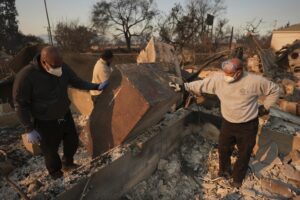
The Los Angeles fires of January 2025 were a shocking and horrific catastrophe. The first concern of course is the threat to the lives of hundreds of thousands of people. This goes beyond just saving people from being burned to death in the fires themselves. What kind of lives and livelihoods will be left for the hundreds of thousands of displaced people and families, after the fires have done all their damage to the Los Angeles metropolitan area? How does a society resettle the inhabitants of the second largest city and metro area in the United States?
In addition to the humanitarian and ecological disaster, there is also the great political danger that the Los Angeles fires will amplify the threat of mass deportations faced by millions of immigrant workers. Trump has surely already aimed to take advantage of the disaster and have ICE target vulnerable immigrants uprooted and displaced by the fires, some of them living in shelters. Even for Latinos with U.S. citizenship, how will they prove it to authorities if they have lost essential pieces of documentation in the fires? Outrageous actions by Trump and MAGA in the midst of a catastrophe need to be opposed by a mass protest movement in response. In his first week in office Trump disgustingly threatened to withhold federal disaster relief funds from California, unless Los Angeles adopts his racist anti-immigrant Voter ID policy that undermines voting rights especially for Latino and Black people. It is heartening to see that the fires did not prevent large numbers of people from mobilizing for immigrants’ rights protests against Trump and ICE in Los Angeles in the first week of February.
For the past century the ruling class in Los Angeles has targeted Black people with many of the worst forms of racial oppression. The legacy of racial segregation and racist redlining practices in the real estate industry have forced Black people to live in areas known to be the most vulnerable to environmental catastrophes exacerbated by the impact of climate change. Many Black senior citizens have worked hard their whole lives to achieve the dream of homeownership in the Altadena area, only to lose their homes in the Eaton Fire. A study by researchers at UCLA showed that the homes of Black residents in Altadena were destroyed or severely damaged disproportionately more than the homes of non-Black residents.i Even the hysterical reaction of far-right MAGA supporters against the Super Bowl halftime performance by Kendrick Lamar and Serena Williams’ Crip Walk dance is an example of the racist hostility against the expression and celebration of the Black culture of Los Angeles and Compton.=
It is also necessary to call out and condemn the capitalist attacks on workers and oppressed people that are being carried out by Democratic Party politicians such as California governor Gavin Newsom. Last summer, Newsom ordered local officials in California to force homeless people to leave their encampments, and then threatened to take away state funding from cities and counties that did not comply with his order. Newsom’s coercive threat was akin to Trump’s method of coercive threats toward California about withholding federal disaster relief funds for recovery from the fires. In 2023, Newsom vetoed a bill that would have provided striking workers with unemployment insurance, and he vetoed another bill that would have granted important protections for laid off workers, including the extension of such protections to long-term contract workers. Even when it is necessary for socialists to make tactical decisions to take the side of Democrats against Trump’s attacks on democratic rights and freedoms, it is crucial to never forget that Democrats like Newsom remain capitalist to the core, the class enemy of workers and oppressed people.
The Los Angeles fires are symbolic of the collapse of American capitalist society in so many ways. Unlike most other large cities in the U.S., which have centuries of history of development, Los Angeles is a relatively young metropolis: It grew from a small town to a big city in the late 19th and early 20th centuriesii, but it kept growing to become the mega-metropolis that it is today (growing larger than Detroit by 1950 and Philadelphia by 1960) during the post-war boom after World War II.iii Its enormous development was fueled by the mass adoption of the automobile, and its growth was enabled by very artificial modern engineering: It makes no natural ecological sense to have such an enormously populous metropolis—Greater Los Angeles has over 18 million residentsiv—located in an area utterly lacking any natural water supply to support such a population. But post-war American capitalism made it happen anyway. For many people on the East Coast, the relocation of the Brooklyn Dodgers baseball team to Los Angeles was the ultimate symbolic expression of this stage of post-war American capitalism. Los Angeles had the space for huge parking lots for all those automobiles, space that Brooklyn lacked.
Los Angeles was rivaled only by Las Vegas, New York City, Dallas, and Miami as a symbol of American bourgeois decadence and hedonism in the middle and late 20th century, reaching its apex in the 1970s and 1980s. The Hollywood Hills, Sunset Boulevard, Malibu, and so many other iconic landmarks of the Los Angeles area were recognized by billions of people around the world in this era, seemingly immortalized in film as well as in other forms of mass media. Its status in this era was celebrated in songs such as “I Love L.A.” by Randy Newman in 1983v, criticized for its excesses in songs such as “Hollywood Nights” by Bob Seger in 1978, and also condemned for its racist greed in songs such as “Burn Hollywood Burn” by Public Enemy in 1990. Now in 2025 many of these iconic landmarks are literally burning to the ground, in a perfect storm brought about by climate change that has been greatly exacerbated by the very types of excessive capitalist measures that built Los Angeles into a mega-metropolis in the first place. It is the Earth taking its vengeance against decadent capitalism.
The Los Angeles fires are a catastrophe of epic and biblical proportions. It is certain that significant works of literature and other artistic forms will be dedicated to portraying the story of the rise and fall of metropolitan Los Angeles. But for political purposes, the main immediate tasks of revolutionary socialists in the United States include the defense of immigrants, Black people, and other workers and oppressed people in Southern California who are and will be in great danger, both from the catastrophe of the fires and from the ongoing racist and anti-immigrant attacks by Trump, MAGA, and other capitalist forces.
Equitable Disaster Relief: “It’s Really Hard to Do Within Capitalism”
As the Los Angeles fires were still burning, a controversy erupted online when the actor and musician Mandy Moore made a social media post asking for charitable donations for family members of hers. Moore merely brought greater public attention to a social reality that has always existed under capitalism and in class society: Disaster relief efforts almost always take care of wealthy people much better and much more quickly than working-class and poor people; they take care of white people much better and much more quickly than people of color.
A recent article in The Guardian, commenting on the Mandy Moore controversy, discussed the broader question of inequitable disaster relief in general. The article cited a quote by disaster historian Jacob Remes, regarding equitable disaster relief:
“‘It’s really hard to do within capitalism, because all of these structures and policies are focused on property,’ Remes says. ‘When you’re trying to restore property, you end up restoring property.’”vi
Leon Trotsky could not have said it better himself. “It’s really hard to do within capitalism” is exactly the point of Trotsky’s theory of permanent revolution and his method of transitional demands. The point is that decaying capitalist society cannot afford to satisfy even the basic democratic demands of working class and oppressed people, including simple humanitarian demands such as equitable disaster relief. Thus, according to this theory and method, it will require a socialist revolution even to carry out such basic democratic demands and simple humanitarian demands in a reliably consistent and lasting manner.
They Built This City on Racist Genocide and Capitalist Anti-Worker Violence
The early history of Los Angeles, from the Mexican-American War in the 1840s through its booming growth in the 1920s, was a vile saga of racist genocidal violence against Mexicans and indigenous people in the 19th century, followed by decades of openly brazen and violent capitalist suppression of workers’ unionization struggles in the early 20th century.vii
In the period after the U.S. conquest of California and other Mexican territories in the war, from the late 1840s through 1870, when Los Angeles was still a town with a small population, it already developed a reputation as the “toughest” and most lawless town in the western U.S. and possibly in the nation. Mobs of white settler vigilantes committed lynchings of Mexicans almost twice a year for two decades. The U.S. flagrantly disregarded the clause in the Treaty of Guadalupe Hidalgo that required the granting of U.S. citizenship to indigenous people of the conquered Mexican territories, not granting this right until well into the 20th century. California’s state constitution deemed indigenous people to be non-persons under the law. White people could drive indigenous people out of their own homes and properties, or simply kill them, with complete legal impunity. As one report stated, the white people of Los Angeles in this period decided that the “quickest and best way to get rid of [indigenous people’s] troublesome presence was to kill them off, [and] this procedure was adopted as a standard for many years.”viii Chinese immigrants were also victims of vicious racial oppression in this period, subjected to brutal exploitation as laborers who built the Southern Pacific Railroad that connected San Francisco and Los Angeles in 1876. The most notorious act of anti-Chinese violence was the Los Angeles Chinese massacre of 1871, when a mob killed 19 Chinese immigrants at a time when fewer than 200 Chinese people lived in the city.
Thus the white settler ruling class of Los Angeles effectively carried out a genocide of the indigenous population and subjugated Mexicans and Chinese people in the middle and late 19th century. Having accomplished this genocide, the white capitalist class of Los Angeles then combined a campaign for economic expansion with an openly brazen and violent campaign against any and all efforts by workers to form labor unions in the city. The Los Angeles Times newspaper played a leading role in this anti-union campaign in the early 20th century.
In 1907 the AFL began a union organizing campaign in Los Angeles. In response, in 1909 the municipal government of Los Angeles banned free speech on public streets and on private property. In 1910 the Los Angeles Times building was bombed, one of the most notable actions of the early 20th century labor struggles in the United States. Unfortunately, renowned defense lawyer Clarence Darrow let down the labor movement in this instance by persuading the accused McNamara brothers to plead guilty. This undermined the socialist electoral campaign of Job Harriman and contributed to his electoral defeat in 1911.
The IWW continued its own union organizing campaigns in the Los Angeles area in the following decade. The Los Angeles police violently attacked an IWW rally on Christmas Day in 1913, killing a person in the process. A protest movement erupted after this police attack, and in response the authorities declared martial law in Los Angeles. The Los Angeles Times even described taco vendors as “cultural subversives”.ix
The last major organizing campaign of the IWW in the Los Angeles area in this period culminated in the longshoremen’s strike in San Pedro in 1923. The LAPD formed a “Red Squad” to arrest strikers, and placed 1,200 dock workers in a stockade in Griffith Park. The Los Angeles Times stated that “stockades and forced labor were a good remedy for IWW terrorism.” Author and activist Upton Sinclair was arrested for reading the Bill of Rights of the U.S. Constitution on the private property of a strike supporter. The strike was broken when the Ku Klux Klan and the American Legion raided a meeting at the IWW union hall, attacking men, women, and children.
The Los Angeles Economy in the Early 20th Century
Thus, having effectively exterminated indigenous people, subjugated Mexicans and Chinese people, and crushed the labor movement—all with unbridled and deadly violence—by the middle of the 1920s the white capitalist ruling class of Los Angeles was free to pursue its own enrichment through unrestrained economic expansion with very little restriction or resistance. Among the largest sectors in the area’s economy that emerged in the early 20th century were the oil industry and the film industry. (Of course the agricultural industry was always a major part of the area’s economy.)
Although Southern California does not have a popular reputation as an oil-producing region, in the way that places like Texas and Oklahoma do, in fact the Los Angeles area was one of the largest oil-producing regions in the world in the early 20th century. By the 1920s the Los Angeles area produced as much as 25% of the total global oil supply.
The film industry, on the other hand, is virtually synonymous with the name Hollywood in popular culture around the world. The development of the technology for “talking pictures”—films with sound—emerged in the 1920s and went hand in hand with the growth of the Hollywood film industry.
As the growth of these new industries attracted a larger and larger population to the Los Angeles area, the demand for housing for the hundreds of thousands of people moving to the region naturally created a boom in the real estate industry as well.
The L.A. Capitalist Class’s War on Mother Nature
There was, however, always a huge problem with unrestrained economic expansion and population growth in the Los Angeles area: The city is located in a semi-arid coastal basin, with almost no rainfall at all during the six-month period from May through October each year. Los Angeles only has an average of about 34 rainy days per year, producing an average of only about 12-14 inches (300-350 millimeters) of rain per year. For comparison, San Francisco in Northern California has an average of about 71 rainy days per year, producing an average of about 23 inches (585 millimeters) of rain per year. Moreover, the entire Southern California region receives substantially less rainfall and precipitation than Northern California does, as the following map illustrates very clearly:
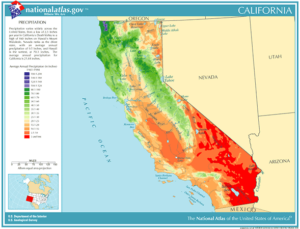
As the map vividly shows, a city such as San Francisco is located in rather close proximity to the high-rainfall regions of Northern California. In fact, California’s two largest rivers, the Sacramento River in northern California and the San Joaquin River in central California, both flow together into the Sacramento—San Joaquin River Delta northeast of San Francisco, which then flows via a series of bays into San Francisco Bay. Los Angeles, on the other hand, is not located anywhere near any substantial high-rainfall regions. As a result, Los Angeles and the rest of Southern California never had a natural water supply sufficient to meet the needs of a population of many millions of people.x
Only the reckless and unbridled economic expansion carried out by the capitalist class of Los Angeles in the 20th century dared to disregard the ecological factors that should have cautioned careful economic planners against the idea of building a major metropolis of many millions of people in such a region. The capitalist ruling elite, who had crushed indigenous people, Mexicans, Chinese people, and the labor movement in Los Angeles, were not about to let a small technicality like the utter lack of a natural water supply spoil their visions of seemingly unlimited profit potential in the rapid expansion of the area’s economy.
The artificial capitalist expansion of Los Angeles in the 20th century as a metropolis with a population of many millions of people, in a location with no natural water supply in the surrounding region, is the original ecological sin of Los Angeles, from which all the additional reckless anti-environmental policy decisions have flowed. Example: the madness of building residential houses for wealthy people in Malibu, an area naturally and permanently prone to frequent wildfires, and then adopting a policy of fire suppression for the benefit of the wealthy residents, which only leads inevitably to catastrophic fires sooner or later.xi
When the Los Angeles fires started, Trump made the false claim that the inability to contain and extinguish the fires was caused by a shortage of water in Los Angeles and Southern California at the present moment, which is not actually true. Trump is confusing the chronic long-term issue of sustainable water supply with the acute immediate short-term issue of presently available water resources to combat the Los Angeles fires right now. Trump’s demand to transport more water resources from Northern California to Southern California would do nothing to effectively combat fires either now or in the future. It would, however, contribute to even greater damage to the regional ecosystem than has already been inflicted over the past century, which would exacerbate the conditions of climate change that increase the risk of fires and make them more devastating when they inevitably occur. Trump’s proposed policy would lead to great harm to people and to fish, by deepening the disruption of the entire ecosystem.
To be clear, human geo-engineering in itself is not necessarily reactionary or wrong—as long as it is carried out for socially necessary purposes of the sustainable development of the productive forces of society in a manner that benefits humanity. But there was no real social necessity for the development of the Los Angeles area in the manner and to the extent that capitalism carried it out, at least since the 1920s. The location of the Hollywood film industry in Southern California was not and is not a social necessity; films can be produced in many places that do not require such ecologically disruptive and unsustainable measures as the large-scale transport of a water supply to Southern California. Places like Hollywood and Disneyland are products of the epoch of decaying capitalism, developed as a type of bourgeois utopian fantasy playground for the fabulously wealthy ruling class of 20th century U.S. imperialism. Supporting such artificial enterprises is not an efficient or justifiable use of human geo-engineering technology. A socialist society would find much more efficient ways to use technology in an ecologically sustainable manner, to support the development of truly socially necessary productive forces of society, for the benefit of all people—and the planet as well.
A Century of Anti-Black Racism in Los Angeles
Following in the footsteps of the violent racist history of L.A.’s white ruling class in the 19th century, their descendants who inherited their ill-gotten gains then treated Black people with racist hostility in the 20th and 21st centuries. As Los Angeles grew to become a large metropolis in the 1920s and the following decades, the city’s Black population grew as well. The booming Hollywood film industry and all the wealthy and middle class people who moved into Los Angeles in this period needed a low-paid labor force to support them—not unionized, of course—and Black workers filled many of these positions.
The racist ruling class of Southern California took measures to ensure that Black people disproportionately bore the brunt of the damage caused by the unnatural capitalist ecological disruptions in the region in the 20th century. South Central, Compton, and other Black areas of Greater Los Angeles became potential death traps in a dangerously unsafe climate prone to ecological catastrophes exacerbated by capitalism. Even in the absence of outright disasters, the steadily worsening conditions created by climate change could make life in these neighborhoods a miserable living hell. Indeed the Watts riots in August 1965 were partly a reaction to the failure of the Los Angeles ruling class to provide sufficient relief from an extreme heat wave that summer: Black people saw the class and racial divide between the comfortable air-conditioned homes and offices of their white bosses vs. the intolerable, miserable conditions of their own homes and neighborhoods.
The LAPD cops have long been infamous for their racist treatment of Black people in Los Angeles. They inherited the legacy of the genocidal racist white settler “Vigilance Committees” of the 19th century and the anti-labor LAPD “Red Squads” of the early 20th century. After the Watts riots and other uprisings of the 1960s, the LAPD’s racist brutality got national and global attention again in the early 1990s when a resident filmed the beating of Rodney King in 1991. When the four police officers who beat Rodney King were acquitted in late April 1992, Black people, Latinos, and others who solidarized with them erupted in rioting for six days in South Central and other areas of Los Angeles.
Labor Struggles in Southern California Today
Undeterred by the vicious and violent history of the capitalist ruling class against labor unions and leftist activists in Los Angeles and Southern California since the early 20th century, workers and socialists continue to fight for unionization campaigns and other struggles to the present day. Shortly before the January 2025 Los Angeles fires started, Amazon workers led by drivers represented by the Teamsters union went on strike across the country during the Christmas holiday week in late December 2024, when Amazon has the largest volume of packages to deliver. Large Amazon facilities in Southern California were one focus of this strike. Socialists and other leftist activists in Los Angeles played an active role in joining the picket lines of this Amazon Teamsters strike: a detailed report has been published recently on the Tempest Collective’s website.xii
Environmental catastrophes such as the Los Angeles fires often serve to sharpen the existing class antagonisms and conflicts already present in capitalist society. The capitalists will attempt to take advantage of the catastrophe to attack workers while they are temporarily disorganized and atomized by the disruptions of their and their families’ lives caused by the fires. Organized workers and socialists who support them will have the combined challenge of continuing the ongoing labor struggles, such as the Amazon Teamsters campaign, while also fighting back against the new capitalist attacks on workers and oppressed people in Los Angeles and Southern California in the wake of the fires. For example, reports of landlords violating laws against price-gouging in rental charges are already widespread. The organized working class has the potential power to be the central agent in the struggles against the capitalist attacks that the disaster of the Los Angeles fires will only encourage.
Conclusion
In many ways, the history of the status of Los Angeles in U.S. capitalist society has proceeded in parallel with the history of the status of U.S. capitalism in the world. When Los Angeles was a fledgling town in the 19th century, the United States was a fledgling capitalist nation in the world. As the United States grew to become an imperialist power in the early 20th century, Los Angeles grew to become a major U.S. city. As the wealth, power, and status of the United States in the world continued to increase during the course of the 20th century, Los Angeles continued to grow in size, wealth, power, and status within the U.S. When the economic growth of the United States peaked and stalled at the end of the post-war boom in the 1970s, the growth and status of Los Angeles also peaked and crested. And now in the 21st century, it is surely not an accident that as the political and economic chickens have come home to roost for the U.S. capitalist ruling class in the age of Trump and MAGA, so the ecological chickens have come home to roost for Southern California’s capitalist ruling class with the wildfires in Los Angeles and elsewhere in the region.
The catastrophic Los Angeles fires of January 2025 are the inevitable ecological result of a century of unsustainable and artificial capitalist expansion in a geographic location that is simply not endowed by nature to support a large population center. The racist white capitalist ruling class of Los Angeles has spent 175 years waging war on indigenous people, Mexicans, Chinese people, labor unions, Black people, and also the Earth itself. Now the Earth has struck back with a vengeance. The time will come, hopefully sooner rather than later, when all the other victims of the racist L.A. capitalists will strike back successfully themselves.
Notes
ii In the period 1870-1900, San Francisco was the only West Coast city among the 10 most populous cities in the United States, at its peak the 8th largest in 1890. Los Angeles replaced San Francisco and became the 10th largest U.S. city in 1920, and then Los Angeles boomed to become the 5th largest by 1930.
iii Los Angeles grew steadily from 5th largest U.S. city in 1940, to 4th largest in 1950, to 3rd largest in 1960, to become the 2nd largest city in the United States during the 1980s, a status that it has held to the present day.
iv Greater Los Angeles has 46% of the entire population of the state of California. It is more populous than all other U.S. states except Texas, Florida, and New York.
v Millions of listeners in the 1980s sang along to the chorus of “I Love L.A.” with sincere enthusiasm, not realizing that the song was actually intended as social satire.
vii Much of the information in this section is based on the excellent and well-documented summary presented in the section “Early American era” of the “History of Los Angeles” article on the Wikipedia website: https://en.wikipedia.org/wiki/History_of_Los_Angeles#Early_American_era
viii Cook, Sherburne F. (1971). “The Aboriginal Population of Upper California”. In Heizer, R. F. & Whipple, M. A. (eds.). The California Indians: A Sourcebook (2nd ed.). Berkeley: University of California Press.
ix “Rioters Must Face the Law”. Los Angeles Times. December 28, 1913.
x A discussion of the complicated regional political ecology of the water supply of the Colorado River, the southern part of which forms the California-Arizona border in southeastern California, is important in its own right but beyond the scope of this essay.