Labor’s Partisans: Book Review
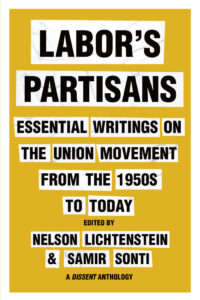
“Putting the movement back in the labor movement,” is an expression that you hear regularly at union events. The sentiment speaks to the idea that labor needs to be aspirational, visionary and connected to improving the lives of everyday people through collective action. The anthology Labor’s Partisans: Essential Writings on the Union Movement from the 1950s to Today, edited by Samir Sonti and Nelson Lichtenstein, provides a useful primer to the struggle to keep labor moving through the writing and activism of Dissent Magazine.
Dissent was created in the 1950s, the heyday of union density in the United States. Its contributors decided on a magazine rather than a journal as a means of signaling the intended popular audience, rather than a narrow academic focus.
One of the throughlines of Lichtenstein and Sonti’s collection of Dissent articles is the tension in labor between those who believe in “bread and butter unionism” and the advocates of unions being a means for social transformation. The bread and butter unionists focus narrowly on improving pay, benefits and working conditions. Most other considerations slip away in this model. In contrast, socially conscious unionism, or social unionism, thrives on the democratic ideals of fair representation and advancing justice in society, especially for those furthest from it.
“Bread and butter” unionists are fine with a consolidation of power within unions to advance narrowly defined member interests. Social unionists believe that the unions themselves must be representative of the members they serve in order to create the kind of power needed to not only bargain and uphold a good contract, but to build the kind of power needed to make sure that working people have a seat at every table where decisions are made.
The way unions operate often mirror the social trends of the era. Times of social upheaval open the door to union reform, conservative retrenchment can breed bureaucratic malaise within unions. As Irving Howe writes in one feature, “You can always measure the level of democracy in any country by the freedom its workers have to organize unions of their own choosing” (78). Recognizing this pattern underlines the importance of the Dissent writers and their effort to nourish the democratic spirit unions that can at times lay dormant.
Labor’s Partisans reminds us that even when things look bleak in our unions and society, transformation is possible. Not shying away from describing what happens when power within unions calcifies provides readers with a glimpse of the resilience of rank and file movements.
Heartbreak and resilience appears most prominently in the story of the coal mining union reformer Jock Yablonski. In 1969, attempting to create a democratic union for coal miners, Yablonski ran against entrenched Association President Tony Boyle. Infamously, the campaign ended with the murder of the insurgent Yablonski. Following an extensive investigation, it was found that Boyle was behind the hit.
Reeling from the loss of a brave leader, rank and file members of the United Mineworkers of America, formed the caucus Miners for Democracy. The caucus went on to narrowly win the 1972 UMA presidential election in a rematch against Boyle by a margin of just under ten percent. Freed from Boyle’s stranglehold, enacted a number of democratic internal reforms, including measures to create more representative voting within the union. Still, without Jock, who had been a catalyst for change, the upstarts faced an uphill battle. With many of the initial rank-and-file stepping into governance, the nascent caucus fizzled, as did their environmentally oriented campaign positions (286).
The inclusion of Jock’s story in this collection reminds the current democratic insurgents of the sacrifices of prior generations, as well as the great promise of worker led reform. Yablonski may be a distant name for labor activists born after the 1960s, yet his willingness to fight for rank and file workers brought about one of the first democratic movements in labor history.
As the founder of the Association for Union Democracy, Herman Benson explained of the grassroots movement, “there were courageous local leaders and rank and file activists without whom nothing would have been possible. There were pro labor professionals who came forward to help…We saw in action the often-sought ‘alliance between intellectuals and labor.’ It worked” (106). Creating a dynamic where leaders can rise from the “shop floor”, aided by movement friendly lawyers, activists and academics, fuels the democratic project, first within unions and then across society.
The tumultuous history of labor proves that no form of progress can be taken for granted. Advancing union democracy, labor backed environmental reform or socially conscious programs of any kind are difficult challenges–both in terms of initiating and sustaining. That’s why rank-and-file visionaries have even launched campaigns from outside the positions of power in union halls, including the teachers in Milwaukee in the 1980s (Schurmer, 296) and more recently in West Virginia (Jaffe, 302-308) . While there has been disagreement between the reform wings of progressive unionism, there is much more that binds these efforts together. From Benson and Yablonski to Milwaukee and West Virginia, and so many places in between, these stories remind us of the sacrifice of the movement for rank-and-file power and the perilously imperfect pursuit of dignity on behalf of working people.
Along these lines, Labor’s Partisans presents a compelling case for why we need rank and file democratic reform movements with unions based on longstanding scholarship. Scholars of labor have linked union member agency with union health. David Moberg, in his chapter “Hard Times for Labor,” cites Michael Goldfield’s The Decline of Organized Labor in the United States, “concluded that unions with a strong tradition of rank-and-file combativeness generally have fared better in their organizing than more conservative or autocratic unions” (156).
Labor’s Partisans provided a timely assortment of examples showing how the fight for working people has seized the moment to build unions that work, even in the most difficult of circumstances. Unabashedly, the collection proclaims that to be a movement, the labor movement must recommit itself to promoting and practicing democracy for the social good. This makes it an important read for reform minded unionists and allies of a robust labor movement today.
Citations
Benson, H. (2025). Labor Leaders, Intellectuals, and Freedom in the Unions. In S. Sonti & N. Lichtenstein (Eds.), Labor’s Partisans (pp. 99–106). The New Press.
Early, S. (2022, December 14). What Today’s Labor Reformers Can Learn From a Rank-and-File Coal Miners’ Victory 50 Years Ago. In These Times. https://inthesetimes.com/
Jaffe, S. (2025). West Virginia Teacher Walk Out. In S. Sonti & N. Lichtenstein (Eds.), Labor’s Partisans (pp. 302–308). The New Press.
Lichtenstein, N., & Samir Sonti. (2025). Labor’s Partisans. The New Press.
Goldfield, M. (1992). The decline of organized labor in the United States. Univ. Of Chicago Press.
Moberg, D. (2025). Hard Times for Labor. In S. Sonti & N. Lichtenstein (Eds.), Labor’s Partisans (pp. 153–166). The New Press.
Schirmer, E. (2025). After Act 10: How Milwaukee Teachers Fought Back. In S. Sonti & N. Lichtenstein (Eds.), Labor’s Partisans (pp. 291–301). The New Press.