La Bola Negra: A Revolutionary Queer Masterpiece
La bola negra (2026), co-directed by Javier Ambrossi and Javier Calvo and co-written by Alberto Conejero, Javier Ambrossi, and Javier Calvo. Movistar Plus+/Suma Content Films
“Nadie desaparece del todo.” (“No one disappears completely.”)
-Rafael Rodríguez Rapún, La bola negra
La bola negra (“The Black Ball”), the new hit film by Spanish auteurs Javier Ambrossi and Javier Calvo (“los Javis”), is a true masterpiece that centers queer love, anti-fascism, and historical memory. It is set against the backdrop of the bloody Spanish Civil War (1936–1939), which notoriously brought General Francisco Franco to power, resulting in a military dictatorship that would last nearly four decades. As Ambrossi explained during his and Calvo’s introduction to the film on October 17, 2026, in Los Angeles, La bola negra is dedicated to the world-renowned queer Andalusian poet and playwright Federico García Lorca (1898–1936), who was summarily executed by fascists 90 years ago, after Nationalist forces occupied his hometown of Granada during their brutal war on the Second Spanish Republic.
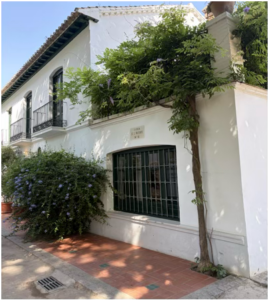
Huerta de San Vicente, Granada (photo by author)
In a truly tragic turn of events, Lorca was arrested on August 16, 1936, at the family home of his Falangist friend and fellow poet Luis Rosales. Legitimately fearing for his life, Federico had fled from his family home at the Huerta de San Vicente to seek refuge at the Rosales’ estate, believing he would be safe there. In reality, he was killed by firing squad at dawn the day after his arrest, alongside a Republican school teacher and two anarcho-syndicalists affiliated with the CNT (Congreso Nacional de Trabajo). The Nationalists’ charges accused the artist of spying for Moscow, being homosexual, and being a Freemason.
As biographer Ian Gibson explains in Federico García Lorca: A Life (1989), the urgent efforts made by his father and the Rosales family to find him a defense lawyer were futile, as there never was any trial. It is unclear if there even was an arrest warrant in the first place. Dismissing an order obtained by Luis’s brother José Rosales from Military Command demanding Lorca’s immediate release, the Falangist governor, Commander Juan Valdés, told José the next morning that Federico had already been taken away. That night, Valdés had consulted with General Queipo de Llano, ranking officer of the fascist forces in southern Spain, who told him to proceed with Lorca’s execution. Try as he might, even the legendary composer Manuel de Falla could not save his friend.
To date, García Lorca’s remains have still not been found.
La bola negra
La bola negra takes its name from the last work that Lorca had been writing before his assassination. This unfinished play openly discusses the question of homosexuality, which the poet had addressed previously in his writings on several occasions, although obliquely. Its title also alludes to Lorca’s Sonnets of Dark Love (1935–1936, not published until 1983), which were dedicated to either one or both of the artist’s last lovers: namely, Rafael Rodríguez Rapún and Juan Ramírez de Lucas.
To date, only the first four pages of “La bola negra” have surfaced, so los Javis and their co-writer Alberto Conejero bring what is available to life on the big screen, while presenting their original development and resolution of the text. In certain ways, their film echoes themes from some of Lorca’s other unfinished or unpublished late plays, such as The Public (a defiant vindication of same-sex love), The Dream of Life (which includes a street revolution), and A Drama against War (which features anti-militarist soldiers).
The film’s plot is divided roughly into thirds. The first centers around the rejection (bola negra) of the gay community in early 1930’s Spanish society, as symbolized in the social struggles of Lorca’s alter ego Carlos (played by Milo Quifes) and his friends. At the outset of the play, Carlos is excluded from a casino to which he has applied to be a member, having received more black balls (bolas negras) than white ones from voting members, on suspicion of being gay. Despite this, los Javis affirm the revitalizing function of art, dance, eroticism, and the imagination. This is seen in a stunning scene featuring cante jondo, or the “deep song” of the Andalusian Roma, as in Penelope Cruz’s risqué cameo as cabaret dancer Nené Romero.
The second third of the plot revolves around Rodríguez Rapún (1912–1937), played in the film by Miguel Bernardeau, who provides a magnificent performance. In the wake of his partner’s assassination, Rapún, a bisexual socialist athlete and engineer, joined the Republican Army. He was gravely injured in 1937 while fighting on the northern front in Cantabria. In Lorca y el mundo gay (2009), Gibson suggests that Rapún’s psychological distress and even suicidality over Lorca’s execution precipitated his own premature death, at just twenty-five years of age. After all, he succumbed anonymously to his war wounds in the Santander military hospital a year to the day after Lorca’s murder, and “[n]o record remains of his last moments, of any death-bed request, of any comments.”
This is precisely where los Javis and Conejero come in: specifically, by imagining the spontaneous development of a gay love-bond between the injured prisoner and his Nationalist guard, Sebastián (played by the musician Guitarricadelafuente). In La bola negra, Rapún comes out to Sebastián as Lorca’s secret lover and—as though he were an apostle of Jesus—discreetly and passionately preaches the martyr’s subversive message from his hospital bed.

The final third of the plot is set in the recent past, in 2017. This sequence follows Alberto (played by Carlos González), a Madrid-based historian and former playwright who researches queerness. Alberto embarks on a journey of personal discovery and historical memory that involves consulting with an academic named Isabelle Durand (played by Glenn Close) who is notably reminiscent of Gibson, despite being female and U.S. American. (Gibson is Irish-Spanish.) Durand is portrayed as the sagacious author of the fictive (though accurate) title Federico García Lorca: The Gay Poet.
In their film, los Javis convey what they fancy Lorca would have stressed in the completed version of “La bola negra”: namely, that one loses one’s life and essence, when denying what one truly is—whether politically, socially, or sexually. By contrast, we must embrace reality and struggle—reason and revolution. This includes grappling with the contradiction between the profound social revolution impelled during the Spanish Civil War by the workers of the CNT (which, in a missed opportunity, goes unmentioned in the film), and the unfortunate homonegativity promoted by certain leaders of the union, such as José Peirats, Félix Martí Ibáñez, and Federica Montseny, and by the CNT’s social theory, which was then traditionalist and heteronormative, in keeping with Castilian custom. Needless to say, such perspectives diverge from the queer-friendly anarcha-feminism proclaimed by Emma Goldman, a CNT supporter, at the time.
In this light, through its celebration of queer life and emancipation, La bola negra proudly resists the homophobia pushed by the right and parts of the left. It aims to fulfill Lorca’s visionary promise to Rapún that this unfinished play would help “people like us” avoid their tragic fate in the future, while lamenting the martyrdom of these freedom fighters and so many other victims of fascist violence during the Spanish Civil War.
That being said, given the unapologetically anti-militarist, anti-fascist, and gay-liberationist themes of La bola negra, it comes as little surprise that the leaders of the Popular Party and Vox are scrambling to ban the film in a Spanish province. Under the guise of regulating films that ostensibly promote “ideological indoctrination,” these political heirs and defenders of Nationalism aim to censor critical films like La bola negra as part of their nefarious efforts to rehabilitate Franco and Old Spain’s absolutist and heteropatriarchal traditions, while erasing the memory of the numerous atrocities carried out by Franco and his allies during the Civil War and thereafter.
In sum, given the puzzling popularity of both Franco and Vox among far too many youth in Spain, plus the enthusiasm shown for the Nationalist dictator on the U.S. far right—up to and including the vice president—La bola negra is a most timely and apt work of art. I can’t recommend this revolutionary queer masterpiece highly enough!