Jewish Rejection of Zionism
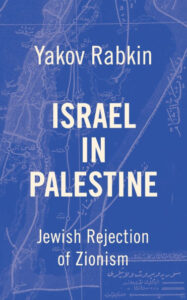
Review of Yakov Rabkin, Israel in Palestine: Jewish Rejection of Zionism (Diversified Graphic, Atlanta, 2025)
These days, when criticism of Israel is labeled by many as “antisemitism,” it is an effective antidote and enlightening to read a 112- page booklet full of documented and thoroughly researched and well- supported criticism of Israel by a scholar, a professor of history at the University of Montreal, and a devout Jew.
Anyone reading this book who does not come away with a jaundiced view of Israel is probably a chauvinistic supporter of “my country, right or wrong,” impervious to the facts. Further, they cannot (or can they?) call Rabkin antisemitic. They would have to resort to the presumably lesser charge of “self-hating Jew.” He is obviously neither.
The subtitle of Rabkin’s book is, “Jewish Rejection of Zionism.” Rabkin speaks first of the well-known opposition of orthodox Jews to the creation of the state of Israel, which they, of course, believe should happen only with the coming of the messiah. Among many revered rabbis, Rabkin cites Rabbi Yoysef Khayim Sonnenfeld, “one of the pillars of the pious Jewish communities in Palestine” (1848-1932) as a “convinced antizionist.” (Is this rabbi antisemitic?)
Rabkin quotes many prominent and famous Jews in their skepticism of or opposition to Zionism and the founding of a Jewish state, among them Freud, Einstein, Rabbi Judah Magnes, Rabbi Zvi Duschinsky, Martin Buber, Hannah Arendt, and Ernst Simon. He quotes Albert Einstein as saying, “It seems to me a matter for simple common sense that we cannot ask to be given the political rule over Palestine where two thirds of the population are not Jewish.” He is also quoted as saying about the party that would be elected in 1977 to govern Israel that “it is closely akin in its organization, methods, political philosophy, and social appeal to the Nazi and Fascist parties.”
Why Jewish rejection of Zionism? To answer that question, Rabkin begins by quoting Vladimir Jabotinsky–an “admirer of Mussolini and the founder of the political movement that produced Benjamin Netanyahu (whose father was Jabotinsky’s secretary)–as saying, “The Bible says, ‘You shall not oppress a stranger…seeing you were strangers in the land of Egypt.’ Contemporary morality has no place for such childish humanism.”
Rabkin tells us of the rise of “ ‘National Judaism’…a relatively recent form of Judaism rooted in Israel.” Although followed by only about a fifth of the Jews in Israel, it is “the dominant ideology of most of the settlers in the West Bank, including their vigilantes, who have stepped up the harassment, dispossession, and murder of Palestinians in the West Bank….Followers of National Judaism may have more in common with those who idealistically embraced National Socialism in Germany and ended up committing genocide,” rather than with traditional Judaism the ethical principles of which are “rooted in justice, compassion, and the sanctity of human life,” says Rabkin. National Judaism aside, Rabkin says Israel in general fosters a new kind of civil religion, which places the individual’s relationship to the nation at its center rather than traditional Jewish values.
Rabkin traces the origins of the violence characterizing much of the Zionist endeavor to the revolutionary movements that many Jews participated in in Eastern Europe in Czarist times. The socialist Zionists from Eastern Europe who dominated Israeli politics between 1948 and 1977, are totally diminished and without power now. They have been replaced by right wing political parties. Rabkin quotes Yitzhak Herzog, who warned, a few years before becoming president of Israel in 2021, “Fascism is touching the margins of our society.” Rabkin quotes Bezalel Smotrich, finance minister since 2022 and leader of the Religious Zionist Party, as declaring he is a “fascist homophobe”; Miri Regev, former brigadier general and IDF spokesperson declared she is “proud to be a fascist”–she was appointed minister of culture; Ayelet Shaked, Israeli parliamentarian, said about the Palestinians in Gaza,
They have to die and their houses should be demolished so that they cannot bear any more terrorists. They are all our enemies, and their blood should be on our hands. This also applies to the mothers of the dead terrorists.
Israel, states Rabkin, claims to be a state of the Jewish people worldwide. This claim, says Rabkin, “has led to the open transformation of major Jewish organizations around the world into vocal advocates and lobby groups for Israeli state interests, such as AIPAC,” which spends millions of dollars to defeat any candidate who dares to criticize Israel. Zionist organizations, such as Canary Mission, Betar, and the Israel Project, Rabkin tells us, supply the names of pro-Palestinian students, and critical academic and university curricula to the government, educational institutions, and employers. This results in individuals “being fired, banned from public events, expelled from academic institutions, arrested and deported.”
Even before the current Gaza crisis, Gaza has been described as “the world’s largest prison.” Israel, says Rabkin, in cooperation with Egypt, “controlled every entry and exit and determined the amount of food and medicine allowed in….80% of the people depended on international aid, water was rationed, electricity was available only two hours a day, and food shortage was chronic. Peaceful demonstrations by Gazans were met with deadly fire from Israeli soldiers stationed across the border fence. Gaza was also subjected to regular military incursions, which Israelis referred to as ‘mowing the grass,’ operations that routinely left hundreds of dead and wounded.”
In 2017, Bezalel Smotrich, the official in charge of administering the West Bank, wrote a Decisive Plan that asserts that “Jewish and Palestinian aspirations do not allow for compromise, reconciliation, or partition….the plan calls for full annexation of the West Bank and a strong ultimatum to Palestinians where they must choose between an officially inferior legal status if they stay, or emigration….any armed resistance is to be met with the killing of Palestinians, including civilians and children.”
“In the space of a few months,” Rabkin tells us, “the Israeli military dropped more explosives, killed and wounded more civilians, and caused a higher civilian-to-military casualty ratio, estimated 4 to 1 in May 2025, than Russia has in over three years of war in Ukraine.”
Many American Jews are protesting the actions of Israel. Rabkin tells us that in November 2023, Jewish protesters unfurled banners at the foot of the Statue of Liberty reading, “Palestinians should be free” and “Never Again for Anyone,” and that in July of 2025 a coalition of Jewish organizations and 28 rabbis held up a banner at the Israeli consulate in New York saying, “Jews Cry Out.” There are Jewish-led demonstrations by such groups as Not in My Name and Jewish Voice for Peace. Rabkin says the following, “Accusing Jews of antisemitism is becoming less and less credible as prominent Jewish intellectuals and activists worldwide, including some from Israel, continue to denounce Israel’s actions and remain among the most consistent critics of Zionism.”
In July 2025, according to Rabkin, the Israeli parliament, on a vote of 71-13, called for the annexation of the West Bank, saying it was “an inseparable part of the Land of Israel.” This would make the “two-state solution” altogether impossible, assuming it was even a realistic possibility, given the settlements. Rabkin says “the total ethnic cleansing (through displacement, emigration, or genocide) of indigenous Palestinians from the Zionist state” has been a century- long Zionist project.
Rabkin points to the conflation of Judaism and Zionism, encouraged by Israel and American Zionists, as likely leading to antisemitism in America, as more and more people turn against Israel for its atrocities in Gaza and the West Bank. Hostility to Israel turns into hostility to Jews and Judaism, since the Zionists and Israel have conflated the two in the public mind. Rather than diminishing antisemitism worldwide, as it once claimed, Israel and Zionism are increasing it.
Israel is a great and willing supplier of surveillance technology to repressive governments worldwide, technology it has developed in its surveillance of the Palestinians, according to Rabkin.
As for Jewish criticism of Israel, Rabkin cites the following:
The largest Jewish organization critical of Israel is Jewish Voice for Peace, which has close to 800,000 members and supporters in the United States and 2.37 million social media followers.
Rabkin quotes Ben Gurion as having expressed the view that Judaism is “the historical misfortune of the Jewish people and an obstacle to its transformation into a normal nation.”
According to Rabkin, Boaz Evron, a noted Israeli intellectual, calls for a reimagining of Israeli identity, suggesting a regional federation of Israel and her Arab neighbors, saying that “only within such a federal structure will it be possible to overcome the self-segregating, communal and protofascist tendencies gathering strength inside Israeli society.”
Rabkin concludes the last of his chapters with the following: “As John Mearsheimer, a prominent scholar and world authority on international relations has stated: ‘What the Zionists and now Israel has done to the Palestinians over time is one of the greatest crimes in modern history.’”
If this incredible, fact-filled survey of Israel and Zionism seems one-sided, it is obviously a side that is not being heard sufficiently.
There is a very significant and old example of Jewish rejection of Zionism that deserves mention in Rabkin’s book that is nowhere to be found in it, and that is the Jewish Labor Bund’s opposition to Zionism from its very beginning. The Bund, as it was usually referred to, had hundreds of thousands of adherents in prewar Poland and around the world. One of its revered and beloved leaders, executed by the Soviets in 1942, had this to say in 1938 about Zionism:
What can a Jewish Palestine be under the best of circumstances? If a Jewish state should arise in Palestine, its spiritual climate will be eternal fear of the external enemy (the Arabs) and the eternal struggle for every foot of ground and for every bit of work with the internal enemy (Arabs). Is this a climate in which freedom, democracy and progress can grow? Indeed, is it not the climate in which reaction and chauvinism ordinarily flourish?
The Bund died at the hands of Hitler and Stalin, but these days young Jews are attracted to it. Rabkin overlooked an old and significant source of Jewish resistance to Zionism.
But that is a cavil, because Rabkin’s book is an extraordinary and well written compendium of information about this most important subject.