The Silence of the State Kills
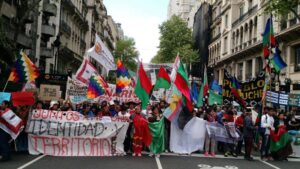 Before Chile and Argentina existed, before the Spanish Empire even knew there was anything across the ocean and eventually drew its first breath in the Americas, there was Wallmapu.
Wallmapu Exists
The land of the Mapuche, the “people of the land,” stretches across what colonial maps now call southern Chile and Argentina, divided by the Andes into Gulumapu in the west and Puelmapu in the east. The Mapuche were never conquered by the Spanish. For over three centuries, from the first incursion in 1536 until the wars of independence, they held the Bío Bío River as a border no empire could cross. They negotiated parliaments and treaty-like agreements with the Spanish Crown, the Parliament of Quillín in 1641 and subsequent accords, that involved mutual recognition and the fixing of the frontier. Historians debate the nature of that recognition, but what’s undisputed is the Mapuche maintained political autonomy for over 300 years. They later signed treaties with the Republic of Chile, including the Treaty of Tapiwe in 1825, which established terms for relations between the two peoples, terms Chile would ignore.
The invasion came not from Europe, but from the new Chilean state. In the late nineteenth century, the military campaign euphemistically named the “Pacification of Araucanía,” a term that encodes the denial of Mapuche sovereignty, did what Spain couldn’t, not pacification, occupation. The Chilean army swept through Wallmapu, killing, displacing, and confining the Mapuche to “reducciones,” reservations, that amounted to 5 percent of their ancestral territory. Over 475,000 hectares were documented, in roughly three thousand Títulos de Merced, the land titles granted to Mapuche families between 1884 and 1929. These documents, as Mapuche claimants and scholars have repeatedly argued, “are not enough.” They don’t represent the land the Mapuche held before expropriation, their “tierras antiguas,” the ancestral lands. They aren’t records of restitution, but records of reduction, designed to legitimize dispossession while providing a documentary basis for future claims that would be tightly constrained by the very boundaries the state drew.
On the other side of the Andes, the same logic operated under a different name. Between 1878 and 1885, the Argentine state’s “Conquest of the Desert,” led by General Julio Roca, dispossessed Mapuche communities of their territory in what’s now commonly called Patagonia. This campaign mirrored the Chilean invasion in its brutality and its framing: both new republics cast the Mapuche as savages standing in the way of civilisation. Today, Argentina doesn’t even recognize the Mapuche as a pre-existing nation, framing them as Chilean immigrants, a position only hardened under President Javier Milei, which explicitly denies Mapuche territorial claims and has declared Mapuche organizations “terrorist groups.” Mapuche communities in Neuquén and Río Negro face extractive pressure from fracking in the Vaca Muerta formation and lithium exploration, as well as violent repression. The binational character of the occupation isn’t incidental: extractive capital operates across the border; and Mapuche communities on both sides maintain kinship and political ties.
Mapuche land was transferred to Chilean (European) settlers, some of whom remain powerful in the region today. The modern forestry industry that dominates the Chilean side of Wallmapu is primarily the product of specific policies: the military dictatorship’s privatizations; subsidy regimes that fueled the plantation boom; and the ongoing partnership between the Chilean state and extractive capital. The results are visible. By the 1990s, forestry companies owned approximately three times more Mapuche territory than the Mapuche themselves. The industry’s monoculture plantations, radiata pine and eucalyptus, now cover vast areas of what was once native forest.
Today the Mapuche number over 1.7 million people, roughly 12 percent of Chile’s population, according to the 2017 national census, forming the country’s largest indigenous group. Their language, Mapudungun, survives despite centuries of repression. Their flag still flies, its colors and symbols representing the sun, moon, morning star, and cosmological order that binds the Mapuche to their territory. Their communities still govern themselves through the Lof, the extended family unit, and the authority of the Lonko, the community head. Their collective memory is being documented and defended by autonomous Mapuche media collectives like Adkimvn, which produces documentary work focused on territorial defense, ancestral memory, and the philosophy of Kvme Mongen, the “good life,” the balanced existence.
Readers encountering the Mapuche struggle may come across references to the Kingdom of Araucanía and Patagonia, a symbolic monarchy led by a European-based “Prince,” with its own chancellery, coronation ceremonies, and diplomatic statements. This institution traces its origins to Orélie-Antoine de Tounens, a French lawyer who in 1860 declared himself King of Araucanía and who was then expelled by Chilean authorities. The modern Kingdom presents itself as an advocate for Mapuche sovereignty, issuing statements on treaty rights, making submissions to international bodies, and commemorating Mapuche martyrs. Its relationship to Mapuche communities on the ground in Wallmapu is, however, contested. Many Mapuche organizations don’t recognize a European monarchy as a legitimate vehicle for their self-determination. The Kingdom is noted here, not because it’s representative, but because it isn’t. Its presence in the international conversation about the Mapuche is itself a form of displacement: a European voice speaking over indigenous ones. The Mapuche have their own governance structures that make decisions through collective deliberation, and it’s these institutions, not any monarchy, that lead the resistance described in this article. Readers seeking to understand the Mapuche struggle should look to Mapuche communities, organizations, and media directly.
Wallmapu isn’t a memory, it’s a living political reality and its people have never ceded their sovereignty. This matters because the international community consistently misrecognizes what’s happening in southern Chile and Argentina. The Mapuche aren’t an “ethnic minority” seeking cultural recognition within a unified state, but a dispossessed nation under occupation, and their struggle isn’t for inclusion, but for restitution. This isn’t a conflict of “ethnic violence,” it’s resistance to illegal occupation.
Camilo, Julia and the Faces of Resistance
The resistance has faces that the Chilean state has spent decades trying to erase, smear, or bury, but the names persist, carried by families and communities who refuse to let the dead be forgotten.
Camilo Catrillanca was 24 years old. He came from a line of Lonko, his grandfather, a respected leader of the Temicuicui community, a place long regarded as a symbol of Mapuche resilience. So much so that in May 2026, the state raided it with 400 heavily armed personnel, tanks, and helicopters, detaining a pregnant woman and a four-year-old child, then omitting to include their detention in official records. Camilo’s father called him a weichafe, a “warrior,” but also a wise man, a protector, a term that signifies not merely combat, but the bearing of communal responsibility. Camilo had a six-year-old daughter and a pregnant wife. He was building them a house, but was killed before he could finish it.
On November 14, 2018, an “anti-terrorist” unit of the Chilean police, known as Comando Jungla, trained in Colombia and the United States and equipped with drones and high-tech communications, entered Temicuicui near the town of Ercilla. They claimed to be pursuing car thieves. The operation involved hundreds of officers and two helicopters. Camilo had gone out with a 15-year-old relative to pick coriander; he was riding his tractor, unarmed.
The police shot him multiple times, with the kill shot entering through the back of his neck. The autopsy would later raise a question the state couldn’t answer: how does an unarmed assailant get shot from behind in the neck while supposedly threatening officers? The 15-year-old with him witnessed an officer remove the memory card from the video camera that recorded everything. The minister of the Interior was eventually forced to confirm this in a press conference. The government spent days insisting Camilo had a criminal record; he didn’t, it was a lie that was disproven, but the smear had already circulated. These facts were established not only by advocacy outlets, but by mainstream Chilean and international press, and they led to the resignation of several officials, including the head of the carabineros.
Camilo was one of at least 15 Mapuche activists who have been killed since 2001, according to the indigenous newspaper Werkén.cl. More than 40 Mapuche children have been mistreated by police, some suffering gunshot wounds, as documented by the Network for the Defense of Childhood Wallmapu. The numbers accumulate, but each is a specific, irreplaceable life.
The face of resistance is also profoundly female. It wears the weathered features of Julia Chuñil, a 70-year-old elder and president of the indigenous community of Putreguel. On November 8, 2024, she left her home to check on her cows. Her dog, Cholito, went with her by her side. Before she walked out, she told her relatives something that reads as both warning and prophecy: “If I do not return, you know who did this.”
She never returned; she vanished into the wilderness she had spent her life defending. Her family has faced police harassment and media misinformation ever since. The Public Prosecutor’s Office investigation has been marred by irregularities: the family kept in the dark; evidence lost; critical protocols ignored. In September 2025, the family’s lawyer, Karina Riquelme, disclosed that intercepted phone calls from the main suspect, forestry businessman Juan Carlos Morstadt Anwandter, the “legal” owner of the land recovered by Chuñil’s community, contained claims she had been burned. These claims haven’t been independently verified by any public authority, and Morstadt hasn’t publicly responded. They remain a lead, not a finding, but the state’s failure to pursue this lead with urgency has deepened the family’s conviction that the investigation isn’t impartial.
Morstadt comes from a family with a documented history of landownership and exploitation in the region. A 1935 local newspaper article titled “The Latifundistas Continue Their Abuses” described his grandfather, a local judge and landowner, as an exploiter of workers. Morstadt filed to evict Chuñil after she resisted selling her land. She refused, then disappeared.
The agency supposedly responsible for indigenous rights, the National Corporation for Indigenous Development (CONADI), acquired the contested land and offered it to a different community. When they refused, the land was left in legal limbo, a state-created vacuum that left Chuñil exposed. In 2011, CONADI’s only two Mapuche board members were removed by government decision after they vetoed a hydropower project that affected Mapuche land, a veto they were legally entitled to exercise under CONADI’s founding legislation. With their removal came the elimination of any indigenous representation from the body charged with protecting indigenous land rights. Scholars of the occupation, including Kelly Bauer and María Montenegro, documented the restructuring that turned CONADI from a potential vehicle for restitution into an instrument of managed dispossession. The body charged with protecting Julia Chuñil’s land rights was stripped of its capacity to represent communities like hers. Julia’s daughter, Jeanette Troncoso Chuñil, speaks for the movement when she says: “This isn’t just a problem for our mother, it’s for the whole community struggling to recover its rights and territory. It’s an attempt to silence the Mapuche struggle.”
Julia Chuñil’s case follows a devastating pattern. In recent decades, several Mapuche women land defenders have been killed or disappeared in circumstances their families and communities regard as suspicious. Macarena Valdés, an environmental activist opposing a hydroelectric project, was found dead in her home in 2016; her family contested the suicide ruling and a second autopsy indicated she had been killed. Nicolasa Quintremán, a leader in the resistance to the Pangue dam, died in 2013. Emilia Bau, a Mapuche land defender, was killed in 2021. In August 2020, both Iris Rosales and her daughter, Rosa Quintana Rosales, members of the Juan Pinoleo community, which had been caught up in a wave of violence, were both found hanged in their home shortly after a far-right mob, aided by police, violently evicted Mapuche protesters from a council building in Curacautin. The coroner ruled the deaths suicides; the family and community contested this.
Efforts to arrest Mapuche resistance fighters have not relented. As this article goes to press, four Mapuche from the Resistencia Mapuche Lafkenche (RML) are in preventive detention following a June 9, 2026, raid by 150 police and naval personnel in Cañete.
Each case has specific circumstances, and the legal processes have varied, but the accumulation of deaths and the pattern of initial rulings that families reject has fueled the conviction among Mapuche organizers and human rights groups that the state’s indifference to violence against Mapuche women is structural.
At the protests, demonstrators carried signs that read: “¿Dónde están Julia Chuñil y Cholito?” “El Silencio del Estado Mata,” the silence of the state kills. “Sabemos quienes fueron,” we know who it was.
The Original Violence Is Land Theft
When international media covers the “Mapuche conflict,” which should actually be referred to as occupation under international law, the frame is invariably violence: burning trucks, blocked roads, sabotaged machinery. The Chilean state calls it terrorism; the forestry industry calls it criminality.
These events are real, and they require honest engagement. The Coordinadora Arauco Malleco (CAM), one of the most prominent Mapuche organizations demanding territorial restitution, advocates armed resistance and sabotage as legitimate tactics of territorial recovery. Its leader, Héctor Llaitul, was sentenced in 2024 to 23 years in prison on charges including incitement to violence, firearms use, and timber theft, charges his supporters regard as political persecution. There are now over 100 Mapuche prisoners in Chilean jails, according to Radio Kurruf.
These tactics aren’t without cost, and they’re not universally supported by the Mapuche. Arson attacks on forestry equipment have sometimes spread to affect neighbouring small holdings. The burning of churches and rural schools, actions that some Mapuche groups have claimed, while other Mapuche organizations condemn, has alienated potential allies. Some Mapuche organizations have publicly distanced themselves from armed actions, arguing the struggle for territorial restitution must be waged through legal and political means. The strategic debate within the Mapuche movement is real, and it’s not the purpose of this article to resolve it. What matters is this debate takes place in the shadow of structural violence that preceded it and continues regardless of which tactics the Mapuche employ.
The category “political prisoner” covers a range of cases. Some Mapuche prisoners have been held under anti-terrorism laws for actions that would, in other contexts, be treated as ordinary protest or land occupation. Others have been convicted of offenses involving arson, possession of firearms, or sabotage of machinery. The cases in which the law has been used to penalize nonviolent protest are the clearest violations of international standards. The cases involving violent offenses are more contested, but the systematic use of anti-terrorism legislation, with its anonymous witnesses, extended detention, and higher sentences, rather than ordinary criminal law, raises due-process concerns that human rights bodies have repeatedly flagged, including the UN special rapporteur on counter-terrorism in 2013.
The question isn’t whether violence exists, but where the violence began.
To understand the current political moment, it’s necessary to grasp the relationship between the Mapuche and the broader Chilean left, a relationship of embrace followed by abandonment. During the 2019 Social Uprising, the largest mobilization in Chile since the dictatorship, the Mapuche flag became a central symbol of the protests. In Plaza Dignidad, the epicenter of the movement in Santiago, demonstrators raised a huge Mapuche star and chanted afafanes, Mapuche protest slogans. The demands of the uprising, an end to the neoliberal constitution, dignity, and the recognition of collective rights, all echoed the Mapuche struggle. This wasn’t an indigenous movement joining a separate protest; the Mapuche and their symbols were at the heart of the estallido from the beginning.
That solidarity found institutional expression in the 2021–22 Constitutional Convention, which included 17 reserved seats for indigenous delegates, a historic first. Mapuche linguist and activist Elisa Loncon was elected president of the Convention, and her opening address, delivered in Mapudungun, called for Chile to be “refounded” as a plurinational state that recognized indigenous territorial rights and self-governance. The draft constitution, for the first time, declared Chile a plurinational state and proposed articles recognizing indigenous autonomy. The draft was rejected by 62 percent of voters in September 2022, following a well-funded right-wing campaign that framed plurinationalism as a threat to national unity and private property.
The rejection was devastating for the Mapuche, closing the institutional path to recognition. Gabriel Boric, the center-left Chilean president who had campaigned on the promise of a new constitution, accepted the result and abandoned the project. The state of emergency, declared by the former right-wing government of Sebastián Piñera in October 2021 during the final months of the Convention, wasn’t just maintained, but extended. The same left that had marched under the Mapuche flag now governed over its repression.
The original violence is the land theft. Under the military dictatorship of Augusto Pinochet, the state targeted forestry as a key sector of development, implementing policies that favored the expansion of large tree plantations, the effects of which scholars have documented in detail. State-owned forests were sold to large corporations at negligible cost, with Mapuche land titles terminated and labor protections gutted. Between 1985 and 1995, nearly two million hectares of native forests were eradicated and replaced with industrial tree plantations. That’s why today Chile hosts the world’s largest expanse of radiata pine, but also why half of the country’s 15.4 million hectares of forests are degraded, with its native forests among the most endangered on earth. While the severity of these effects depends on management practices, as well-regulated plantation forestry can mitigate impacts through buffer zones and selective harvesting, in the Araucanía, where regulation is weak and profit pressure high, the pattern is one of intensive extraction with minimal mitigation, which has drawn criticism from Chilean environmental scientists and Mapuche communities.
The Mapuche lost 95 percent of their ancestral lands, with companies like Mininco and Arauco operating on territory Mapuche communities claim. The monoculture plantations drain the water table, erode the soil, contaminate livestock feed, and, through the proliferation of highly flammable eucalyptus, intensify wildfires that have devastated central and southern Chile. In Argentina, the same extractive logic operates, with the expansion of fracking in the Vaca Muerta formation and lithium exploration and land acquisitions by international investors. This includes, in 2024, the takeover by the owner of Tottenham Hotspur Football Club of thousands of hectares of ancestral Mapuche land in Patagonia, which places further pressure on Mapuche territory. The binational character of the conflict is material, not symbolic: extractive capital crosses borders and Mapuche communities on both sides of the Andes face structural pressures that differ in legal form but share a common logic.
This is the structural violence. It’s not a conflict between equal parties with legitimate grievances, it’s an occupation by industry and state united in dispossession, facing a people who refuse to leave, some of whom pursue that refusal through direct action that the state labels terrorism.
The state’s response to resistance isn’t justice, but militarization. The 1984 Anti-Terrorism Law, drafted under the Pinochet dictatorship to crush political dissent, has been deployed against the Mapuche for decades. It allows anonymous witnesses, extended pre-trial detention, and sentences far beyond normal criminal proceedings. In 2013, the UN special rapporteur on counter-terrorism called on Chile to reform the law, citing its discriminatory application against the Mapuche. Amnesty International condemned its use in Mapuche cases. Chile has ratified ILO Convention 169, which requires consultation with indigenous peoples on matters affecting their lands and resources, an obligation successive governments have honored only in rhetoric not practice.
The Comando Jungla occupy the Araucanía with armored vehicles, drones, and body cameras, the footage from which has a habit of disappearing when it incriminates the police. Wallmapu had been under a state of emergency since October 2021, declared first by Piñera’s government and extended without interruption by Boric’s. This enabled militarization that now includes thousands of troops, checkpoints, and intelligence operations across Mapuche territory. In cities like Temuco, the streets empty after nine at night, driven by both the state of emergency’s restrictions and the atmosphere of militarization; an undeclared, de facto curfew has become normal. Boric increased security spending by $1.5 billion and provided police with specialized surveillance drones. His government declared CAM an “illicit terrorist organization” and oversaw Llaitul’s prosecution.
The continuity is striking. Boric came to power promising a “path of dialogue” and reconciliation with indigenous peoples. In office, he reauthorized the same militarization he once criticized. What explains this? The answer is likely not monolithic. Public opinion in Chile has shifted rightward on security issues. The electoral cost of appearing “soft” on rural violence is high. Forestry capital exerts structural pressure on the state regardless of who governs. Boric may well have concluded that maintaining the status quo was politically necessary, while betraying his campaign commitments. None of this excuses the outcome, but it helps explain why the militarization has been bipartisan, and why it will not end simply with a change of government.
Boric’s repression didn’t go uncontested within his own coalition, as left-wing deputies and parties, including elements of the Frente Amplio, the coalition he helped build, criticized the extension of the state of emergency, the application of the Anti-Terrorism Law to Mapuche prisoners, and the prosecution of community leaders. Social movements that mobilized for Boric during his campaign publicly broke with him over the Mapuche question. The internal criticism mattered because it demonstrated that militarization was a political choice, not a structural inevitability. Boric had alternatives, and he chose repression.
In December 2025, Chile elected as president José Antonio Kast with 58 percent of the vote, a far-right politician with a long history of defending the Pinochet dictatorship. His victory represents an escalation in violence and oppression. Where Boric maintained the state of emergency, Kast intensified it, deploying a “hermetic” new security plan, tightening the military cordon around Mapuche communities. His administration discussed blockades of supplies in order to starve communities, like in Temucuicui, and it has already dismantled the government’s indigenous rights unit. The infrastructure of repression that both right and left constructed is now weaponized by a president who denies the Mapuche are a people at all. What Boric demonstrated was the machine of militarization, once built, wouldn’t be dismantled by those who claimed to oppose it. What the Kast era confirms is who was always waiting to take control of it. The left allows and sustains, the right utilizes and cleanses.
The state’s land restitution program, run by CONADI, is itself a mechanism of containment. It requires Mapuche claimants to prove historic land dispossession using Títulos de Merced, the very documents designed to legitimize their reduction to 5 percent of their territory. The program ignores tierras antiguas that fall outside the reducciones. It disregards territorialidad: the living, ongoing cultural, economic, and spiritual practices through which Mapuche communities express their relationship to the land, the rivers crossed, the medicinal plants harvested, the ceremonial sites maintained, and the names spoken in Mapudungun, which all still mark the landscape. As scholar María Montenegro argues, the Títulos de Merced function as instruments of ongoing dispossession. This form of colonial violence forces Mapuche claimants to validate their ancestral claims through documents designed to legitimize their dispossession.
CONADI’s program involves 32 procedures in four phases. The backlog for land recognition has been estimated to take decades to clear, by some calculations, over 80 years. In Julia Chuñil’s case, CONADI’s mismanagement of the land title created the legal confusion that left her vulnerable. The institutions designed to provide justice serve instead to manage dispossession. This isn’t mere bureaucracy, it’s an intentional state policy of attrition.
Kast announced a reform to the Indigenous Law on June 1, 2026, eliminating the restrictions on the use of Mapuche territory, allowing leasing and mortgaging of ancestral lands. Mapuche organizations, including Ad Mapu and the National Mapuche Assembly, condemned the reform as “a new dispossession” and “a retreat of 150 years.” Ana Llao from Ad Mapu said “Mapuche land is not for sale…this is how they invaded us and wanted to exterminate us and today the Mapuche people are present, with the few lands we have left.” No consultation with Mapuche communities was conducted, in direct violation of ILO Convention 169, which Chile has ratified and is legally bound to honor.
On June 3, 2026, Aucán Huilcamán, spokesperson for the Consejo de Todas las Tierras (Council of All Lands), called on president Kast to end the military deployment in Malleco and Cautín provinces and to initiate “sincere and good faith dialogue.” Huilcamán added, “there seems to be more personal interest than genuine commitment to finding solutions.” The Consejo’s demand distinguishes between the state of emergency and the militarization it enables, a framing the Chilean press has rarely adopted.
“We Know Who Did This”
The Mapuche don’t regard their land simply as property, but as mapu, a living entity from which the people, the che, have emerged. Their bond is ontological. The Mapuche word for territory is also the word for identity, body, memory, and spirituality. Their relationship to the land is expressed through territorialidad: not a deed, but a practice; not a boundary, but a belonging. What the Chilean state calls a conflict over property is, for the Mapuche, a defense of existence itself.
The Mapuche resistance doesn’t represent a fleeting news cycle, but a 500-year refusal of oppression, dispossession, and supremacist domination. The Mapuche have survived the Spanish Empire, the Chilean invasion, the Pinochet dictatorship, and false promises of democratic and “progressive” governments alike. They survive now in communities that occupy ancestral land, in women who block the logging trucks, in hunger strikers in Chilean prisons, in media collectives that document their stories in their language, in families who hold the names of their dead and disappeared, and by those who refuse to let the world look away.
Camilo Catrillanca was building a house. Julia Chuñil went to check on her cows. The ordinariness of their lives is the exact point, for they weren’t soldiers, they were people defending the ground beneath their feet, as their ancestors had done before them, as their children will after them.
The sign at the Santiago protest said everything the world needs to hear: El Silencio del Estado Mata, the silence of the state kills. But the silence of the international community is complicity, and complicity can be broken by specific acts. International human rights bodies can investigate the Escazú Protocol, which Chile ratified and guarantees protection for environmental defenders, and see that it is implemented in full. ILO Convention 169 can be honored, not only gestured toward. Consumers and investors can scrutinize supply chains of the forestry industry that profit from occupied land. Solidarity movements can amplify Mapuche voices rather than speaking over them.
The urgency is intensifying; for every month Kast remains in office, the legal architecture of dispossession is being extended. The Mapuche are not asking for sympathy, they are asking for the international community to stop looking away.
I recognize that these demands sit in tension with the article’s own analysis. Implementing ILO 169 and reforming CONADI are improvements to a state system that some currents of the Mapuche movement regard as structurally illegitimate. The demand for restitution of tierras antiguas points beyond reform toward a territorial settlement that the Chilean state has shown no willingness to contemplate. This tension isn’t a contradiction to be resolved here, but it is the political reality within which the Mapuche struggle operates. Some Mapuche organizations pursue both tracks simultaneously, engaging the state’s mechanisms while refusing to recognize their ultimate authority, as a matter of strategy. Others reject any engagement with the state as collaboration.
This article’s refusal to choose between these paths reflects the diversity of the movement it describes, as it is not my place to tell the Mapuche how to defend their lands, and neither is it anyone else’s.
The Mapuche have been telling their story for centuries, and it’s time the rest of us listened.
Sourcing
This article draws on the scholarship of María Montenegro, Martín Correa, Kelly Bauer, José Bengoa, Patricia Richards, and Fernando Pairican; reporting from NACLA, Green Left, the PRIF Blog, Resumen Latinoamericano, El Clarín de Chile, the Human Rights Defenders Memorial, and Byline Times; the autonomous media work of Adkimvn; statements from the Mapuche International Link, Amnesty International, and the UN special rapporteur on counter-terrorism; and the words of Mapuche community members and their families.
All sources are politically aligned to varying degrees. Readers are encouraged to consult them directly and to seek out the voices of Mapuche communities themselves.
Further Reading
This list is a starting point for a conversation the reader is invited to continue. It includes Mapuche advocacy sources, scholarly literature, state and industry perspectives, and international human rights documentation. Readers are encouraged to engage with the strongest arguments on all sides of this dispute. Advocacy gains credibility when it seeks out and honestly characterizes the positions it opposes. This list isn’t comprehensive, it’s a starting point for a conversation the reader is invited to continue.
Mapuche Advocacy and Media
Adkimvn Cine y Comunicación Mapuche
Mapuche International Link
Radio Kurruf
Werkén.cl
Scholarly Literature
José Bengoa, Historia del pueblo mapuche: Siglo XIX y XX
Martín Correa, La reforma agraria y las tierras mapuches: Chile 1962–1975
Kelly Bauer, Negotiating Autonomy: Mapuche Territorial Demands and Chilean Land Policy
Patricia Richards, Race and the Chilean Miracle: Neoliberalism, Democracy, and Indigenous Rights
Fernando Pairican, Malón: La rebelión del pueblo mapuche, 1990–2020
María Montenegro, articles on Títulos de Merced, territorialidad, and archival dispossession
State and Industry Perspectives
Corporación Chilena de la Madera (Corma), Reporte de Sostenibilidad (annual sustainability reports)
Centro de Estudios Públicos (CEP), Puntos de Referencia series on the Mapuche conflict and rural violence
Chilean government submissions to UN human rights bodies regarding the Anti-Terrorism Law
International Human Rights
Documentation
UN special rapporteur on counter-terrorism, 2013 report on Chile
Amnesty International, reports on the Anti-Terrorism Law and Mapuche prisoners
ILO Convention 169 compliance reports for Chile
Escazú Agreement implementation documentation