
 Livin’ in a city of immigrants
I don’t need to go travelin’
Open my door and the world walks in
Livin’ in a city of immigrants
Livin’ in a city that never sleeps
My heart keepin’ time to a thousand beats
Singin’ in languages I don’t speak
Livin’ in a city of immigrants
— From the 2007 song “City of Immigrants,” by Steve Earle
In June of 2025, heavily armed and masked federal agents appeared on the streets of metropolitan Los Angeles, terrorizing businesses and workplaces, in order to detain people of Latin American heritage without due process. Asylum seekers, workers with green cards, young dreamers who came as children, and even citizens based on their physical appearance were swept off the streets and whisked away to federal detention centers where they were held or quickly deported. They weren’t allowed to seek legal representation or call family members. The food they were given and the water, sanitation, and health services were all inadequate. The cruel treatment has killed 46 detainees in federal custody since President Donald Trump took office in January of 2025.1
Today, many still sit in privately-run detention facilities increasingly viewed as concentration camps. The camps are run by multi-billion-dollar corporations like Core Civic and the Geo Group, which won no-bid contracts from the Department of Homeland Security after sidling up to Trump and providing him with lavish campaign contributions. Moreover, each day, more people are picked up off the streets and out of their homes and are brought to these politically connected hell holes.
It’s no accident that Trump, who has repeatedly characterized Mexican immigrants as rapists and criminals, unleashed his war against immigrants in Los Angeles, a Democratic stronghold with a huge county-wide population of 10 million, including 3.5 million immigrants, 55 percent of whom hail from Latin America and about 800,000 of whom are undocumented.2 After all, Los Angeles is a place where, as city Mayor Karen Bass notes,3 52 percent of residents speak one or more of 224 languages, in a state where immigrants have long formed the backbone of the economy, but that MAGA loves to hate. From Silicon Valley engineers to farm workers, both documented and undocumented immigrants bolster the productivity of California, which if a nation would be the fourth largest economy in the world. The state stands behind only the nation as a whole, China, and Germany as an economic powerhouse, yet it remains in Trump’s crosshairs.4
Trump’s made-for-TV spectacle in Los Angeles included an armed march through MacArthur Park, a prominent center for the Latin American immigrant community lined with open air markets. After the march, ICE (Immigration and Customs Enforcement) and CBP (Customs and Border Patrol) agents fanned out across much of southern California and conducted heavily publicized raids in restaurants in San Diego, on farms in Ventura County, and in businesses and neighborhoods across a state of more than 39 million people, 28 percent of whom are foreign born.5
And the sad truth is that the spectacle marked how little is really new in a nation that for most of its existence has exploited immigrants, particularly from Mexico and Latin America. Indeed, most of the Southwest was part of Mexico before it was part of the United States, showing how the nation still refuses to reconcile itself to its fraught history of racial prejudice, brutal territorial expansion, and slavery.
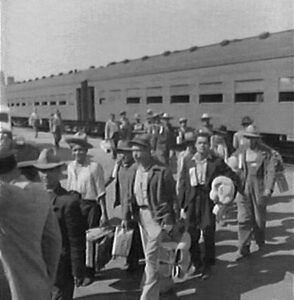
Tracing the History of the U.S. Vilification/Exploitation of Latino Migrants, 1942-2015
It was not that long ago, for instance, that a 17-year-old Texan murdered a 13-year-old Mexican boy, thinking he’d stolen the family’s car. The 17-year-old was convicted and sentenced to three years in prison before a Texas appeals court overturned his conviction.6
That teenager, Harlon B. Carter, would later go on to head the federal Border Patrol program and direct a mass deportation campaign against Mexican farmworkers. The farmworkers had been brought in under the federal Bracero Program to work the fields in 1942 when the nation suffered a labor shortage as it fought World War II. In a career that no doubt must truly inspire today’s MAGAs and immigrant haters, Carter headed the heavy-handed Operation Wetback drive that has deported an estimated 1.3 million Mexican workers since it began in 1954. The workers were dubbed Wetbacks because many came to work in Texas outside of the Bracero Program by fording the Rio Grande. The mass deportation was driven in large part by the ire of Texas sharecroppers and small farmers whose produce prices were undercut by the large farm operators who employed Mexican laborers and often underpaid them. After serving in the Border Patrol, the gun-loving Carter later went on to head the National Rifle Association. Mexican immigrants and advocates saw the deportation program Carter directed as a repeat of “The Mexican Repatriation” that President Herbert Hoover carried out in the early 1930s in response to the stock market crash of 1929 and the ensuing Great Depression. Meanwhile, the federal government folded the Bracero Program in 1964 as large farms increasingly mechanized and as the last of the sharecroppers deserted farms in the face of unbeatable price competition.7
In sharp contrast to what was happening in the U.S. farm economy, Mexico in 1962 formed CONASUPO, the National Company for People’s Subsistence, a state-owned enterprise that bought crops produced locally by small farmers, processed the foodstuffs into 20,000 different products, and sold them on the retail market to 50 million customers through some 17,000 supermarkets, 80 percent of which were located in poor urban areas. These markets typically sold food for 15 to 30 percent less than the price of comparable products sold in privately owned markets. The state-owned enterprise earned about $2 billion in 1986, representing about 2 percent of the nation’s federal budget. CONASUPO not only helped feed the poor, it helped preserve small-scale farming and the domestic production of staple crops, like corn, beans, and rice, at a time when Mexico needed to import a growing amount of food due to its burgeoning population of 80 million in the mid-1980s. Today, the nation has 130 million people.8
Certainly, CONASUPO ameliorated the plight of the poor in a nation where the gulf between wealth and destitution remained after 50 years of socialist economic aspirations. But it could not stop the country from becoming increasingly reliant on loans from big U.S. and European banks. By 1982, the weight of that mounting debt became unbearable. The price of oil, a key Mexican export, had collapsed as Alaskan Prudhoe Bay and European North Sea oil came online. Meanwhile the cost of the loans rose as the Federal Reserve Board and other Western central banks jacked up interest rates to record levels to break the grip of inflation stemming from the Vietnam War and the Arab and Iranian oil embargoes of the 1970s. Unable to make payments on $80 billion of foreign debt, Mexico declared bankruptcy. The rest of Latin America was not far behind.
In response, the United States and the International Monetary Fund brokered what became known as the Mexican Deal, a series of new loans to bail out Mexico (and other Latin American nations) in exchange for austerity and opening markets to foreign trade and investment.9 It was the dawn of neoliberal economics championed by British prime minister Margaret Thatcher and soon by U.S. president Ronald Reagan to allow an unlimited flow of money and goods across borders. The effect of the new economic paradigm was exacerbated by the dirty wars in Central America, in which Reagan supported the right-wing Contras in a war against the leftist Sandinistas in Nicaragua and also supported right-wingers in El Salvador, Guatemala, and Honduras. Immediately, the combination of austerity and political repression in Central America set off a wave of immigration as people fled poverty and armed conflict.10
By 1986, the United States overcame the remnants of political opposition to the emerging neoliberal order in Mexico as its southern neighbor joined the General Agreement on Tariffs and Trade, a precursor to the World Trade Organization. By the late 1980s, Mexican president Carlos Salinas already was laying the groundwork for eventual negotiation and ratification of the North American Free Trade Agreement, which took force in President Bill Clinton’s first term in 1994. Other Latin American nations followed suit.
Along the way in the march of neoliberalism, it seemed that the hard-hearted Reagan found at least a shred of compassion in his heart as he championed the last comprehensive overhaul of U.S. immigration law to date, paving the way for 3 million undocumented immigrants to become permanent U.S. residents or citizens.11 In fact, Reagan promoted this bill because it was advantageous to U.S. capitalism.
Yet, bailouts, fostering right-wing governments in Central America, and the acceptance of neoliberal economics in Mexico did not end widespread poverty and inequality in Mexico and Latin America. Throughout the 1990s, Mexico continued to struggle financially as NAFTA uprooted small Mexican farmers, forcing them off the land to head north to work in the maquiladoras of the Mexican border states or to cross the border in search of economic opportunity in the United States. They left their farms because NAFTA allowed U.S. agribusiness to export corn and food products into Mexico, undercutting domestic producers on price. By 1999, the Mexican government folded CONASUPO and resigned itself to importing food and opening its agricultural sector to foreign investment in large-scale mechanized and irrigated agriculture.12
On the U.S. side of the border, NAFTA allowed carmakers, appliance manufacturers, and other factory businesses to open shop in Mexico where labor costs were a fraction of those in the United States, whipping up fury against immigrants and free trade in the United States. In the Republican Party, 1992 and 1996 presidential primary candidate Pat Buchanan went on the war path against immigrants. “America needs to take what some have called a ‘time out’ on immigration,” he said, “closing of our southern frontier to invading illegals, by troops if necessary, a toughening of our asylum laws, a cutback on legal immigration to spouses and minor children of those already here.”13 In California, Governor Pete Wilson backed the racist Proposition 187, which state voters passed in 1994 to take away public services from immigrants amid a deep economic downturn that shuttered much of the state’s defense weapon-making capacity after the Cold War ended. “They keep coming,” said Wilson in a televised gubernatorial race debate against Democrat Kathleen Brown. “Two million illegal immigrants in California. The federal government won’t stop them, yet requires us to pay billions to take care of them.” The proposition, eventually overturned in court, prompted the largest immigrant rights demonstration in U.S. history in Los Angeles.14
By 2008 with the election of President Barack Obama, the Tea Party emerged along with the proponents of the birther myth, which falsely claimed that Obama was born abroad and not a U.S. citizen and therefore not eligible to be elected president. The Tea Party, which mostly focused on reducing taxes and other traditional conservative and libertarian ideas, took a populist approach to politics and absorbed many anti-immigrant groups that helped block comprehensive immigration legislation that President George Bush Jr. sought in the early 2000s. By 2016, Tea Party politics had come to dominate the Republican Party and create a fertile playing field for Trump.15
The New York impresario could see the potential as he latched onto the birther myth and became its leading proponent while exploring a run for president again in 2012. He found that talking about the birther myth boosted his standing in early polls regarding exploratory and declared candidates from fifth place to tied for first among Republican voters.16 By the time he decided to run in 2015, he rode down the golden escalator in Trump Tower to proclaim:
When Mexico sends its people, they’re not sending their best.… They’re bringing drugs. They’re bringing crime. They’re rapists. And some, I assume, are good people. But I speak to border guards and they tell us what we’re getting. And it only makes common sense.… They’re sending us not the right people. It’s coming from more than Mexico. It’s coming from all over South and Latin America, and it’s coming probably—probably—from the Middle East.
Upon being elected in 2016, Trump initiated a hardline policy against immigrants, but was stymied by the courts and public outcry. In his second term since 2025, however, he has consolidated his political power through a shock-and-awe blitz of the federal bureaucracy, the press, and institutions throughout society to launch the ICE paramilitary-style raids on immigrant workers and neighborhoods. The raids were met by ordinary people of moral conscience with immediate opposition in the streets, the courts, and halls of local and state governments.
Conclusion
By tracing this history from 1942, we can see the role that U.S. government policies and U.S. capitalism have played in uprooting and displacing people in Latin America. Indeed, U.S. economic and foreign policies have pushed millions of Latin Americans to leave their homes and families for the United States in search of a better life. Even though the mass movement of people came largely in response to U.S. actions, U.S. politicians and many members of the public have vilified migrant laborers despite the immense benefits they have provided to the nation as inexpensive and skilled laborers.
More recently, internal crises of authoritarian governments in Cuba, Venezuela, Nicaragua, and Honduras, including a massive climate-change-driven hurricane there in 2020, have fueled a continuing immigration crisis. The unfortunate bottom line is that without major political and economic changes in the United States, more people will be uprooted, which will fuel growing volatility in the Western Hemisphere.
Notes
1. Jazmine Ulloa, Allison McCann and Emiliano Rodriguez Mega, “Under Trump, 46 deportees have died in ICE custody, Genocide Watch, March 30, 2026. Originally published in the New York Times, March 29, 2026.
2. “State of Immigrants in Los Angeles County, 2024,” USC Dornsife Equity Research Institute, 2024.
3. Mayor Karen Bass (@MayorOfLA), tweet, April 26, 2024.
4. Gavin Newsom, “California is now the 4th largest economy in the world,” April 23, 2025.
5. Marisol Cuellar Mejia and Hans Johnson, “Immigrants in California,” Public Policy Institute of California, January 2026.
6. Laura Smith, “The man responsible for the modern NRA killed a Hispanic teenager, before becoming a border agent,” Medium, July 6, 2017.
7. Sierra Pettengill and Roxanne Dunbar-Ortiz, “How the Modern NRA Was Born at the Border,” History News Network, May 7, 2021; Fred L. Koestler, “Understanding Operation Wetback: A Historical Overview of U.S. Immigration Policy,” Texas State Historical Association, Dec. 1, 1995; Erin Blakemore, “The Largest Mass Deportation in American History,” history.com, March 23, 2018
8. National Autonomous University of Mexico online clip of “CONASUPO, Livesaver of Food Production?” published in The Nation circa 1986
9. Kwan S. Kim, “Mexico: the Debt Crisis and Options for Development Strategy,” Working Paper #82, Kellogg Institute, September 1986.
10. “The Countrerrevolutionaries (The Contras),” Understanding the Iran-Contra Affairs, Brown University.
11. “A Reagan Legacy: Amnesty for Illegal Immigrants,” National Public Radio, July 4, 2010.
12. Personal communication with Global Exchange co-founder Kevin Danaher.
13. Patrick Buchanan, “West’s Doors Closing,” 1993.
14. Mario Koran, “‘A failed experiment’: the racist legacy of California governor Pete Wilson,” Guardian, July 31, 2020.
15. The White House, “President Bush Plan For Comprehensive Immigration Reform,” 2007; Walter Ewing, “Report Draws Connections Between Anti-Immigrant and Tea Party Movements,” American Immigration Council, Jan. 24, 2012
16. Ashley Parker and Steve Eder, “Inside the Six Weeks Donald Trump Was a Nonstop ‘Birther’,” New York Times, July 2, 2016.
 If you’ve read this far, you were pretty interested, right? Isn’t that worth a few bucks -maybe more? Please
Leave a Reply