The Name of the Beast
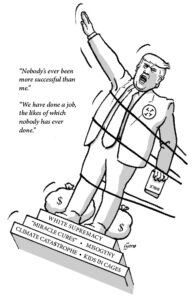 For the last decade there has been a debate on the left on how to characterize Trump, the political movement around him, and the rise of a new wave of far-right politicians globally. Is this “Fascism” or is Trump a more typical far-right politician, buffoonish oftentimes, but operating within a traditional conservative framework of the existing political system? As we get deeper into the second year of the second Trump presidency it is worth assessing the Fascism debate.
His first year back in power was a politically momentous one in the United States in ways that are familiar, long, and expanding by the day. For their part, the New York Times editorial board outlined 12 “red-flag” warning signs of democratic erosion as Trump moves the United States toward autocratic rule. According to the list, Trump has routinely sought to bypass the legislature, defy court orders, declared fictitious national emergencies, used the military for domestic control, prosecuted political enemies, attacked free speech in the universities, press, and among dissenters, carried out purges within the Federal administration, and used the presidency to enrich himself and his cronies at our expense.1
On top of this list, it is worth emphasizing Trump’s sending his personal secret police to put a major American city under military occupation, with the ICE siege of Minneapolis, and his pivot to a bellicose American Imperialism shorn of any ideological pretense, just straight gangsteristic imperialist misadventures. Proudly and openly pillaging or threatening to pillage other countries for their resources from Iran, to Cuba, to Venezuela, to Greenland. All of this has led those such as the centrist The Atlantic to publish an article straightforwardly titled, “Yes, It’s Fascism,” pointing to Trump’s leader cult self-aggrandizement, his police state tactics, his affinity for white Christian nationalism, and his work to undermine elections, now with the aid of the Supreme Court’s decision to gut the Voting Rights Act.2
I think it can be argued that this is both true and not true. It is true to the extent that “fascism” is a useful descriptor of Trump’s own politics, his desired political end goals, and a solid portion of the MAGA mass movement that supports him more broadly. But it is untrue to the extent that we try to use it to describe the American state, at least at this time. Similar to how you can differentiate between lowercase-d and uppercase-D Democrat, we can differentiate between broadly two types of “fascism”; uppercase-F and lowercase-f. Uppercase-F Fascism is the historical fascist states in Germany, Italy, Spain, and elsewhere, and the movements that supported them historically or wish to recreate them presently. They are fully realized police states, the “merger of state and corporate power” to use Mussolini’s terminology,3 and the systemic suppression of dissidents and scapegoat minorities. Lowercase-f fascism, however, is more flexible. It represents similar kinds of political forces as historic fascism, with similar authoritarian intent, but altered, reflected, and refracted into a different time and place. It is this lowercase-f fascism that I believe Trump embodies, and understanding what differentiates his present rule from uppercase-F Fascism is critical for understanding this political moment. For as Richard Seymour reminds us, “whatever emerges” from the present far-right movements in power “will not be cosplay of the 1920s and the 1930s.”4 It is an analog, not a copy.
Historic uppercase-F Fascism’s appeal to its downwardly mobile middle-class base was that it appeared outside of the status quo of mainstream politics to masses of people, as something new and insurgent to shake the political system in often nebulously defined terms. Fascism claims to attack “elites,” but the truth was its mission was always to maintain the capitalist system, even as it shook up the status quo. As Trotsky explained:
German fascism, like Italian fascism, raised itself to power on the backs of the petty bourgeoisie, which it turned into a battering ram against the organizations of the working class and the institutions of democracy. But fascism in power is least of all the rule of the petty bourgeoisie. On the contrary, it is the most ruthless dictatorship of monopoly capital.5
Palmiro Togliatti, writing in the 1920s, warned against labeling all forms of reaction “fascism,” saying, “Fascism was not simply capitalist reaction. It embraced many other elements. It comprised a movement of the petty-bourgeoise masses.”6 This mass movement element is a key piece in any definition of Fascism as it sets it apart from purely top-down reaction. Fascism mobilizes some segments of the masses, mostly centered in the traditional middle classes or “petty bourgeoisie”—small business owners, landlords, certain professionals—against other segments of society, namely, the workers and minorities. David Renton in his work on modern authoritarianism sees fascism as a “specific form of reactionary mass movement. The specificity is fascism’s leadership cult, its party form, its ideology of anti-socialism and anti-liberalism,” and it being absolutely “saturated in violence.”7
On a number of levels Trump would meet many of these criteria. He leads a reactionary mass movement in the form of his MAGA followers with a strong base within the traditional middle classes. This MAGA base is the congealed representation of what Mike Davis warned of when he referred to the “deeply reactionary…petty bourgeoisie and middle strata” in America that “has been protofascist forever”8 and therefore most susceptible to these kinds of politics.
Trump has organized this reactionary petty bourgeoisie and has built a leadership cult around himself, motivated by an ideology of anti-socialism and anti-liberal democracy and its institutions. His politics are the “anti-emancipatory politics of crisis.” For Trump and his loyal followers of goose-stepping used-car dealership owners and incels, they are, in Theodor Adorno’s terms,
[m]otivated by a profound sense of grievance and victimhood. The ingroups are conceived of as superior in morality, ability, and general development; they ought also to be superior in power and status, and when their status is lowered or threatened the ethnocentrist tends to feel persecuted and victimized. Attempts by subordinate groups to improve their status are regarded as threats; he cannot imagine that they are struggling for equality.9
Trump and his followers have become obsessed with destroying “the woke mind virus” or the very conception of equality across races and genders, all to shore up the ego of an increasingly irrational white supremacist movement.
The modern racist conspiracy theory of the “Great Replacement”—that is, white “western civilization” being replaced by people of color through demographic changes, birth rates, and immigration—is an animating paranoia for the authoritarian right. “Race and especially the nebulous and all-possessing idea of whiteness is…a pulsing void at the heart of the mythological machine of the right.”10 Fear of too many brown people, as well as fear of minorities and nonconformity in gender more broadly, is what animates fascism today. Throughout his time in and out of office Trump has played relentlessly with these psychological and demagogic “classical-fascist tropes” of “apocalyptic and hypermasculine language of nation, race, action, strength, power, authority, and violence,”11 making white nationalism a persistent theme of his speeches and even official government social media.
In sum, what Trump offers his mass movement base through the “bullying rhetoric, the hatred of racial and ethnic minorities, the xenophobia, the violence, the hostility to dissent, and for a time, the invocation of American workers humiliated and mangled by the workings of a global capitalism that did not have their interests at heart,”12 is an opportunity to punch down. In her discussion of the appeal of the alt-right to (mostly white) women like January 6th “martyr” Ashli Babbitt, Robyn Marasco described the attraction of “a semblance of power that substitutes for the real thing.”13 Beyond far-right women, this intoxication with a “semblance” of power is emblematic of all fascist foot soldiers, and the MAGA movement overall. They will never be the Führer, never be the tech billionaire, never wield any sort of real power, but they can gain license from the hierarchy above to bully, harass, oppress, and kill the “other” below. The cruelty is the whole selling point for MAGA and now for ICE recruitment in particular.
Trump and his MAGA movement have openly embraced an ever more violent far right, including the fascist Proud Boys. This same violent far right is now being actively courted and recruited by ICE, with Proud Boys founder Enrique Tarrio revealed to be an ICE employee. A welding of street militia thugs and the state apparatus is underway. The Republican Party has been transformed over the last decade into Trump’s personal political organization with a sizable and openly white nationalist core motivated by absurd conspiracy theories and paranoia. Simultaneously, Trump has been actively purging the state of any dissent or disloyalty and using mass deportations to purge the United States of immigrants and non-white immigrants specifically.
Trump’s second term has further seen aggressive melding of corporate and state interests. His Federal government has taken a direct stake in companies and he is openly taking bribes from major corporations and billionaires in exchange for sweetheart deals, appointments, and pardons. At the same time, Trump has made massive slash-and-burn austerity cuts to healthcare, public services, the environment, scientific research, and just about anything else worthwhile the Federal government does for us that isn’t war and funding his ICE gestapo. Fascism doesn’t necessarily have to be “big government,” though arguably Trump has done more to intervene in the economy than any other president in the neoliberal era. Fascism is about the terroristic, counter-revolutionary rule of capital. That rule can take different forms and require different things from the state, including austerity.
No less a figure than Ludwig von Mises, a founder of the Austrian school of economics and with it neoliberal economic theory, welcomed the rise of Fascism saying, “let the State give us a police force, to save gentlemen from scoundrels, an army ready for any eventuality, a foreign policy attuned to national necessities. Everything else…belongs to the private activity of the individual.”14 This recipe of the state only being there to secure the safety of property shows the close affinity between so-called anarcho-capitalists and authoritarian fascists that is being embodied by the Silicon Valley tech oligarchs. As Toscano summarizes, “Today’s far right melds a cynically selective anti-statism with a revanchist ethno-nationalism passionately attached to the symbolism and reality of the repressive state.”15 These oligarch tech “libertarians” like Peter Thiel are highly supportive of the authoritarian iron fist of the state, so long as the state is still working at their behest economically.
We should temper our analysis of Trump though. During Trump’s first term, Corey Robin observed,
if fascism’s achievement was to mobilize a mass base of the nation or race, consolidate the state apparatus, clear the political field of opposition and dissent through terror from above and violence from below, and thereby pursue its program with maximal leverage and authority, it’s plain that Trump has fallen short of the ideal.16
Despite everything we can still largely agree with this assessment, though the gap between Trump in his second term and this ideal version of uppercase-F Fascism is getting smaller and smaller. We are still at a transition point toward a new form of authoritarianism. Trump may be part of, as Seymour says, the “pathfinders for a new type of fascism” though “not yet Fascism”17 in the historic uppercase-F sense itself.
But there are forces that are pushing for Trump to close the remaining gap between what I consider his lowercase-f fascist impulses and the goal of uppercase-F Fascism of full police state and dictatorial rule. Constitutional restraints are not principles the administration has been shown to believe in and oftentimes seem to be adhered to only to keep up appearances or avoid conflict with allies.
Stephen Miller has said it himself: he considers Trump to have “plenary authority,” that is, effectively limitless executive powers. Trump’s political instincts have shown themselves to always side with the most authoritarian option, demanding obedience from subordinates and the general population alike. He believes the only limit on his power to be his own morality and he muses openly about his desire to somehow cancel the 2026 midterm elections, send ICE to intimidate people at the polls, or otherwise serve an unconstitutional third term. He wants to be a Fascist tyrant, he wants to make the final step over the Rubicon into an end-run constitutional crisis, but he does not (yet) have the full freedom of action and support to do so. He is held back—by a number of factors and forces.
He has been held back by the consistent and wide-ranging resistance of the American left and everyday people which have checked and countered his authoritarian moves step by step. We saw this with grassroots movements that stopped the Muslim Ban in his first term, and we are seeing it in the upsurge of resistance against ICE raids in his second. This resistance has turned the tide of popular sentiment against Trump and his draconian immigration policies, has successfully made being an ICE agent a badge of shame, and has probably done more to check Trump’s unconstitutional moves than the courts have.
But the limits on his lurches toward authoritarianism are more multilayered than that. Beyond the opposition from below, there are also cracks in the edifice of his support occurring from above. The American capitalist establishment has been largely supportive of Trump’s second term and policies. They have provided Trump many overt and indirect bribes and have been rewarded for their investment with tax cuts, handouts, and pardons. Trump has arguably been one of the friendliest, if not the friendliest administration to the billionaire elite in U.S. history. But there are limits to that support.
In severe enough political and economic crises, and with revolution knocking at the gate, even the most modest of democratic norms and social reforms “appear to the capitalist class as obstacles to the ‘normal’ process of production. Democratic institutions prevent it from doing this; so it turns against them.”18 But such a revolutionary crisis is nowhere to be seen at this moment. The ruling elite in society doesn’t turn to counter-revolutionary violence like uppercase-F Fascism lightly. As Renton observes, “counterrevolutionary movements cannot go further than the interests of the ruling class.”19 On the institutional level by the American capitalist establishment, Trump is held back due to the lack of a real need for a fully formed uppercase-F Fascist police state from the capitalist class.
There are key goals that the different segments of the American capitalist class are after from Trump: the tech oligarchy wants a friendly regulatory environment for their AI and crypto scams; the fossil fuel industry wants a Federal administration willing to work with them to kill the renewable industry as competition; domestic manufacturers want lower wages and a weaker dollar that can compete in exports internationally; and every capitalist wants lower taxes for themselves. But these goals are perfectly achievable for them within the existing constitutional political system. There is no need for them to resort to any desperate measures like a fully formed Fascist police state to get what they want. Some billionaires are clearly ready to support Trump in his most authoritarian and fascistic endeavors—notably Elon Musk, Peter Thiel, and their fraternity of tech bro oligarchs—but this sentiment is far from universal among their class.
If anything, the American capitalist order and its position as global hegemon has been shown to be more at risk from Trump’s disastrous actions than from other threats. For 80 years the United States has been able to assert its domination through a network of both soft and hard power, both trade agreements and military bases. This has been exerted through its many alliances, but Trump’s alienation of these key allies, especially in Europe, is undermining these global power structures. This risk to global American hegemony is creating splits in the ruling class on Trump’s foreign and domestic policy, from the disaster in the Iran War to opposition to Trump’s tariffs.
If we wanted to pinpoint the single most critical aspect of the difference between Trump’s present political project and the original Fascist movements, it is the present lack of a real mission. There is no mass working-class upsurge to combat like in the 1930s. Trump is a counter-revolutionary looking for a revolution to counter. A virulent anti-communist without a real communist threat to squash. While the last decade has provided many examples of left-wing resurgence and heroic resistance—most spectacularly in the George Floyd Uprising in 2020—at no point could anyone claim the capitalist system was at real risk. That risk of imminent revolution is what historically galvanized the ruling classes in Italy and Germany to throw out their constitutions and support the Fascist usurpation of their preferred status quo. Without that threat, the critical support from the majority of the American elite is lacking for Trump’s more authoritarian desires.
The MAGA movement seeks to counter not the imminent overthrow of the capitalist order, but at best mild reformism. Slightly higher taxes for the rich, fewer persons of color murdered by the police, trans inclusive spaces, cultural changes they object to like more minority representation in media, a pathway for citizenship to immigrants, more empathy to people in general. An “end of western civilization” these do not make, no matter how much the Nazi-saluting Elon Musk says they do. This is why Trump and his movement must project overwhelming paranoia in regards to their enemies on the left. The “globalist” “woke mind virus” “cultural Marxist” “gender ideological” “terroristic” threat must be all-powerful, all-pervasive—a literal “anti-Christ” in Peter Thiel’s imagining—to justify the fascists’ sense of victimhood and their desire for violence. It is politics by overcompensation and scapegoating, inventing an enemy to get mad about.
The ideals that motivate the MAGA movement when not outright nihilistic—the “pillaging [of] what future exists to live out their revenge fantasy”20 here in the present—are often banal. At best they can be a watered-down version of what motivated Fascism in the past. “To the extent that we can speak of fascism today, it is a fascism largely emptied of…utopia…. [I]t is not reacting to an imminent threat of revolutionary politics, but which retains the racial fantasy of national rebirth.”21 For today’s fascists, the mythological “utopia” they desire is not some glorious, purified empire of their earlier counterparts, but the images created by Madison Avenue advertisers of the 1950s regurgitated by AI bots on Twitter: white picket fence, racially segregated suburbia, post-war abundance, heteronormative male-dominated households. Without a utopian/dystopian vision for what the MAGA right is fighting for, and a non-imaginary enemy to fight against, it is hard to see them crystallizing the cohesion to go on a counter-revolutionary assault against the whole of society. At least not yet.
Trump is also held back now by the fact that he is supremely unpopular. His approval rating is as of this writing hovering in the mid-thirties. His popularity among young men, which was key to his 2024 victory, has largely collapsed. The proportion of Republican Party members who identify as MAGA is rapidly decreasing, showing that the core of his base and movement is losing momentum. With this weakening of his mass movement base, thin cracks are emerging in his hold over the Republican Party, though his dominance within the party is still a long way from slipping. As Trump’s actions continue to undermine American imperial hegemony, and his popularity continues to fall, we can expect the cracks in the ruling class to grow ever larger as different sections of capitalists with different immediate interests come to blows.
Trump is old, possibly senile, directly and extensively implicated in the Epstein files, losing popular and ruling-class support, and beset with real political weaknesses. But we shouldn’t mistake having weaknesses for being politically weak. As the mainstream center-right Financial Times warns us:
Anyone who assumes that Trump will quietly slide into lame duck status would be misguided. His recent targeting of Somali immigrants is a reminder that there are few limits on what he will consider doing. In Trump’s mind and according to Project 2025 there are no restraints on a president’s power.
Trump’s fascist desires face real restraints from popular resistance and establishment impediments, but he can do a lot of damage nonetheless as he tries to push beyond those impediments. As we get closer to the midterms and the likelihood of a major defeat for the GOP grows, we should expect Trump’s authoritarianism to increase and become more dangerous, not less. The mass racist redistricting in the Southern United States is a direct assault on our democracy. Trump’s ICE gestapo is already kidnapping our neighbors, occupying our cities, and murdering us in the streets. His FBI has been ordered to launch a new Red Scare by targeting those who believe in “anti-fascism, anti-Americanism, anti-capitalism, and anti-Christianity; support for the overthrow of the United States Government; extremism on migration, race, and gender; and hostility towards those who hold traditional American views on family, religion, and morality.”22 In other words, a McCarthyite attack and suppression of the whole left.
This isn’t a Fascist police state, but the seeds of that kind of police state are present and the tools of mass political repression are being laid out. As Trump continues to blunder from crisis to crisis, and communities and movements across the country continue to rise up against his rule, we can expect Trump to try to increase repression. Which one wins out, the people or the regime, can only be determined in struggle.
So where does this leave the “Is it Fascism” debate? On a certain practical level the distinctions aren’t of critical importance. The MAGA GOP is not insulted or deterred by the “fascist” label at all. Fox News hosts joke about appropriating “Nazi” as an ironic greeting to each other. Trump himself is fine with the label. The taboo against fascism in American politics is alas no longer an effective tool against it. Liberals and the left might have been mobilized by fears of “Fascism” in the abstract, but it’s the real-world oppression and repression of Trump that is galvanizing the opposition now.
In terms of left-wing strategy, the differences on whether we call it “Fascist” (whether “neo,” “pseudo,” “proto,” “late-stage,” “end times,” “semi,” or otherwise), “new authoritarianism,” “disaster nationalism,” “authoritarian right,” just “far right,” or (God forbid) “the populist right,” the starting point is still building an effective united front mass movement to counter it. Oppose Trump wherever we can, push every movement to do more to throw wrenches into his machine, demonstrate the unpopularity of MAGA in the streets, assist the creation of as many fissures in the ruling class as possible, demoralize and disperse his base. Unite the left, win over the middle, isolate and defeat the MAGA right. Calling Trump a fascist or not won’t change the need to build movements that can oppose and defeat him.
For what it’s worth, my own take is that to whatever extent Trump possesses a coherent political ideology outside of personal self-enrichment and narcissism, he is aligned with enough features and processes of fascism, at least in the lowercase-f sense, to warrant the label. If, “on the level of individuals and civilizations, personality predates ideology. Meaning, before you were a fascist, you were a bully and an asshole,”23 then Trump is the bully par excellence. His chief demand is that everyone obey him, and his chief complaint is when they don’t. His politics, such as they are, are deeply contradictory but so was historical Fascism. His MAGA movement base has strong fascist leanings in outlook, ideology, makeup, and components, but is also heterogeneous in composition overall, creating opportunities for fissures to emerge. There are fully self-described Fascist grouplets and individuals actively working within the MAGA movement, and through it the wider GOP and Trump administration, but even then MAGA is more of a lowercase-f fascist movement than the disciplined stormtroopers of the 1930s. And the Federal state Trump rules over like one of his personal companies is not a Fascist police state, at least not yet. At best it is a flawed bourgeois democracy in the process of being transformed into a so-called competitive authoritarianism state.
Trump, his inner circle, and his movement are a reflection of analogous political forces that birthed historic uppercase-F Fascism—downwardly mobile middle classes energized by racist demagoguery of national renewal into a mass movement of reaction, a tottering crisis-ridden status quo that isn’t meeting people’s needs, a left that has failed to provide a real alternative—but in a far different context that lacks the key ingredient of an intense revolutionary crisis that it seeks to combat. But all of these things are in flux as the crisis continues. It is small-f fascism with the potential to evolve as the moment itself evolves.
We are in a fraught and fragile situation where the enemy has a lot of power, is attempting to consolidate that power, but has little popular support outside of certain segments of the oligarchic elite and a shrinking mass movement of diehard loyalists. The “F” label—whether we agree with its use or not—should not lead us into despair as if he has already won, but steel ourselves for the fights to come that are needed to defeat him. There is still much room for political maneuver and we have to make the most of all of it while we can.
In this, the common everyday solidarity and resistance we saw from the heroic people in Minneapolis showed us the way forward. This broad, popular, organized popular mass resistance is the real check on Trump’s creep toward authoritarian rule; not the courts, not the institutions, and not the Democratic Party.
One of the most common lessons talked about from the rise of Nazism in Germany was that the left was not united against the common enemy and ended up being defeated without a fight. The lesson is to not let the fascists entrench themselves. Resistance must be united, generalized, and start early to prevent the uppercase-F Fascist state from being consolidated. This lesson I believe has been internalized.
Notes
1. Editorial Board, “Are We Losing Our Democracy?” New York Times, Dec. 10, 2025.
2. Jonathan Rauch, “Yes, It’s Fascism.” The Atlantic, Jan. 25, 2026.
3. “Mussolini on the Corporate State,” Political Research Associates, Jan. 12, 2005.
4. Richard Seymour, Disaster Nationalism (Verso Books, 2024), 11.
5. Leon Trotsky, What Is National Socialism? (1933).
6. Palmiro Togliatti, “On the Question of Fascism,” 1928, quoted in Marxists in the Face of Fascism (Haymarket Books, 2019), 138, 144.
7. David Renton, The New Authoritarians (Haymarket Books, 2019), 16.
8. “Podcast: Mike Davis and Adam Shatz, Catholics and Lumpen-Billionaires,” London Review of Books, Oct. 27, 2020.
9. Theodor Adorno, et al., The Authoritarian Personality (Verso Books, 2019), 149.
10. Alberto Toscano, Late Fascism (Verso Books, 2023), 130.
11. Bill V. Mullen and Christopher Vials, The U.S. Anti-Fascism Reader (Verso Books, 2020), 2.
12. Corey Robin, The Reactionary Mind, 2nd ed. (Oxford University Press, 2018), 264–5.
13. Editorial Board, “Reconsidering the Sexual Politics of Fascism,” Historical Materialism, June 25, 2021.
14. Alberto Toscano, “The Nightwatchman’s Bludgeon.” NLR/Sidecar, Oct. 2022.
15. Toscano, Late Fascism, 72.
16. Robin, Reactionary Mind, 265.
17. Seymour, Disaster Nationalism, 11, 208.
18. Otto Bauer, “Fascism,” 1936, quoted in Marxists in the Face of Fascism, 295.
19. D.K. Renton, “Fascism Without a Mass Movement?” Spectre Journal, May 22, 2026.
20. Folding Ideas, “Ruminations on that DHS Penguin Tweet,” YouTube, Jan. 2026.
21. Toscano, Late Fascism, 2.
22. Adam Goldstein, Trump’s ‘Domestic Terrorism’ Memo Chillingly Targets People by Ideology, Foundation for Individual Rights and Expression, Oct. 1, 2025.
23. Brennan Lee Mulligan, quoted on Adventuring Party, episode 6, with Amy Vorpahl.