The Far Right in Europe and the Fight Back in France
 The 2020s has been a reactionary period in Europe. Across the continent, the far right is in ascendance, gaining footholds everywhere and entering government in multiple countries.
The far right leads the governments in Hungary and Italy, with the regimes of Viktor Orban and Giorgia Meloni dominant in these countries. At the end of 2024, the far right supports or participates in the government in the Netherlands, Sweden, and Finland. The far-right party is the largest in parliament in Austria, France, Hungary, Italy, the Netherlands, and the German state of Thuringia; they are a close second in Saxony and Brandenburg (Germany) and Flanders (Belgium). Additionally, far-right parties occupy at least 10 percent of the parliamentary seats in Belgium, Bulgaria, Czechia, Denmark, Estonia, Finland, Germany, Latvia, Norway, Poland, Portugal, and Sweden; and in Greece, Romania, Spain, and the United Kingdom, they are polling above 10 percent.1 Very few parts of the continent are untouched by this scourge.
The rise of the far right is not a new phenomenon in Europe, but the current situation is systemic, continent-wide, and appears to be durable. When Jörg Haider’s Freedom Party joined the Austrian government in 2000, diplomatic sanctions were placed on the country, and Jean-Marie Le Pen reaching the second round of the French presidential election in 2002 provoked a sense of profound shock and a national crisis. Today, such events and worse occur regularly, becoming a normalized, everyday occurrence of European political life. Despite their presentation as the bulwark of moderation and civility, establishment parties are complicit in this situation. Their pursuit of neoliberal austerity created the basis for populist discontent, which the far right attempts to capture; and their offensive against the left weakened an alternative articulation of the discontent in an emancipatory direction.
The European Ruling Class Suppresses the Left
In the early 2010s, imposition of vicious austerity after the financial crisis sparked the most powerful working-class uprising in a generation, most notably in Greece and Spain. Indignant precarious workers occupied the Syntagma Square in Athens and Puerta del Sol in Madrid, demanding an end to the neoliberal paradigm. Mass demonstrations and general strikes shook the old order. In parliamentary politics, new left parties that grew with the movement of the squares—Syriza and Podemos—achieved a spectacular rise.
In Greece, Syriza won the elections in January 2015 with a commitment to reverse the memoranda imposed by the Troika, the leading European Union economic institutions, with Alexis Tsipras becoming prime minister. Syriza’s election was met with an all-out assault by the entire European establishment. As Yanis Varoufakis recounts,2 the negotiation of the Troika with the Syriza government was not simply aimed at maximizing the returns for German banks, but especially at crushing any political alternative to the austerity paradigm. On this point, the entirety of the “extreme center”—social democracy as well as conservatives—was united.3 Greek people continued to support rejection of the draconian memorandum, voting for this position by a large margin in the referendum called by Tsipras in July. However, merely a week later, Tsipras capitulated completely to the European ruling class by accepting an even worse memorandum, betraying the Greek workers and destroying the Greek left.4
The defeat of the Greek anti-austerity movement and destruction of Syriza as a leftist force in July 2015 weakened the European left as a whole. In Spain, Podemos came close to overtaking the social democratic PSOE (“sorpasso”) in the 2015 and 2016 elections, but sorpasso turned out to be an elusive goal, and the party was weakened by “lawfare” of illegal police surveillance and manufactured judicial controversies. In Britain, the left’s rise was achieved inside the Labour Party, as Jeremy Corbyn rose to leadership with unprecedented levels of support from the mobilized base. Corbyn repelled the Blairite opponents in the parliamentary party with a renewed popular mandate from the members in 2016, and came close to winning the 2017 elections with a popular manifesto; but Corbynism was defeated by powerful internal enemies in the Labour Party, who preferred to sabotage their own party’s electoral chances to prevent a Corbyn victory, as well as the relentlessly hostile media apparatus.
While political dynamics in each country are distinct, the suppression of the left alternative across Europe meant that austerity continued unabated. It has enabled far-right parties to capitalize on discontent with the status quo, drawing support especially from blue-collar or manual workers and those in worse economic situations,5 while offering them false solutions. In the 2020s, as inflation soared and its cost was mostly imposed on the workers, this pattern was further exacerbated. It is not that the working class as a whole has shifted to the far right; the pattern is the fracture of the working class, as urban, multicultural fractions of the class have generally continued to be the base of the left. Without the left that can unite various fractions of the working class against the far right, the latter grows quickly.
Collaboration with the Far Right
As the far right gained support, its entry into government in multiple countries has been facilitated by the center right. Abandoning their prior cordon sanitaire, conservatives are increasingly willing to cooperate with the far right across the continent. The case of Sweden demonstrates this clearly. The Sweden Democrats (SD), a party with an explicitly neo-Nazi origin led by Jimmie Åkesson, received 20 percent of the votes in 2022, becoming the second largest party in parliament. The conservative Moderate Party had long rejected any cooperation with SD, but their position began to weaken in the late 2010s, under Ulf Kristersson’s leadership. After the 2018 elections, the conservatives formed coalitions with the far right in many municipalities, and soon they began to seek cooperation on a national basis. In 2022, Kristersson and other bourgeois party leaders negotiated the Tidö Agreement, an extensive confidence and supply agreement with SD that incorporated many of their key demands. In pursuit of power, any principled objections fell away. The most illustrative is the case of Romina Pourmokhtari, a Liberal politician who had publicly advocated for rejecting any cooperation with SD. Three months before the election, she called SD’s politics “infinitely more dangerous than the challenges Sweden faces today”; she then became a cabinet minister in the government dependent on the far right.6
A similar pattern of center-right collaboration with the far right has repeated in many countries. In Italy, where the far right is already larger than the center right, they coordinated and ran as part of the same coalition even before the election. In Finland, the center right has led a coalition government with the far right since the 2023 election, forming the “most right-wing government in Finnish history” of Petteri Orpo.7 In the Netherlands, Geert Wilders’ Party for Freedom (PVV) became the largest party in 2023, and even though he was blocked from becoming prime minister himself, three other conservative parties had no problems forming a coalition with his party. In Spain, the conservative People’s Party (PP) formed governments in multiple regions with the far-right Vox,8 which minimizes the evils of the Franco dictatorship or worse. Even in Germany, where the taboo against collaboration with the far right should be the strongest, the Christian Democrats’ leading figure Friedrich Merz hinted at cooperation with the Alternative for Germany (AfD) on a local level;9 even though they still reject it at the state and federal level,10 it is questionable how long such principles will be sustained.
Acceptance of the far-right governments internationally has followed a similar trajectory. Those in Hungary and Poland regularly faced conflict with other EU states, even though EU integration contributed to Orban’s rise11 and European capital benefits from his economic policy that enables more exploitation of Hungarian workers. With Meloni, however, there is not even a pretence of opposition; she has been actively embraced by the European establishment,12 once she pivoted to Atlanticism and softened Euroscepticism. The establishment parties are, of course, not identical, equivalent, or similarly guilty as the far right. However, repeating the pattern since the dawn of capitalism, the far right poses less of a problem for the capitalist class and their political representatives—even when it is not their first preference—than the radical left does.
On immigration policy, indeed, the European establishment is following the far right; the far right sets the agenda, the center right promotes it, and the center left follows. Meloni’s attempt to prevent refugees from claiming asylum rights in Europe—through repression of organizations rescuing migrants in the Mediterranean,13 cooperation with authoritarian regimes in North Africa and processing of asylum claims in a country outside the EU—has been praised and followed by the EU Commission president Ursula von der Leyen and British prime minister Keir Starmer, among others.14 Meloni’s anti-migrant policy is an acceleration of the violent logic of “Fortress Europe,” which the European establishment has pursued.
The situation in Denmark is another case in point. The Danish center-right government has implemented a raft of policies designed to weaken asylum rights and make lives of immigrants as difficult as possible, under pressure from the far-right Danish People’s Party.15 This immigration policy, which is seen as a model for the European far right,16 has now been thoroughly embraced by the Social Democrats,17 further entrenching it. The center left plays an active part in perpetuating this vicious cycle, as the anti-immigrant discourse increasingly becomes “common sense” and the hateful, fascist rhetoric of “great replacement” is normalized.
On social and labor policy, the far right and the center right together pursue further austerity and attacks on the working class, contrary to the far right’s occasional appeal to economic populism. Åkesson claims to “restore the People’s Home,”18 a reference to the Swedish welfare state in its heyday, combining it with a xenophobic interpretation of the “people.” But they are not even “welfare chauvinists”; the far right in government across the continent continued attacks on the welfare state and workers’ rights. In Sweden, the SD is an active partner in the ongoing privatization and deterioration of the once social-democratic welfare state.19 In Finland, the Orpo government launched a massive attack against the labor movement—the agenda includes undermining their right to political strikes, weakening of national and sectoral collective bargaining, and worsening job protection and sick pay.20 In the Netherlands, the austerity attack targeted the universities particularly viciously,21 imposing hundreds of millions of euros of cuts and decimating thousands of jobs in the sector already characterized by precarity. In Italy, the far-right government scrapped the “citizen’s income,”22 a limited program of minimum income guarantees for the poorest Italians, while further deepening precarity by promoting short-term employment contracts.
The far right’s rise has degraded and poisoned political discourses,23 as they propagate anti-feminist, anti-LGBTQ, as well as racist speech, influenced by the U.S.-style “anti-woke” discourse. In many countries, their narrative includes fascist-friendly interpretations24 of their country’s history.25 The far right has targeted the media and cultural institutions that can present an opposition to their rule, especially where they control the government. Orban has largely succeeded in seizing much of the Hungarian press,26 while Meloni is attempting to do so through increasing control over the public broadcaster RAI.27 It appears that stopping the far right’s momentum is difficult in many countries, with one potential exception: that of France.
Social Mobilizations in France
France occupies a decisive position in this political landscape in Europe. The far-right Rassemblement national (RN) came first in votes in the European parliament and the National Assembly elections this summer and Marine Le Pen has a serious chance of winning the next presidential election. At the same time, France remains one of the few countries where the left is vibrant and growing, and forms a serious force against the far right. Instead of the far right dominating the challenge to the status quo, and the “extreme center” posing as the sole alternative to fascism, the political field is clearly divided into three camps; bourgeois liberals (Macronists), the far right and the radical left.
The strength of the radical left in France today comes from many cycles of popular struggles over the past decade. Nuit debout in 2016, against the neoliberal labor reform that reduced protection against dismissal, was the first spark. Inspired by the movements of squares that emerged earlier in the decade with Tahrir Square, Nuit debout occupied the Place de la république in Paris, and created a new foundation of mobilizations. The French left and organized labor then led a significant wave of mass strikes against Macron’s pension reform (an increase in retirement age, among various cuts) in 2019-20 and in 2023, mobilizing millions of supporters.
The gilets jaunes (yellow vests) of 2018-19 was another significant social mobilization in this period. Its political articulation was more ambiguous—its initial trigger of opposition to the fuel tax included an anti-ecological tendency, and far right sympathy was present in the movement. However, the movement did clearly target economic inequality and the rising cost of living, and helped discredit Macron and his politics. With a base in rural areas, the movement used innovative tactics, including the use of yellow vests as a visible symbol and blockading of roundabouts, and organized weekly mass demonstrations across the country, while facing violent repression by the police.
Facing a series of popular uprisings, French governments have taken an increasingly authoritarian approach. The Socialist Party (PS) government of François Hollande and Manuel Valls forced through the 2016 labor law reform without a parliamentary vote, using a special constitutional provision, Article 49.3. Despite the failure of the immediate aim, the mobilizations were successful in weakening support for the PS government. After attacking their own base, the PS collapsed; Hollande’s approval rating dropped to the unprecedented 4 percent in late 2016, forcing him to abandon his re-election bid. The dynamic of the PS collapse was more similar to Greece’s rather than that in other countries, where the center-left parties retained their dominance. This is what provided an opening for the radical left, in the form of La France insoumise (France Unbowed, LFI), founded by Jean-Luc Mélenchon. In the 2017 presidential election, Mélenchon obtained 19.6 percent of the vote and was only 1.7 percentage points short of Le Pen, who advanced to the second round against Macron.
The waves of social mobilizations also made Macron deeply unpopular and further strengthened the left. In 2022, the LFI made a breakthrough, with Mélenchon winning 22 percent of the votes and only one point behind Le Pen; the PS candidate Anne Hidalgo, the mayor of Paris, obtained a mere 1.7 percent. Mélenchon’s performance gave LFI decisive leverage to create an alliance for the legislative election—Nouvelle Union populaire écologique et sociale (NUPES) with the PS, the Communist Party, and the Ecologists. The LFI was predominant within NUPES, which makes France a unique case in Europe today. NUPES rose to second place in the legislative election, depriving the Macronists of a majority in the Assembly. Lacking a parliamentary majority, the Macronist governments began regular recourse to passage of legislation without parliamentary approval (using Article 49.3), most notably to pass the wildly unpopular pension reform in 2023, further eroding the legitimacy of the government.
The far right also grew in the same period. Racism, xenophobia, and misogyny are obviously the driving force for their support, fueled by proliferation of right-wing media such as CNews. Le Pen’s claim to “dediabolisation” —normalization—of the party, as well as pretention to economic populism, further broadened support. Le Pen has claimed to support economic redistribution28 and even “social justice,” which attracted strong support in the post-industrial RN bastions and among gilets jaunes supporters.29 In 2022, Le Pen obtained 41.5 percent of the votes in the second round for the presidential election, compared to 33.9 percent in 2017; the RN also gained a major presence in the National Assembly for the first time, going from 8 seats to 89 seats.
Nouveau Front Populaire and the 2024 Legislative Elections
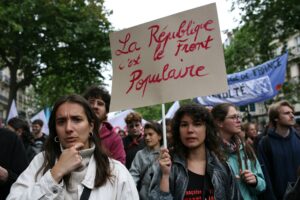
The dramatic events in the summer of 2024 emerged out of this context. The RN came first with a large lead in the European Parliament election on June 9, and Macron unexpectedly dissolved the National Assembly. The left immediately mobilized against rising fascism, on the streets as well as electorally. Labor unions, student associations, social movement groups, and left parties united to organize regular street demonstrations, bringing hundreds of thousands out into the streets on June 15. For the snap election, the sense of anti-fascist urgency brought left parties together to create the Nouveau Front populaire (NFP), with the name clearly invoking the 1930s struggle.
The NFP proposed a common program,30 whose flagship policies included abolition of Macron’s pension reform, price control of essential goods, and raising the minimum wage to 1600 euros a month; these were proposed as the urgent measures of rupture for the first 15 days. For a broader agenda, they advocated for ecological planning of the economy, a wealth tax, expanded construction of social housing, abolition of Macronist laws limiting immigrant and asylum rights, as well as democratization of the French state through creation of the sixth republic. After weeks of frenetic campaigning, the first round of the election saw the NFP in second place, behind the far right. For the second round, the NFP took the principled step of withdrawing all their third-placed candidates in constituencies where a fascist came first. The presidential camp (Ensemble) reciprocated it with the NFP, though to a more limited extent.
The night of July 7, 2024, was a euphoric one for the French left. Overturning the widespread expectation of a first-place finish for the far right, the NFP prevailed on top in the second round, defeating the RN and Ensemble in seat counts. After a period of negotiations between the NFP parties, they nominated Lucie Castets as their common candidate for prime minister. A civil servant working for the city government of Paris and an activist for improving public services, and without an attachment to one of the parties, the young and previously little-known Castets effectively served as the public face and symbol of the NFP’s unity.
If Macron was committed to anti-fascism, he would simply have appointed Castets as prime minister. But he sought to govern on anti-socialism, more so than anti-fascism. He rejected her nomination on the basis that she lacked a majority, even though it was his own party that prevented this majority. After dithering for two months, Macron appointed Michel Barnier, a conservative politician from the Republicans, whose majority was dependent on the fascists; a perfect embodiment of “Macrono-Lepenism,” as LFI calls it. Barnier’s government fell in three months, after it passed cuts to social security yet again through Article 49.3; the RN opted for voting against Barnier, in order to maintain their populist image. As of this writing, Macron has appointed François Bayrou, from his own political camp, as yet another prime minister. A stable government remains unlikely.
Future Prospects
The LFI represents a rare success story in the 2020s European left. Mélenchon’s charisma, strategic acumen, and principled pursuit of independence from the PS, played a pivotal role in the LFI’s breakthrough, which was by no means a certain outcome at the beginning. They built a solid, enduring base in the popular neighbourhoods in the urban areas and banlieues, with a program of solidarity and rupture. They skillfully combined tactical flexibility with principled politics; their strategy in 2024 involved prioritizing defeat of the RN at the ballot box, while rejecting any disingenuous overture from the Macronist camp, which would involve selling out on the political commitment. Initially a party solely focused on Mélenchon, they developed young leading figures such as Mathilde Panot and Manuel Bompard, who have become household names in France this year through their role in the summer elections and the National Assembly.
The path forward is challenging and by no means certain. It is imperative that the LFI maintains a predominant position in the NFP. If the balance of power shifts towards the PS, left unity is unlikely to be maintained, as the PS feels emboldened to reject the common program of the left and seek closer cooperation with the Macronists. The right-wing of the PS has always resisted cooperation with the insoumis, and the PS once suspended an alliance with the LFI,31 attacking the latter’s position for Palestinian solidarity. After the summer of 2024, the anti-LFI tendency in the PS surfaced more; if they gain more influence, it would have a devastating impact on the popular front, benefitting the Macronists and the far right.
The events of this summer also highlighted the question of internal democracy in the LFI. As sociologist Manuel Cervera-Marzal has meticulously documented,32 LFI’s structure is very top-down, and members have few rights or leverage to change or oppose the leadership’s positions. This came to the fore dramatically this summer, when several prominent long-time LFI figures—such as Alexis Corbière and Danielle Simonnet—were suddenly stripped of the party’s nomination, presumably due to their disagreements with Mélenchon. Corbière and Simonnet ran against the official LFI candidates and won, forming a new group—L’Après. This dispute precipitated the departure of other prominent and independent-minded LFI figures, including feminist writer Clémentine Autain as well as journalist and filmmaker François Ruffin.
As LFI leadership’s supporters argue, there is a case to be made that these dissidents were shifting the party rightwards, as attested to by the fact that L’Après caucuses with the Ecologists in the parliament. Furthermore, Ruffin’s lack of commitment to anti-racism33 should be vigorously criticized. However, weak internal democracy in LFI remains a concern. Even if the LFI leadership has so far performed brilliantly, the leadership of any left party faces immense structural pressure to compromise with the political and economic forces of capital, especially when they come to power or are close to it. The power of grassroots militants is always essential in keeping the leadership from succumbing to such pressure.
Even as the far right rises all across Europe, the French summer of 2024 showed that anti-fascism can spark mass mobilizations, and that the left can effectively counter their rise. The only way to defeat the far right in a durable way is through an alternative model of political economy, rooted in solidarity and an exercise of popular power over capital. Such a prospect may not be particularly likely in the near-term, even in France. However, the potential victory of the French left represents the greatest hope to reverse the tide of the far right across Europe. The trajectory of the struggle is unpredictable; but it is certain that the struggles in France will be of decisive importance in coming years.
notes
1. A far-right party is defined as a party affiliated with the European Conservatives and Reformists Party, Patriots.eu or Europe of Sovereign Nations, as well as the Progress Party in Norway and the Reform Party in the UK. The data is based on seat share in the lower house.
2. Yanis Varoufakis, Adults in the Room: My Battle with Europe’s Deep Establishment (London and New York: Random House, 2017).
3. The foremost advocates for the punitive approach against Greece included Wolfgang Schäble, a German Christian Democrat, and Jeroen Dijsselbloem, a Dutch social democrat.
4. Stathis Kouvelakis, “Syriza’s Rise and Fall,” New Left Review, 97, Jan.-Feb. 2016.
5. Far-right parties in France (RN), Germany, Italy, Sweden and the UK fit this pattern, among others. Some exceptions include Vox in Spain and Éric Zemmour’s Reconquête in France, which draw more support among higher-income voters from traditionally privileged stratum.
6. Anne-Françoise Hivert, “In Swedish politics, Pourmokhtari is accused of ‘selling her soul for a ministerial post’,” Le Monde, Nov. 8, 2022, updated Nov. 9, 2022.
7. Jon Henley, “Finland’s ‘most rightwing government ever’ to cut spending and immigration,” Guardian, June 16, 2023.
8. Sam Jones, “How Spain’s conservatives joined forces with far-right Vox,” Guardian, July 21, 2023.
9. Philip Oltermann, “German centre-right leader retreats from remarks about working with AfD,” Guardian, July 24, 2023.
10. Jon Shelton, “Germany: Opposition leader Merz rules out AfD cooperation,” DW, Sept. 6, 2024.
11. Áron Rossman-Kiss, “How European Integration Set the Stage for Viktor Orbán,” Jacobin, Sept. 4, 2024.
12. David Broder, “Giorgia Meloni’s Europe,” Dissent, Spring 2024.
13. “Italy approves clampdown on migrant rescue ships, fines charity,” Euractiv, Feb. 24, 2023.
14. Jennifer Rankin and Angela Giuffrida, “Von der Leyen to ask EU leaders to explore using ‘return hubs’ for migrants,” Guardian, Oct. 15, 2024; “UK PM Starmer praises Italy’s Meloni for reducing illegal migration,” Le Monde, Sept. 16, 2024.
15. Anne-Françoise Hivert, “Denmark’s increasingly harsh immigration policies,” Le Monde, Oct. 27, 2022.
16. Jean-Baptiste Chastand, Alexandre Pedro and Anne-Françoise Hivert, “Immigration: The ‘Danish way’ appeals to the European right,” Le Monde, May 28, 2023, updated Sept. 3, 2023.
17. Anne-Françoise Hivert, “Denmark’s left wing promotes immigration restrictions,” Le Monde, June 1, 2023, updated Sept. 3, 2023.
18. “Jimmie Åkesson: ‘Vi tänker återupprätta folkhemmet,’” [‘We intend to re-establish People’s Home’] SVT, July 7, 2017.
19. Anne-Françoise Hivert, “Sweden’s social model is on its last legs,” Le Monde, May 6, 2024.
20. Toivo Haimi, “Finland’s Right-Wing Government Is Trying to Crush Labor,” Jacobin, Mar. 20, 2024.
21. KNAW, “New government’s austerity plans detrimental to Dutch higher education and research,” June 11, 2024.
22. Allan Kaval, “Italy’s Giorgia Meloni chooses International Workers’ Day to cut minimum incomes,” Le Monde, May 2, 2023.
23. Anne-Françoise Hivert, “In Sweden, the far right makes the political debate Trump-esque,” Le Monde, June 1, 2024, updated June 2, 2024.
24. David Broder, “Italy’s Far-Right Government Is Relitigating World War II,” Jacobin, Feb. 10, 2024.
25. Miguel Urbán, “Franco Never Left,” Jacobin, Jan. 5, 2019.
26. Diana Maria Prisecaru, “Media control is key to Orbán’s anti-gender discourse success,” The Loop, April 19, 2024.
27. Angela Giuffrida, “Italian government accused of exerting ‘ruthless’ influence at state broadcaster,” Guardian, May 23, 2023.
28. Elsa Conesa, “How Marine Le Pen gave up economic liberalism for a ‘social-populist’ agenda,” Le Monde, April 21, 2022.
29. “Presidential election. Who did the Yellow Vests vote for?,” West France, Apr. 11, 2022.
30. NFP, “Contrat de legislature”.
31. “Nupes: le Parti socialiste suspend sa participation à l’alliance de gauche,” [“Nupes: Socialist Party suspends its participation in the left alliance,” France 24, Oct. 18, 2023.
32. Manuel Cervera-Marzal, Le populisme de gauche [Left-wing populism], 2021.
33. Mathilde Goanec, “François Ruffin et les classes populaires: les militants antiracistes pas surprise mais quand même déçus” [“François Ruffin and the working classes: anti-racist activists not surprised but still disappointed,”] Mediapart, Sept. 28, 2024.