The Berkeley Independent Socialist Club
[The International Socialists (IS), an American revolutionary socialist organization of the 1960s and 70s, was the most successful of the many left groups involved in labor organizing in that era. The IS helped to organize and found Teamsters for a Democratic Union and was active in the auto, steel, and telephone workers unions. And the IS created Labor Notes. Its members were also involved in supporting the Black liberation struggles, the anti-colonial movements, and in broader international solidarity. The IS advocated independent political action to the left of the Democrats, helping to create the Peace and Freedom Party. Now Andrew Stone Higgins has written a history of this group—From the Free Speech Movement to the Factory Floor: A Collective History of the International Socialists—by assembling short memoirs of many of its members. With the kind permission of the publisher, Haymarket Books, two of those memoirs are included here, this one by Thomas Harrison and one by Anne Mackie. These are followed by a review of Higgins’ book by Alan Wald.]
Berkeley in the 1960s, both the university and the community, was an exciting combination of bohemian culture and leftist politics. When I enrolled in the fall of 1966, an escapee from the ultra-bland suburbs of San Jose, I instantly fell in love with the place—its bookstores, coffee houses, the free rock concerts and “happenings” in the parks. As a frequent patron of the city’s three art-house cinemas—for which Pauline Kael wrote the program notes—I acquired an extensive education in film history. Like almost everyone else, it seemed, I read Berkeley’s alternative weekly paper, The Barb, and listened to KPFA, the local listener- supported radio station founded by pacifists right after World War II. KPFA featured jazz and classical music, poetry, political commentary (Hal Draper, along with his wife, Anne Draper, had a monthly program throughout the ’60s), and thorough on-the-ground reporting of protests and demonstrations on and off campus.
The university’s stellar faculty—including such outstanding figures as Carl Schorske, Larry Levine, and Reggie Zelnik in history, and Sheldon Wolin, Mike Rogin, Hanna Pitkin, and John Schaar in political science, all of them allies of the student movement—attracted high-caliber graduate students from all over the country and the world. UC was tuition-free to state residents, although there were “incidental fees” of $120 per semester, a bit less than $1,000 in today’s dollars. Since I got no financial assistance from my parents, Berkeley was still hard to afford even with a scholarship. I had to take out sizeable National Defense loans and hold 15-hours-a-week Work-Study jobs, plus full-time work in the summers—including 12-hour shifts at two local canneries, Hunts in Hayward and Del Monte in Emeryville.
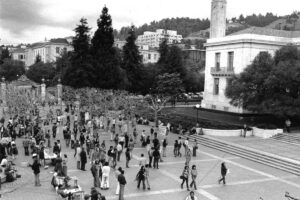
Sproul Plaza, a broad square in front of the administration building was like the Agora in ancient Athens. At midday there was a long row of folding tables belonging to political (mostly left-wing) groups, where members distributed leaflets, sold literature, buttons, and bumper stickers, and recruited. Every weekday, the ISC table was there. Our literature always included a series of pamphlets introducing the ideas of independent Third Camp socialism, including Hal Draper’s seminal Two Souls of Socialism, in which Draper put forward the concept of “socialism from below,” as distinct from and opposed to putative versions of socialism imposed “from above.” We also sold “clipping books,” reprinting selected articles from the Workers Party and Independent Socialist League press in the ’40s and ’50s. The ISC table regularly carried issues of International Socialism, the journal of the British International Socialist group led by Tony Cliff, and New Politics, published in New York by Julius and Phyllis Jacobson, who like Draper were veterans of the WP and ISL. Comrades, sympathizers, and passers-by would hang around the table for hours talking politics. After it was taken down in the afternoon, people would move to The Terrace, behind Sproul Plaza, and continue discussions over coffee for hours more.
In September 1966, right after I arrived on campus, I was attending a rally at Sproul Plaza, when a young woman came up to me with a piece of cardboard that was filled with political buttons. One of the buttons said, “I Wouldn’t Vote for Brown even if He Ran against Reagan,” referring to the upcoming California gubernatorial contest between Reagan and the Democratic incumbent, Edmund (Pat) Brown. She asked me if I’d like to buy this button, and I said, “No, but I’d like to buy the button with a picture of Karl Marx,” which she had. We then proceeded to have a conversation that lasted several hours on the steps of Sproul Plaza. We covered many issues, among them Stalinism and communism—she argued that there was nothing progressive about any of the so-called socialist states, including Cuba. Regarding the Democratic Party she argued that the struggle for socialism required as a first step “independent political action” by the left, and a break with the Democrats. I was already close to these positions, but after our conversation I began to understand what consistently democratic, revolutionary politics looked like, and I was persuaded to join the ISC. This was Joanne Landy, the ISC’s star recruiter. We became the closest of friends and comrades for fifty years, until her untimely death in 2017.
As my interest in the Karl Marx button indicates, I was already a socialist when I arrived at Berkeley. Like most sixties leftists, I was radicalized by the Vietnam War and the civil rights movement. But I was also prepared, in a way, by my family background. My father was a career army officer, and when I became an adolescent we had bitter fights about politics, especially the war. My mother, on the other hand, was a staunch labor liberal. Her brother, my Uncle Arnold, voted for Henry Wallace in 1948. My brothers and I were taught never to cross a picket line, and whenever my mother would drive by one, she would honk and wave. She was always a New Deal Democrat (Franklin Roosevelt was her idol), and I am sure that had she lived she would have been an enthusiastic supporter of Bernie Sanders.
Because my father was in the army, we moved around a lot. But both my parents were from Seattle, and we lived there off and on when I was growing up. Seattle had a fabulous history of militant labor activity like the Industrial Workers of the World and the 1919 General Strike, of which I was very much aware even at an early age. I used to do odd jobs for a neighbor, an elderly widow named Betty, who told me how she and her husband would join the mass pickets, thousands of them, in support of the 1934 waterfront strike.
We moved to San Jose in my senior year of high school. I used to spend time with my best friend (who later joined the ISC) at a bookstore downtown that had lots of Marxist and left-wing books and was owned by two friendly older women who must have been current or former members of the Communist Party. And my high school library happened to have Isaac Deutscher’s anthology of Trotsky’s writings, which I checked out. As a result, I started to think of myself as a Trotskyist. It was only after joining the ISC that I read Max Shachtman on the “Russian Question” and was convinced that Trotsky had been wrong to characterize the USSR under Stalin as a “degenerated workers’ state.” I thus ceased to be an “orthodox Trotskyist,” as we called the members of the Socialist Workers Party (SWP) and other groups with a relationship to the Fourth International.
As a newcomer to Berkeley, I was extremely eager to get involved in a mass protest, and at the end of November 1966 I finally got my chance. UC Chancellor Roger Heyns had permitted the Navy to set up an ROTC recruiting table in the basement of the Student Union, by the entrance to the bookstore—a privilege denied to student and nonstudent political groups. A protest sit-in gathered around the Navy table, and I rushed to join it. Cops were called and waded in, arresting six people, including Mario Savio, but not me. Upstairs at an impromptu rally, Draper and Joel Geier, a leading ISCer, spoke, and a vote was taken in favor of a strike. About twelve thousand students joined the strike, holding out against the hostility of the faculty (in contrast with the FSM) and threats from the UC Regents. Although the strike was only recessed because of exams, it failed to revive after winter break. Still, coming two years after the Free Speech Movement in the fall of 1964, and with its demands for “student power” rather than simply free speech, the 1966 strike was an indication that campus radicalism was alive and on the rise. I was excited and encouraged.
The ISC played an active role in the strike, working not only to build but also further radicalize it. We criticized strategies that emphasized “good faith dialogue,” arguing instead that the interests of protesting students and liberal administrators were irreconcilably opposed. In line with this analysis, we advocated the creation of a radical mass organization on campus. Such an organization never did come into being. A possible candidate, Students for a Democratic Society (SDS), which was rapidly growing on other college campuses, never amounted to much at Berkeley. So, while massive protests continued to erupt until the end of the decade, the two largest being the 1969 strike in favor of open admissions for students of color and the formation of a Third World college, and the struggle around People’s Park, both of which saw the deployment of National Guard troops, none of them left an organizational legacy.
The ISC produced high-quality leaflets. We frequently distributed thousands of them: on campus, at meetings, and at marches and demonstrations. Leaflets aimed at a campus audience were not only about the movement at UC Berkeley, but also U.S. politics and world events. In the fall of ’66, for example, I helped pass out a leaflet on the Cultural Revolution in China, which was being celebrated by many on the left as an antiauthoritarian uprising, part of the worldwide youth revolt. The ISC leaflet, on the contrary, analyzed the Cultural Revolution as a mass purge instigated by Mao Zedong to destroy his rivals in the party bureaucracy and tighten totalitarian control over Chinese society, and highlighted violent confrontations between Red Guards and workers. A few years later, we put out a leaflet exposing Mark Zborowski, a guest lecturer in the Anthropology Department. Before becoming an academic, Zborowski had been an agent in Stalin’s 1930s secret police; he infiltrated the circle around Leon Trotsky’s son, Leon Sedov, in Paris, where he arranged for Sedov to be murdered, and was involved in the assassination of Trotsky himself in Mexico in 1944.
While it was not a “vanguard party” in the Leninist sense, the ISC did play the role of a vanguard among the campus left. We held classes, many conducted by Hal Draper, and held big meetings addressing everything from the nature of the Castro regime in Cuba to free speech in the U.S., how to fight fascism, the Paris Commune, and the origins of anarchism. We commemorated the fiftieth anniversary of the Bolshevik Revolution in November 1967 with a well-attended meeting at the YMCA. What we called our “periphery,” those who were educated by our meetings and leaflets and attracted to our politics, numbered several hundred, far more than our membership. ISC speakers were prominent at rallies and demonstrations, forcefully articulate, and persuasive. Among the best were Draper, of course, Joanne Landy, Joel Geier, Mike Parker, Charlie Capper, and Lois Weiner. The organization was thoroughly democratic, and internal debate was always on a very high level. Our membership meetings, for me at least, were hardly ever boring.
Beyond the campus, a rising tide of protest in 1967 inspired hope that the country was headed toward a crisis that might provide a breakthrough for the radical left. April saw mass marches against the war—four hundred thousand in New York, one hundred thousand in San Francisco. The San Francisco mobilization was so huge that the front of the march reached its destination—Kezar Stadium in Golden Gate Park— while the rear was still waiting to start on Market Street downtown, four to five miles away. That summer, Black ghettos in several major cities exploded in armed uprisings. The Black Power movement, launched the previous year, had produced the Black Panther Party for Self-Defense in Oakland. The Panthers advocated a radical alternative to the tactics and program of the civil rights movement, calling for armed self-defense of the Black community against police aggression and for Black liberation rather than simply desegregation and legal equality. They were moving in an anticapitalist direction and were open to alliances with white radicals. Even the conservative bureaucracy of the labor movement was being confronted by rank-and-file revolts in some important unions.
The ISC argued that to effectively challenge the establishment, these struggles needed a political party. In 1966, groups called Communities for New Politics (CNPs) sprang up throughout California.1 Many grew out of antiwar primary challenges to Democratic incumbents, but because they were organizationally independent of the Democratic Party, ISCers worked within local CNPs to promote a clean break with the Democrats. As a first step, we proposed a third ticket of Martin Luther King and Benjamin Spock to run against President Lyndon Johnson in the 1968 election.
The formation of New Politics groups in other parts of the country and the strong performance of peace candidates in the 1966 elections led to the convening of the National Conference for New Politics (NCNP) in 1967. In July, I squeezed into a Volkswagen Beetle with some other comrades for a cross-country trip to Chicago and New York. In New York, we joined a meeting to form a national federation of ISCs—groups had been springing up in several places outside the Bay Area under the banner of Independent Socialist Clubs of America (ISCA). But before that was the NCNP at the Palmer House Hotel in Chicago. Our goal there was to get the conference to initiate the process of building a radical third party, beginning with an aggressive national campaign in favor of a third ticket in 1968. The conference was chaotic and proved a big disappointment, passing only a weak motion allowing local CNPs to run presidential candidates if they chose. Shortly afterward, we were compelled to abandon the idea of pushing Martin Luther King Jr. to run for president. His opposition to the ghetto uprisings and the Black Power movement had made his leadership untenable with most of the left.
In the fall of 1967, the antiwar movement reached a new, more radical stage. Stop the Draft Week was a series of militant confrontations aimed at closing the Oakland Induction Center. At its height, ten thousand protesters descended on the center to block the buses carrying inductees. We expected violence, and many of us were prepared for combat, or at least prepared to be brutalized by the cops. I wore a pith helmet, though I can’t imagine where I found one. The police responded with clubs, tear gas, and, for the first time, mace. We put up barricades of park benches, garbage cans, and cars with deflated tires. Downtown Oakland was totally disrupted, and the governor, Ronald Reagan, threatened to deploy the National Guard. Stop the Draft Week did not halt the induction process, but it did raise the social costs of the war.
Meanwhile, after the debacle of the Chicago New Politics Conference, the ISC decided to take the initiative by launching a vehicle for a third party in California. There were others involved, but the campaign was initiated and led by ISCers. To meet the legal requirement for ballot access, a new party had to reregister at least 1 percent of the vote in the last election, which meant 66,059 people. The reregistration drive was a tremendous success. An incredible 105,000 people were registered out of the Democratic Party and into the new Peace and Freedom Party (PFP). An alliance was formed with the Black Panthers, and to make the PFP broad enough to attract left liberals alienated by the Johnson administration, it had a minimal radical program of immediate withdrawal from Vietnam and support for Black liberation, rather than explicitly socialist politics.
To the extent that the PFP acquired a mass base, the ISC perspective was to relinquish organizational responsibility and become a left wing within it. But soon after the party was launched, Eugene McCarthy and Bobby Kennedy’s candidacies reabsorbed the bulk of the antiwar movement. Once Hubert Humphrey won the Democratic nomination, as expected it seemed possible that PFP could attract masses of disgruntled Kennedy and McCarthy supporters. Unfortunately, in most states, PFP ran Eldridge Cleaver, a leader of the Panthers, for president. Cleaver, along with his chosen running mate Jerry Rubin, the Yippee prankster, ran a farcical, narcissistic campaign full of misguided mockery (“Erection Day”) and “revolutionary” rhetoric. Consequently, whatever opportunity there was for mass independent political action in 1968 was lost.
After the ’68 election, antiwar sentiment increased exponentially; millions marched in the October 1969 Moratorium. But at the same time, much of the New Left and the radical wing of the antiwar movement was gravitating increasingly toward extremely antidemocratic regimes and movements—notably Maoist China and the Vietnamese National Liberation Front (NLF). For the ISC, these had nothing in common with real socialism, which is all about popular rule, but were rather cases of Stalinist totalitarianism. Marxists have traditionally supported national liberation movements, not only based on the right of national self-determination, but also because they unleashed domestic class struggle. We foresaw, however, that an NLF victory would not only drive out U.S. forces but also impose Communist Party rule on South Vietnam and crush all existing and potential opposition.
Antiwar rallies were now filled with NLF and Chinese flags and chants of “Ho, Ho, Ho Chi Minh.” Some of us were concerned that the ISC was accommodating itself to this trend. While never wavering on the issue of immediate withdrawal, it had always opposed both the NLF and the U.S., along with Washington’s puppet regime in Saigon, and supported a third force in Vietnam. This third force was a real contender for power until the Johnson administration massively escalated U.S. intervention. In 1963 and again in 1966, the South Vietnamese government was challenged by a Buddhist peace movement that organized mass actions calling for democracy and neutralism, and demanding U.S. withdrawal. The peace movement was at that time equally opposed to the NLF. A manifesto issued in 1965 declared, “The Vietnamese people do not wish this nation to become one of the Sino-Soviet satellites or a colony of Western imperialism.” In support of the movement, the ISC put out a pamphlet in 1966, The Fight for Independence in Vietnam, with essays on the Buddhist revolt by Draper and the NLF by Kim Moody.
But in 1968, the ISC adopted a new position of “military support,” though still not “political support,” for the NLF. Military support meant, in a practical sense, urging all Vietnamese who were fighting to expel U.S. imperialism to join the ranks of the Viet Cong. Hal Draper produced a lengthy document, The ABC of National Liberation Movements, justifying the change. Draper argued that the Viet Cong’s assault on South Vietnam’s cities that winter, the Tet Offensive, showed that the NLF had overwhelming popular support and that it had become the only alternative to U.S. imperialism and the military dictatorship in Saigon.
Despite the organization’s continuing formal stance of political opposition to the NLF, this part of its policy was now rarely if ever mentioned in the leaflets that were handed out at antiwar events. I was part of an informal group that coalesced around Joanne Landy, Mike Shute, and Charlie Capper, and included Lois Weiner, Nelson Lichtenstein, Cheri Stevenson, and Bruce and Cynthia Novack. The ISC had always defined its politics as “Third Camp Socialism,” based on an understanding of the simultaneous antagonism and symbiosis between two reactionary social systems, capitalism and bureaucratic collectivism, both deadly enemies of workers’ revolution and workers’ democracy. Our little group, the Third Camp Tendency (TCT), argued that, with the new position on the NLF, the ISC’s commitment to the Third Camp was becoming pro forma. In response, we were labeled “Stalinophobes” and compared to Max Shachtman, whose increasing support for U.S. foreign policy and establishment liberalism in the 1950s and ’60s allegedly stemmed from his obsession with Stalinism. We replied that Shachtman and his followers went to the right not because they were “phobic” about Stalinism, but because they had lost confidence in the possibility of Third Camp struggle from below and believed that only the U.S. state could counter advances by Communism. Likewise, we said, the ISC’s position on Vietnam denied the continuing possibility of independent popular struggle against both sides, even if such an opposition was harder to discern after Tet.
In November 1971, TCT distributed an internal discussion document written by Joanne Landy, “The NLF and the Third Camp,” which argued against the military support position. Citing demonstrations in Vietnam by Buddhists, students, veterans, and trade unionists against President Nguyen Van Thieu, Joanne argued, contrary to Draper, that a Third Camp still existed.2
It was in 1969 that the national ISC changed its name to the International Socialists and began to remodel itself on what it considered Leninist lines—a centralized revolutionary organization rather than a federation of clubs, aspiring to a working-class rather than a primarily student base. “Discipline” was introduced, meaning that after a position was debated and adopted by a vote, members were forbidden to publicly organize against it. Comrades were urged to pull up stakes, move to the Midwest, and get jobs in auto factories, telephone, trucking, steel, and the Post Office. Our criticism of all this was that the IS was not yet developed enough to reinvent itself as a quasi-vanguard party. Because it was still mainly a youth group, it lacked a substantial, experienced, and politically sophisticated cadre. By trying to force the process of building such a tendency, we predicted, the IS would abort it and eventually disintegrate. We didn’t object to “industrialization,” but insisted on the importance of work in nonindustrial sectors such as teaching and argued that we could still make substantial gains on college campuses. We needed more time and development before forming a revolutionary pre-party that would be realistic.
Since the Third Camp Tendency insisted that fighting for unilateral U.S. withdrawal from Vietnam should not entail supporting the NLF, and because we refused to accept the organization’s restrictions on the expression of minority opinions, we went ahead and distributed a leaflet with our position at an antiwar demonstration in 1971, knowing this was a violation of discipline. So, in January 1972, the TCT was expelled from the IS. The previous year, I had moved to Seattle, where I was active in the local IS and also passed out an antiwar leaflet calling for opposition to the NLF as well as U.S. and South Vietnamese forces. The Seattle IS did not try to expel me, but I resigned in solidarity with my Berkeley comrades. So ended my formal association with the International Socialists. Despite the expulsion of the Third Camp Tendency, there was very little rancor, and I remained friendly, both personally and politically, with many ISers, including those who supported our ouster, and remain so to this day.
Following the expulsion, the TCT reconstituted itself as a small, informal group called Socialists for Independent Politics (SIP). Within a few years, several of us moved, for different reasons, to New York City, to attend grad school at Columbia. There, I became active in, and eventually a codirector of the Campaign for Peace and Democracy East and West (CPDEW), founded by Joanne Landy and Gail Daneker in 1982. Joanne and I had remained revolutionary Third Camp socialists, and those politics clearly inspired the work of the campaign. CPD (the name was shortened after the end of the Cold War) promoted a new, progressive, and nonmilitaristic foreign policy aimed at dismantling the U.S. empire and supporting movements for democracy and social justice throughout the world. Organizing conferences and rallies, protest demonstrations and visits to embassies and consulates, and sign-on letters in the left press and The New York Times, we built support for movements and dissidents in the Soviet Bloc; Greece; the Middle East and greater Arab world; China and Tibet; and South Africa. We built opposition to U.S. invasions of Haiti, Panama, Grenada, Somalia, Iraq, and Afghanistan, as well as Russian aggression in Syria, Georgia, and Ukraine.
The Campaign was inspired initially by Polish Solidarity and the European Nuclear Disarmament movement (END). END was a real embodiment of the Third Camp ideal, with its commitment to forging links with independent peace activists in Eastern Europe and the Soviet Union in a common struggle across the Cold War divide. In addition to the Campaign’s links with END and Solidarity, CPD had friendly relations with unofficial Soviet peace groups, Charter 77 in Czechoslovakia, the then-radical Green Party in West Germany, and the great historian and antinuclear activist E. P. Thompson, who coined the term “détente from below.” After the 1989 revolutions and the fall of Communism in Europe, we focused on opposing “shock therapy” economic policies, which were designed to impose a savage form of neoliberal capitalism on the former Soviet Bloc.
I joined the editorial board of New Politics in 1986 and wrote frequently for the journal. A major preoccupation of mine was the breakup of Yugoslavia and the war in Bosnia, about which I spoke often for the Campaign and contributed a considerable amount of writing to New Politics and other publications. My emphasis, and that of the Campaign, was on lifting the international arms embargo on Bosnia to enable it to defend itself against vicious Serbian aggression.
To conclude, I consider myself highly fortunate to have been a member of the Berkeley Independent Socialist Club. The politics and values I acquired in the ISC have guided me ever since I joined in 1966.