
 Most folks hear “New York” and the looming skyscrapers of New York City (NYC) come to mind. It makes sense; the skyline is gorgeous, the city a veritable jungle of glass, steel, and concrete. Pick ten random people from around the globe and it’s almost certain that they’ll have heard of NYC. Travel farther north, though, and we come to a part of New York that is not nearly as familiar to people. I’m speaking of thick woods, vast expanses of farmland, and the Adirondack Mountains. I’m speaking of a backwater region just south of the Canadian border—the North Country.
The dialectical relationship between town and country—between urban and rural society—has always occupied a place in Marxist thought. From Marx himself to Mao to Gramsci, some of the most renowned thinkers in the Marxist tradition have made a point of examining the relationship between town and country. For example, the emergence of enormous European industrial centers in the nineteenth and twentieth centuries occurred in part because of capital’s drawn-out efforts to dispossess the peasantry of its land, thereby allowing for the creation of a landless proletariat. Capital played an important role in heightening the divide between urban and rural areas.
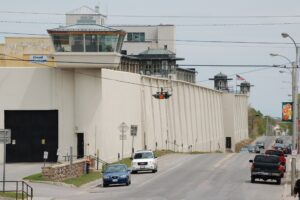
I focus here on a particular aspect of American class struggle—how the rural prisons of Upstate New York, and especially Clinton Correctional Facility (CCF), have been used to isolate and divide the urban-based revolutionary movements of the twentieth century. Condemning revolutionaries to CCF and other institutions like it has been advantageous for the state in that it impedes communication between the incarcerated and their allies.
Clinton Correctional Facility has existed for over 175 years. Known as “Little Siberia” to some in NYC, the complex sits just a half hour from the Canadian border. Plans for a facility in Clinton County were approved in 1844; the site was imagined as a labor camp where convicts would mine for metal. The first prisoners arrived in Dannemora in June 1845 after walking there from Plattsburgh, the largest nearby town. The mining program lasted for some thirty years, but by the mid-1870s the state government had decided it was not profitable. In 1877 prison operations pivoted. Prisoners now worked to produce more common items like shoes, brooms, and baskets.1
Prison design changes accompanied this directional shift. Between 1879 and 1881 over 600 cells were built, a major increase in containment capacity. In the late 1880s, aging wooden walls surrounding the facility were replaced with concrete. A fire damaged part of the prison in 1890, but renovations were already scheduled by then. Repairs proceeded as planned and the prison gained several new additions, including a mess hall and bathhouse.
Around this time, the prison was equipped with an electric chair. Such instruments are installed for a reason, and twenty-six men were executed at Clinton between 1892 and 1913. Dannemora Prison was now a symbol of state power.
While the Dannemora facility was being renovated, the socialist movement was gaining steam across the United States and throughout the world. When capital’s ceaseless drive for the augmentation of surplus value drove humanity to conflict on a scale hitherto unseen—the First World War—it proved to be a decisive moment in the history of socialism. In Russia, the Tsar was deposed in February 1917 and Vladimir Lenin, Leon Trotsky, and the Bolsheviks took power later that year. Two vastly different socialist camps crystallized not long after events in Russia came to light—there were those who praised the revolutionary methods of the Bolsheviks and those who reviled them. This split became as pronounced in the United States as it did anywhere else; in Ohio, C.E. Ruthenberg—a notable Marxist—dove headlong into the turmoil.
Based in Cleveland, Ruthenberg ran for office several times while he remained a member of the Socialist Party. When war broke out in 1914, he condemned the various imperialist powers vying for predominance. He attacked the U.S. government for its entry into the war and was arrested in 1917 for comments he made about the draft during one of his speeches. He spent a year in prison for this. By the time he emerged, the Bolsheviks had seized power. A pro-Bolshevik left wing of the Socialist Party of America was coming into existence, coalescing around Louis Fraina’s “Left Wing Manifesto.” Ruthenberg quickly embraced this faction and helped coordinate its press. State officials, fearful of the growing popularity of the left wing, were unwilling to let the followers of the new tendency operate unhindered.
Resurrecting in 1920 a New York State law against “criminal anarchism,” which the “Left Wing Manifesto” had supposedly violated, many of the left wing socialists were arrested. Gus Alonen, tried and convicted in NYC in November 1919, was perhaps the first of them to end up in Clinton. He would be joined by three others—Benjamin Gitlow, Harry Winitsky, and James Larkin. It was the first time the repressive state apparatus had sent political prisoners to CCF in chains—it would not be the last.
Gitlow’s memoirs contain valuable information about life in Clinton during this time. Gitlow recalls how the Jewish chaplain at the prison, Rabbi Judelson, let prisoners slip letters into his coat. Then Judelson would proceed to smuggle the letters out of the prison and mail them to the friends and family members to whom they were addressed. Harry Winitsky had his letter to political allies outside the prison mailed in this way.2 Gitlow claimed that visitation rights for political prisoners were unfairly restricted. Once, according to Gitlow, when Agnes Smedley—a famous journalist—visited the prison, guards ordered her to leave purely because they disliked the cordial nature of her interaction with Jim Larkin.
Isaac Ferguson, an attorney and convinced revolutionary socialist, visited the convicts in 1920. He writes of the conditions he encountered in the prison; his account would later be published in the socialist press and is of interest to us.
The prison is not so bad, in comparison with others, as I had been led to suppose. Ex-Senator James L. Long, Deputy Superintendent of Prisons, ran the prison for a month this spring in an interval between wardens and introduced various betterments which the new warden, Mr. Kaiser, has continued. It is still regarded as a punishment prison for old offenders and refractory convicts, but it is less different than formerly from Sing Sing and Auburn. The prisoners do not have so much time to themselves. Their visiting privileges are more restricted; their correspondence is more interfered with. In the prison staff there are still guards bred in the old school of man-breaking savagery.
Later, Ferguson continues,
Reading matter sent to the political prisoners is apt to be kept from them—especially The New Republic and The Nation, which some of the other prisoners are allowed freely to receive. Letters written by or to the political prisoners are frequently detained. This includes correspondence with their counsel. Important and confidential letters between Larkin and me, relating to the conduct of his case on appeal, were entirely suppressed.3
The state continued its repression by cracking down on Ruthenberg and the socialists. Ferguson, after having represented and visited earlier arrestees, came under state scrutiny himself. Ruthenberg and Ferguson were tried in October for links to the publication of the “Left Wing Manifesto.” They were convicted and sentenced to five years’ imprisonment. Both spent time at Sing Sing prison—a prison complex just north of NYC. Ruthenberg also spent part of his sentence in the CCF. It is less clear if Ferguson was ever transferred north to CCF during his imprisonment.
In 1919, the Socialist Party splintered. The Communist Party of America (CPA) was founded that same year; the two men contributed to its formation. While Ferguson and Ruthenberg were imprisoned, a complex series of party reshufflings, mergers, and further splits occurred. In 1921 this process ended with the merger of the CPA and another splinter faction, the Communist Labor Party of America. Ruthenberg and Ferguson were set free in July 1922 after the reversal of their conviction in the New York Court of Appeals. The party they helped to found was the precursor of the CPUSA.
In prison Ruthenberg wrote of the difficulties of building the party amidst state crackdowns. His own experiences must have weighed on him. “What is argued here is that to conduct its work most effectively the Communist Party must have two arms, one out in the open, functioning publicly, the other unseen, secret, underground.”4 This is a point that many revolutionaries, including Lenin and the Bolsheviks, have stressed throughout the history of the socialist movement.
Isaac Ferguson’s prison experience had some impact on his willingness to openly espouse revolutionary politics—he elected to focus on his law career as opposed to party work post-1922. Ruthenberg remained closely involved with the CPA until his death in 1927; he was one of its most prominent administrators. After his death his remains were transferred to Russia, where they were buried. Their transfer speaks of Ruthenberg’s close ties to both the international labor movement and the incipient Soviet Union.
In his account of the Ruthenberg-Ferguson trial, Isaac Ferguson recounted the story of a seventh Communist whose misfortunes took him to CCF. “In July 1921 Paul Manko was sentenced to from two and one half to nine years. Treatment Manko received at the hands of the authorities was so severe that his mind was shattered and he is now in the Hospital for the Criminal Insane at Dannemora, N.Y.”5 Ferguson’s tale is a blistering indictment of the state. If true, it represents one more contemptible action on the part of the government. But notably, Gitlow’s memoirs contrast with Ferguson’s account on this point—Gitlow says that, at least in Sing Sing, the prison officials treated Manko “gently.” This description contrasts sharply with what he says about his own treatment and that of the other political prisoners; he maintains that the guards treated the other leftists poorly. Gitlow’s memoirs at least seem to confirm that Manko was troubled mentally; the Communists did not object when he was transferred to the insane asylum. Whether or not state officials broke Manko’s mind after he was arrested, his arrest by those officials can be condemned; Gitlow maintains that Manko was thrown in jail for merely distributing leaflets.
Decades later, CCF would house two more revolutionaries, Sekou Odinga and David Gilbert. Sekou Odinga—formerly Nathaniel Burns—was born in Queens on June 17, 1944. As a young man in NYC, he became interested in securing equality for black Americans and joined the Organization of Afro-American Unity, which had been founded by Malcolm X. Around this time the famous Black Panther Party (BPP) started expanding across the country. Bobby Seale, one of its founders, visited NYC in 1968. Odinga and some of his friends were captivated by him, and they became New York Panthers shortly after attending Seale’s lectures.
Any revolutionary organization as successful as the Panthers was bound to be targeted by police and the state security system. Virtually the entire New York Panther leadership was indicted in the year 1969 on accusations of organizing bombings, for which they were acquitted in 1971. Odinga was one of the accused, as was Afeni Shakur, with whom Odinga worked closely. In a remarkable twist of fate, Tupac Shakur—Afeni’s son and a world-renowned hip-hop artist—spent time in CCF himself in the 1990s. It seems that the world, at times, is a very small place.
The bombing charges were dropped, but not before they damaged the cohesion of the New York Chapter of the BPP. Similar actions were taken against other Panthers chapters and concerted destabilization efforts by police infiltrators contributed to the decline of the group. In California, the Panthers devoted considerable resources to local elections, which failed to amount to anything. This allocation of resources hurt the party further. The BPP declined throughout the 1970s and eventually fell apart by 1982.
For many former Panthers, including Odinga, the Black Liberation Army (BLA) filled the void left by the BPP. The BLA was a clandestine group committed to toppling the U.S. government and to liberating black Americans. Odinga worked closely with Assata Shakur, another former Panther and Tupac’s godmother. Odinga is credited—or accused—with helping break Assata out of the Clinton Correctional Facility for Women (a New Jersey prison). Shakur escaped to Cuba and was given political asylum there in 1984. She died in Havana, Cuba, in September 2025 at age 78, from her health conditions and advanced age.
Odinga was arrested in 1981 when a truck robbery went wrong. While Odinga was not involved in the robbery himself, one of the robbers went to him for aid after fleeing the scene; the authorities found them and gunfire was exchanged, for which Odinga would serve thirty-three years in prison. Odinga was released from CCF in 2014 and has since passed away. His role in the escape of Assata Shakur was quite memorable, and his anti-racist activism should be commended.
David Gilbert was born on October 6, 1944. He was raised in Brookline, a small community near Boston, Massachusetts. His family is Jewish. He attended Columbia University and became involved with Students for a Democratic Society (SDS) in the 1960s. SDS was known for its demands for racial equality and its staunch opposition to the Vietnam War. When American involvement in Vietnam escalated in 1965, SDS members held teach-ins on college campuses across the country, informing people about what was happening and condemning U.S. imperialism abroad. They quickly grew in popularity.
Years of fruitless SDS protests frustrated some of the organization’s members, including Gilbert. These members were radicalized by their failures to contain the war effort and became inspired by Marxist critiques of capitalism.The new, radical segment of SDS reorganized. The group became the Weather Underground, a militant communist organization that bombed monuments and non-human targets like weapons research labs in hopes of ending the U.S. presence in Vietnam. Gilbert had several close encounters with the FBI and other law enforcement agencies; he relocated across the country multiple times in hopes of evading them.
In New York in 1981, Gilbert’s luck ran out. He’d spent over a decade underground at the time of his arrest, ceaselessly pursued by the state. Gilbert was imprisoned due to his participation in an armed truck robbery in New York’s Rockland County—the same event for which Sekou Odinga was arrested. Gilbert himself was unarmed, but four people died in the chaos.
CCF was the state’s destination of choice for the Weatherman. While incarcerated Gilbert spent time advocating for better treatment of prisoners. He wrote an autobiography, in which he spoke about the successes and failures of the Weather Underground and its revolutionary model. While many of the organization’s members showed commendable bravery and perseverance, the choice they made to go underground without a legal arm of the party like Ruthenberg described isolated them from the masses. It made them easy to vilify. Conversely, the Communists of the 1920s forged links with the labor movement, and people became invested in the existence of the Black Panther Party because of its commitment to providing community service programs.
Gilbert’s actions in the robbery earned him seventy-five years in prison. The loss of life that took place is lamentable and punishment of some kind for Gilbert was warranted. However, the political nature of his sentence cannot be ignored. Derek Chauvin, the police officer who murdered George Floyd, received twenty-two years in prison. Were the actions of an unarmed David Gilbert more than three times as reprehensible as those of Chauvin? One might be inclined to think that the state saw a chance to rid itself of a revolutionary nuisance and took it. It has certainly done so before. The FBI’s murder of Fred Hampton in Chicago in 1969 is proof enough of this.
What are we to make of the CCF prisoners and their stories? What lessons can we learn from their struggle?
First, regardless of any failings of strategy or tactics, the Socialists, Communists, and other leftists of Dannemora prison shared an earnest commitment to human liberation. Their willingness to act to realize a world without exploitation placed them fundamentally at odds with the ruling class in the United States. What the prisoners fought for—the construction of a new politics, based on an end to the exploitative capitalist system—is a project that we must resurrect today.
Second, the prisoners were consistently subjected to poor treatment. By all accounts, abuses continue in the U.S. prison system today. The socialist left must continue to demand prison reform until all prisoners are guaranteed basic human dignity while incarcerated. And perhaps, at some point in the future, we can work toward dismantling such dehumanizing institutions entirely.
While the willingness of David Gilbert and Sekou Odinga to fight for a better future was (and remains) admirable, in the end their clandestine activities only amounted to long prison sentences. Both men grew old in their cells. The Weather Underground especially developed a revolutionary model that could not possibly have yielded fruit—it largely ignored the working class and became an organization entirely separate from it. Working people will bring about profound social change, working in tandem with a revolutionary party—the party cannot go it alone. The people always have been and always will be the drivers of history.
The U.S. government has a long history of repressing radicals, which this article has tried to shed light on. It points out the role that one facility specifically, the CCF, has played when it comes to the repression of revolutionary movements. The author hopes to have introduced the reader to a piece of the past that they may not formerly have been familiar with. The history of revolutionary movements must be understood if we are to build a better future.
Notes
1. New York Correctional History Society, “History of Clinton CF.”
2. Benjamin Gitlow, I Confess: The Truth about American Communism (E. P. Dutton, 1940), p. 118.
3. Isaac E. Ferguson, “The Political Prisoners at Dannemora: Report of Their Attorney.”
4. C.E. Ruthenberg, “The Need for Open Work.”
5. Isaac E. Ferguson, A Communist Trial: Extracts from the Testimony of C.E. Ruthenberg and Closing Address to the Jury by Isaac E. Ferguson.
Bibliography
Ferguson, Isaac. A Communist Trial: Extracts from the Testimony of C.E. Ruthenberg and Closing Address to the Jury by Isaac E. Ferguson. National Defense Committee.
Ferguson, Isaac. “The Political Prisoners at Dannemora: Report of Their Attorney.” The Communist [UCP], vol. 1, no. 6, [circa Aug. 1920], pg. 8). Retrieved from marxists.org, Feb. 20, 2025.
Fernandez, Johanna. The Young Lords: A Radical History. Univ. of North Carolina Press, 2020.
Gilbert, David. Love and Struggle: My Life in SDS, the Weather Underground and Beyond. PM Press, 2012.
Gitlow, Benjamin. I Confess: The Truth About American Communism. E. P. Dutton, 1940. Retrieved from archive.org.
Gramsci, Antonio. The Prison Notebooks, Volume 1. Columbia Univ. Press, 1991.
Hall Jr., Clarence Jefferson. A Prison in the Woods. Univ. of Massachusetts Press, 2020.
Hogarth, Peter. “The rise and fall of the Black Panther Party.” Spring Magazine, Feb. 1, 2022.
The Huey P. Newton Foundation. The Black Panther Party: Service to the People Programs. Univ. of New Mexico Press, 2008.
New York Correctional History Society, “History of Clinton CF.”
“Rabbi Sundel Judelson Dies at Hospital.” The Plattsburgh Sentinel, July 9, 1926.
Ragozin, Rachel. “Memories of C.E. Ruthenberg.” Ohio Historical Society. Retrieved from marxisthistory.org, Sept. 5, 2025.
Ruthenberg, Charles Emil. “The Need for Open Work.” The Communist [NY: unified CPA], vol. 1, no. 2 (Aug. 1921), pp. 56. Retrieved from marxists.org, Feb. 20, 2025.
Sale, Kirkpatrick. SDS. Random House, 1973.
Village of Dannemora, “History of Clinton Prison.”
Wright, Bruce C.T. “Sekou Odinga, Movement Elder and Former Political Prisoner who Freed Assata Shakur, Dies at 79.” The Westside Gazette, Jan. 24, 2024.
 If you’ve read this far, you were pretty interested, right? Isn’t that worth a few bucks -maybe more? Please
Leave a Reply