From The Editors
 Donald Trump in his second term is a president like no other American chief executive. Dominating the Republican Party that controls Congress and with a compliant Supreme Court, he has as he promised unleashed political and economic chaos, shattering old international relationships, shredding political pacts, destroying longstanding traditions, and calling everything into question. Overseas, he has become the war president, causing death and destruction in the Middle East, leading to the blocking of the Strait of Hormuz, stopping oil and fertilizer that will lead to hunger in many nations. And at home, he is bringing misery to millions. At the same time, his violent and cruel foreign and domestic policies are enriching his friends in the billionaire class. The results are staggering.
Since our last issue, Trump continued to fully support Israel in its genocidal war against the Palestinians. He joined Israel in its war on Iran and allowed Israel to simultaneously make war on Lebanon. As we go to press, Trump has clearly lost the war but is trying to negotiate a face-saving deal. In the Western hemisphere, Trump ordered the seizure of Venezuelan President Nicolás Maduro and his wife on January 3. And he has continued and worsened the economic strangulation of the Cuban economy.
Domestically, the Trump administration has destroyed the social safety net for working class and poor people, slashing or freezing funds for Temporary Assistance for Needy Families, the Child Care and Development Fund, Social Services block grants, the Women, Infants, and Children program, housing programs, Head Start, and Job Corps.
Trump, Congress, and the Supreme Court have also waged a domestic, racist war against immigrants. The Supreme Court has upheld the government’s policy of turning away immigrants seeking asylum. And it has ended Temporary Protective Status for hundreds of thousands of Haitians and Syrians, with other groups such as Ukrainians to follow. They face deportation back to the dangerous, in many cases life-threatening, conditions they fled.
Trump has destroyed important government agencies such as the Centers for Disease Control and fired hundreds of thousands of Federal workers. He has attacked universities attempting to control their curriculum, extra-curricular activities, and faculty, cutting their financial support and enrollment of foreign students. And he has worked to control the media, especially its news programming and its critical talk shows and comics.
Fortunately, however, all these horrific policies have led to an enormous resistance movement. Millions participated in the national No Kings demonstrations, the largest in U.S. history, and tens of thousands joined in Bernie Sanders’s “Fighting Oligarchy” rallies against the billionaires.
Democrats won recent gubernatorial elections; they won control of two purple state supreme courts and special elections to several state legislatures. Zohran Mamdani’s election as mayor of New York was a spectacular victory for progressives. A Muslim and a member of the Democratic Socialists of America, Mamdani has been able to use his influence to carry other DSA members and progressives to victory in Congressional primaries. The New York Times reported that “Socialists Have Momentum in Urban America,” explaining that “Democratic socialists, harnessing generational frustration over affordability, lead New York and Seattle and are knocking on the door in Los Angeles and Washington.”
Polls show that Trump has lost support, especially from his white working-class base. The social protests and Democratic election victories suggest that many, perhaps a majority want to end Trump’s reign. Many Americans, however, distrust the Democrats who have proven so gutless during the Trump decade. So many will vote for Democrats but through protests fight for something better.
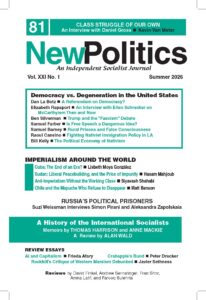
In this issue we have seven articles focusing on the United States. Dan La Botz gives an overview of the political situation as we head toward the November elections. Elizabeth Rapoport interviews historian Ellen Schrecker to help us understand how the current threats to civil liberties compare with those of the McCarthy era. Ben Silverman takes up the debate over whether Trump is a fascist. And Samuel Farber asks, “Is Free Speech a Dangerous Idea?”
Samuel Barney looks at rural prison economies as exemplars of false consciousness. Two articles focus on the war on immigrants. Raoul Cansino provides a report from Los Angeles on the fightback against the repression, while Bill Kelly examines “The Political Economy of Nativism.”
We turn next to look at imperialism and the world. Lisbeth Moya González assesses the current situation in Cuba, asking whether this is the end of Cuban state communism. Sudan went from high hopes a decade ago to one of the world’s worst humanitarian disasters. Husam Mahjoub writes about the international responsibility for this tragedy. Siyavash Shahabi criticizes those anti-imperialists who ignore the working class living under authoritarian regimes. And Matt Benson draws attention to the struggle of the Mapuche people in Chile who “refuse to disappear.”
We take up many of the issues confronting workers and their unions in an interview with labor organizer and former labor lawyer Daniel Gross by Kevin Van Meter. And Suzi Weisssman interviews Simon Pirani and Aleksandra Zapolskaa, two writers who have championed Russian political prisoners. Two courtroom speeches — final statements by defendants before sentencing — are included here.
Andrew Stone Higgins has edited a new history of the important U.S. political organization, International Socialists. We reprint two memoirs from that book—by Thomas Harrison on the Berkeley Independent Socialist Club and Anne Mackie on organizing UPS workers—and a review of the book by Alan Wald.
The issue includes several review essays. Frieda Afary reviews two books on AI and the issues it poses. Javier Sethness offers a sharp rebuttal to Rockhill’s Who Paid the Pipers of Western Marxism? And Peter Drucker considers Molly Crabapple’s Here Where We Live Is Our Country: The Story of the Jewish Bund. In addition, we have other reviews: David Finkel on the new edition of Medea Benjamin and Nicholas Davies’ volume on Ukraine; Andrew Sernatinger on Sam Friedman’s analysis of Teamsters for a Democratic Union; Fran Shor on the Bernard Goetz case and its context; Amna Latif on the partition of South Asia; and Farooq Sulehria on the media and Afghanistan. We end with a letter from an Afghan feminist on the condition of women under the Taliban.
We hope you find this issue interesting and helpful for the current struggles. We will continue to be part of the resistance to Trump as well as to the barbarism of capitalism. More than ever we need a liberatory socialism.