From The Editors
 Donald Trump is president, again. We will need to organize across sectors to resist the coming attacks on working people, immigrants, the LGBTQ community, and what he calls “the enemy within.” The Left is, of course, that “enemy.” Trump will go after unions, Black voting rights, women’s reproductive rights, and especially trans people. And his “drill, baby, drill” policies will continue and exacerbate the climate crisis that threatens human survival.
Trump will aggravate many of the world’s already existing problems. In the Middle East and North Africa region, his appointment of pro-Israeli hardliners will continue the American government’s support for the slaughter and dispossession of Palestinians. We can expect him to end support for Ukraine and force it to cede a fifth of its territory to Russia. His nationalist America First orientation will likely worsen already tense political relations with China.
Trump and his Project 2025 inner circle have already promoted a kind of “brown international” of far-right parties. The president-elect has expressed admiration for strong-man leaders such as Vladimir Putin of Russia and Narendra Modi of India. On social media Hungary’s Viktor Orbán and the Netherlands’s Geert Wilders have expressed their elation at Trump’s election. Around the world authoritarianism is on the march and democracy is in retreat.
Still there have been some bright spots. In South Korea, President Yoon Suk Yeol’s imposition of martial law led to a popular rebellion that blocked the establishment of military rule while singing “Feliz Navidad,” with new Korean lyrics meaning, “Impeachment is the answer.” In Uruguay, the socialist Frente Amplio was again elected to the presidency. And in Syria, people opened up the prisons and released the thousands detained there after Assad abandoned the country. Social movements can still defeat authoritarianism and win power.
Here in the United States, Trump says he will be a “dictator for a day.” Who will resist and how? The Los Angeles City Council, and other towns and cities, passed sanctuary resolutions while the L.A. Unified School District reaffirmed that it will continue to be a sanctuary for immigrants. The ACLU, NAACP, and other such groups are preparing for legal battles to protect our civil rights, while immigrant groups are organizing at the state and local level.
Most labor unions know that a Trump labor board will make fights for union recognition and contracts more difficult and some are readying themselves—some for the struggles to come and some to try to make deals. Still, at the moment, few labor or social movements are prepared for Trump’s promised mass deportations and his threats to call a state of emergency and mobilize the military to handle immigration and social protests. Trump’s second term, his white supremacy and authoritarianism, and what some see as a step towards fascism, will challenge every movement and activist.
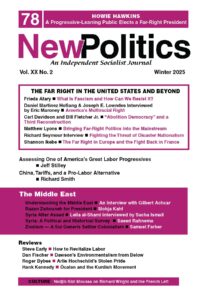
In this issue, Howie Hawkins addresses a political paradox: how could an electorate that is quite progressive have chosen a far-right president?
A special section provides a deep dive into the far right, in the United States and beyond, and how we can fight it. Frieda Afary takes up the definition of fascism and how it might be resisted. The far right in the United States, however, is not just white, as Daniel Martinez HoSang and Joseph E. Lowndes discuss in their interview with Eric Maroney on America’s Multiracial Right. For Carl Davidson and Bill Fletcher Jr. the way to challenge the right is by building a Third Reconstruction, a multiracial movement for justice. Matthew Lyons looks at how extreme right-wing ideologies become part of the mainstream. Richard Seymour, in his interview with Phil Gasper, argues that the “disaster nationalism” of Trump, Bolsonaro, Modi, and other far-right figures, is moving in the direction of a new form of fascism but is not there yet, and it is still possible for the left to defeat it. And Shannon Ikebe describes the growth of the far right in Europe, and the way the French left has worked to fight it.
Two articles focus on questions confronting the labor movement. Jeff Stilley reviews the career of Frank Walsh to understand the limits of labor progressivism. And Richard Smith offers a pro-labor approach to dealing with the issue of tariffs and human rights with respect to China.
This issue also has a section on the Middle East. Prominent leftwing scholar Gilbert Achcar explains what has happened in Syria and then offers crucial background for understanding the region more generally. In her essay “Razan Zaitouneh for President,” poet and scholar Mohja Kahf asks us to join her in imagining a brighter future for Syria. Leila al-Shami discusses some of the challenges facing Syrians today. And Saeed Rahnema provides some important historical context to Assad’s fall. In an article focused on Eastern Europe, but with profound implications for Palestine, Samuel Farber reviews the history of Zionism.
Turning to culture, Nedjib Sidi Moussa examines the way in which Richard Wright was received by the French left during the Cold War.
Finally, we offer reviews of several important books. Steve Early discusses two recent volumes on labor struggles: Hamilton Nolan’s The Hammer: Power, Inequality, and the Struggle for the Soul of Labor and Eric Blanc’s We Are the Union: How Worker-to-Worker Organizing is Revitalizing Labor and Winning Big. Dan Fischer reviews Ashley Dawson’s book on environmentalism from below. Roger Bybee reviews Arlie Russell Hochschild’s Stolen Pride, a study of Trump voters. And Hank Kennedy takes up Abdullah Öcalan and the Kurdish struggle.
We will need all of the insights in our articles and reviews as well as the experiences of our movements in order to resist Trump and the far right. The Republicans have become a far-right party and the Democrats have no interest in defending the working-class majority. More than ever, we need an independent political alternative. We have the numbers and the potential power to stop him and turn the country around. Together, working collectively, and organizing against oppression and exploitation, we will fight for freedom, for justice, and for equality for all.