Fighting the Threat of Disaster Nationalism
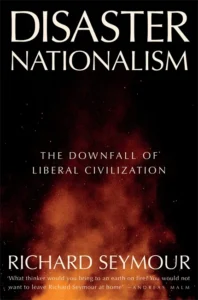
Richard Seymour is a writer and broadcaster from Northern Ireland and the author of numerous books about politics including Corbyn: The Strange Rebirth of Radical Politics and The Twittering Machine. His writing appears in The New York Times, London Review of Books, The Guardian, Prospect, Jacobin, and several other publications, including his own Patreon platform. He is an editor at Salvage magazine. Phil Gasper interviewed him in early December 2024 about his latest book, Disaster Nationalism.
Phil Gasper: Your new book is called Disaster Nationalism, and this is your label for the far-right movements and parties that have emerged in countries around the world over the past couple of decades or so. Can you start by saying a little bit more about what you mean by disaster nationalism? What insights does this label give us about these far-right movements, their origins, and potentially where they’re headed?
Richard Seymour: In the first instance, I needed some sort of label for a right-wing nationalist movement that isn’t quite fascism, isn’t yet fascism, but is obviously not civic nationalism either. The term “disaster nationalism” first occurred to me because I’d been paying attention to the Brexit right in the UK, noticing their fascination with ideas of collapse, of downfall, the pound sliding, you know, chaos. And the idea of going to war. [Nigel] Farage famously said, if they don’t deliver Brexit, I shall get my rifle and put on my fatigues and go to the front line. They like that imagery and the imagery of invasion. Immigration as invasion is a regular trope.
But looking more broadly, I realized that I’ve been seeing this for some time. I mean, in the US, for example, the Tea Party was obsessed with the idea that something dreadful was coming out of Medicare. It was going to be death panels, FEMA death camps. Obama, his birth certificate wasn’t real. He was a secret Kenyan and a socialist who was going to crush middle-class property. All that stuff.
Looking further afield, it’s everywhere. In India, right-wing Hindu nationalism thrives on the idea of a grand Muslim plot to dominate and crush the Hindu fabric of the Indian nation. One example of this is their idea of so-called Romeo Jihad, which is where, allegedly, Muslim men woo and seduce Hindu girls into relationships so they can convert them. We’ve got the same sort of stuff about bathroom predators, about satanic, communist, pedophile elites, coming from QAnon. We’ve got the idea that sex education is teaching children to be gay—that came up in Brazil. All of this stuff is global. And it’s always obsessed with some sort of catastrophe that is being visited on people by very evil groups and very evil rulers.
I think the thing that nailed it for me was watching what happened with the Oregon wildfires in 2020. I talk about this in the book, but briefly, the wildfires were the worst on record. They should have been expected to be, because climate change has been making wildfires much worse than they needed to be. There have to be wildfires, of course. The planet is meant to burn—it’s got plantable materials, oxygen, lightning, yada, yada. But these wildfires were out of control, and they were deadly. And they resulted in people being expelled from their homes, people losing their homes—tens of thousands, I think—and a lot of people dying. But during that wildfire, a lot of local people decided that it wasn’t actually climate change, but that these fires had been lit by Antifa activists. And they’ve been hearing for a long time on the internet that Antifa was engaged in a plot, a conspiracy, to annihilate white conservative Christians. Because they couldn’t do it face to face—you know, try that in a small town—they had to do it by some sneaky means, like setting fires.
And so, this mass apocalyptic fantasy spreads spontaneously. It didn’t require Donald Trump or the local police to start it, they only helped it spread. And so this is a different level of analysis than one that talks about leaderships and elected governments and parties. Those are all very important. But a lot of what’s happening here is on the model of a social contagion. And we kind of know what social contagions are like, because we know about the civil rights movement, we know about political protest and how it spreads. And also, any fad or product that needs to be spread will spread in a similar sort of fashion, which is typically the S-curve—mosey along for a bit and then, suddenly, there’ll be the inflection, and then it will reach a new plateau.
So that’s what’s been happening with a lot of these right-wing, far-right, I would say, movements. They were building slowly in the late 1990s, early 2000s, and there’s a number of inflections. I think you can see a number of S-curves, building one on top of the other. So you can see 9-11 contributing its role in mainstreaming state brutality, torture, Islamophobia, surveillance, extraordinary rendition, carpet bombing, all of this sort of stuff. The credit crunch and the ensuing austerity programs, you can see that hardening civil society in ways that make people, on the one hand, quite unhappy, because the society is becoming more broken down and atomized, and on the other hand, much less trusting, and much more likely to blame poor people and migrants and so on for the problems that they’re dealing with. And then I think COVID was another inflection altogether.
PG: It accelerated the trends.
RS: There were three moments of acceleration, I would say, and all of them have to do with some sort of crisis of capitalism. Not straightforwardly a crisis of accumulation, of course, but in terms of the world system, a crisis that radiates through every level, starting with 9-11, then the credit crunch, then COVID. And at each point, it has shaken people up. And at the same time, the secular trends of neoliberal society, making it more unequal, more unhappy, have created some of the fissile material for these explosions.
So that’s disaster nationalism. And the main point I’d make about disaster nationalism is that it’s a compensatory ideology. Because when you’re confronted with real disasters that you can’t really do much about and you have very little power, it gives you disasters that are totally made up, but which you can, in principle, do something about, and which are sort of personalized. So it’s much easier to imagine shooting Antifa than, as I say, shooting climate change or capitalism. These are abstract phenomena that are difficult to conceptualize properly, let alone do anything about.
The prolonged project of neoliberal disempowerment, the evisceration of substantive democracy, the destruction of the unions, and of civic society, I would say, left people needing some alternative way of feeling efficacious of not being paralyzed. That’s what these ideologies give—an animating disaster, something to take up arms against.
PG: You’ve used the metaphor of social contagion. What’s the role of social media in this? Some people see these developments as dependent on social media. Or do you think social media just happens to be the means by which these developments have taken place, and we could have seen something similar twenty years ago, before the rise of the main social media platforms?
RS: I think it would have been a different type of thing. But, of course, the thing about social media is that it catalyzes and potentiates existing trends, it doesn’t cause anything that wasn’t already there. But I would say that the social industry, the way in which our social relationships are being reshaped around computing technology, around mobile privatization, to use Raymond Williams’s term, and the way in which for a lot of people that’s their social life now, it’s no good saying the internet’s not the real world. It is. If that’s how you do your social life, that’s the real world.
And that real world happens to be also a simulacrum. It happens to be a system in which you basically contribute on the basis of regularly producing digitally produced images, digital images, whether you do so by writing a tweet, or uploading something on Instagram or TikTok, or whether it’s just that your engagement with the device and the way in which you pause and scroll contributes to how the feed is generated. It can be in any number of ways, but basically, you are contributing to the production of images, and that’s your social life. Well, I would say that the social industry was designed by people—rich white men from Northern California, basically—who made it reflect their values, their aspirations and their obsessions, their values being hierarchy, celebrity, competition, status, etc. So they made it a status game.
Twitter is basically a rip-off of an old app that was developed for activists, using the technology of texting to allow activists to communicate without being busted by the police. And this was used outside the Republican National Convention, the Democratic National Convention. And the police spent forever trying to force the app to hand over its records and, you know, lock people up, not with much success. But it was a very good and useful thing at the time.
But Twitter basically made it without any of the kind of security options or whatever. It was designed as a system of surveillance, as far as Twitter was concerned. Everybody’s watching everybody else. Nobody is being watched by the company. And it’s designed on a commercial basis to extract data. So they took something that was useful for activists and they turned it into something that is basically a status game, a “like” hunt. And everybody has an incentive on that medium to basically constantly try and stab one another in the back. You know, it’s a neoliberal playground.
One of the things that it does is filter social and political life through these volatile interactions, where essentially what matters is how many likes you accumulate, which therefore means what matters is what tribe you belong to. The result has been a tendency to harden and ossify cultural divisions. Think about it as the difference between a weather front and a border. A border is hard and it’s militarized and it’s violent. A weather front is porous, it’s mobile. That’s how cultural differences usually work out. This has tended to make them into something much more polarized. And I don’t mean polarized in a way that would be useful. Most of the time it’s not. Most of the time it’s polarizing people around issues that are entirely contrived. For example, Gamergate was a nonissue. It was based on the idea that women in gaming are getting ahead by using sex and so on. Just standard male resentment. There was nothing to talk about there, but it became a huge thing. Same thing with Obama’s birth certificate, Birthergate, a nonissue, and yet it became a major vector of reaction.
So, the fact that it is able to generate these regular little ecstasies—everybody cruising towards the same conclusion or slogan or idea—purely because of its way of organizing emotions and connections, like-to-like between people, has created a new vector of politicization to the right. And I don’t think it’s straightforward because the left has used it too, sometimes quite efficaciously. But I think the bias has been towards, I would say, a form of politics that is dependent on the symbiosis between—if I can put it in American terms—let’s say, Trump reaction and resistance liberalism. They sort of fire off one another in these media. And the result is that both seem a lot more important than they actually are. It has a performative effect. Ultimately, they do become important. I mean, Trump, for example, was a celebrity, but he wasn’t politically important. But he built himself out of Birthergate. And then he became worth about two billion dollars to Twitter.
And, you know, you can see these little resonance machines being built throughout the 2010s between a new far right, which is filled with grifters and people with stuff to sell, often male supplements and what have you, but also reactionary neo-Nazi ideas sometimes, whatever. And the social industry is raking it in because ultimately, for them, they’re not really bothered about what the content is, they’re bothered that people are engaging. And if you post some Nazi shit, either people are going to be engaging because they’re Nazis or because they’re titillated—you know, they hadn’t thought of looking at this stuff before, and it’s just been put in front of them—or they’re going to be engaging with it because they’re really offended, and they want to argue against it. The machine doesn’t care why we engage. It just takes engagement as a sign of approval and keeps going.
When we talk about social media encouraging extremism, that term can be misleading, but I encourage people to think of it in terms of extreme sport. In other words, it’s something that is associated with an adrenaline high. So it can be Nazi stuff, or it can be really conspiratorial stuff, which can be politically ambiguous. What it can’t be is anything that’s hard work. What it can’t be is anything that requires you to think. So it’s basically disinfotainment. It makes your consumption of political ideas, of news, and whatever, fun and thrilling, like a Hollywood movie. I think that started with the Loose Change movie. I don’t know if you remember that. It was a sort of 9-11 truth documentary. And it was very exciting and so on, but it was nonsense. Well, that showed that this tendency was already there.
So yes, to some extent, I would say, after all that, the social industry has catalyzed trends that were already at work. And had it not been for the invention of these apps and these platforms, probably the tone and the characteristics of it would be different. It wouldn’t have so much celerity. It wouldn’t go so rapidly. It wouldn’t have such turnover in terms of its ideas. It would probably have more consistency in terms of its focus. I think more of a straightforward, traditional Islamophobic focus, for example. Whereas with the social industry, I think they can shuffle very quickly between different points of excitement, different rallying points, different ideas. So yeah, it contributes.
PG: Let’s talk a little bit more about the relationship between disaster nationalism and classical fascism, because you discuss this in the book and elsewhere. You’ve said that disaster nationalism isn’t a return to fascism. You’ve also said it’s not yet fascist. That second formulation leaves open the possibility that it’s developing in that direction. So what are the similarities, what are the differences? Is disaster nationalism going to remain a distinctive version of far-right politics, or is it converging on what we saw in the 1920s and 1930s?
RS: If and when we see fascism, a mature fascist threat, it will not look like the 1920s and 1930s. That world, of colonialism, of global racial sovereignties like segregation, apartheid, all the rest of it, that’s gone. The nation state is a fully globalized phenomenon. You could almost think about the difference between the fascism of formal subsumption versus the fascism of real subsumption. Capitalism has thoroughly saturated the planet. And when you look at the kind of far-right movements that are rising in Brazil, in the Philippines, in India, just for example, these are big populous states, they’re middle-income countries. They probably aren’t growing as fast as they want to be, they feel under the shadow of China, and there’s a little bit of a sense of, you know, we’re being left behind here. But they’re still quite well off. The old idea of a destitute Third World just does not hold. So, different situation, and that means different forms of fascism.
One thing that would be very different today is the way in which race and racist ideology works. Do not think that today the major way in which racism works is through, for example, skin [color] or the body, physiognomy, phenotypes, that kind of thing. I also think that increasingly, cultural essentialism is rolling back somewhat. Islamophobia is a very important form of cultural essentialism, but I watched the alt-right cheering when the Taliban retook Afghanistan. So their Islamophobia is somewhat conditional, and it’s contextual.
I think they’ve been welcoming to black, non-white, mixed-race leaderships. Enrique Tarrio is an obvious one. A lot of the lone-wolf Nazis have been non-white. The guy, I can’t remember his name, who played a leading role in organizing the pogroms in the UK, mixed-race, Finnish Nazi. Different racial politics. I think they’re much more concerned about your metapolitical affiliation. In other words, where do you stand on the big issues? And if you stand in the right place, then that’s as good as being, as it were, white.
I think whiteness, although it’s an obsession of the liberal resistance—you know, this is white supremacy, that’s what Trump represents—I don’t think so. I don’t think he would have got the increase in support from black voters and Latino voters and Asian American voters and so on. I think that the situation is changing. So that’s one way in which it would be different.
PG: There’s a significant far-right movement in the Chinese American community on the West Coast.1
RS: Yeah. The idea that whiteness was the only source of reaction was always a cliché, and it was basically, I think, people looking for an easy and obvious answer.
In terms of the differences between what we see today and what we saw in interwar fascism, manifestly, we don’t see big parties, right? We don’t see big paramilitary movements. There are forms of collective organized violence today, but they’re much more like a kind of armed shitstorm. In other words, on the pattern of social media organizing, like, for example, the militias that went after Black Lives Matter in the U.S. Several of them were organized on social media. Utah Citizens’ Alarm was formed basically overnight, had 15,000 members, just because it started there with a Facebook post. But you had a bunch of people there who were already armed and willing to do stuff. So, you had a militia.
I think what we see today is not so much big parties and paramilitary movements. What we see are flash movements, which are usually a situation in which a political line can develop. So the Yellow Vests is an obvious one.2 The Yellow Vests wasn’t a right-wing movement necessarily, but it had right-wing and left-wing elements. It created a political situation on the basis of a hashtag and a slogan. And the Nazis were involved, the Front National were involved, and the left was involved. And the left argued against the inclusion of the Nazis. So that’s the kind of situation that we see.
And pogroms—and we’ve seen many of them recently—are an example of how a form of online organizing that doesn’t necessarily have to be consciously political or right wing (even though it is, and it’s racist and what have you), often starts from some sort of local issue and a citizenry up in arms. So in the case of the UK, it was rumors about some guy who murdered a bunch of children. Rumors spread that he was a migrant, that he was a Muslim. And so you had a kind of vigilante movement spring up and that became the pogroms that we saw. So that’s the kind of thing that we see.3
And then on the other side, in terms of political leadership, it tends to be celebrity leaders, usually without any kind of major centralized organized structure around them, but with dark money, with unusual connections within the state and within the capitalist class, usually to capitalist outliers. The one exception to all of this is India, because there you do actually have a big centralized political movement with paramilitary organizations, with a dominating party that has colonized the apparatuses of the state. But what’s noticeable is that even there, they haven’t overthrown parliamentary bourgeois democracy. They haven’t tried to crush every last human and civil right. They could make that attempt. I mean, they’re quite powerful and they’ve got the arms if they want to do it. But presumably one has to conclude that the nature of the capitalist crisis is not yet severe enough for that to be a realistic option.
So, I think that’s part of what’s going on. But I also think we’re partly seeing things happen here, which are basically prefigurative. They’re experimental, in other words, like in insurrections and so on. These are actions being carried out by people who don’t have the political maturity, ideological maturity, or experience to achieve their objectives. But by doing the things that they’re doing, they’re achieving experience. And they’re objectifying themselves, they’re learning a way of being in the world. And they’re creating the kinds of repertoires of action that are going to turn out to be quite useful to them in the future.
I think probably the most important way in which contemporary incipient fascism, if you could call that, is different, is that it has thoroughly internalized the culture of neoliberalism. Not just the sort of political economy, which we see with Modi, Orban, Le Pen—they’ve all experimented with authoritarian neoliberalism—Bolsonaro, straightforwardly, Javier Milei. Trump, I expect, will be leaning on the cyber-libertarian wing of neoliberals in his second administration. We see all that, but also culturally, they are what Wendy Brown calls sociophobic. In other words, they are paranoid about any claim made on behalf of society. They’re absolutely averse to the idea that any claim on behalf of society could infringe their freedom of movement, their freedom to dispose of their property as they see fit. Social distancing is communism, masks are muzzles, that kind of thing.
So, they’re paranoid about the claims of society. And they don’t worship the state in the way that interwar fascists did. They support and approve of what they regard as the good guys within the state, which is usually the repressive apparatuses. But they’re paranoid, extremely paranoid, about the reach of the state in terms of its medical and welfare interventions. They have always had lurid, totalitarian fantasies about this. So they don’t worship the state, they don’t approve of society, they’re not collectivist, even in the sort of contradictory way that interwar fascism was. They have no interest in an anticapitalist agenda. Interwar fascism often represented itself in opposition as anticapitalist. It didn’t deliver on it in office, but usually their proposals included substantial reforms—a politics of what Michael Mann would call class transcendence. You reform class, change its spiritual meaning, [you’re] not overthrowing it, but you’re nationalizing the class system, as it were.
Nobody’s interested in doing that today. Instead, it’s all about growth, growth, growth, muscular capitalism. Take off all the fluffy woke constraints, all the politically correct stuff about the environment, health and safety laws, you know, drill, baby, drill and we’re going to do amazing stuff. We’re going to have amazing growth and it’s going to be very, very, muscular. So muscular national capitalism, not a kind of utopian anticapitalist ideology. It’s not a kind of romantic anticapitalism, it’s beyond that. That goes back to my point about the difference between the fascism of formal subsumption and the fascism of real subsumption. We’re in a different phase now.
PG: In explaining this in the book, you’re critical of the slogan “It’s the economy stupid.” So maybe you can say a little bit about that and why you think that’s not the right slogan to raise to understand the rise of the far right.
RS: Of course, it always depends on what you mean by the economy, because I think a lot of people would say, well, hold on a minute, Seymour, you’re saying it’s not the economy, but we just saw an election which Trump won on the basis of inflation. Inflation was the number one issue, galvanizing voters. And when you looked at who said that they had been badly affected by inflation, overwhelmingly, it was Trump voters. When you looked at who said they hadn’t been affected at all by inflation, it was Harris voters. And that partly accounts for the flipping of the class valences of the vote between 2020 and 2024.
However, I would say a number of things. First, if you’re struggling, and you’re angry with the political system and you’re angry about inflation, it’s not a foregone conclusion that you would turn to Trump. That’s not obvious to me. That is something that requires some further explanation.
Second, there’s a relationship between how people experience economic shocks and how they act in the world, but it’s mediated. Crucially, it’s mediated by another type of economy, which is known as libidinal economy, the economy of emotions, the things that you go through in your life. So if we didn’t understand that mediating step, we would not be able to explain how it is that people start off with really difficult class experiences—and this isn’t always the left behind or the poor or whatever, that’s actually not the case. By and large, it’s people who have experienced some form of class decline in their lifetime, both middle class and working class, but particularly the poorest are the least interested in this kind of politics. And, certainly, trade union members usually aren’t interested in it either.
The people who are most interested are people who are traditional middle class, radicalized new middle class, elements of the professionals, and sectors of the working class who get paid a little bit more, live in the posher end of town, that kind of thing. Anyway, how does the experience of decline turn into resentful nationalism? How does it turn into “I think my problem is going to be solved by getting rid of the migrants,” and so on? One of the things they found in Europe is that if you’re in a workplace where there’s a great deal of unevenness in terms of conditions and status, the workers who have full-time contracts and get paid a little bit more and aren’t precarious—this depends on whether they’re organized, of course, but in unorganized workplaces or badly organized workplaces, they regard their situations as being one where they have an interest in common with the bosses. They see themselves as belonging to a little island of prosperity that they’ve worked their way into. And they see the problem as the moochers and the migrant workers and people coming in to try and get a share of this scarce wealth. And so they see things from the point of view of the bosses.
Okay, that makes a certain amount of sense. And it would help explain the sort of grumbling deference to people like Donald Trump, a billionaire, as he likes to say. But also, if you look at what’s going on with people who’ve experienced relative class decline, think about what neoliberalism has done to society. It’s not just that it’s made society more unequal, although, of course, it has done that. One effect of that is to make the slope of decline very steep—you can fall fast. Another effect is that they created this culture of social sadism towards the poor, and deference towards the rich. Trump was a beneficiary of that deference before he became a politician. Whereas people were having their doors kicked in for not being able to pay their bills and so on. And we got television programs making this into entertainment.
If you are used to a certain kind of recognition and status by virtue of being in some way better off than somebody else—whether you’re just a slightly better-off worker, or whether you’re somebody who’s run a medium-sized business and it’s been quite successful, and suddenly since 2008 it’s been going downhill and you’re losing money—you can suddenly see yourself being thrown into the big turbulent mass of humanity, and you lose all your distinction. Suddenly, you’re just one of them. And you know, from experience that nobody gives a shit about them, that they aren’t very highly regarded at all. And that’s your future. They’re terrified of that.
So I think that when we talk about the economy, we really want to look at how the economy affects people differently. What kinds of life experiences does it act upon? Rather than assuming that just because you’ve been through an economic shock, you’re going to react politically one way or another. I think it’s telling that the vast majority of times, financial crises tend to benefit the far right. They do also benefit the left, but to a much lesser extent. Electorally, they benefit the right. Now, that’s a really interesting thing to me, because that suggests that maybe it problematizes our crisis theory. And I know there’s a book by Ståle Holgersen from the Zetkin Collective arguing just this point.4 So it may be that it throws our crisis theory into some sort of problematic relief.
But I think it also means that when people’s ontological security is threatened, the only way in which they would not respond by moving to the right would be if they had some kind of collective organization to which they passionately belonged. And if you look at the early 1930s, say, before the Third Reich, there’s an argument that could be made there that the effect of the capitalist crisis was to throw people out of those organizations, to make class politics less relevant and less salient. Large numbers of unemployed people, but they don’t have any bargaining power, whereas those who remain employed, you know, they’re organized, but they’re sticking to the Social Democratic Party out of fear of something worse. In other words, at moments of crisis, the kinds of things that we on the left look to, to organize people in a radical way, are themselves thrown into crisis. Our habitual modes of organization are thrown into crisis. And that’s when fascism can gain a foothold, or when, in this case, incipient or inchoate fascism can gain a foothold, just at the moment when the left—as weak as it has been for these many decades, and as tenuous as its recovery has been—is thrown into a crisis along with capitalism.
Fascism has a certain unfair advantage in this situation, I think, because of their lack of rigor, their lack of scruple, their programmatic opportunism. And that was one thing that the early fascists understood very well about themselves. Programmatic opportunism means that they are very well able to move quickly, to take advantage of a situation, and to manipulate as they see fit.
PG: I wanted to ask you a little bit more about the environmental crisis and disaster nationalism. One of the arguments you make in the book is that there are real disasters that the world is facing, particularly the climate crisis, yet the far right has focused instead on imaginary crises. But there’s a connection between the real crises and the paranoid fantasies. Could you elaborate on that a bit more? I’m also interested in hearing your thoughts on why major sectors of the capitalist class are willing to go along with this, because in the long run, it poses major problems for them. They need to address the real crises, but at the moment they’re not doing that. We see this in the failure of the COP talks and the failure to reach an agreement about what to do about plastic pollution. It’s as if they’re ostriches with their heads stuck in the sand. Their focus is on short- or medium-term profitability, not on the bigger crisis that might undermine the whole system.
RS: In terms of the bourgeoisie, the idea of a far-sighted long-term planning bourgeoisie, or fraction of that bourgeoisie, went out of fashion with neoliberalism. Short-termism has been the fashion and it’s been incentivized and disciplined by financial markets, so that essentially, if you’re not delivering short-term profits, you’re out. And the whole system of debt and speculation forces capitalists, even if they had some idea of their long-range interests, to act against them. I think Neil Davidson wrote a pretty good essay on this—on why neoliberalism is incapable of defending the interests of the capitalist class.5
But I think also the only instance, to use the Poulantzian language, where a general capitalist class interest could be organized would be the state.6 And it would be at the point of organizing a particular class coalition within the state, that you might get some sort of forward-thinking capitalist class strategy. And to some extent, you did get that with Biden. But only to a very limited extent, and only insofar as it was competing with China.
Essentially, what we get from the order of nationalized capitalism, where the state plays a pronounced role—which is the most that they can do for us in terms of any sort of executive planning for the future of capitalism—the most that you get is the kind of policy you get from Chinese state capitalism. On the one hand, we exploit fossil fuels to the last drop. On the other hand, we do everything possible to build up our competitive advantage in green technologies. And, you know, China is obviously way ahead of any other country, as far as I’m aware, in terms of electric vehicles. Their electric cars are way, way ahead of Tesla and all the rest of them. Electric trains. They’ve got the technology, they’ve got the infrastructure, they’ve been investing. That’s what you get from the capacity of a party-state to oversee the whole system and to impose its political priorities on the system of production.
Biden didn’t exactly attempt to do anything like that, but he did try and even up the competitive disadvantage. That’s the most you’re going to get, I think. And I think that even then it’s resisted, you know. There are sections of finance capital that really didn’t like what Biden was doing, particularly the fact that he was doing stuff for organized labor. Now, I’m no fan of Joe Biden—Genocide Joe—but I think it is fair to say that he was more pro-labor than any Democratic president has been for a long, long time. On that issue, he tried to do something, and they didn’t like it. But the fact of the matter is that it was a sensible pro-capitalist measure to tilt the balance in favor of labor. And they can’t see that. Structurally, they’re incapable of cognizing the benefits of a kind of liberal reformism. So I think it’s something to do with the structural stupidity of capitalism, to put it like that. It’s the way it breaks up and distributes knowledge and frustrates its effective aggregation in political terms, and in other ways, too. So that’s that part of it.
In terms of the relationship between this new far right and the environment, it’s interesting because up till now, overwhelmingly, the emphasis has been on denialist conspiracy theory. They basically, as Andreas Malm and the Zetkin Collective put it, took over the denialist apparatuses that were built up by fossil fuel industries, just as they were being abandoned.7 So these fossil fuel companies decided it was no longer worth bothering with denial. We’re going to go with climate governance and bank on kicking the can down the road, a very effective strategy, it has to be said. But they [the far right] took up the junked apparatuses, the ideas, the myths, etc., and they associated it with stuff like immigration, borders, and a threat to middle-class property. There was an idea that climate change is a hoax, that it’s going to take your wealth away and give it to the moochers of the Third World. That was something Anders Behring Breivik argued, Pamela Geller argued, that Trump argued. So that’s been the dominant tendency. I don’t think that’s sustainable. But you can see that there is still some mileage in, let’s say, a kind of nihilistic politics of fuck it, let the planet burn, party like it’s 1999, drill and drive. Let us drive everywhere we want to drive. Let us enjoy the last few days of auto mobility and petro-modernist freedom. Fuck the snowflakes and the future generations, that kind of thing.
But that’s not going to be tenable as we start to see societies really suffer. And that’s already happening, like really suffer from wildfires, floods, storms, tornadoes, desertification. You know, you’re going to see major production problems, major supply shocks, and lots of death. I don’t know what happened with the tsunami that was just about to head to the coast of California the other day, but that kind of thing is not going to be surprising. I mean, we already saw these massive storms kill, I think, hundreds of people in Florida going up into middle America—whole towns flooded, things like that. Now, what then does the far right do if it intends to have something practical to relate to? The tendency has been for a version of green nationalism—in the model of lifeboat ethics developed by Garrett Hardin8—to say essentially, look, we are past our carrying capacity, we can’t take in any more people. And if we do, we’re going to have a much more depleted environment, a much more polluted environment. And essentially, there’s the idea that the migrants themselves are the pollution, because they’re matter out of place, and therefore they’re dirt. So there’s that idea. Now by the way, just to clarify, this idea that a nation is a lifeboat in this context is nonsense. The planet is the lifeboat. Moving between different nations doesn’t make any difference at all.
But the other side of it is to say, essentially, as Marine Le Pen does, these people who move around, they don’t have a homeland. And because they don’t have a homeland, they don’t care about land and nature. They’re nomads, we care about the homeland. And so again, this is about renovating a kind of nineteenth-century romantic nationalism, blood and soil. I think that’s the logical direction they’re going to have to take.
So at the moment, the way in which disaster nationalism works is to deflect from the real crisis that’s right before us and demands radical solutions. It demands action to tackle capitalism, if not overthrow capitalism, because we’re not there, to contain capitalism, to shackle it and to roll back its operations, and to destroy a huge amount of profit and capital. Okay, that’s threatening. That’s difficult. And the far right instead gives you a disaster that you can relate to much more easily, and that isn’t threatening, and that doesn’t require you to think about challenging anyone with real power and doesn’t require you to challenge the system. Crucially, you could have a crisis involving the murder of a lot of people like, for example, the QAnon fantasy, you know, the day of awakening the storm, the day of the rope. They’re going to murder thousands of leftists and so on, send a bunch of people to Guantanamo. But you could do all that without changing the system one iota. Okay, so that’s one side of it.
But I think the next step will be that the crisis is “matter out of place.” It’s mutant biology. I think we’ll also hear that the crisis is democracy, that the democratic state can’t cope with the ecological crisis, which in a way, has an element of truth to it. It’s not because it’s democratic states, it’s because a bourgeois democracy is intrinsically limited in how it can deal with planetary processes. So there will be an appeal to a kind of eco-fascist dictatorship, based upon violent borders, and probably a renewal of imperialism.
We’re in an interesting moment here, where the far-right disaster nationalists are ambiguous about imperialism. They’re very critical of what they regard as woke imperialism—wars for humanitarian purposes, that kind of thing. And they have been critical of the war party, you know, Liz Cheney and Kamala Harris and all the rest of them basically being violently pro-war. And there’s a certain nativist element, an isolationist element, and to some extent it’s an expression of ideologies of imperial decline. But I think if you end up with the eco-fascist regimes, there’s no choice but to plunder. There’s no choice but to take rare earth metals, for example, to look for whatever you can to build up a sustainable energy system, given that in the next energy system there’ll be a much lower energy density than we’ve been used to with coal and oil and gas and so on. And that means that we’re going to have to have a huge infrastructure using a great deal of steel and titanium and cobalt and all the rest of it. That’s going to require a lot of extractivism. I mean, there’s no getting around that, and that can be done in more or less cooperative ways, more or less imperialist ways.
I think eco-fascism probably in the long run means predation. It means, if we just look at how Trump views the world system today, his open cynicism, the fact that basically he thinks that powerful people should be allowed to do what they want. And I think if it was up to him, I think he might even have said this, just let Putin have Ukraine, whatever, because he’s a tough guy, and tough guys should get what they want. And there’s a kind of open brazen, realpolitik. I remember he was interviewed, and he was asked about Putin back in 2017. And his answer was, do you really think we’re so innocent? Do you really think we haven’t done anything?9 And correctly, of course. The hypocrisy of the liberal media is legendary, but the mask is coming off, and [with] the normalization and valorization of brutal realpolitik, and brutal predation, I think we would end up in a very, very dark place. And that’s kind of what we’re seeing prepared now, under the rubric of disaster nationalism.
PG: That’s grim. The final thing I wanted to ask you about is building opposition. Unfortunately, the left is weak in most countries. I agree with you that the economic crisis doesn’t automatically lead to the triumph of the far right, and it has opened possibilities for rebuilding the left as well. And there have been attempts, but they’ve mostly been failures. Recent efforts to build broad left parties have not been outstanding successes. So what do we need to do to counter the rise of disaster nationalism and the far right? What are the steps that we can take to build a more effective left?
RS: You see, I think we give up too quickly. And I understand why that is. But the fact of the matter is, if I look at the situation in the UK today, with Nigel Farage and Reform UK surging in the polls, they don’t have this really deep penetration of British society. They don’t have a lot of members. They have now become a proper party, as opposed to a corporation, but their roots don’t go deep. They’re basically beneficiaries of a strategy by Farage of, you know, sensing which way the wind is going. He’s very good at this. He senses the trend. He knows when there’s a crisis coming. He jumps in and exploits it. He’s had excellent timing throughout a series of crises. And, you know, this is just the latest situation.
Now, Farage is not a fascist, to be clear. He’s a bourgeois rightist who experiments with fascist ideas and hangs about with fascists. But the point I’m making is that their success has not been done on the basis of building up huge organizational power. They don’t even get a huge amount of money. The idea that this is all dark money coming from billionaires—not really. It’s just middle-class civic action, standard middle-class civic activism. That’s where UKIP came from in the first place, and then the Brexit party, and now Reform UK. They get a little bit of money. Farage and his colleagues, like Richard Tice, have some money. They’re very good at investing and making money on the stock market. They’re nouveau riche. But they’re not really part of the capitalist class. They don’t really reflect capitalist class interests. That’s important. But they’ve grown.
The left, I think, has kind of internalized defeat. I think, first of all, when Corbyn was leader of the Labour Party, we were far too soft. The argument that people bought and accepted was that we have to pursue a broad-church policy, because otherwise the right will kick us out and there will be a crisis. I think the left should have argued forcefully, no, the more you give them, the more they will take. Force them to make a move, and every time they make a move it’s going to hurt them. And it did. Every time they tried to have a coup against Jeremy Corbyn, it hurt them. So we should have been more aggressive. That’s the first thing.
Second, once it was clear that Corbynism was over, rather than disappearing and crying into our beer for three or four years, we should have thought about starting a new organization, because there are now, I don’t know, a couple of hundred thousand people, maybe more, probably a lot more in the UK, who were members of the Labour Party because of Jeremy Corbyn, who want to be part of the left-wing movement, and who haven’t changed their ideas all of a sudden. And there’s no way for them to make their political will efficacious. So they retreat into passivity. And they’ll come out for the big marches for Palestine, for Gaza, but there should be an organization for them, an organization that’s not about standing in elections, per se, although I’m all for electoral campaigns where it can do something. But it’s about how to maximize our force.
One of the problems is that the parties that tended to be built in the last decade, tended to be obsessively electoral, and they got swallowed up by the electoral system. Look at what happened to Rifondazione [in Italy]. Look at what happened to Syriza [in Greece]. I think to some extent Podemos [in Spain] too, and maybe Die Linke in Germany, although Germany is a weird country with many, many, many pathologies and problems, not just parliamentarism. I think that Charlie Post was right when he said we are in an era where the problems are like those facing the Second International, not the Third International.10 The problems are not those of reform versus revolution. We’re not in that situation. We don’t have to argue about that, because there’s not going to be a revolution, certainly not in time to avoid the climate crisis. But the problem of unifying people on the basis of a common militant strategy, that does matter. So I would like us to have a bash at this.
I do think we need to build unions, of course. I’m very much in favor of that. But the thing about it is that even union activism needs to be, in order to be politically efficacious, federated at some level. There needs to be some nodal point of communication where unions and cooperatives and street movements and single-issue campaigns are all connected. They’re all feeding into something. So that would be my answer.
I think if we had done that, we could have taken quite a number of seats [in the UK general election]. I mean, look how weak Labour’s win was. You know, they got two-thirds of the seats, but they got a third of the vote. They got fewer votes than Jeremy Corbyn did when he lost in 2019. It’s a joke. We could have taken seats from them. If we’d known, we could have stopped the health secretary, Wes Streeting, from getting elected. Some young woman called Leanne Mohamad could have taken the seat from him. If we’d known, and if we’d organized, and if we’d helped, that’s the kind of thing we could have been doing. We could have been much more efficacious. Instead, it was like paralysis, and waiting, and too much credulity. People wanted to believe what Keir Starmer was saying. I didn’t get sucked in by Starmer but I think, to be fair, everybody who went in for the Corbyn project got pulled to the right a little bit, and also was forced into a kind of faux naivety, pretending not to understand what is glaringly right in front of you, the overwhelming hostility and enmity of the system and the overwhelming odds against you succeeding now. You need to be in this for the long game.
And that’s the final point I would make about this. You know, we talk about fascism. They thrive on paralysis. They thrive on the emotions of despair and revenge, which are also cultivated by the neoliberal center. The neoliberal center basically says, stay at home. Don’t do anything. We don’t want you to be active. The far right says, no, come out. We want you to do something. Go and start a pogrom. Go and start a riot. Go and kill some people. We recognize your aggression. We value your aggression. We give you something to do about it. Well, the left should be in that mix. We should be recognizing and valuing people’s aggression, which is valid and legitimate. It’s not always legitimately directed, but people have a right to feel pissed off and angry and want to do something. So we should be in that game. And we should be breaking out of the sort of stalemate of permanent paralysis and internalized defeat and auto subalternization.
So we need a party, I think. We need militant organization. We obviously need to rebuild in unions, but it’s not going to be just about the unions. It’s got to be much bigger than that. It’s got to be about building up social capacities wherever we can in organizations, like building against the rent rises in your community or against water privatization, whatever the issue happens to be. And I think that that would to some extent undercut the ability of the far right to project influence far beyond their real social depth. So that would be a crucial thing.
When they engage in organized collective violence, I argue in the book that this is not a problem for them. It’s not an electoral embarrassment. It’s not going to cause problems for Trump if people engage in a pogrom, or vigilantes go out shooting black people, or whatever it happens to be. That’s a unique selling point. That really organizes. It excites and agitates their base. They really love it. We saw that in the summer of 2022, when Bolsonaro was going around saying leftists should be machine gunned. We see it in Israel—we saw it even before the genocide began. We saw it with the pogroms in the West Bank. We see it in India, the pogroms in Delhi in 2019. And since then, it’s just nonstop escalation, rhetorical and physical towards something like a genocidal situation there, frankly. They thrive on collective violence, and it makes their members and their base feel powerful.
We need to have forms of emergency intervention. We need to have capacities to do that, because this is going to happen again and again. We need to be capable of responding quickly and immediately when there’s something escalating. There’s an attack on a mosque, for example. We need to have emergency community organization. We should have those networks built up—people who are willing to go out and march against them and send them home with their tails between their legs every single time. Because if they aren’t sent home with their tails between their legs, if they aren’t sent home humiliated and beaten, they will see it as a glorious thing. They’ll be excited. They’ll be energized, and they’ll want to come out and do it again, and it will spread. So this is partly about how to intervene in a social contagion when it’s just taking off. You really need to cut it off immediately. Otherwise, it will have its own dynamic and it will spiral.
I don’t think I’ve given you any sort of magical solutions that you couldn’t have thought of yourself. We’re talking about party, union and street organizing. That’s it. I don’t have any new ideas. I do have a sense of the emotional dynamics that need to be involved there, because—this is the final thing I’ll say—I think the most important point I make is that it can’t just be bread and butter politics. It’s not just about bribing people, as it were. Vote for us and win a toaster or whatever, this kind of transactional politics. Of course, you won’t get anywhere if you don’t defend people’s material interests, like Bernie talked about healthcare, and he also talked about the billionaire class and why we should oppose them. But he also had this bigger sort of vision, ideology, about standing together. If we stand together to change the country, a bunch of people united by the improbable adventure of trying to change a country. Quite animating, quite exciting.
We need to think about how do you get to a situation where people who maybe start out interested in an organization because they want to defend their material interests, like their rent or wages or whatever, or because they agree on one particular political issue, how do you get to a situation where all the members need that organization? They need one another. So Marx talks about this dialectic. You start off in the union wanting better wages, you discover that you need one another, and it reaches a point where you will strike to defend the union even if you lose wages, even if your conditions get worse. And then the most radical endpoint of that, of course, is the need for universality. Once you’ve discovered that need for one another, you realize that you might need everybody else, too. You might need to live in an equal world. I think that’s something so far from where we are at the moment, which is quite bleak in some ways. But you do see snippets of that in left-wing organizations and unions, church groups, all that sort of thing. People engaging in everyday acts of solidarity. That’s how we’re going to build the emotional counterpoint to fascism, I think.
Notes
1. Promise Li, “The Rise of the Chinese American Far Right,” The Nation, Nov. 26, 2024.
2. Patrick Le Tréhondat, “The Yellow Vests: A Social Insurrection,” New Politics 67, Summer 2019.
3. “The storm & the street – racist riots and how to fight back,” rs21, Aug. 7, 2024.
4. Ståle Holgersen, Against the Crisis: Economy and Ecology in a Burning World (Verso, 2024).
5. Neil Davidson, “Neoliberalism as the Agent of Capitalist Self-Destruction,” Salvage #1 (July 2015).
6. Nicos Poulantzas, State, Power, Socialism (Verso, 1978).
7. Andreas Malm and the Zetkin Collective, White Skin, Black Fuel: On the Danger of Fossil Fascism (Verso, 2021).
8. Garrett Hardin, “Lifeboat Ethics: the Case Against Helping the Poor,” Psychology Today (Sept. 1974). For more on Hardin, see Alex Amend, “First as Tragedy, Then as Fascism,” The Baffler (Sept. 26, 2019).
9. “Asked about Putin, Trump says U.S. isn’t ‘so innocent’,” Associated Press, Feb. 5, 2017.
10. Charles Post, “What Is Left of Leninism? New European Left Parties in Historical Perspective,” Socialist Register Vol. 49: The Question of Strategy (Monthly Review Press, 2013).