Fighting Nativist Immigration Policy
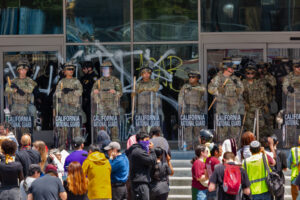 On Friday, June 6, 2025, federal agents descended on four businesses in Los Angeles and arrested dozens of workers on suspicion of violation of U.S. immigration laws. In response, hundreds of people gathered around federal buildings in downtown Los Angeles to protest the raids, and there were clashes between some demonstrators and the police department (the LAPD), who ruled the protest an unlawful assembly. On June 7, the protests continued. As on Friday, the demonstrations were largely peaceful, but some protesters threw objects at the police, and three self-driving cars were set on fire. Even though the unrest encompassed only about eight city blocks, on which Mayor Bass imposed a nightly curfew, Trump declared that Los Angeles was “under siege” and, ignoring the objections of Gavin Newsom, governor of California, and the mayor, ordered 2,000 federalized National Guard troops to deploy to the city. On June 8, 300 members of the National Guard arrived in Los Angeles, and the first of a series of federal “takeovers” of major American cities had begun.
Neither the vehement reaction to federal immigration raids nor the deployment of National Guard troops to quell the protests should have been a surprise. After all, these events had been ten years in the making. On June 16, 2015, Donald Trump descended on the golden escalator in the Trump Tower in New York City to declare his candidacy for president of the United States and to say, in justification of his candidacy, that “When Mexico sends its people [into the United States], they’re not sending their best.… They’re bringing drugs, they’re bringing crime, they’re rapists.…”
Ever since that day, anti-immigration proposals, the Muslim Ban, the border wall, or, most insistently, Mass Deportation, have been among the most popular elements in Trump’s nativist America First agenda. However, during Trump’s first term, the steps taken to implement these proposals were abject failures. He managed to build only 69 new miles of border wall, failed to deport as many undocumented immigrants as either Biden or Obama, and, despite a lengthy court battle over the Muslim Ban and a replacement Executive Order that was intended to address the problems with the original ban, he didn’t succeed in showing any plausible gains in national security from the measure.
What Is New About the Trump 2.0 ICE Raids and How Are Los Angeles Grassroots Activists Responding?
Trump 2.0 has taken advantage of its dominance in all three branches of the federal government to renew its anti-immigration efforts. The Department of Homeland Security (DHS) claims that the construction of the border wall, which was largely halted under Biden, will be completed by January of 2028. On June 9, 2025, Trump issued a new travel ban, restricting entry to the United States of nationals from nineteen countries (up from the original seven in the 2017 order). In December 2025, Trump issued a revised order barring entry to nationals of 39 countries (and the Palestinian Authority). However, Trump’s regime has devoted its greatest efforts to an impossible goal—deporting every last “illegal” from the United States.
Los Angeles was a natural first target for Trump’s mass deportation campaign. It has the largest undocumented population of any American city (over 1.1 million, according to the Migration Policy Institute), and it is a sanctuary city, making it the object of Trump’s anger for defying his authority. It is a deeply blue city, and, more to the point, it is rabidly anti-Trump (he lost Los Angeles County to Kamala Harris by more than 1.2 million votes). Finally, Stephen Miller, Trump’s homeland security adviser and the chief anti-immigrant ideologue in the Trump regime, is a Los Angeles native and bears a special animus toward his home city’s immigrant population—perhaps because he was forced to attend a majority-minority public high school instead of his older brother’s pricey private school after his family suffered an economic downturn.
Raids by Immigration and Customs Enforcement (ICE) (and Customs and Border Protection [CBP] and Homeland Security Investigations) in Los Angeles began in earnest on June 6, 2025, and, between that date and July 8, a bare month later, 2,719 allegedly illegal immigrants had been detained. The methods of ICE and other anti-immigrant agencies (“la migra” )were brutal, effective, and themselves illegal. Federal agents swarmed places frequented by immigrants (Home Depot parking lots, car washes, open-air markets) and seized anyone with brown skin and a Spanish accent. Agents grabbed gardeners trimming bushes, vendors selling birria, shoppers at Target, people walking home or driving to work, and they even swept MacArthur Park with armored vehicles, disrupting a children’s summer camp. In the eleven months since the raids began, Home Depot parking lots have become human hunting grounds, with over 700 day laborers abducted while they were looking for work there.
Fear stalked the streets of Los Angeles, and the local and state authorities that had promised “sanctuary” complained about ICE but did little else and failed even to rein in the LAPD, which made a practice of brutalizing protesters and facilitating ICE kidnappings by establishing “safety perimeters” to keep observers and neighbors at bay during arrests.
This “surge” of ICE agents into Los Angeles, followed by sustained immigration campaigns in Chicago, North Carolina, Washington, DC, and Minneapolis–Saint Paul (not to mention raids in many other cities), aroused courageous and creative resistance in the communities under attack.
The first attempts to protect people from ICE raids in Los Angeles were spontaneous efforts by community members to sound the alarm and even intervene when agents suddenly appeared in their neighborhoods. Online chats exploded with videos of masked, armed men seizing people (almost always Latinos) on the streets, smashing car windows and dragging people away, chasing people through an open-air market, a car wash, or a Home Depot parking lot, and, on one occasion, even blowing a door down to grab a father at home with his family.
Elizabeth Castillo, a mother of five and an American citizen, is married to a man who had been deported in 2012. She exemplifies the response of ordinary citizens in Los Angeles. Soon after the raids began, she began patrolling Pasadena, her hometown, located northeast of downtown Los Angeles. Whenever she spotted ICE activity, she warned the neighborhood with her megaphone. Neighbors joined her, and they partnered with NDLON (the National Day Laborers Organizing Network) to set up an ICE Watch on a corner in their town. The idea spread quickly and “adopt-a-corners” appeared on many of the major streets in Los Angeles’s Latino neighborhoods. Sometimes these were organized by established groups, like the Los Angeles Tenants Union (LATU) or the Democratic Socialists of America (DSA), but often people just called up friends and started a local ICE Watch. For example, in El Sereno, a long-established Latino community just northeast of downtown Los Angeles, a group of friends founded the “Community Care Collective,” which recruited dozens of neighbors to patrol the streets and to watch over a local food distribution and a weekly night market. Community organizations with a long history of service, like Union del Barrio (UDB) and Centro CSO, stood up a Community Self-Defense Coalition (CSDC) and began to offer “Know Your Rights” trainings and to organize their own patrols, involving hundreds of volunteers.
Protests against ICE started almost immediately as well. CLUE Justice (Clergy and Laity United for Equity and Justice) initiated a “freedom cruise” of dozens of vehicles, slowing traffic on major roads leading to City Hall, where the drivers gathered to protest the raids. NDLON coordinated an “ICE scraper” action in Monrovia, where a day laborer had been struck and killed by a vehicle on the 210 freeway while trying to escape an ICE raid in the Home Depot parking lot. Hundreds of protesters clogged the cash registers in the Home Depot store by buying and returning ICE scrapers repeatedly. The video of this action went viral and was viewed nearly two million times, inspiring copycat “ICE scrapers” at Home Depot stores in many cities across the country.
Resistance to mass deportation also became a central theme in the national mobilization of opposition to Trump’s agenda. The public seemed to be waking up to the realization that ICE was not merely a mechanism of immigration enforcement. It was a secret police force akin to the Gestapo, free to violate central rights guaranteed by the Bill of Rights with “absolute immunity” (according to J. D. Vance) from any court supervision. Fatal ICE shootings of American citizens soon made it clear that, while the agency was focused on “illegals” now, anyone their agents saw as obstructing their mission was subject to arrest or even lethal force. From the early “Hands Off” marches to the series of massive “No Kings” rallies that brought millions of Trump regime opponents onto the streets, the anti-ICE sentiment was evident. In cities like Los Angeles, where the raids wrought havoc in immigrant communities—tearing families apart and causing hundreds of thousands of workers to stop doing their jobs—the ICE terror was accompanied by widespread impoverishment.
Dozens of organizations have joined the Home Depot Boycott Coalition, including the Northeast Los Angeles Alliance for Democracy, a local anti-fascist group, which had started its own boycott campaign. Many actions followed: vigils for day laborers who had died in ICE custody, Day of the Dead celebrations, anti-ICE caroling, mutual aid for families affected by the raids, and an ongoing attempt to encourage the buying public to shun Home Depot. Although Home Depot hasn’t given in to the pressure of these campaigns, its complicity with ICE has been exposed, and its stores have become a rallying point for activists everywhere.
Los Angeles, Chicago, Minneapolis Learning from Each Other How to Fight Back
It’s difficult to capture the diversity and complexity of this effort to protect Los Angeles neighborhoods from ICE and the devastating effects of the raids or to assess its efficacy. Once ICE agents had stopped a community member, it was nearly impossible to prevent that person’s arrest, but groups like the Harbor Area Peace Patrol, which stood watch outside the ICE center at Terminal Island every morning and circulated photos of agents’ vehicles leaving for their raids, and numerous Rapid Response and Watch teams throughout the city formed an almost seamless network that was often able to warn communities in advance that ICE was coming. Undoubtedly, many kidnappings were foiled by this system, but just as important, ICE was not able simply to disappear people. Observers reported the names and birthdates of detainees to CHIRLA (Coalition for Humane Immigration Rights of Los Angeles), Union del Barrio, and other rapid-response hotlines, while spreading the word throughout their own networks, informing family members of the kidnap victims, and initiating legal and mutual aid. It seems clear that the resistance to ICE kidnappings, whether in Los Angeles, Chicago, Minneapolis, or any of the other cities where ICE conducted major raids, had an effect by arousing public opposition and forcing la migra to change its approach to mass deportation.
The Los Angeles ICE surge reached its peak during its first month, June 2025, but raids continued throughout the year, diminishing in frequency and size as ICE reduced its reliance on mass raids in Los Angeles and pursued less public detention tactics, often involving people already under supervision by immigration, such as those enrolled in the Intensive Supervision for Asylum Seekers or DACA (Deferred Action for Childhood Arrivals) recipients. Also, ICE and CBP turned their attention to other cities, whether out of the calculation that they wouldn’t fight back or simply to punish Democratic-leaning communities, it is hard to say. In any case, resistance to mass deportation had only grown stronger in reaction to la migra’s brutal and indiscriminate attack on Los Angeles’s communities. When “Operation Midway Blitz”—the assault on Chicago’s immigrants—began in early September 2025, the anti-fascist movement had learned many valuable lessons about how to throw sand in the gears of mass deportation. By the time the attack on Minneapolis–St. Paul (“Metro Surge”) took place in December 2025, despite the enormous force mustered by DHS, this relatively small city pushed back with such tenacity and demonstrated such a depth of neighborly love for its immigrant community that national public opinion turned against Trump’s brutal immigration policy, and “Metro Surge” ended abruptly with the firing of DHS secretary Kristi Noem and the retirement of CBP chief Greg Bovino.
The changes in leadership do not, of course, mean that the Trump regime has abandoned its mass deportation policy. Stephen Miller, Trump’s Heinrich Himmler, hasn’t yet lost influence with Trump because of popular resistance, and DHS has vast resources—approximately $191 billion—to hire new agents, complete the border wall, and expand its system of detention centers. Furthermore, Republicans in Congress are now planning to use “reconciliation” to circumvent any Democratic move to hold up ICE funding while reforms in ICE tactics are debated.
Nevertheless, the resistance has only grown. It has become nearly impossible for Trump to build new detention centers because of local pushback. Nationwide, a protest movement has been building against the network of established private and state-funded concentration camps where detainees are held in advance of deportation. The next big battle against mass deportation is likely to take place over these camps. As I write, in California, a new anti-camp coalition (NO Camps CA) has formed and carried out its first action on May 4, 2026—a coordinated, statewide protest at every detention center in California. Fittingly, this effort was led by two Angelena organizers. Several of the actions were impressively large—involving hundreds of protesters who traveled to remote concentration camps (in the High Mojave Desert, for example) to voice their opposition and let the detainees know that they are not forgotten. Detainees report abusive and inhumane conditions at the detention centers, including overcrowding, lack of basic hygiene, food infested by maggots, and extreme medical neglect (sometimes resulting in the death of detainees). ICE plans to expand the capacity of its detention centers to 92,600 beds by November of this year (from a current capacity of about 60,000).
It will take all the passion and creativity of the resistance to slow down this juggernaut and to turn public sentiment against it. Just as in the past year, we can’t expect politicians to help us in this fight, even if Democrats win the midterm elections. This is the people’s struggle—for their democracy and for their communities.
Solo el pueblo salva al pueblo!