Democrats
Today’s Democratic Party has no recognized leaders, no coherent program to address today’s multiplying problems, never had actual members, depends on the kindness of well-to-do donors, has, despite significant gains in a handful of elections in 2025, lost working-class voters of all races, and is stuck in the status quo. Many of its own advisers, officials, candidates, and office holders describe it as chaotic, leaderless, its brand “toxic,” and its broader message muddled. Voters, even those who vote for its candidates agree, and say the party and its various representatives aren’t listening to regular folks. The Democratic Party reached an all-time low in March 2025, when an NBC survey of registered voters conducted by Democratic pollster Hart Research revealed only 7 percent had a “very positive” attitude toward the Democratic Party and another 20 percent a less-than-enthusiastic “somewhat positive” attitude. Fifty-five percent had a negative view.
To be sure, America’s oldest party got a shot in the arm in the 2025 elections with big victories in the governorships of New Jersey and Virginia, California’s pro-Democratic redistricting Proposition 50, and a number of down-ballot successes. The movement-like election of democratic socialist Zohran Mamdani as mayor of New York revealed deep voter anger at the party regulars, but is a somewhat different matter since both candidates were actually Democrats in a deep blue city. Furthermore, Mamdani was running against the Democratic policy mainstream, and despite his efforts to court them or theirs to incorporate him, he is not exactly the favorite of the local or national party leaders or the majority of centrist Democratic pols who fear his radicalism will cost them election in 2026 despite his dazzling and carefully nonconfrontational performance when he met with Trump at the White House. Both of the newly elected Democratic governors of New Jersey and Virginia, on the other hand, were “safe” members of the centrist New Democrat Coalition (NDC) when in the House of Representatives, touted their military backgrounds, and have received nothing but praise.
As Trump’s authoritarian actions became more outrageous, his approval ratings dropped, and Democrats discovered “affordability” (a cover-up for the crisis of social reproduction of the majority), the Democratic Party’s ratings rose to a still deeply under water 39 percent approval and a higher than March 58 percent disapproval after the election. Considerably worse than 50 percent favorable to 25 percent unfavorable twenty-five years ago.1
For many on the left who have hopes for this forlorn party as the antidote to Trump and MAGA or even a potential working-class party, the answer is for the party to turn economically populist and win back the working-class voters it has lost. Indeed, even party pundits and moderate candidates and for that matter Trump et al. now talk of “affordability.” For the Democrats to deliver on the cost of living, however, they would need to address not only prices but the enormous gap between stagnant working-class income and the soaring income and wealth of the top 10 (and 1) percent in the United States that their own neoliberal practices have enabled for half a century. Even to ameliorate the situation they would need specific policies that effectively address the major problems immediately facing the majority of the population, not just “populist” rhetoric or dickering with utility rates. This would include a living minimum wage, labor legislation making union recognition automatic upon a majority joining the union, universal healthcare, free childcare, a massive public housing program, etc. That would require broadly taxing both incomes and assets of corporations and the wealthy. And this, I will argue, the Democratic Party will not and cannot do for deep structural reasons.
To fund the New Deal programs, the Revenue Act of 1935, dubbed the “soak the rich” act, raised taxes to 75 percent on incomes over $1 million, established an inheritance tax, and proposed to raise the corporate tax rate on large companies from 13.25 percent to a modest 16.25, although Congress lowered that to 14.25 percent.2 The Democrats could do this in 1935 because of the push of a deep crisis and a mass social upsurge, on the one hand, and the enabling factor of local party organizations that allowed them to win elections without big money from capital, on the other. In any case, as Roosevelt put it, “I wanted to save capital.”3 Today, without a massive redistribution of society’s wealth, a comprehensive “populist” or working-class program is impossible.
The contemporary Democratic Party, however, is stuck in the political center as the party of the status quo and has been for half a century. And the victories of centrist candidates in New Jersey and Virginia, along with the rise of California governor Gavin Newsome as a potential leader of the pack of presidential candidates only help keep it there. Furthermore, as a party ideologically and institutionally committed to capitalism, the forces keeping it in the center have intensified. Its crisis reflects the deeper changes in global capitalism. These include the prolonged crisis of productivity, growth, and inflation affecting most developed capitalist economies; the crisis of “center” and “center-left” parties in Europe, Latin America, and elsewhere, including the Democratic Party itself; the changed electoral terrain of polarization and diminished competition in the United States, and above all the huge and rising maldistribution of wealth and income already mentioned. These will be examined below, but the major political impediment to a left turn or to authentic “populism” lies in the changed nature of the Democratic Party itself.
From Grassroots to Greenbacks
The Democratic Party of the twenty-first century is fundamentally different from that of a half century ago in its base, structure, and centers of power. Until the 1970s, the Democratic Party rested on an organized though decentralized base composed of long-standing political machines; precinct, ward, and county organizations; a system of political clubs in some cities; associated ethnic organizations; construction and transportation unions, and from the 1940s through the early 1960s the new industrial unions—all of which had active roots in many urban and working-class neighborhoods and industrial towns. In the South, segregationist “courthouse gangs” upheld the party’s national vote and its congressional majorities for decades. That was the party of the New Deal.
The machines depended on patronage from the public trough and graft from private actors but also provided minimal social services and aid to constituents from city jobs to fixing traffic tickets. Corrupt, boss-driven, and often opposed to real reform, they nevertheless played a role in assimilating immigrant/ethnic/white and in some northern cities recently arrived Black working-class groups into politics providing dependable votes for the Democratic Party.4 To be sure, the Democrats had their capitalist supporters, but this grassroots voter base allowed Roosevelt and to a lesser degree Lyndon Johnson to pass costly reforms from the New Deal through Medicare and Medicaid when faced with disruptive mass social movements even over the reluctance or opposition of major sectors of capital.
All of this changed by the 1970s as the old machines dried up due to lack of patronage and demographic changes in most cities. Unions weakened and lost the ability to mobilize voters as seen in the deep decline of the union household Democratic vote as early as the 1950s.5 Local, county, and district party organizations were hollowed out as old-style patronage disappeared and they ceased to play an effective mobilizing role in elections. For example, a study of local party organizations revealed that by 2012 only 6 percent of Democratic Party local organizations had even “some paid full-time staff.”6 Unions also lost much of their ability to direct and mobilize members politically. As for the old club system, in New York City whereas the party of Roosevelt had 703 neighborhood Democratic clubs in the five boroughs, by the early 1970s it was down to 154, while today POLITCSNY lists only 79 such organizations.7
Politics abhors a vacuum and it was corporate capital that rushed to fill that left by the decline of local party organization. While labor invented the political action committee (PAC) to help re-elect Roosevelt, it was the corporations that took advantage of this legal conduit of campaign money in the 1970s. The number of corporate PACs soared from 89 in 1974 to 1,467 in 1982, with their donations rising from $8 million to $85 million over that period more or less split between the two major parties.8 Candidates and the national committees of both parties rushed to get business donations. This rush was further energized by the torrent of income and wealth upward during the international neoliberal era that made capitalist funding of elections and the party bureaucracy on a new and larger scale possible, furthering the era of locally “hollow parties.”9 By 2024, 1,677 corporate PACs contributed $152,603,615—56 percent to Republicans, 44 percent for Democrats.10
| Money and the New Deal Democrats |
|---|
| The presidential election of 1936 cost the Democrats a little over $5 million, much of it from individual cash contributions. A far cry from the $6 billion of 2024, even adjusted for inflation. Big business had largely deserted the Democrats and what remained was mostly “little” business—garment, smaller retailers, etc. Grassroots organizations filled the vacuum even beyond what the machines provided. The Democrats’ new “Nominators” program of $1 fees raised a little over $1 million through “collections from local groups, more than 5,000 of which functioned throughout the country” with most gifts being $1.00 but all less than $100. In fact, donations of $100 or less rose from 18.5 percent in 1932 to 34 percent in 1936. Larger donations of $25,000 or more brought in just 4 percent of individual contributions. As the major study of the 1936 election summarized, “Eighty-two percent of all that was given was in small individual contributions collected by local groups, and gifts from labor organizations.” In addition, the party raised a lot of money from local Jackson Day Dinners: $100 in Washington attended by officeholders and $5 .00 a plate elsewhere, mostly organized by the local machines. The party also cleared about $250,000 from ads and sales of its convention book, about half its costs covered by ads from or sales to businesses, many of which also gave to the Republicans.
Altogether, excluding ads and purchases of the convention book, businesses gave about 15 percent of the total cost of Roosevelt’s campaign. The combined contributions of labor and union-backed organizations, however, with the United Mine Workers playing a big role, actually equaled those of business at 15 percent. None of these institutional sources of funds, however, came close to those raised locally, largely in person, in small donations. More than anything it was local grassroots organizations that financed Roosevelt’s victory in 1936.11 How different things are today. |
As elections became driven primarily by money, their cost rose rapidly. In 1978–80 Democratic party and local campaign committees spent just $26.9 million on federal elections. By 1992 that had risen to $97.2 million and by 2024 $1.3 billion.12 Increasingly, a big bite of this went to high-priced political consultants. A major study of such consultants found that in 1970 only about 20 percent of House candidates employed a consultant. By 1992 it was two-thirds. By the 2012 election cycle the political consultant industry had become big business, penetrating state and local politics as well and earning an estimated $3.6 billion up and down the ballot. As early as 1968, as the old machines were fading or already gone in many cities, the Congressional Weekly Report observed of the increasing use of consultants, “The most important single condition which forces candidates to look to the professionals for help is the absence of a strong and continuing party organization.”13
The next step was the digitalization of campaigning both to raise money and to target the most favorable voters for media and such actual contact as occurred. Political advertising, via TV, radio, and increasingly social media to a large extent replaced door-to-door contact. Spending of $5,000 or more on digital ads via Google and Meta alone in 2024 cost $619 million on federal elections, with Democratic money outnumbering Republican by three-to-one, according to the Brennan Center.14 Thus, the hollowing out of grassroots party organization and candidate campaigns, on the one hand, and the intervention of big business via the corporate PACs and political consultants, on the other, transformed elections and, as we will see below, the party itself into an increasingly elite phenomenon far removed from the atomized electorate.
By 2024, the nature of campaign and party finance had again changed as the gap between capitalist funding and that of every other source continued to widen. Overall, according to OpenSecrets, in terms of PAC and individual contributions to candidates, parties, super PACs, and other “outside” groups, “business has a close to 7-to-one fundraising advantage.” The ratio of business-to-labor spending is sixteen-to-one.15 Corporate and trade (industry) PACs continue to account for over half of all regular PAC contributions to Democrats. The new super PAC and 527 Committee “outside” spending, legalized by the 2010 Citizens United Supreme Court ruling, once again changed and expanded how capital and the wealthy intervened in elections. Small individual contributions, on the other hand, became depersonalized as they flowed via credit card through centralized digital operations, most notably ActBlue for Democrats.
What is more, individual donations from the superrich played a much bigger role. The fifty biggest individual donors alone spent $1.5 billion in 2024, almost 10 percent of all the money spent on the 2024 presidential and congressional elections, much of it via the relatively new super PACs.16 The cast of multi-millionaires and billionaires giving to the Democratic super PACs was mostly the same as those giving through traditional PACs or individually and most were from tech, finance, and media. But now they were even richer.
By 2024, 623 super PACs raised some $5 billion and spent $2.7 billion. Republican backers outspent Democrats almost two-to-one, but pro-Democratic super PACS still spent close to a billion. What was particularly new in 2024 was the huge addition of big-time crypto currency PACs that hedged their bets by giving to both parties.17 Along with continued increases in business PACs and wealthy individual donations, the cost of national elections had risen from $3 billion in 2000 to $16 billion in 2024. This huge amount, however, is only for federal political campaigns. It does not include the operating expenses of party committees, transfers between committees, or state and local office campaigns. The phenomenal rise in the dependency of candidates and party organizations alike on money necessarily transformed the Democratic Party’s structures and politics.
The Separation of Party and Voters: The Conglomerate Party
The intensifying triangle of corporations and the wealthy seeking influence over politicians and parties, candidates seeking money to fund their increasingly expensive professionalized and media-driven campaigns, and national parties attempting to raise and direct money and choose the “right” candidate altered the party and how elections were conducted, nationalizing and centralizing the flow of funds. For one thing, as a major study of congressional elections argues, “House election patterns confirm that the United States has entered an era of nationalized, polarized, party-centered electoral politics that is very different from the candidate-centered world of the 1970s and 1980s.”18
This, in turn, “has a centralizing effect on American politics as the national party committees, and more recently, super PACS, have become important brokers in the collection and distribution of campaign contributions from wealthy donors.”19 As a recent Congressional Quarterly text concluded,
Few districts today boast strong local parties. In most places, the traditional local parties have been replaced by hybrid organizations that partner with state and national parties and their allied interest groups.20
Locally raised money plays little role in House campaigns with Democrats getting only 17.2 percent of their contributions on average from their districts, down from an already diminished 28.4 percent in 2012.21 This, too, is a radical change from twenty-five years ago when, according to the executive director of OpenSecrets, of those who raised $200,000 or more for a House election 79 percent “collected that money from within their districts from people they would ultimately represent if they won.”22 Not anymore. The connection between representative and voter has been broken, that between big donor, party committee, and politician tightened.
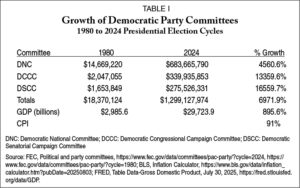
Thus, the rise of business and wealthy donors enabled by increased economic inequality has contributed to the nationalization of campaign and party funding further increasing the relative role and centrality of the national party committees. This is reflected in the enormous growth of the budgets of the three major national Democratic committees seen in Table I that have created a huge central party bureaucracy.
Equally important in the process of centralization are the sources of these huge budgets. Table II shows the percentage of individual donations that comes from those who gave $100,000 or more. Along with donations to super PACS, these large contributions to Democratic party committees have soared recently from $58.9 million in 2020 to $125.8 million in 2024, according to FEC figures. There is no doubt that these large donors overlap, so that fewer than a thousand individuals underwrite the party’s major committees.
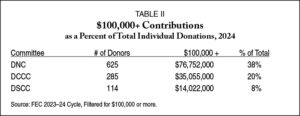
Not only were a tiny number of superrich donors responsible for a disproportionate amount of individual contributions and the nationalization of political money, but the donors were concentrated in a few of the nation’s wealthiest metropolitan areas and in industries currently reaping the lion’s share of profits.23 In order of the size of donations as counted by OpenSecrets these are: New York, Los Angeles, San Francisco, Boston, Washington, DC, Chicago, Seattle, and San Jose. All areas that disproportionately house high tech, finance, and media companies and investors. Not surprisingly, of the top ten political consulting firms five are in the Washington, DC, area, two in New York, and one in Chicago, with only two in outlying Utah and Missouri.24 Hence, the “coastal” donor-PAC-consultant-party-elite complex right-wing “populists” often point to.
The result of these developments is a hierarchical conglomerate national party composed of its individual office holders at the bottom; party caucus leaders in Congress (e.g., Hakeem Jeffries in the House, Chuck Schumer in the Senate); party committees and their leaders (DNC, DCCC, DSCC); consultants who gobble up 15–20 percent of campaign funds; wealthy individual donors (e.g., Reid Hoffman, Michael Bloomberg, Fred Eychaner, etc.); wealthy donor networks (e.g., American Bridge, Democracy Alliance, Future Forward, Next 50, and many more); and a plethora of business PACs and wealth-backed super PACS. The three official party committees are top-down bureaucracies. One study found “a DNC that is built to be an undemocratic, top-down institution.”25 The others are no different. This is the material reality of the Democratic Party.
The party ballot line is the visible entrance to this conglomerate at its bottom floor. Voters and small-to-medium-sized donors, however, have no place in the corridors of this conglomerate party. Nor do the denizens of the party hierarchy pay much attention to what their voters think, as a recent Gallup poll revealed.26 Unlike the powerful industry lobbyists that often shape or prevent legislation, the plethora of social issue NGOs and advocacy groups that focus on Democratic politicians have little influence on party policy and, in any case, are not part of the party structure or officialdom.27 The flow of money between big donors, PACs, party committees, and candidates is complex and opaque. The amounts of money and their capitalist origins that uphold the material reality of the Democratic Party are not. To imagine that entering this conglomerate party at its lowest level has no determining impact on the office holder is pure idealism.
In 1978–80, national and state Democratic committees raised $37.2 million. By 2024 just the three national committees raised $4.5 billion, a growth that even adjusting for inflation or comparing to GDP growth is no less incredible.28 This does not include PAC or individual donations given directly to candidates or funds raised by super PACs. Clearly, the increase in money raised and spent over this period by national party committees indicates a qualitative change in the power and function of the national party bureaucracy in relation to candidates and office holders. One sign of this power is the large operating expense budgets that are to a large extent controlled by the leadership of these top-down committees.
The DNC spent a huge $432,900,701 on operating expenses or 63 percent of its expenditures in the 2024 cycle, with a staff of 775 as of 2025.29 Much of the rest goes to state committees, selected candidates’ campaigns, and national convention expenses. In the 2024 cycle the DCCC operating expenditures were $192,363,225, which account for 58 percent of all its spending, while the rest was distributed to other party or campaign committees, direct “coordinated expenditures” to candidates, and independent (outside super PACs) funds. The DCCC employs over 400 staffers—almost two to every Democratic Representative.30 Thus, the DCCC has considerable operating power and influence over House members and candidates that simply didn’t exist four decades ago. It has been chaired by members of the centrist NDC for years. The DSCC has a smaller $135,445,312 budget with 113 employees largely because it covers only 100 senators and only a third run for election in each cycle, but its operating budget was still 45 percent of its spending.
Aside from the individual donations examined in Table II, each committee gets money from transfers between committees, gifts from office holders’ “Leadership” PACs, and regular PACs. Some Leadership PACs give a lot. Hakeem Jeffries “Victory” PAC gave substantial amounts to all three committees. His PAC and his campaign funds, however, come disproportionately from business or wealth-backed PACs. His PAC raised $22 million in the 2024 cycle with the largest donations coming from AIPAC, Blackrock, Apollo Global Management, Lockheed-Martin, and Met Life.31 While the level of his generosity may not be typical, it shows that even donations from office holders to the party’s leading committees, as well as to other members, have business roots.
More substantial for these party committees are regular PAC donations. The DNC gets 20 percent from corporation-heavy PACs. The twelve biggest DNC givers are all major tech and finance company PACs. Overall, according to OpenSecrets, its biggest source, excluding “other,” comes from Finance, Insurance, and Real Estate (FIRE), close to $100 million, followed by “Communications/Electronics; i.e., tech, at close to $40 million, with Labor at less than $5 million.32 The DSCC’s top donor PACs include some Senators’ PACs, but also an impressive list of corporate donors, again with FIRE leading by far at about $30 million, Communications/Electronics some $12 million, and Labor way behind again.
The DCCC received $28 million of its budget from “affiliated” committees, which are themselves conduits of wealthy and corporate money. $33 million more comes from the Leadership PACs of House members. Heavily corporate-funded House minority leader Jeffries is again the biggest donor at $5 million. The remaining 40 percent of its budget comes entirely from PACs. Corporate PACs, then, account for about a third of all DCCC funds—not including corporate money that flows through the PACs of House members and others. Not surprisingly, FIRE and Communications/Electronics are again by far the leading corporate sources of DCCC funds at about $60 million together.
Funds from just these industries plus the 20 percent of largest donations of $100,000 or more from individuals means that at least 40 percent of all DCCC money comes from businesses or wealthy contributors. Add the 239 individuals who gave between $50,000 and $99,999, who would also be among the richest 1 percent of the population, the total gifts from just two major groups of corporations and a little over 500 wealthy individuals would be well over 60 percent the DCCC’s income. Thus, a handful of superrich individuals and a couple of dozen corporations uphold the committee that has major influence on who runs and wins for the House of Representatives and what legislation is possible.
Take away that money and the edifice would collapse. Faced with the party’s crisis, the defection of some tech moguls to Trump, and the DNC’s (though not at the other two committees’) cash flow problem due to paying off Harris’ campaign debts,33 party pols, strategists, and donors are already rushing to come up with ideas for improved “messaging” and for new sources of money to keep the party alive and pay for the 2026 midterm. As one participant put it, “the repeated gathering of donors to mull such ideas has felt like a ceaseless calendar of cattle calls.”34
The DCCC, in turn, provides campaign resources such as media and funds via “coordinated” activities that increase dependence on the committee.35 Much of this goes to favored candidates who are mostly centrists, particularly in the DCCC’s Frontline program to defend vulnerable seats and its Red-to-Blue candidates who attempt to capture Republican-leaning swing districts. In this way, the party reproduces the centrist majority of the House Democratic Caucus with each election. In 2022, 17 of the 35 new members of the House joined the centrist NDC compared to 11 for the Progressives Caucus; 20 percent of all Progressive Caucus members also belonging to the New Dems. In 2024, of the 33 new House Democrats, 25 or three-quarters, joined the New Dems, while just 9 joined the Progressive Caucus, two of whom also joined the NDC.36 And, of course, two of the newer members of the Squad, Cori Bush and Jamaal Bowen, lost their seats in 2024 under assault from AIPAC. Similar proportions are almost certain for 2026 given that 22 of the 2026 Frontline’s 26 candidates are NDC or even more conservative Blue Dog caucus members.37
The idea that simply replacing the party’s aging leaders and office holders with younger ones will move the party leftward is wishful thinking. Congressional leaders are not hesitating to make sure centrists and moderates win in the 2026 House primaries beyond the Frontline and Red to Blue programs. Both the House leadership-aligned House Majority PAC and the DCCC have stated they will intervene in primaries in order to win back the House.38 After Spanberger’s victory in Virginia, the DCCC initiated a new program aimed at Latinos and rural voters that will provide money, staff, and advertising in “competitive battleground districts.”39 Given the centrism of minority leader Hakeem Jeffries and the rest of the House Democratic leadership that control these PACs, along with New Democrat DCCC chair Suzan DelBene, there is no doubt which side they will support in a primary. Super PACs will also intervene and given that 98 percent of the $4.5 billion super PAC funds in 2024 came from the top 1 percent of donors (6,786 individuals and 35 organizations), the well-to-do Democrats among them are certain to back moderates in most cases.40 Of course, as Mamdani demonstrated, money doesn’t always win, just 90 percent of the time.
So stuck in their ways, the congressional leaders even refused to back a small group of self-identified working-class candidates running for the Senate and House against Republicans in competitive races in Pennsylvania, Maine, Iowa, and Wisconsin in 2026. Although not from the organized left, these Democrats made the mistake of talking about the hard life of most people these days and openly denouncing the “oligarchy.” In some cases, the party leaders and the DSCC and DCCC backed “safer” moderates in the primaries. As one of them said of Chuck Schumer and the DSCC, “They’re comfortable where they are at, they want to continue the status quo.”41 The DSCC also chose a more mainstream candidate over a self-styled “Prairie Populist” in the Iowa Senate race.42
The flow of funds and power, of course, doesn’t end when the election is over. The new office holder remains ensnared in this permanent web of money and organization. The idea that using the Democratic primary ballot line is simply a tactic is naïve at best. It is the path to the highly organized and hierarchical reality of party organization in Congress and just about every other legislative body in the United States. Famously, House re-election campaigns and fund raising begin the day after taking office. Democratic members of the House are expected to fund raise via “call time” with substantial donors.43 In addition to campaign money, some of the funds go to the DCCC, dues to the Democratic Caucus, and to other members through their Leadership PACs. Thus, with few exceptions House Democrats are both beneficiaries and conduits of business and/or wealth-based money to and from the party and fellow members. In addition, once new Representatives have committee assignments, corporate PAC money from industries affected by those committees suddenly increases.44 In reality, the distinction between who is and who isn’t a “Corporate Democrat” is a fuzzy one indeed.
The House Democratic Caucus leadership is well funded and commands a staff of about 200 employees and a dozen senior staff chiefs or directors and has a great deal of power over members.45 The leadership plays a major role in committee assignments that determine a member’s effectiveness. It also decides which bills go to which committees and which will see a floor vote in the House. As Alexandria Ocasio-Cortez (AOC) said of the party Caucus, “the structural shifts in power in the House both in process and rule to concentrate power in party leadership, of both parties, frankly, but in the Democratic Party leadership (are) to such a degree that an individual member has far less power than they did 30, 40, 50 years ago.”46 Given the leadership’s power it is not surprising that in 2024, “Congressional leadership positions attracted extraordinary outside [of district] funding.”47
The idea that this conglomerate party would turn on its major sources of money and threaten its own existence by “soaking the rich” is an ahistorical fantasy. That’s not to say that there aren’t dissidents and those who employ populist or even class rhetoric. The Justice Democrats are already endorsing progressive candidates, more will come, and some may even win.48 And there is DSAer Zohran Mamdani’s impressive victory in the New York City mayoral race. His campaign will inspire more DSAers to run as Democrats at various levels. But all the trends discussed above point toward the continued hold of capital and the political center on the Democratic Party as a whole. While it may win enough suburban seats to take back the House in 2026, it is not an “opposition” party that can defeat Trumpism/MAGA politically and ideologically or permanently win back a clear majority of working-class voters. At the same time, the crisis of this party of the center opens possibilities for a left alternative.
The Settings for an Alternative: The Economy
The alternative has already begun in grassroots movements in the streets and workplaces and widespread disgust with both the Democrats and Trump. But to understand the possibilities of this period a deeper look at the context is needed. I will examine three major elements of the economic, political, and social setting mentioned at the beginning. It is the interaction of these elements that can open the door to an independent left, even socialist political alternative if, and it’s a big if, the left acts to take advantage of this unfolding situation. Nothing in this analysis implies inevitability.
Relative stagnation in productivity, growth, and profitability combined with a tendency toward inflation of the United States and developed capitalist economies since the Great Recession of 2008–2010 not only intensified capitalist resistance to increased taxes but brought forth demands for aid and succor for business, as in Biden’s “industrial policy” subsidies to certain industries or Republican tax cuts. Yet, it is precisely this combination of slow growth, inflation (stagflation) with the continuing shift of both wealth and income upward that creates the near zero-sum situation that underlies the crisis of social reproduction, misleadingly labeled “affordability.” The ownership of wealth, from which most of the economic elite’s income derives, shifted from 62.6 percent held by the top 10 percent in 2000 to 87.2 percent by mid-2025, while that of bottom 50 percent fell from 3.2 percent to 1.1 percent, little of which produces income.49
The richest households’ share of mostly income-producing wealth rose by 40 percent, allowing them to account for half of all consumer spending in the United States in 2024—up from 36 percent in the 1990s. The bottom half, on the other hand, saw their “wealth” fall by two-thirds. As the Wall Street Journal summarized it, “well-off people have increased their spending far beyond inflation, while everyone else hasn’t.”50 “Affordability” galore at the top, cost-of-living crisis at the bottom. Short of absolute confiscation, “affordability” for the masses can only be real if the wealth and income of the superrich are heavily taxed and redistributed downward both through higher wages and extensive public programs that underwrite working-class social reproduction. This, the Democrats of today will not do.
Due to the underlying contradictions of capitalism, however, the same conditions that limit Democratic policy options simultaneously create more social conflict. Capital is driven by these conditions of relative stagnation to speed up and intensify work while holding down real wages and benefits even as inflation continues to erode their value and the rich get much richer. The growing efforts to increase productivity through both technology and increased workloads intensify the need and desire for resistance on-the-job as work-related stress has risen over the past period to “historic highs.”51 In addition, the highly visible growth of inequality and astronomical wealth for the few is driving an anger that seeks outlets.
The number of strikes rose from 279 in 2021 to 433 in 2022 and 471 in 2023. In 2024 they fell to 359. In the year from November 2024 to November 2025, however, there were over 500 strikes indicating that they would far surpass even 2023.52 At least so far, Trump has not been able to rein in worker resistance. Despite an increase in National Labor Relations Board (NLRB) elections until recently, and continuing efforts to organize Amazon and various efforts outside the NLRB, however, unions continue to lose more members than they gain. Trump has already gone far in dismantling the NLRB so that it will be even less of a path to new organization. The need for innovative strategies and broad alliances in workplace organizing is more urgent than ever. There are a number of such projects, notably the Emergency Workers Organizing Committee, sponsored by the United Electrical Workers and DSA (Democratic Socialists of America). A useful analysis of some new approaches can be found in the Center for Work and Democracy’s report Beyond the NLRB.53
Economic conditions, however, do not automatically produce a social upsurge. That requires the accumulation of an activist layer of the class, what is sometimes called the “Militant Minority” that provides leadership and direction at the rank-and-file level. There is evidence that this process is underway. The organized socialist left has a key role to play in this development. There are thousands of self-identified socialists in today’s workforce and unions. Many belong to DSA. There are rank-and-file caucuses in several important unions including: United Auto Workers, American Federation of Teachers, International Alliance of Theatrical Stage Employees, Teamsters, United Food and Commercial Workers, and the International Brotherhood of Electrical Workers. Many radicals are among those organizing at Amazon. Thousands of union members and their allies marched on May 1 in over one thousand U.S. locations, organized by May Day Strong initiated by the Chicago Teachers Union and the United Teachers of Los Angeles. This was one of the many efforts to defend immigrant workers from Trump’s mass and vicious deportation assault.
Beyond organized labor, the rise of opposition to Trump is also part of the development of activists for an alternative and to a large extent they, too, are driven by the cost-of-living crisis and obscene inequality as well as the defense of basic democratic rights. The “Fighting Oligarchy” tour by AOC and Bernie Sanders drew tens of thousands in city after city. By most accounts the “No Kings Day” was the largest political mobilization since the 2020 Black Lives Matter demonstrations. More generally, the deep contradiction between Trump’s policies and actions and his working-class supporters also opens possibilities. There is, in short, growing material for a Militant Minority, an activist layer generally, and mass movements for change. Without these the emerging potential cannot be realized. The task for the left is to turn events and projects into ongoing action and organization.
The Settings for an Alternative: The Crisis of the Democratic Party
The political crisis of the Democratic Party—driven in part by the limits imposed by the prolonged crisis of stagflation and its dependency on funding from capital—involves a lot more than simply bad polling. But it is also a result of a deeply rooted conformity to the status quo that has left the party with electoral technicians and bureaucratic officials but no real political leaders as shown in the lineup of uninspiring presidential candidates, the “leadership” of Congress, etc. Some six million people who voted for Joe Biden in 2020 failed to show up in 2024. The top reason for abstention in a pro-Democratic poll was that the Democrats “didn’t have a strong enough plan to get the cost-of-living down” and failed to address “deeper issues like poverty and inequality.”54 The elections in Virginia, New Jersey, and New York City reversed some of this, but they are a small “blue” slice of the U.S. electorate and the Democrats still lack the concrete programs and leadership to defeat Trumpism.
According to the New York Times analysis, in the thirty states that register voters by party, Democratic registrations just before the 2025 elections fell in every state and overall dropped by 2.1 million between 2020 and 2025. And they fell in key battleground states as well. For example, the Democrats’ edge of registered voters in Pennsylvania in 2020 was 517,310, by summer 2025 it was down to 53,303. Republican registration went up everywhere. Furthermore, the Democrats even lost ground among new young registrants—a further sign of declining vote share to come. While there are still more registered Democrats than Republicans, the gap is narrowing and the trend is clearly a fatal one for presidential and congressional elections.55
The forces of political moderation including its wealthy donors as well as politicians are, of course, aware of the Democratic Party’s crisis and are already organizing to keep it soundly in the center. One such new group of relatively younger Democrats call themselves the Majority Democrats. They are mostly elected officials from Congress, the states, and even local government. The House members are mostly New Democrats or conservative Blue Dogs. The group wants a “big tent” party and is solidly centrist-to-conservative judging by its membership. It will help Democrats like themselves who face tough races and will soon have both a regular PAC and a super PAC and that means money.56
Then there was the big WelcomeFest in the California desert where hundreds of Democratic centrists gathered in June to put an end to populism and “identity” politics. As the New York Times reporters put it, “Moderate Democrats are having a moment and there is a cadre of consultants and strategists ready to support them.” Panels featured such anti-woke party right wingers as Representatives Jared Golden (ME) and Marie Gluesenkamp Perez (WA), Senator Elissa Slotkin, and newly converted anti-woker Governor Gavin Newsom, along with hundreds of other self-proclaimed centrist or moderate elected officials.57
In a more strategic vein is the new Project 2029. Yes, an imitation of the Trumpite Project 2025, but this one composed of Democrats who think the party has a messaging and perhaps even a policy problem. Its advisory board, however, features strategists and thinkers from other think tanks, mostly from the Clinton, Obama, and Biden currents of the party. Or as Branko Marcetic of Jacobin put it, Project 2029 “is quite literally composed of the same line-up of people who brought the party to its knees in the first place.”58
While much of the discussion among strategists and donors is about “message,” others are planning to invest in online media to spread the message to a younger audience. American Bridge, “one of the largest Democratic donor networks,” according to the New York Times, is backing a for-profit media company with a projected budget of $70 million over the next four years. It will be designed by a former Biden White House digital strategist and will avoid the “hall monitor style of Democratic politics that turns off younger audiences.” There are several other similar donor-funded media projects in the works to give the Democrats a more youthful and contemporary look: Project Echo, a $52 million “influencer” effort led by former Harris aide Rob Flaherty; Channel Zero, also by Flaherty; Double Tap Democracy, with initial funding of $250,000 from the wealthy donor network Future Froward.59 The fact that they are run by former Harris and Biden aides suggests little more than tech-boosted centrism.
Another sign of the Democrats’ inability to move beyond the status quo was the August meeting of the DNC. The DNC is composed of state party chars, vice chairs, and various appointed members. There is nothing democratic about it, but it does provide money for state parties, organize the convention, draft the party’s platform, and set the schedule of primaries. What it doesn’t provide is real political leadership. DNC chair Ken Martin had promised to improve the party’s state and national infrastructure, but that didn’t come up at the DNC’s August meeting. Instead, the committee debated and postponed a decision on the 2028 presidential primary schedule. The DNC also rejected a motion to end military aid to Israel to end the war in Gaza. Charman Martin pulled his more moderate motion repeating the Biden policy for a ceasefire and a two-state solution but nothing about military aid—kicking the can down the middle of the road again. In other words, it did nothing to deal with the party’s crisis.
The Settings for an Alternative: The Demise of Two-Party Competition
The legitimacy of the two-party monopoly in the United States rests on the notion of electoral competition. In electoral terms, however, political polarization, redistricting, and population movements have created a situation in which only 40 to 50 or so out of 435 congressional districts are competitive.60 These tend to be those with large white populations of homeowners, many suburban with higher-than-average incomes.61 The political wisdom of the day is that these swing districts can only be won by moderate Democrats—as in Virginia and New Jersey. And experience shows more often than not it is not wrong. Thus, the swapping of working-class for middle-class professional voters is virtually locked in by efforts to defend or win a congressional majority as well as the presidency.
On the other hand, a consequence of this is that the vast majority of the House’s 435 seats are judged safe and in most of them there is no spoiler effect, which is the heart of the first-past-the-post electoral system’s enforcement mechanism. That is, Republicans in most Democratic districts are too small a percentage to win if a third party takes votes from the Democrats and vice versa. So, there is a significant opening for a third party to establish itself as the first or second party in many districts. This goes beyond the left’s urban home base and includes many Republican districts as well where a candidate running on a working-class program could end the “red” monopoly if it was built on grassroots organization. As I pointed out elsewhere, on average “rural” districts represented by Republicans, the majority of which are not entirely “rural,” have a higher proportion of both manufacturing and public sector workers than urban areas.62 Nebraska mechanic and former union leader Dan Osborn’s 2024 independent and close run for Senate didn’t win but at 46.7 percent it showed significant support across this largely rural state.63 There are openings here for independent politics.
Furthermore, both registration data and polls show that the number and percent of those identifying as independents or third-party voters has grown—mostly at the expense of the Democrats. Altogether, the proportion of those registered as independents has grown from 23 percent in 2000 to 32 percent as of 2025. In 2024, for the first time, election polls showed self-identified independents outnumbering Democrats and equaling Republicans. On top of this according to polling commissioned by NBC, 34 percent of independents are people of color, “double the share from 2012.”64
This suggests that the young, black, and Latino voters may be more open to ditching the two-party trap. Furthermore, not only did Trump’s approval drop to 38 percent among registered voters, but 57 percent of independents opposed his Big Beautiful Bill with only 20 percent supporting it.65 This doesn’t mean all independents are left-leaning or that most will be ready to immediately join or vote for a genuinely left working-class-based party. Still according to an August 2025 Gallup poll, only 36 percent of independents had a positive view of big business and just a slight majority of 51 percent of capitalism, while 38 percent favored socialism.66
The same poll revealed just how out-of-step party officials, donors, consultants, and most office holders are even with those who still identify as Democrats. A mere 17 percent of Democrats polled had a positive view of big business, while only a minority of 42 percent approved of capitalism and 66 percent had a positive view of socialism.67 This may mean a Bernie-style Scandinavian social democracy or even just a generous welfare state, but it certainly indicates a deep dissatisfaction with the status quo and the conglomerate party that upholds it. Taken together, all these trends are certainly something new in U.S. politics.
Economic conditions are tending to push workers to action, while Trump’s authoritarian and reactionary actions are pushing more and more people generally into opposition. The Democratic Party is still dependent on educated, largely suburban voters in competitive districts, while more people see themselves as political independents. It is out-of-touch even with those who remain loyal, and the electoral system has opened new possibilities for independent or third-party candidates. It’s worth remembering that throughout the 1930s at the height of the New Deal, Wisconsin and Minnesota were primarily represented in the House by the “populist” Progressive Party and Farmer-Labor Party respectively—not by Democrats.68 Today, steps toward building local or state-level workers’ parties can be taken by running candidates where labor and social movements are most active and grassroots political organization is possible. Independent worker candidates may not win the first time out, but the converging conditions for independent class political action are favorable and it would be tragic for the left to miss the opportunity.
Notes
1. Hart Research Association, “NBC News Survey, Study #25060,” March 2025; “Real Clear Polling, Democratic Party Favorability,” Nov. 14–17, 2025.
2. Steven A. Bank, “Taxing Bigness,” Tax Law Review. 66 (2012); Wikipedia, “Revenue Act of 1935.”
3. John Newsinger, Fighting Back: The American Working Class in the 1930s (London: Bookmarks), 2012: 138.
4. Dennis R. Judd and Todd Swanstrom, City Politics, 9th ed. (New York: Routledge, 2016), 48–63.
5. Steven P. Erie, Rainbow’s End: Irish-Americans and the Dilemmas of Urban Machine Politics, 1840–1985 (Berkeley and Los Angeles: Univ. of California Press, 1988), passim; Judd and Swanstrom, 2016: 48–63; Kim Moody, US Labor in Trouble and Transition: The Failure of Reform from Above, The Promise of Revival from Below (London: Verso, 2007), 145.
6. Douglas D. Roscoe and Shannon Jenkins, Local Party Organization in the Twenty-First Century (Albany: SUNY Press, 2016), 52.
7. Ira Katznelson, City Trenches: Urban Politics and the Patterning of Class in the United States (Univ. of Chicago Press, 1982), 126; PoliticsNY, “Political Clubs,” n.d.
8. Val Burris, “The Political Partisanship of American Business: A Study of Corporate Political Action committees,” American Sociological Review 52 (Dec. 1987), 732.
9. Daniel Schlozman and Sam Rosenfeld, The Hollow Parties: The Many Pasts and Disordered Present of American Party Politics, Princeton: Princeton University Press, 2024, 7; Robby Brod, “Outside money, inside influence: How national donors shaped the 2024 congressional elections,” OpenSecrets, Apr. 30, 2025.
10. Federal Election Commission (FEC), “PAC Contributions to Candidates,” Jan. 1, 2023 through Dec. 31, 2024, Mar. 14, 2025.
11. Louise Overaker, “Campaign Funds in the Presidential Election of 1936,” American Political Science Review, 31 (3), June 1937: 473–98.
12. FEC, “Republican Party Spent $123 Million More in ’90 Than Democrats, Final FEC Report Shows,” Dec. 10, 1991; FEC, “Democratic Party Committees’ Federal Activity through Sept. 30 of the Election Cycle,” Mar. 24, 2014; FEC, “Democratic Party Committees’ Detailed Summary Page Total Reported through Sept. 30 of the Election Year,” Party Table 2b, July 9, 2025.
13. Adam Sheingate, Building A Business of Politics: The Rise of Political Consulting and the Transformation of American Democracy (New York: Oxford University Press, 2016), 155, 182–191, 222.
14. Brennan Center for Justice, “Online Political Spending in 2024,” Oct. 16, 2024.
15. OpenSecrets.com, “Business-Labor-Ideology Split in PAC & Individual Donations to Candidates, Parties, Super PACs and Outside spending groups, 2025.”
16. Clara Ence Morse, Luis Melgar, and Maeve Reston, “Meet the megadonors pumping millions in the 2024 election,” Washington Post, Aug. 26, 2024. Of the 50, 18 were Democrats and four crypto currency outfits gave to both parties.
17. All of these facts and figures and those below unless otherwise cited are from OpenSecrets.com.
18. Gary C. Jacobson and Jamie L. Carson, The Politics of Congressional Elections, 10th ed. (New York: Rowman & Littlefield, 2020), 256–57.
19. Sheingate, Building A Business, 210.
20. Roger Davidson et al., Congress and Its Members, 19th ed. (Thousand Oaks, CA: Sage/CQ Press, 2024), 78.
21. Brod, “Outside money, inside influence.”
22. Hilary Braseth, “We follow the money in politics, and the trail just keeps getting longer,” The Hill, Aug. 19, 2025.
23. Michael Roberts, “From the Magnificent Seven to the Desperate Hundreds,” Michael Roberts Blog, Apr. 7, 2024; Michael Roberts, “Profit Margins and Rates,” Michael Roberts Blog, Mar. 18, 2024.
24. Culture Currents Institute, “The Top Political Consulting Firms,” Aug. 8, 2023.
25. Sunjeev Bery, “The Democratic National Committee is Undemocratic. That’s by Design,” The Intercept, Feb. 1, 2025.
26. Gallup News Service, Gallup Poll Social Series: Work and Education, Aug. 1-20, 2025, Timberline: 937614.
27. Philip Rocco, “How the Democratic Party Was Hollowed Out,” Jacobin, Aug. 23, 2025.
28. All Federal figures are from the FEC unless otherwise cited.
29. leadiQ, Democratic National Committee Employee Directory, July 2025.
30. leadiQ, Democratic Congressional Committee, July 2025.
31. OpenSecrets, Hakeem Jeffries, Representative (D-NY).
32. These and the following figures are from OpenSecrets.org unless otherwise cited.
33. Shane Goldmacher, “In Private Deal, the D.N.C. Covered $20 million in Harris Bills Post-election,” New York Times (NYT), Aug. 25, 2025.
34. Theodore Schleifer, “Democrats Throw Money at a Problem: Countering G.O.P. Clout Online,” NYT, May 20, 2025.
35. Jacobson and Carson, Congressional Elections, 97–106.
36. New Democrat Coalition, “New Dem Chair Schneider Celebrates Swearing in of 110 New Dem Members, including 25 Freshmen,” Media Center, Press Release, Jan. 3, 2025.
37. DCCC, “DCCC Announces Members of 2026 Frontline program,” DCCC, Mar. 6, 2025.
38. Elena Schneider and Nicholas Wu, “Messy Democratic primaries could hurt party’s chances of retaking the House,” Politico, May 22, 2025.
39. Samuel Benson, “Democrats spending big to expand coalition in midterms,” Politico, Nov. 25, 2025; DCCC, “DCCC Announces Historic, Earliest-Ever Investments to Engage Voters of Color and Rural Voters Key to Winning the House Majority,” Press Release, Nov. 25, 2025.
40. OpenSecrets.com, “Super PACs: How Many Donors Give,” accessed Aug. 29, 2025.
41. Annie Karni, “In the Battle for Congress, Working-Class Democrats Try a Hardscrabble Pitch,” NYT, Sept. 7, 2025.
42. Austin Ahlman, “Amid DSCC Pressure, Democratic Populist J.D. Scholten Exits Iowa Senate Race,” The Intercept, Aug. 18, 2025.
43. Davidson et al., Congress, 71, 116.
44. Jonathan D. Salant, “New House members saw PAC donations jump after getting committee assignments,” OpenSecrets, July 8, 2025.
45. Davidson et al., Congress, 27; Hakeem Jeffries, “Incoming Democratic Leader Jeffries Announces Senior Team,” Democratic Leader, Press Release, Jan. 2, 2023.
46. Jeremy Scahill, “AOC on Ending the Pelosi Era, Biden’s Corporate Cabinet, and the Battle for Medicare for All,” The Intercept, Dec. 16, 2020.
47. Brod, “Outside Money, inside influence.”
48. Nick Asokan and Lauren Pfeil, “Squad Hopeful in L.A. Has Lived through ICE Terror Before,” American Prospect, Sept. 4, 2025.
49. Federal Reserve, Wealth by wealth percentile group, Sept. 19, 2025.
50. Rachel Louise Ensign, “The U.S. Economy Depends More Than Ever on Rich People,” Wall Street Journal, Feb. 23, 2025.
51. Caitlin Mazur, “40+ Worrisome Workplace Stress Statistics,” [2023]: Facts, Causes, and Trends, Zippia, Feb. 11, 2023; Gallup 2023, State of the Global Workplace 2023 Report, Washington, DC: Gallup.
52. Deepa Kylasam, Luke O’Brien, Henry Han, and Johnnie Kallas, The ILR-LER Labor Action Tracker Annual Report 2024; ILR Labor Action Tracker, accessed Aug. 28, 2025.
53. Benjamin Y. Fong, Michael McQuarrie, and Maria Esch, Beyond the NLRB: Contemporary Strategies and Practices for Labor Movement Renewal, Center for Work and Democracy, Arizona State University, Feb. 2025.
54. Robert Kuttner, “Bringing Back Nonvoters,” American Prospect, Today on TAP, July 21, 2025.
55. Shane Goldmacher and Jonah Smith, “The Democratic Party Faces a Voter Registration Crisis,” NYT, Aug. 20, 2025.
56. Katie Glueck, “These Younger Democrats Are Sick of Their Party’s Status Quo,” NYT, July 10, 2025.
57. Adam Wren and Elena Schneider, “The Great Un-Woking,” Politico, June 7, 2025.
58. Shane Goldmacher, “Sound Familiar? Democrats Lay Groundwork for a ‘Project 2029,’” NYT, June 30, 2025; Branko Marcetic, “Democrats’ Project 2029 Is Doubling Down on Failure,” Jacobin, July 20, 2025.
59. Theodore Schleifer, “Democrats Throw Money at a Problem: Countering G.O.P. Clout Online,” NYT, May 20, 2025.
60. Amy Walter, The Cook Political Report: 2026 House Ratings, June 30, 2025; 2026 Senate Race Ratings, July 17, 2025; 2026 Governor Race Ratings, May 12, 2025; Ballotpedia, “U.S. House battlegrounds,” 2024.
61. US Census, Census Reporter, Congressional District Profiles.
62. Kim Moody, Breaking the Impasse: Electoral Politics, Mass Action & The New Socialist Movement in the United States (Chicago: Haymarket Books, 2022), 77–80.
63. Jordain Carney, “Deb Fischer Wins Nebraska Senate Seat, Live Map,” Politico, Updated Sept. 2, 2025.
64. Jocelyn Shek, “Independent and third-party voter registration growing, largely at the expense of Democrats,” nbcnews, Data Graphics, June 25, 2025.
65. Quinnipiac University Poll, June 11, 2025.
66. Gallup News Service, “Gallup Poll Social Series: Work and Education,” Aug. 1–20, 2025, Timberline: 937614.
67. Gallup News Service, Aug. 1–20, 2025.
68. U.S. House of Representatives, “Congress Profiles, 74th and 75th Congresses.”