Class Struggle of Our Own
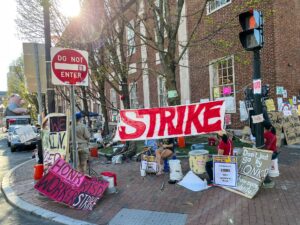
It is no secret that the labor movement in the United States is in trouble. The past few decades have been marked by a decline in overall union density coupled with aggressive anti-union employer campaigns in the private sector and recent attacks on federal workers. But the uprisings in Minneapolis and militant organizing by autoworkers, baristas, nurses, and education workers have opened new paths for class struggles of our own. Recently released by Haymarket Books, Unions of Our Own: Eight Building Blocks to Change Work…and the World, written by labor organizer, former labor lawyer, collaborator with the late Staughton Lynd, and close friend Daniel Gross provides an additional path forward for the labor movement—a framework for workers to design and refine their own unions.1 In this conversation with author and labor educator Kevin Van Meter, Daniel assesses the labor movements strategies and organizing approaches, provides eight building blocks for building power, and looks toward the horizon of future class struggle and the 2028 General Strike.
Kevin Van Meter: What is your assessment of the current state of the labor movement, labor organizing, and the larger class struggle in the United States?
Daniel Gross: Workers over the last ten, fifteen years in the United States have been in undeniable motion. Not all of that motion has been successful and it’s not all union activity, but there have been breakthrough victories and a definite turn toward unionism. Industry after industry, the “unorganizable” are organizing, and in many cases winning. It’s very different and much better than when I came of age around the turn of the century. There’s so much to celebrate.
You knew the “but” was coming, unfortunately. The vast, vast majority of workers remain badly screwed at work and, therefore, in life and in society. A tiny percentage of private sector workers are part of a union; including the public sector takes that percentage up just a bit. The oligarchs are extracting from us unfathomable sums, controlling us, and destroying the planet.
So, the undeniable and courageous motion of the working class has not yet translated into the collective power and organization to make the job and the world as they should be.
Every day I get to speak with—and I’m talking deep conversations—with workers who are beyond fed up with what they’re putting up with on the job. Many wonder if it’s possible to form a union through which they can really meet their needs and honor their values too. Values like member control of the union, racial justice, gender justice. Some of these folks are in geographies or industries where unionism has never had much scale.
The reality is, and I know there are those who don’t agree, but there is no cookie-cutter method one can just carry out really well and “bam,” after some super hard fights, we’ll have the workplaces and the labor movement many of us envision, across industries and geographies at the scale needed. Methods and techniques are great and important; we must draw from them and do so well; I have a few key ones in the book and there are many great resources out there.
But on a deeper level, it is workers, era after era, who make the forms that will work for their context and time.
I wrote Unions of Our Own precisely because it is coworkers in a workplace, at a company, and in an industry, who are best positioned to design their own union and who have the collective power to make good on it. But to try to do that from a blank slate is ill-advised because you can waste precious time and energy banging your head against the wall on dead ends and you can make unforced errors that suck. You benefit greatly from a framework to do your design and to test which parts are working and which parts need to change. You also need a channel to working-class wisdom that has come before; stuff that has been validated often across many generations.
No one can guarantee victory, but the goal of all this is maximize the chance of winning; and if you have to lose, to lose as quickly and painlessly as possible so you can you take your learning and your energy to give it another go down the line.
I’m optimistic about people who work in a wide variety of industries and geographies taking the undeniable energy out there and the undeniable disgust with the economy so many are feeling to successfully build sustainable unions to meet their needs, honor their values, and advance the vision they have for their city and world.
KVM: As a founding organizer of the IWW Starbucks Workers Union and with a long history in the independent wing of the labor movement, what is your appraisal of the Starbucks Workers United campaign?
DG: Having worn the green apron and knowing firsthand how incredibly exploitative Starbucks is, when the baristas of this generation started organizing, I was deeply moved and remain so now. The level of leadership and participation of trans, queer, and other marginalized baristas in the campaign inspires me greatly. The viral nature of their strategy is a must to understand, and I address it in Unions of Our Own.
I say without any exaggeration that the fact that baristas are still successfully organizing store after store after years of high-quality and immense union busting by Starbucks is one of the most remarkable things I’ve seen in twenty-five years in the labor movement.
The baristas I’ve spoken with are super committed to seeing through the fight to victory and clear-eyed on the challenges to get there. The strategic milestone they’re focused on now is getting a contract. How to assert enough power to get there is no easy feat, to state the obvious. Once you get a contract you have to avoid the fate of the courageous baristas in Canada who did obtain union contracts at Starbucks, only to have the company give those gains at nonunion stores as well and to continue the union busting until the union was sadly dismantled. There’s also the question of how the ethos of many of the baristas: member control and direct action minded; queer liberation and pro-Palestine; how the governance structures of Workers United and SEIU and the types of union contracts those unions seek could impact expressing those values over time.
In any event, Starbucks baristas have gained incredible ground and they’re clear that there’s much to navigate to get to a victory where they meet their needs as they define them, honor their values, and advance their vision of Starbucks, the coffee industry, and the world. I believe in them wholeheartedly.
I feel really happy—Unions of Our Own is only just out— but the first Starbucks baristas who have engaged it have been enthusiastic about the material.
KVM: Reform caucuses and the rank-and-file strategy are all the rage in the left labor movement today. How do they compare to your own strategy?
DG: The union model framework is as applicable to those struggles as it is to form a new union. Why is our union the way it is? The good, the bad, and the ugly. That’s not just a question of who is in leadership as tempting as that diagnosis might be. Nor is it just a question of how broad the rank-and-file solidarity structure is, as important as that obviously is. It’s a question of union model.
For hard, material reasons of funding systems, representational dynamics, and the push from the legal and institutional framework for unions, labor history has shown consistently that without more member involvement, even the most amazing, visionary, and ethical leaders of unions will not be able to avoid the pull of a model that drags against the values and goals of members.
What type of union are we in? What provisions are in our union agreements, and what are the implications? What’s the union governance structure? What are the strategies of our union? What metrics are prioritized? Those are a few of the questions of union building that the book helps workers work through via principles, examples, and labor history. We have to align as coworkers on what the current union model is and then prioritize taking on the parts of it we don’t like in order to find something that works better.
Nine out of ten workers are not in a union, but for those who are, making those unions better so that members can meet their needs in full, honor their values, and advance their vision is profound work. Again, the book is just out, but I was thrilled that at the launch workers contemplating forming unions or in the process of doing so were joined in the audience by workers in unions looking to revitalize them.
One other thing, Kevin, and I know how you meant it in your question but just to say, I don’t have a strategy. In fact, I would be skeptical of anyone, writers most of all, who says here is the thing or things that labor needs to do and then all the good stuff we want will then happen. Strategy is one of the eight building blocks of a complete union, and as I point out in the book there’s no doubt it’s a major, major one. Strategy moves the immovable, I’ve seen it countless times, and it never gets old.
In the chapter on strategy, instead of offering one up that would be far less powerful, I provide coworkers with a strategy formulation framework so they can make their own. Strategy is like learning a language, it’s learnable and it’s doable, but it’s kind of weird and it’s helpful to have guidance. In the chapter, I also make a pitch to check out research methodologies because that’s a prerequisite for a fleshed-out strategy, though not for a first draft.
Only after the framework to stimulate original thinking do I offer up what I call the labor strategy canon. These are tried and true categories of asserting power that campaigns can benefit from, real powerhouses, like adjacency, movement integration, choke point, secondary targeting, direct action at work, and others. It’s there that I explain the dynamism of the breakthrough United Autoworkers (UAW) strike victory in 2023; it’s there that I show how—many decades apart—supermarket clerks and minor league baseball players used the same strategy to break down the opposition and dramatically transform their jobs.
But even the strategies in the canon, I don’t say ‘hey, just take these off the shelf, plug them into your campaign and your off to the races.’ The idea is to take them off the shelf and consider using them or maybe they inspire you to do something else. But it’s always after and in addition to original thinking.
KVM: Similarly, thousands of militants have taken Organizing for Power or are engaged in Workers Centers and Non-Profit Advocacy Models. Do you think these can build worker power and a class struggle of our own?
DG: So, for the first part, I love that there are much more training opportunities today than when I got involved in labor when I was searching for support while I was working at Borders Book and Music. Method and technique which are what most of the trainings out there deal with are super important. Because there’s good books and good trainings on them is one of the reasons that Unions of Our Own is about designing and testing a complete union and not about the method and technique of organizing, except some methods and techniques that are so important that I would have been remiss to leave them out, namely organizing committees, one-on-one meetings, and workplace charting.
So yeah, I’m thrilled that folks are getting trained up and gaining confidence to meet with coworkers, identify who highly respected coworkers are, and build toward strikes. For me Jane McAlevey who created Organizing for Power, may she rest in peace and power, her great, great contribution was breaking some of these skill sets out of the union hall and putting them out there more broadly. I’m an alum of the Industrial Workers of the World, and those folks have trained many thousands of workers going back I believe to the late 1990s, super valuable work.
My direct experience in my own jobs, accompanying workers in diverse industries at their workplaces, and through studying many contemporary and historical campaigns is that method and technique is necessary but not enough, there is no cookie-cutter approach that will work in all eras, in all geographies, in all industries, and for each vision that coworkers have. Again, that doesn’t mean to start with a blank slate either, that’s its own problem. The approach I recommend is a middle way between blank slate and cookie-cutter recipe: using an intentional framework to help you discuss and make the key decisions and systematically test those decisions out. Plus, as I mentioned, a pathway to working-class wisdom that has come before including but not limited to methods and techniques.
Solidarity Union Network (SUN) where I work and am member does tons of training in method and technique; organizer trainings, research trainings, etc. both in group and one-on-one settings. But we supplement those method and technique trainings with awesome facilitated processes to design your own union model, with trainings on how to formulate new strategies, and with training on union building through experimentation, along with other subjects that go beyond the important but sort of technocratic craft part of union organizing.
To the second part of your question, as I say in the book, we must honor the broader eco-system of worker organizations that struggle alongside unions. You name the worker center form and that’s a vital form; it’s where in many cases some of the absolute most marginalized workers wage and sometimes win survival fights. When Amazon wanted to dominate Western Queens with a new headquarters and destroy affordability for deeply rooted immigrant and African-American residents across the borough, unions’ opposition only went so far as wanting a neutrality deal. It was worker centers and other grassroots base-building groups that said ‘no’ full stop to allowing Amazon in, and it was those groups in the end who did succeed in keeping their communities from being wiped out by Bezos.
The other form you mention, non-profit advocacy groups, if they can be accountable and helpful to base-building groups, that’s great. I’ve seen that and benefited from that in union campaigns I’ve been part of. Nutrition groups, health and safety groups, advocacy orgs around formerly incarcerated people, reproductive justice orgs, international labor rights groups, immigrant advocacy groups. There are also non-profit advocacy organizations that are email harvesting, fundraising, and mobilization machines, and even outright grifts. I’m skeptical of those obviously and caution worker groups about ceding space to those organizations.
All this being said, I say in Unions of Our Own that the labor union, while not the only useful form, is a uniquely powerful form. It’s uniquely powerful because unions are where workers organize themselves based on their role producing, caring for, creating, servicing, maintaining, and designing what society needs. In other words, it’s the form best suited to delivering or withholding the labor on which the world, and corporate profits, turns. I elaborate in an early chapter on what the tangible advantages of that unique power are, and the book while it can be used for other forms effectively, is about building unions.
KVM: Staughton Lynd—one of your mentors and a guiding light of the labor movement for me and many others—offered that “at moments of social crisis, working-class self-activity would take on new organizational forms, outside the trade union movement.” What is the importance of self-activity and self-organization in the emergence of a new front in the class struggle?
DG: Staughton was my great friend and a preeminent mentor; to me and to many other rank and filers. He not only believed deeply in rank-and-file agency, but he was also a dogged opponent of institutional restraints, or any restraints, on that agency. He was deeply concerned with the move toward unions that used heavily bureaucratic models instead of ones led and operated by workers. He was endlessly frustrated by union contracts that gave up the right for workers to vie for control over jobs and industries. His experience in the Youngstown steel layoffs helped fuel an opposition to management prerogatives clauses that never cooled. He was deeply opposed to no-strike clauses as well. His heartbreak about unions and a labor movement that had taken the road away from socialism was matched only by his optimism that workers sitting together in rooms across the country and world could change that. Staughton was a believer that small seeds of solidarity, of direct action, of conversation could sprout big.
The importance of self-activity and self-organization is central to new fronts of class struggle. Staughton’s thinking and mine are 100 percent aligned on that. Still, as Alice Lynd another great friend and mentor said to me, and I share this in the book, is that if I had written this one with Staughton as I had with Solidarity Unionism at Starbucks and Labor Law for the Rank and Filer it would have been a very different book. I agree with her.
Staughton was very big on what might be called generative or emergent strategies. Ones that bubble up, workers sitting in a circle in a room and talking. I am too. But the fires of union building (and the union busting it occasions) have led me to an approach a bit more deliberate or intentional might be a way to put it. So, I’m really passionate about say how do workers structure the conversation they’re going to have in that room? What framework will they use to advance the conversation and to experiment? What channels do they have to rooms that have come before?
Worker self-activity and self-organization is paramount; it’s the most powerful and effective way. But it’s not easy and we need to make the path less murky. I had an image in mind throughout the time I was writing Unions of Our Own. Could I hand this book to someone thinking about forming a union where they work and believe, honestly and truly, that it would help them maximize their chance of victory? Whether in the end the book delivers, that will be for coworkers to decide.
KVM: In the introduction to Unions of Our Own you argue, “[a]mong the most important lessons, if not the most important: it is workers who can best develop and refine unions until they succeed; it takes a complete union model to win for real; and a complete model has eight fundamental building blocks.” Can you provide a brief overview for our readers?
DG: Yes! Four foundational building blocks and four structure and growth building blocks. I give step by step processes to work through them, plus copious examples, and labor history for each. It all starts with Constituency, who your union is of, by, and for. Plus, secondary constituents you’ll need to win; folks or groups that can help you come together and amplify your power when you do. I show how fiery this question has been in labor history and remains today. We start there because we design the rest of the model around the coworker constituency we define. Problem comes next, the stuff that’s grinding on us most. I show how to identify them well and also offer up a key related tool, the AEIOU (Agitate, Educate, Inoculate, Organize, Union) organizing meeting.
Solution is an exciting chapter in part because it restores to workers the decisions often kept from them; which type of union to form, I cover the traditional type of union which is more widely known but also solidarity unionism, a very dynamic form which has been kind of hidden and is often misunderstood. That chapter also assists workers in navigating union affiliation choices. Finally, and critically, it helps you design the benefits of being a member of your union. The foundational building blocks wraps with Strategy, asserting the awesome power that it takes to win, which I spoke to already.
Once you have the foundation you have a good problem which is protecting and growing that foundation. That starts with Mechanism, the agreements we use to codify our gains or other processes we use to hold our gains. I help you have solid discussions about traditional collective bargaining agreements and their alternatives. Mechanism is deeply impactful on how your union will perform at work day-to-day but also on the overall character of your union. I then go to Union Structure, the governance type, decision-making method, and other elements. Here we visit the union which fought fascism and operated large swaths of the Spanish economy without capitalists and then across the ocean to workers at Columbia University, among other examples. I also weigh in to the debate of whether unions will inevitably end up with oligarchic governance.
Next comes Funding—seed funding at the beginning and sustainable funding at scale— critical to win and critical to having a union which is your own. You can fund your union, and you can fund it in a way that keeps it in your hands. Dues are the best and the type of dues system matters, how you talk about dues matters. The last building block is Metrics, and if used ethically and wisely, they help you supercharge your learning about your choices in the prior blocks, do wonders for your focus, and are a very powerful vehicle for sticking with your values.
KVM: Throughout the book you clearly distinguish between “union organizing” and “union building.” Why are these often conflated in the contemporary labor movement and how does this distinction aid us in furthering the class struggle?
DG: Yup, so union organizing is the beautiful beating heart of union building, but it’s not the whole story and we need the whole story to really win—needs fully met, values honored and vision advanced, in a sustainable union. Union organizing in practice is generally understood something like creating a solidarity structure of coworkers, prepping a plan to win together, and fighting until you accomplish your demands. Awesome.
Union building on the other had is the full mission of creating a sustainable union. A big part of that is getting to make the incredibly key decisions which make up the eight building blocks I outlined.
For example, as I say in the book, union organizing is about organizing your coworkers. Union building asks which coworkers? Let’s say you work at a store in a multinational chain. Is your union going to consist of workers from that one store? All the stores in that city? In that region? Is it everyone in a store or just the occupation you find yourself in? How about the folks who bring products to the store in trucks every day; where do they fit into the model? What about app-based workers who deliver the product to customers? How about workers at other chains selling the same category of products?
There is a chart on this in the book, and I won’t go on and on, but one more example. Union organizing is about getting into a union, forming one. It’s not, how it’s mostly practiced, about what the structure of that union will be. That’s above the pay grade of the organizer we’re told. Other people above us worry about that. In rank-and-file union building, workers work through how they’ll control their own union.
I think union building frankly is something that is wrongly kept away from many workers, folks just aren’t given access to it. In some cases, it’s because union officials think it’s too cumbersome for the rank and file too do it, or even maybe unknowingly, have lost faith that the rank and file can do it. In other cases, choices workers might make might be scary to those officials. In still other cases, the traditional labor movement has made some of the key choices, like what provisions should or shouldn’t go in a collective bargaining agreement, literally in the 1930s and 1940s! The model they chose became the hegemonic, dominant model by 1950. As I show in the book, that model, simplifying here a bit, has gone downhill since.
If there’s no union officials in the picture, it’s still hard to access the full spectrum of unionism because there’s not many training resources there. There’s a ton of resources on union organizing thank goodness, there’s a ton of manifestos on what unions should be or labor should do. There are resources here and there, some really good and cited in my book, on one piece or the other of union-building. But in general, and I’ve asked many workers straight up, for the most part it’s very difficult to connect with this stuff in terms of guidance, tools, resources, trainings. That gave me a lot of validation to go ahead and write the book.
Now I could have argued, hey organizing is really all the other things like the type of dues system you use, whether you do solidarity unionism or traditional unionism, which union you affiliate with, your organizing strategy but also your union’s overall strategy, etc. Then I wouldn’t have had to coin a term, union building. But I just felt frankly it would be too easy to hide the other things if there wasn’t a term associated with them. Because organizing is just used so often to mean organize your workplace, go public, win an agreement.
I could have used an old term, “Organization.” From the famous, if you’re a labor nerd, trilogy, “Education. Organization. Emancipation,” as the IWW put it. Organization meant what I mean by union building. Frankly, I just felt “organization” sounded too inert, too old-timey, and again because it sounds like organizing it might confuse the issue of the big, fundamental decisions that go to the performance and character of your union that are beyond union organizing— that pieces that safeguard organizing, that hold and grow its gains.
I went with union building, and leaving aside this term or that, what’s exciting is that for a while now a community of workers doing that full spectrum of unionism has been growing. Unions of Our Own is an invitation to join that community if you haven’t yet and unionsofourown.org has great resources to do so. You can get the book of course, but also access free, ready-to-use tools from the book like the Union Model Canvas. You can request trainings, also without charge, including the companion training to the book which is called Intro to Union Model Design. Through a partnership with SUN you can also get confidential, one-on-one support to talk through problems you might be experiencing at work and options to solve them.
KVM: As a solution to the myriads of “problems” at work you offer “solutions”—types of unions workers can build, choosing to affiliate with an established union or going independent, and the benefits of solidarity. How do workers make decisions about these three parts as they seek to “solve problems with solidarity”?
DG: Yup, we do unionism not only to challenge what we’re facing at work but to overcome it. In the union model framework, the solution to our problems is, quite simply, a union; our job in the Solution chapter is to define our union. For example, do you and your coworkers lean toward member control in unions and a willingness to participate at a higher level that member control entails, or are you ok with less control which requires a lower level of participation? That will influence the union type you choose. In the chapter, I also explain my strong recommendation to workers to do their utmost to find an existing union, whether it’s independent or established, to affiliate with and organize through and I outline the landscape out there to facilitate that process. But also, I affirm clearly that if there’s simply not a vision fit you can access, it’s your right to start something from scratch and that’s an honorable choice too.
For defining the benefits of membership in your union, I share how to use different categories of value like material value, community value, and ideological value to come up with them. I illustrate using diverse examples from the immigrant food delivery workers of New York City to the Black sanitation workers of Memphis.
If there’s something in the chapter that might be controversial- and let me say first, I acknowledge there are many “unionisms” people have come up with. You pick an adjective and you put it in front of unionism, and they do refer to real tendencies, good ones and bad ones. The controversial part perhaps is let’s say you think of choosing union type as a series of decisions: I argue the first big decision to make is traditional unionism versus solidarity unionism. One can parse those down more but that’s the first question of union type, the threshold question if you like. Because that’s decision that will lay out the hard material and structural elements that will shape whichever other flavor choices you make down the line.
Traditional unionism is a representational model; solidarity unionism is predominantly carried out directly by workers. The holy grail of traditional unionism is a certain type of agreement with the employer, in solidarity unionism the agreements with employers are significantly different, and in some cases, workers even choose to hold their gains without agreements. Solidarity unions use a variety of pressure tools but have a strong preference for direct action. Finally, we all know that it’s important to follow the money to understand things. In non-“right to work” states, which is where most union members are, traditional unions are funded by dues which are mandatory because of a contract between the union and the employer. In solidarity unions, dues can be mandatory too but only by virtue of workers self-activity, which doesn’t require the boss signing on the dotted line. The solution chapter gets into the implications of all this.
I and the book honor whichever path workers want to take, fully. What I don’t accept is taking away the choice from workers or hiding that one exists. Neither though do I hide the ball of what I believe in or the unionism I personally prefer.
In places I offer critique, it’s always comradely, based in the empirical record, and to help workers have the context to make decisions that are right for them, not to persuade. As I write, surely many readers of the book will pursue or are in unions that use traditional collective bargaining agreements; still, by unpacking those agreements I hope to facilitate conversations among workers about how to mitigate or avoid parts of those agreements they might not like.
KVM: One of the challenges facing unions and workers organizations is maintaining gains through building power on the shop floor as well as building the capacities of workers and the class. Legacy labor focuses on maintaining gains though collective bargaining agreements, legislation, and cozy relationships with the political class. How do the mechanisms you provide seek to overcome this divide while moving the class struggle forward?
DG: Unions of Our Own doesn’t offer a particular vision for a labor union or the labor movement aside from this: workers have the right to dream up their own visions and have space to design and test union models that will help those visions flourish, rather than constrict them. The mechanism chapter in the book on holding gains starts with the traditional collective bargaining agreement, as it’s the hegemon and has a major impact on the character, vision, and values of traditional unions. If the traditional collective bargaining agreement (CBA) is your way forward, there’s still tons to be done in terms of limiting the bad parts. For example, is your no-strike clause so broad that you can’t even lawfully strike when your coworker who works next to you is in on strike and picketing but they are in a different union? Will you have cool provisions like the west coast longshore workers do where you can kind of, sorta strike for a bit by invoking the “stop work meeting” provision in their contract? Will you push like the UAW did in their last strike to at least shave down a bit the management prerogatives clause to be able to use strike power against plant closings?
I then go beyond the traditional CBA, including the option to outright invent your own mechanism to hold gains. I nod at other mechanisms, but the ones I cover with some depth besides the traditional CBA is the non-traditional collective bargaining agreement, the cease-fire agreement, and the issue-by-issue mechanism. In a nutshell, the non-traditional CBA which was a giant mechanism but is hidden to most people now, is an “exclusive representation” contract with a time duration but, at a minimum, is different from the traditional variety because it doesn’t have what are known as the pro-capital or pro-management clauses.
The cease-fire agreement, which was also a giant before labor, capital, and the State decided on a different road, wins your biggest picture demands and ensures freedom of association protection to stay organized to meet other needs; it doesn’t have a specific time duration. You upgrade once you’re well rested up and conditions are favorable to win an upgrade. Finally, the issue-by-issue agreement unlike all of the previous ones has no overall framework that has been accepted by the employer: you hold the gains you win strictly by staying organized and promising to be a credible threat in the event of take backs. It’s a really popular option in giant corporations where a framework agreement is a way’s away but even smaller shops may prefer it for its flexibility.
KVM: The call for a 2028 general strike by the UAW has been picked up by left labor over the last year and is even more plausible following the uprisings in Minneapolis. In a forthcoming book chapter “Fifteen Theses on the US Labor Movement,” my coauthor Robert Ovetz and I argue that a “general strike must seek to abolish and transcend all hitherto existing political institutions or it is doomed to be coopted, de-escalated, or defeated.”2 What is your vision of the 2028 general strike? How could it build the capacities of the working class? What would it seek to accomplish?
DG: Kevin, if I knew how to organize a general strike I probably would have done that instead of spending five years writing the book. I’ll say my pay grade is, what are the union models that are more compatible with general strikes, rather than highly incompatible, and how do we get more of them. So let me start there. One of the most important concepts in the book is the back-and-forth relationship between union visions and union models.
It’s really common in union organizing for folks to realize they’re starting to, “think like an organizer.” It’s awesome. With the book, for those coworkers so inclined, I’m inspired imagining more folks also starting to, “think like a union builder.” Does our union strategy include participating in a general strike as part of our definition of victory? If so, how to be successful? What spaces, popular education, narratives, and cross union, cross working-class conversation channels are needed? Let’s start experimenting. Finally, what are the pieces of our mechanism building block, funding building block, and other elements that are likely to hold us back, and how can we change those? So that’s my jam. You want a general strike? Form or transform a union so that it is general-strike friendly.
That being said, the eight building blocks and the union model framework with teeny adjustments is also fully usable for designing other types of worker forms like a general strike initiative, a worker center, a coalition, a collective, and so forth. The experimental nature of the framework would be useful for getting to a general strike in that there’s a lot of uncertainty in what will work and we can test things out well in advance.
Let me give an example. In the 2006 general strike in the U.S., the Day Without Immigrants, I got to participate. A major channel— channel is a key part of the strategy building block— was Spanish-language radio DJs. Radio today, though still a big channel, is nowhere near as significant as it was in 2006. So, we need other channels and those can be systematically tested well in advance of any strike date. There’s a simple, free tool at unionsofourown.org to help you run labor experiments of all kinds.
I’ve been fortunate over the last few years to participate in national stoppages in Ecuador and Colombia. A paro nacional is not a general strike but it’s a cousin to the general strike. There’s much to say here, but just one point I’ll make. These actions are preceded by extensive assemblies or related bodies where ample conversation flows, and in the assembly form in particular, decisions are made. They happen in neighborhoods, they happen in unions and union federations, they happen in sector-based organizations (student, farmworker, Afro-Latinx, etc.), and they happen in indigenous base and confederated organizations— the latter being extremely pronounced in Ecuador. The national stoppage is a social process; it’s not strictly a mobilization call for a single day.
This is not to say hey, let’s just copy Latin America and it’s not to brush over the contradictions and complexities in the struggles there. But there’s a lot to learn and be inspired by there and many other regions. Workers connecting in assemblies across industries and across unions was vital to the large actions you mentioned in Minnesota and a great example to be inspired by. Our general strike muscle is a bit rusty in the United States although we’ve had many great ones. They were knee capped once the traditional model became the hegemon here.
I don’t know enough yet about the 2028 call to say anything definitively though I’d like to learn more. I’ll give you some thoughts for any general strike call that emerges from a union institution or its principal officer, the UAW or whomever and for any year.
To be honest, and again, I just don’t know what the UAW approach is yet, but if any union were to just say, hey we have this contract expiration date. If we don’t have progress on the contract by that time, if we decide to hold a strike vote, and if members authorize the strike, and finally, if union leadership calls for the strike, we might strike on the general strike day or days until we get a contract. That leaves me cold. I’m not excited to participate in years of work under those circumstances, just to risk the institutions who called for the general strike not giving members a meaningful up or down vote on whether to actually do it.
Instead, I would propose some minimum requirements for any union to expect the broad working class, again mostly non-union, to consider participating and contributing leadership to a general strike project. I think the union would have to commit well in advance to specific spaces and funding, ample spaces and funding, for rank-and-file members to discuss the prospect of going on general strike, and if interested, explore building one. Really participatory, free-flowing spaces. Small ones, medium ones, big ones.
I think the minimum requirement should be a commitment to holding a meaningful membership vote where members get the chance to decide whether to go out on a general strike. That any decision to accept a contract and the no-strike clause which traditional union contracts have, will be subordinate too and separate from the general strike vote. Now we’re in member well-being territory where we want to be, but we’re also in working class well-being territory where we need to be too. In other words, I’m not wanting workers’ agency and right to decide to withhold their labor as part of a general strike to be trumped by the union institution and the company making a tentative deal, or by some other maneuver
Speaking only for myself, if a union or unions credibly offered up real discussion and building spaces for a general strike and credibly offered members a chance to democratically decide to go on a general strike without getting side-swiped by the next contract resolution; I would be excited about that, fully throw my hat in the ring, and would invite the workers I move with day to day to consider doing the same.
Either way, I’m going to put the lion’s share of my energy and care toward the aspiration of more working people meeting their needs as they define them through sustainable, victorious, and liberatory unions. For whomever that resonates, my email and Bluesky along with the free resources I’ve mentioned are at unionsofourown.org.
Appreciation Kevin for your great work; I know you’ve earned the respect, and even affection, of many outstanding shop floor fighters. And thank you for your thoughtful questions, this was a great conversation.
notes
1. Daniel Gross, Unions of Our Own: Eight Building Blocks to Change Work…and the World (Chicago: Haymarket Books, 2026).
2. Robert Ovetz and Kevin Van Meter, “Fifteen Theses on the U.S. Labor Movement,” in Gabriel Kuhn, Workers’ Power from Below: Syndicalism in the Twenty-First Century (London: Pluto Books, 2026).