Assessing One of America’s Great Labor Progressives
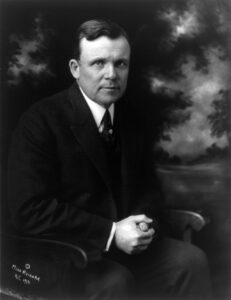 Frank P. Walsh (1864–1939), a progressive defense lawyer from Kansas City and political ally of Woodrow Wilson, almost single handedly created a worker-friendly labor control system during World War I. Throughout the Gilded Age and Progressive Era, U.S. politics were dominated by politicians who had not recognized the legitimacy of labor unions or collective bargaining, and the court system regularly issued injunctions against unions engaging in strike activity (de Leon 2015; Greene 1998). As co-chair of the 1918 National War Labor Board (NWLB), Walsh pushed it in directions that laid the foundations for the National Labor Relations Board (NLRB). The NWLB was the first federal body to effectively recognize and enforce the right to organize unions. Granting that it did not formally endorse the creation of new unions, the NWLB briefly rewarded and protected shopfloor industrial unionism in practice. On that note, Walsh hoped the board would help Black workers in the South to gain a foothold in the union movement, with mixed success (Conner 1983:81–83; McCartin 1997:115; Zieger 2000:135). The NWLB experiment, forced ahead by Walsh, was the prototype for labor law around collective bargaining in the 1930s.
Although paradoxes and contradictions abounded in labor law after 1935, this essay examines an underappreciated source of inspiration for the Wagner Act and NLRB system of collective bargaining—Frank Walsh’s activities in the 1910s.1 Walsh’s strategy rooted itself in radical agitation from within the halls of power and state legitimacy, while consciously remaining aloof from the internal struggles of labor and leftist organizations. Walsh’s approach proved highly effective during the accommodation of labor by Democrats. In this essay, I will examine the limitations of Walsh’s strategy using a Gramscian lens.
In short, Walsh’s political effectiveness in the 1910s came from his role as a traditional intellectual who could act authentically as liaison between Democrats and the restless working class. Although he remained committed to the interests of the working class, his approach was tragically flawed in three ways: Walsh placed excessive trust in Woodrow Wilson, in American state institutions, and in the notion that once reforms were achieved, they could not be taken away (McCartin 1997: 200). These beliefs limited his considerable potential for pushing the country by preventing him from becoming an organic intellectual. Part of the reason for Walsh’s trust in Wilson and aligned Democrats is that they took up an accommodationist strategy toward the labor movement during the 1910s. This was a period of proletarian upheaval and radical industrial unionism among miners and transit, garment, and textile workers. After being rebuffed by Republicans in 1906 and 1908, and following the Democrats selecting a major union official to chair the House Committee on Labor in 1910, the AFL gave their first presidential endorsement to Wilson in 1912 (McCartin 1997: 12–37). The mainstream labor movement gave Wilson not only votes, but also a way to control an explosive working class. Significantly, Walsh used this opening to push the enactment of policies that were conducive to industrial unionism.
Although Walsh should be considered one of the most important figures on the path toward collective bargaining, his legacy also includes the limitations of pursuing legal strikes2 and of linking working-class politics to the Democratic Party. He may have achieved more with a shift toward embracing organizational membership and discipline, but instead he resisted any infringement on his individual independence. In the language of Antonio Gramsci, Walsh never became an organic intellectual. These tragic limitations make him a difficult figure for leftist scholars to fully embrace, while he was too radical and confrontational for liberals to claim.
Walsh’s political biography demonstrates that agitators within the political system should move toward organizational discipline outside of electoral logics, particularly when the political environment becomes hostile to their influence. For those who tend to reject insider tactics out of hand, his story exhibits how powerful such tactics can be in the hands of an anti-opportunist, even if the gains are temporary and dependent on the political landscape. Walsh’s achievements also represent the upper limits of attempting to use patriotism and the two-party system to leftist ends, and of modern agitation methods disconnected from mass organization. Rather than ask “reform or revolution?” in the abstract, the lesson suggested by Walsh’s experiences is that insider agitation has its time and place—if agitators do not demobilize working-class activity in exchange for influence.
Trump won the 2024 election as I made final revisions to this essay. Keeanga-Yamahtta Taylor convincingly argues that a key reason why Trump could make a comeback is that left leaning movements demobilized once Biden defeated him in 2020.3 Black Lives Matter, immigrant rights groups, climate change activists, LGBTQ groups, and others may have fought local defensive campaigns, but remained quiescent in challenging national Democrats. At the same time, politicians with working-class appeal, like Bernie Sanders and Alexandria Ocasio Cortez, traded allegiance to Biden for access. I will return to the current moment in the conclusion but hope the reader notices that Walsh took a different approach with Wilson in office—one that helped push inclusive working-class formation forward, rather than demobilizing it. Nonetheless, there is a tension in this paper between my desire to bolster Walsh’s historical importance and left credentials with my argument that his path is ultimately not one to be imitated in the current moment. The limitations imposed on the Left by the U.S. Constitution (Ovetz 2022), the two-party system (Moody 2017: 107–70), and the Democratic Party (Eidlin 2018) should caution influential progressives today from taking too much inspiration from Walsh’s approach in the current moment.
Walsh’s Significance
As a defense lawyer-agitator, Frank P. Walsh made three major contributions to the working class during the Progressive Era (1900–1920). First, he exposed the direct hand that John D. Rockefeller Jr. had in events surrounding the 1914 Ludlow Massacre in Colorado, thereby revealing the hidden economic and political might of analogous titans of industry, which the nascent public relations industry had effectively concealed. Second, Walsh convinced President Woodrow Wilson to establish the eight-hour work day for 400,000 railroad workers through the 1916 Adamson Act. Third, he laid the political and institutional groundwork for collective bargaining, later hinted at by Section 7(a) of the 1933 National Labor Relations Act and solidified in the 1935 Wagner Act.
From 1914 to 1920, Walsh was one of the most effective and recognizable advocates for industrial democracy, collective bargaining, and working-class women’s rights. “Walsh, more so than any others who grasped the term,” observed historian Joseph McCartin, “linked industrial democracy to the right to join unions and tied this right to the nation’s democratic heritage, suggesting a vision of a new and just workplace” (1997: 28). Although American Federation of Labor president Samuel Gompers kept him at arm’s length, most trade unionists, revolutionary syndicalists, Socialists, rank-and-file militants, and free speech advocates did not merely respect him, they revered him. Historian Graham Adams Jr. noted that, “Labor and radical journals [had] elevated Walsh to the status of a national idol” by 1915 (1966: 170).
Through Congress’s Commission on Industrial Relations (1913–1915), his own Committee on Industrial Relations (1915–1916) and National Labor Defense Council (1917–1918), and the White House’s National War Labor Board (1918), Walsh established the precedence and political framework for government intervention in industrial relations on behalf of workers’ rights to organize and collectively bargain. Despite the ongoing historical debates about the origins of the Wagner Act—is it explained by politicians choosing to benefit workers, or by a workers’ insurgency that necessitated reform? (Blanc 2022b)—New Deal legislation clearly had its origins in Progressive Era class struggle (Scott 1959) and immigrant-led “new unions” in the 1920s that took the lessons of the 1910s to develop a broader vision of what role the federal government could play in industrial relations (Montgomery 1994). Several scholars have traced the direct connections between New Dealers and World War I–era progressives, often specifically mentioning Walsh as a key link between the two eras (Conner 1983: x; Dubofsky 1994: 109; McCartin 1997: 224; Ovetz 2018: 369). This essay contributes a sustained analysis of Walsh’s import and the strategy behind his actions.
Assessing Walsh
To observers of Frank P. Walsh past and present, he represented a reckless inciter of the masses (Davis 1963; The Nation 1915b), a hero of the humble working person (Barton 1913; Bradley 1966; Dubofsky 1994: 53–75; Meehan 1962: 210–11; Stromquist 2006: 106, 194), and a man whose considerable gifts of persuasion helped to incorporate a militant working class into the two-party system and bureaucratic state (Conner 1983: 180–85; Fink 1997: 107; The New Republic 1915; Ovetz 2018: 371, 393, 420–22, 454; Weinstein 1971: 185–88). Walsh is impossible to briefly categorize, and each interpretation holds some element of truth. Indeed, the most sophisticated depictions of Walsh highlight both his genuine championing of worker power and an assessment that he ultimately failed to permanently transform workers’ structural position (Greene 1999: 250; McCartin 1997: 22; Montgomery 1987: 361). This essay, based on archival research in Walsh’s correspondence, demonstrates that he was guided by a commitment to supporting a militant and inclusive labor movement. His failures did not stem from a liberal orientation to class struggle or higher loyalty to Democrats, but rather an overly optimistic view of the possibilities of insider tactics.
Walsh genuinely hated poverty, the corruption of democracy by corporate interests, and social injustice.4 Whenever Walsh made strategic alliances with the Democratic Party, Woodrow Wilson, and the World War I war machine, he did so with the conviction that he could wield these institutions as weapons to go well beyond what they were designed for. Whatever short-sightedness we may attribute to him, my own review of his papers at the New York Public Library has made clear to me that Walsh was definitely not an opportunist on behalf of the Democratic Party, nor of his own political career. Part of my motivation for writing this essay is to show the limitations of insider agitation through a figure that was as independent of the Democratic Party and genuinely concerned about the entirety of the working class as possible. Some of the criticisms of Walsh from a left perspective give the impression that Walsh was a partisan liberal who pretended to be populist. However, even when I critique Walsh’s failure to evolve a strategy after the end of the war, my hope is that the narrative that follows shows that Walsh was never fully incorporated into the Democratic capitalist apparatus.
Curiously, one reason Walsh is so difficult to categorize is that his mixture of insider political strategy with public antics appears demonstrably opportunistic. “Part outlaw, part actor,” as Joseph McCartin described him, “Walsh constructed a public persona as a militant maverick, which was calculated to give him maximum leverage in the world of pragmatic politics. It was his skill in pulling off this role that made Walsh so attractive to both the reformers and the radicals of his time” (McCartin 1997: 24). But Walsh never ran for office because he could not resign himself to compromising his principles to please various supporters.5 And when he eventually realized how ephemeral his influence was with Wilson and the Democrats by the middle of 1919, he refused to support his former allies in the 1920 elections.
Becoming the Stormy Petrel
An observant journalist christened Walsh the “Stormy Petrel” in 1918 when describing how keen he was for a righteous political fight (Manning 1989: 32). Although his detractors saw Walsh as an obnoxious agitator, his supporters appreciated Walsh’s fighting spirit.
Walsh built his progressive credentials in Kansas City and Missouri politics between 1902 and 1913. At the 1902 Missouri Democratic convention, he set off a firestorm by proposing that the party denounce corporate campaign contributions. Despite attempts to threaten and bribe Walsh, he did not back down and somehow forced its passage, possibly the first campaign-reform plank in a party platform in U.S. history (Barton 1913).
Already in 1907, investigative “muckraker” journalists Ida Tarbell and Ray Stannard Baker were impressed with Walsh’s work in addressing social problems in Kansas City (Haskell 2007: 106). At the municipal level, Walsh pushed for public intervention to address slum housing conditions and helped create the Board of Public Welfare (BPW) in 1910. The BPW was the first government organization of its kind in the United States, providing a number of taxpayer-funded services to workers and unemployed residents. Writing about Walsh and his closest Missouri progressive collaborators, historian Jack David Muraskin noted that they “gradually concluded that isolated reforms would not get to the core of the problems of the poor.… These men were almost alone among the social progressives in their willingness to see the problems of workers and the poor as ones which might require a restructuring of economic relations and change in social values” (1969: 260).
Despite the Stormy Petrel nickname, Walsh had a knack for putting powerful people, politically to his right, under his influence. An early example was the Republican owner of the Kansas City Star, William Rockhill Nelson. Although Nelson notoriously hated lawyers, Democrats, and machine politics (Walsh worked with Democratic ward bosses Joe Shannon and Cas Welch), Nelson came to view Walsh like the son he never had. Walsh convinced him to keep his socialist friend Dante Barton on as a political editorialist and personally pushed Nelson in a more progressive direction. “Nudged by Walsh, he had begun moving to the left on social issues and even allowed his writers to comment favorably on Russia’s October Revolution in 1905” (Haskell 2007: 95).
Walsh’s political acumen would not be contained at the municipal or state levels. In 1913, President Wilson thrust him onto the national stage by placing him in charge of the Commission on Industrial Relations. Walsh’s antics there earned him the Stormy Petrel reputation.
Commission on Industrial Relations
Frank Walsh met Woodrow Wilson for the first time in 1912 and became convinced that the future president was a true progressive. Walsh donated his energy and skills to Wilson’s Chicago campaign office, earning admiration from people close to Wilson.
In 1913 Wilson needed to fill positions for the Commission on Industrial Relations, a body established by Congress and the outgoing President Taft to assess the causes of violent class struggle and suggest legislation. The impetus for the investigation came from the bombing of the Los Angeles Times building in 1911 that unintentionally killed twenty people, later revealed to have been carried out by a mainstream trade union. Progressives associated with the Survey periodical coordinated a persistent campaign to convene a government-backed investigative body about industrial violence, similar to Congress’s 1898–1901 Industrial Commission (Adams 1966; Davis 1963). After Louis Brandeis turned down the chairmanship, Wilson decided to nominate Walsh, then an unknown entity outside of Missouri.
The kinds of progressives who wanted to tamp down violence and disruption to everyday life, while leaving capitalism intact, were not yet worried about Walsh’s appointment (Adams 1966: 58). Of the nine commissioners, three were businessmen who were relatively friendly to labor. Three were conservative trade unionists, and the last three represented “the public” (to which Walsh belonged). Walsh was the only member without previous experience inside the National Civic Federation, and its founder, Ralph Easley, felt he could be easily shepherded into advocating for the corporate-friendly private arbitration service that the NCF offered (Adams 1966: 58).
Indeed, Walsh seemed to play along in public as the Commission got going throughout most of 1914. He wrote that the Commission “believes that if every employer could get labor’s point of view, and vice versa, the so-called constructive remedies would take care of themselves.… What we need now is an interpretation of the facts, an understanding by the public of what they mean.” (Walsh 1914). Walsh initially whistled the corporate-backed tune of the NCF, which was designed to dissolve working-class militancy in order to make unions more compliant.
Secretly, Walsh had no intention of playing Easley’s NCF game6 nor of suggesting the technocratic solutions of John R. Commons, one of the other public commissioners and a proponent of the Wisconsin Idea. Commons entered the Commission hoping to convince Congress to establish permanent investigative bodies so that academics such as himself could collect quantitative data on industrial conflict in order to churn out narrow tweaks in the regulation of industrial relations. This sort of expert and rational control of modern society was the hallmark of the Wisconsin Idea flavor of progressivism. Walsh indulged Commons for a time, placing him in charge of the research department so that Walsh could focus on the public hearings.
The Stormy Petrel’s plan was this: take wing across the country to allow working people to communicate their qualitative experiences and interpretations of industrial relations for the country to see, using newspaper media’s desire for sensationalism to his advantage. He saw the Commission’s greatest potential as a platform for pro-worker agitation. “Few persons selected to federal governmental responsibility,” remarked Leon Fink, “had developed a less respectful attitude towards the trappings of office or the niceties of procedure than Walsh” (1997: 84). Over time, these hearings portended a potentially effective threat to capital’s total domination of the working class.
Always impeccably courteous to everyone he spoke with or wrote to no matter their economic or social class (outside of the more combative settings of a courtroom or newspaper interview), Walsh was the perfect person to facilitate the masses speaking for themselves in the mass media society of the newspaper. By this point, Walsh elicited deep respect and devotion among the working class and impoverished people in Kansas City. His friend Jacob Billikopf told Walsh ahead of a planned speech there, “You should consider yourself extraordinarily fortunate to think that so many kind” and judicious people, “(White and Black; Jew and Non-Jew) are ready to” overcome any barrier that “confronts them, to see ‘Walsh!’ A comforting thought! … To be regarded as the savior of so many persons” (NYPL Walsh: Box 1, 19 July 1913, Billikopf to Walsh).
If the NCF–aligned progressives were starting to feel nervous about Walsh’s antics toward the end of 1914, Walsh’s treatment of John D. Rockefeller Jr. during public hearings regarding the Ludlow Massacre in February and May of 1915 left them aghast. When Rockefeller entered the first set of hearings, he charmed everyone in the courtroom, including the legendary Mary Harris “Mother” Jones, who believed his sincerity when he told the commissioners that he was as horrified as anyone about the violent repression of Colorado miners (Adams 1966: 161–64). In response, Rockefeller claimed he had no control over the day-to-day operation of mines, nor of labor management policies.
To the shock of everyone present, Walsh laid into the young and smooth industrialist. Walsh did not yet show his cards, holding back on hard evidence for the moment in favor of stirring up plenty of drama for the newspapers, to keep the Commission on the front pages alongside the war in Europe (Adams 1966: 169). To the great consternation of progressives at the Nation and Survey magazines, Walsh used the chance to attack the philanthropic work of the Rockefeller Foundation, accusing it of influencing social scientists on its payroll to run public relations for an evil-doing corporation (Adams 1966: 211–13; Stromquist 2006: 178–82). Walsh lobbed these grenades into the hearing without submitting much, if any, evidence. The editorial board of the Nation sputtered, “What the inquiry into charitable foundations has to do with industrial relations, we have never been able to see” (The Nation 1915a). Leon Fink explains: “With his courtroom bluster, Walsh implicitly opened fire on an entire generation of intellectuals, targeting them as apologists for monopolists” (1997: 99). For the next couple of months, Walsh gleefully read the attacks on his intelligence and character from all the middle-class media sources, knowing he would soon catch them flat-footed.
By the time Walsh put Rockefeller on the stand again in May, Walsh held plenty of documentary evidence showing that Rockefeller personally oversaw and approved of the violent repression of the Colorado miners, that he paid for public relations consulting with his own money, and that he ghost wrote statements for the Colorado governor. Rockefeller was indeed a puppet master of intellectuals and politicians. For Walsh, Ludlow was the perfect example of runaway corporate power undermining political democracy, and he was not about to go halfway (Adams 1966: 150). “Hour after hour, day after day, the Chairman kept up this relentless cross-examination. Walsh’s voice barked and rasped as he tore into his witness. ‘Rockefeller’s face grew whiter and whiter until it was ashy. His features seemed to sink back into the contours of his face’, remarked one spectator.” (Adams 1966: 168).
Although President Wilson was furious when Walsh used the Commission to investigate the mine wars in Colorado (Adams 1966: 146–47)—not to mention highlighting the embarrassing problem of burgeoning unemployment during his administration—Walsh used his fame to put force to his theory that without every citizen enjoying the right to a living wage, political democracy would continue to evaporate before our very eyes. Appealing to middle-class anxiety about working-class morality, he wrote, “The greatest influence on life is produced by environment. The only factor which enters into environment is the economic factor. The income of a family absolutely determines its place of living, its manner of living and its interpretation of life” (Walsh 1915a: 105). He argued that, therefore, every worker (including women) should be paid a living wage to support time with family, enjoyment of culture, and participation in democracy.
By the summer of 1915 the Commission on Industrial Relations ran out of money from Congress and had to submit their conclusions. The three businessmen submitted their own report, blaming industrial violence on a few irresponsible capitalists but primarily on the labor movement as a whole. Two of the public commissioners endorsed a report advocating for the Wisconsin Idea. But the “Walsh Report,” written by staffer Basil Manly and signed by the three union representatives, captured the headlines. The report stated, “We find the basic cause of industrial dissatisfaction to be low wages; or, stated in another way, the fact that the workers of the nation, through compulsory and oppressive methods, legal and illegal, are denied the full product of their toil” (quoted in Bradley 1966: 27). Concluding that “Political freedom can exist only where there is industrial freedom; political democracy only where there is industrial democracy,” the report commanded attention and debate (quoted in McCartin 1997: 12).7
Melvyn Dubofsky wrote that the “Walsh Report” “was perhaps the most radical document ever released by a federal commission. It blamed social and economic problems on the gross maldistribution of wealth and income, the ubiquity of unemployment, and corporate denial of workers’ human rights” (1994: 55). David Montgomery observed that Walsh had made “the commission the tribune for the oppressed American worker” (1987: 361). Progressives and capitalists alike gnashed their teeth, hurling at him the vilest insults their dumbstruck brains could summon—“socialist” and “Jacobin” (Adams 1966: 219–20).
Yet it was the New Republic’s assessment of the “Walsh Report” that was seemingly the most insightful. The editors found Walsh’s argument lacking in comparison with Marx’s systematic critique of capitalism, although, curiously, they preferred the approach of Commons’s Wisconsin Idea–inflected report.8 Nonetheless, they wrote, “Though conservative people will be surprised to hear it, Mr. Walsh has in all probability done a great deal to re-establish the confidence of labor in the promises of political action” (The New Republic 1915). As the United Mine Workers union fell into an all-out factional battle between conservative unionists and industrial unionists, it was Mother Jones and Frank Walsh, respected by both sides, who helped keep the union together through the contentious 1915–16 period and convinced its rank-and-file members to vote for Wilson in 1916 (Montgomery 1987: 361–63).
Wilson’s Reelection
Walsh’s influence among workers grew ever deeper through the summer of 1916. The railroad Brotherhood, 16 independent unions, threatened a national strike, making Wilson extremely nervous about his prospects for reelection. Wilson made a show of inviting Walsh to the White House for advice. Incredibly, Wilson actually followed through—he pushed the Adamson Act through Congress to head off the strike, which established the eight-hour work day for railroad workers without any stalling tactics of, for example, forced arbitration. Gompers and Easley watched dismayed from the sidelines as Wilson followed Walsh’s lead, rather than Walsh acting to dampen mass action with empty promises (Green 1956: 235; Greene 1999: 259).
After the Commission on Industrial Relations submitted its final reports, Walsh launched his own organization, the Committee on Industrial Relations, purposefully choosing a name nearly identical to that of the Congressional body which had powers to compel evidence and testimony. The group aimed to provide legal and media resources to the labor movement, and to create a space for a range of working-class advocates to collaborate. Had it been successful, it might have worked like what sociologist Aldon Morris calls a “movement halfway house.” That is, an organization like the Highlander Folk School which assisted mass movements with resources and strategy, and thus were essential to the success of the Civil Rights Movement (Morris 1984). Walsh’s hope was to include radicals, militants, and conservative unionists in its activities (McCartin 1997: 33). Walsh used the Committee as a public relations and legal support network for industrial unionism. The Committee, for example, flooded Minnesota with pro-strike propaganda during a summer of 1916 IWW strike in the Mesabi Range (Dubofsky 2000: 190). After providing similar support for a Machinists strike in Pittsburgh, an employer called for Walsh’s assassination in the newspapers (Montgomery 1987: 326). Despite strong support from miners, Gompers ensured that most AFL unions turned a cold shoulder to the Committee.
However, rather than use their considerable credentials among mine workers to advocate for militant industrial unionism and expanding membership, Walsh and Mother Jones focused on ensuring the workers would vote for Wilson’s reelection (Montgomery 1987: 363–65). Walsh, to his credit, felt uncomfortable making public statements about internal union politics. Yet the only outlet he seemed able to seize upon at this moment was to use his influence to gain votes for a Democratic politician. One politician in the Socialist coalfields of southeast Kansas wrote that “Frank P. Walsh is the only man in the world who can swing this Socialist vote to Wilson” (quoted in Greene 1999: 265). Although he refused to allow the Democratic Party to dictate his campaigning schedule or stump message, “Frank Walsh hailed the Adamson Act, with characteristic hyperbole, as the beginning of a ‘worldwide’ movement that meant ‘the beginning of the end’ for ‘industrial despotism’” (McCartin 1997: 34).
This cashing in of political capital on behalf of a politician seemed particularly onerous to Walsh’s friend Emma Goldman. She begged him over the fall of 1916 to spend his time instead fighting for the freedom of Warren Billings and Tom Mooney against the organized effort to frame them for the bombing of the Labor Day parade in San Francisco that July. Goldman knew Walsh was privately a radical person and had previously supported leftist elements of the Mexican Revolution. After meeting with him in person, Goldman wrote that she “left Walsh with a feeling of impatience at the credulity of this radically minded man and his co-workers in the Wilson campaign. It was an additional proof to me [Goldman] of the political blindness and social muddle-headedness of American liberals” (1970: 586). Walsh did go on to trade his help on the 1916 campaign for a great deal of influence shaping wartime labor markets to the benefit of worker militancy. Yet he failed to get more involved with the organizational life of left-labor movements once wartime accommodation to workers ended with an employer counter offensive and Red Scare.9
Packinghouse Arbitration and the National War Labor Board
The United States entered the Great War in early April of 1917, soon after Wilson took the oath of office for the second time. Walsh did not wish to see America go to war, but he also believed that if he played his cards right he could shove pro-war reactionaries to the side and direct the war economy in favor of working people (Montgomery 1987: 358–59). A month after the election, Walsh already warned a friend in St. Louis that, in reference to staying out of the European war, “we are in for a mighty disappointment, notwithstanding the best efforts that Wilson himself may put forth” (NYPL Walsh Papers, Box 4, 4 December 1916, Walsh to Cook). That same day Walsh wrote to anarchist labor organizer Anton Johanssen that he not only believed in Wilson’s candidacy, but also felt compelled to remain in the good graces of the administration due to “the importance of a few of us keeping our eye on the gun during the very close future in Washington” (NYPL Walsh Papers, Box 4, 4 December 1916, Walsh to Johannsen). Walsh probably understood that, on the one hand, President Wilson was thin-skinned and held grudges against anyone who directly criticized him. On the other hand, Wilson gave free rein to his appointees—people he chose based on how well they stroked his fragile ego, not for conforming to a restrictive political project (Hochschild 2022: 209–10, 236, 316).
Many of Walsh’s radical friends assumed he would come out against the war, but when he refused to lend his name to the anti-war People’s Council for America for Democracy and Peace, some were furious (Montgomery 1987: 372). Worse, when the AFL and Wilson administration created the pro-war American Alliance for Labor and Democracy, he agreed to put his name on the board (McCartin 1997: 66–68). Even the Industrial Workers of the World did not formally oppose the U.S. entry into the war, but endorsing a nationalist front was another thing entirely. Ever confident in his abilities to leverage insider access for the cause of labor, Walsh bided his time rather than publicly throw his lot in with radicals.
After Gompers helped bring about the demise of the Committee on Industrial Relations, Walsh tried to establish another “halfway house” called the National Labor Defense Council, with a similar goal of supporting industrial unionism. The hope was that the new organization could more successfully convince trade unionists that they merely offered legal and media support services, rather than directly telling unions how to organize workers or engage in political action. The organization fought the suppression of radical literature in the mails, and sent an investigation team to Bisbee, Arizona, where miners had been violently deported from the region in which they were striking (McCartin 1997: 70–72).
His first opportunity to use his courtroom brawling skills during the war came in early 1918 when President Wilson forced compulsory arbitration on the nation’s meatpacking trust and packinghouse workers. The packinghouse union hired Walsh to represent them in front of Judge Samuel Alschuler in Chicago. Approaching the hearings much as he did the Commission on Industrial Relations, Walsh compelled the public to question what the justification for entering the war meant if hardworking people at home lived in abject poverty. Walsh asked, “Why should industry be made safe for autocracy while soldiers are dying on a thousand battle fields to make the world in general safe for democracy?” (Walsh quoted in McCartin 1997: 83).
Walsh made sure to explicitly include women in such arguments: “I saw [at a packinghouse], for instance, a great long table there, at which women were sorting meat. I asked what they were doing. I saw a man and a woman sorting.… I could see no difference in the employment of that man and that woman.” Before Judge Alschuler rendered his judgment, the butchers’ labor paper gushed, “With accustomed force and emphasis, our champion, Frank P. Walsh, drove home a compendium of incontrovertible facts to prove the justice of the contentions of the organized packing-house workers. A more sound and logical summary in open court has never been offered” (NYPL Walsh Papers, V. 67, March 1918, The Butcher Workman).
In strategizing for these hearings, Walsh worked closely with Chicago-based militants John Fitzpatrick, Edward Nockel, and William Z. Foster. When Alschuler returned his arbitration decision in late March, workers across the country had cause for elation. The federal government had, for the first time, stepped into a labor dispute involving a socially diverse and mostly unorganized proletariat in order to force huge concessions on the employers (Dubofsky 1994: 74; McCartin 1997: 83).
Soon after the Alschuler award, President Wilson created the National War Labor Board in an attempt to stem the tide of wildcat strikes paralyzing the war economy (Conner 1983: vii). No one seriously expected much to come from the NWLB—it had no Congressional-legal mandate to compel employers to enter its voluntary arbitration. Additionally, Wilson appointed polar opposites as co-chairs—Walsh and the anti-union former president William Howard Taft. Surely this little outfit would simply pour water on workers’ militant energy and keep Walsh busy spinning his wheels in meaningless bureaucratic work (Dubofsky 1994: 71–75).
But Walsh worked his peculiar charm on Taft. Entering the NWLB work, Taft was staunchly anti-labor and virtually anti-Walsh.10 Nonetheless, Walsh’s charisma worked almost immediately. Walsh wrote the principles that would guide the NWLB’s decision-making approach, and he amazingly convinced Taft not only to sign off, but to bully the capitalist members of the NWLB to approve them. Although the principles stated that neither capital nor labor should alter existing conditions (namely, union recognition status), they also encouraged shopfloor organizing, living wages, and equal pay for equal work (Conner 1983: 36). Over time, Taft would move even further toward a progressive point of view regarding labor, especially after visiting textile mills in the South and witnessing firsthand their brutal working conditions. Taft later told Walsh that he had convinced Taft to leave behind his beloved Adam Smith (Adams 1966: 222–23; Dubofsky 1994: 72; McCartin 1997: 87–88).
As with the Commission on Industrial Relations, Walsh tempered his public statements at the outset of the NWLB, attempting to reestablish a semblance of neutrality. He wrote, “Capital has been at fault, and so has labor.” Walsh did not hesitate to establish patriotism as the watchword of the NWLB’s mandate: “The chief concern of the Board has been to keep the war industries at top speed. A week’s delay in any one of the large munition works might mean defeat for our armies.” Leaning even harder into embarrassing liberal aphorisms, he claimed, “There is no conflict of ideals, there is only a misunderstanding of them” (Walsh 1918a). In other moments, however, he could not help but admit he did not really believe the old National Civic Federation canards, stating, “anyone who hopes to lay down a ‘constructive’ program that both sides to the labor situation will accept, is chasing rainbows” (Walsh 1918b).
In June and July of 1918, the NWLB, contrary to its intended purpose, helped fan the flames of wildcat strikes by quickly intervening with rulings friendly to workers, including equal pay for women workers. As it turned out, President Wilson’s nationalization of the Western Union telegraph company on 16 July, coming almost seven months after he nationalized the railroads and forced arbitration on the packinghouses, made for a compelling threat to employers to go along with the NWLB during the war. From the workers’ points of view, all they needed to do in order to get a raise during out-of-control inflation, or to reinstate co-workers fired for union organizing, was to threaten a strike, call in the NWLB, and wait a few weeks to win their case. “The NWLB had indeed instituted a mini-legal revolution by making the right to unionize real and by requiring employers to bargain collectively” (Dubofsky 1994: 73). Political scientist Robert Ovetz summarized the dynamic: “Government intervention made the costs of escalation extremely low while rapidly raising the opportunity for achieving desired gains. This had the effect of encouraging workers to quickly circulate their struggles to other shops, companies, and industrial sectors” (2018: 391). The powerful agents of capital wanted to wring Walsh’s neck, and their friends in military intelligence agencies monitored his mails hoping to find something incriminating or embarrassing, but to no avail (McCartin 1997: 91).
However, over the late summer of 1918 the militant District 55 of the International Association of Machinists in Bridgeport, Connecticut, broke out in open revolt. Walsh desperately tried to use the NWLB to get war production there back on track in a way favorable to workers. He appealed directly to Wilson for help, which instead took the form of a bitter pill. Despite threatening the employers with nationalization if they did not listen to the NWLB, he also told the workers in no uncertain terms that they would be drafted for the front lines of battle if they did not immediately return to work (McCartin 1997: 141). The powerful industrial union in Bridgeport was decimated. Wilson had already used Walsh to get reelected, and apparently his patience had grown thin with the rank-and-file militancy that Walsh’s shenanigans were encouraging.
Despite the short-lived effectiveness of the NWLB, it nonetheless inspired and paved the way for further industrial unionism, particularly in the steel industry after the war. The organizer of that effort, William Z. Foster, stated in 1918 that “the Federal administration was friendly; the right to organize was freely conceded by the government and even insisted upon.… The gods were indeed fighting on the side of Labor” (quoted in Dubofsky 1994: 74).
Yet as soon as the war was over, the direct influence of the NWLB evaporated and capital launched an all-out war on the labor gains of the 1910s. Although Walsh had believed that his victories up until that point ratcheted up workers’ rights to a higher floor, to his credit, he recognized how wrong he had been the moment the crackdowns began. As panic set in, he issued empty warnings to industry: “If those who talk glibly of getting back to normal wages will but face the cold facts, they will understand that they are advocating a policy as inhuman, as atrocious, as destructive of human freedom as any of the crimes committed by the Imperial German Government” (Walsh quoted in The Nation 1918).
He desperately proposed that the NWLB declare itself a permanent body and issue a blanket ruling establishing collective bargaining for the whole country—in effect proposing by fiat what later became the 1935 Wagner Act. Taft, however, had no intention of using an emergency wartime board created by the Executive branch to legislate industrial relations. Walsh resigned from the NWLB as soon as this effort failed and shifted his efforts to representing workers in front of the increasingly irrelevant NWLB (McCartin 1997: 176–77). Notably, he helped women streetcar conductors in Cleveland advocate for themselves against not only their employers, but also the male transit union (Bradley 1966: 98–99).
As soon as the war ended, right-wing attacks on radicals and workers’ rights gained even more traction (Hochschild 2022). Walsh threw himself against this tide for several years. Let us return to the question driving this essay—what lessons do Walsh’s experiences teach us about the limits of insider agitation? I first take up his strategy of combative insider agitation to explain why liberals do not claim his memory, then I use Gramsci to demonstrate Walsh’s limitations within left politics.
Agitating Within the System
Walsh’s insider strategy of agitating within the outer limits of the Democratic Party, the war machine, and the U.S. Constitution went far, and helped set the table for the Wagner Act. Admirably, to get the most out of this strategy, he made many of his liberal friends uncomfortable and was willing to burn personal and political bridges when the moment called for it. Once the right-wing backlash of the 1920s took root, Walsh was no longer useful as a “labor and radical whisperer” for powerful interests. The influence he had at the national level turned out to be very short-lived in retrospect.
His hesitancy to completely break from the Democratic Party left him driftless and unremembered in the 1920s and beyond. “No other political figure of his time, or perhaps of any time in American history, so clearly personified the possibility and the potential character of a labor party as did Frank Walsh,” David Montgomery averred. “His strategy for creating such a party, however, was to mobilize a hegemonic labor caucus among the Democrats” (1987: 361). At the end of the Wilson Administration, when Walsh was most frustrated with Democrats, an opportunity came along to blaze a different path—an opportunity that was tragically missed.
In late 1918 and early 1919, Walsh’s militant labor friends in Chicago and across Illinois formed an independent labor party. Edward Nockels in particular kept Walsh apprised of their activities from the start, and Walsh assured him that he watched closely with approval. The episode affirms both Walsh’s sympathies with industrial unionism, and his hesitancy with getting caught in the middle of internal labor politics. A labor paper editor named K. C. Adams attacked the third-party push and claimed Walsh had spoken ill of John H. Walker, who was in fact one of Walsh’s militant friends. Walsh respectfully asked Adams to retract the statement, to which Adams responded with a bizarre and angry letter. Walsh seemed genuinely hurt and confused by the whole affair. Although he remained loyal to his radical labor friends, Walsh seemed a bit more hesitant to travel to Chicago to speak at party rallies after the dust-up (NYPL Walsh Papers, Box 7: 21 November 1918 to 28 January 1919, correspondence with Nockels and Adams). Years earlier, in a letter to a Kansas City labor organizer, Walsh had written, “You know how earnest my effort has been to hold aloof from all internecine or factional difficulties in the ranks of organized labor,” indicating that such detachment was a conscious choice (NYPL Walsh papers, Box 2, 24 July 1915, Walsh to Mittelstadt).
Walsh’s ultimate strategic shortcoming was not that he fetishized laws or that he did not think systematically about economic inequalities, as historian James Weinstein argued (1971: 185–88). The political problem distilled is that Walsh believed in the individualistic democratic promise of the Constitution over and above his strong internationalist11 and radical instincts. He could have switched strategy in the 1920s. His failure to do so is clarified by Gramsci’s writings on intellectuals.
Traditional Intellectual
Walsh’s Achilles’ heel was his firm resistance to anything resembling organizational discipline. Although Walsh put his name on dozens of organizations throughout his career and started several of his own, he thought of them as associations of like-minded, yet independent, actors. On the one hand, Walsh had no problem ignoring, criticizing, or quitting groups like the American Alliance for Labor and Democracy when they did not serve his left-leaning political goals.12 On the other hand, Walsh never truly transcended his origins as a traditional intellectual into an organic intellectual. Neither labor organizations nor revolutionary groups could ever claim him as one of their own in terms of organizational discipline. This was a tragic outcome, as Walsh had every opportunity to embrace organizational life during the right-wing domination of the 1920s.
In the words of Antonio Gramsci, traditional intellectuals “put themselves forward as autonomous and independent of the dominant social group” (Gramsci 1999: 138). Indeed, as a member of the Progressive Era’s version of a “professional middle class,” Walsh never tired of rhetorically contrasting himself to lackeys of corporate power among his fellow professionals in law. Three brief examples suffice: “It is ridiculous to say that judges declare the law as they find it. They declare it the way they believe it to be, and they believe it to be the way they want it to be”; “This is a government of the people, by the federal judges, for the special interests” (Walsh quoted in The Commoner 1911). “I have no judicial poise, I don’t care to have judicial poise. Judicial poise is a bar to human progress” (Walsh 1915 quoted in Meehan 1962: 70).
Why do traditional intellectuals take pleasure in making such declarations? Back to Gramsci: “The whole of idealist philosophy can easily be connected with this position assumed by the social complex of intellectuals and can be defined as the expression of that social utopia by which the intellectuals think of themselves as ‘independent’, autonomous, endowed with a character of their own, etc.” (Gramsci 1999: 139).
Writing about the goal of working-class hegemony, Gramsci further elaborated: “One of the most important characteristics of any group that is developing towards dominance is its struggle to assimilate and to conquer ‘ideologically’ the traditional intellectuals, but this assimilation and conquest is made quicker and more efficacious the more the group in question succeeds in simultaneously elaborating its own organic intellectuals” (Gramsci 1999: 142). I want to emphasize that Walsh was conquered ideologically by working-class interests. He was not a traditional intellectual on behalf of corporate liberal interests. Unfortunately, because he never moved into organizational discipline, Walsh lost his influence once Democratic accommodation ended.
I do not intend to downplay the important and courageous legal defense work Walsh did in the 1920s on behalf of labor militants and radicals (Bradley 1966: 92–93; Meehan 1962: 112, 130). But had he embraced his new outsider status in 1919 and thrown himself into the politics of left organizations by shedding his identity as a progressive ally external to decision making processes in collective action, his considerable talents may have been more fully utilized.
Conclusion
The lesson I draw from Walsh’s life is that the usefulness of intellectuals and insider agitational tactics should be evaluated with an analysis of political context. Traditional intellectuals using an insider strategy (crucially, while resisting opportunism) can be quite useful for a labor or left movement in terms of building working-class hegemony. Walsh demonstrated this on the symbolic front with his ability to influence public discussions to link poverty directly with industrial despotism. He also created institutional inventions through the 1918 National War Labor Board, illustrating what was possible in industrial relations for the New Deal reformers who created the American system of collective bargaining.
Although it was inevitable that the push for industrial democracy would eventually face a powerful backlash from within the Democratic Party as well as the state, it would be a mistake to conclude that Walsh’s activities in the 1910s were meaningless. When labor and the Left are ascendant, and powerful people reach out for advocates like Walsh to act as mediator, it forms a moment, however brief, where much is possible. In reviewing the history of the ascendant labor-Left movement during the 1930s, labor sociologist Eric Blanc concluded that, “it took a combination of workplace militancy and government-level political initiatives to bring about labor’s unprecedented wins. Both were essential—and neither were simply an effect of the other” (Blanc 2022a).
As I write these words, liberalism’s hegemony has been shattered to an unprecedented extent in the United States. Tens of millions of Americans yearn for a politics free of corporate power, neoliberal international trade relationships, and imperial foreign policy intrigue. The cynical co-optation of identity politics by Democratic politicians has lost its credibility. Something we can take from Walsh’s story is that traditional intellectuals who care about the working class should make a concerted effort at contributing their skills and political capital toward building a strong labor-Left that is independent of the Democrats as members of labor unions, rank-and-file caucuses, leftist political organizations, and other groups directly connected to the interests of a socially diverse working class. The people I have in mind include past and present officials with a close resemblance to Walsh like Lina Khan, Nina Turner, and Robert Reich. We can also consider politically influential online streamers like Jon Stewart, Sam Seder, Emma Vigeland, Roland Martin, Hasan Piker, Krystal Ball, Kyle Kulinski, Rashad Richey, and More Perfect Union. An example of someone with a large social media presence who has already made a shift toward organic intellectual status is Adam Conover, who was deeply involved in the 2023 Writers Guild of America strike as an elected union negotiator. My concern, however, is that many influential voices in the progressive left seem to be focusing already on how the Democrats can be taken over or pushed to the left in the next election cycle. They would do better to heed Kim Moody’s words in this publication: “Socialist electoral politics need to be organized on an entirely different mass, grassroots basis with an entirely different strategy outside the real-time institutional confines of the Democratic Party and its ballot line.”13
When the political opportunities particular to an era close off, it is imperative that such insiders shift gears. When radical progressives like Walsh lose their usefulness to people in power, they must recognize this as the moment to embrace an outsider status and contribute to organizational life from below. Whether they as individuals transform into an organic intellectual, or step aside for other organic intellectuals, such moments require outsider strategies of survival and capacity building within labor-Left movements.
Archival Sources
Frank P. Walsh Papers, New York Public Library (NYPL), Manuscripts and Archives Division, Stephen A. Schwarzman Building.
References
Adams, G., Jr. (1966). Age of Industrial Violence 1910–15: The Activities and Findings of the United States Commission on Industrial Relations. New York: Columbia University Press.
Barton, D. (1913). “Frank P. Walsh.” Harper’s Weekly, 58(October), 24. HathiTrust.
Blanc, E. (2022a). “Liberals Get the New Deal Wrong: Why Voting is Not Enough.” Substack: Labor Politics.
Blanc, E. (2022b). “Can Laws Spur Labor Militancy? A New Look at the New Deal.” Substack: Labor Politics.
Bradley, H. C. (1966). “Frank P. Walsh and Postwar America.” Dissertation, St. Louis University.
The Commoner. (1911). “‘I Have Done With Compromise,’ Says Frank P. Walsh of Missouri.” 29 Sept. 1911. Newspapers.com.
Conner, V. J. (1983). The National War Labor Board: Stability, Social Justice, and the Voluntary State in World War I. Chapel Hill: The University of North Carolina Press.
Davis, A. F. (1963). “The Campaign for the Industrial Relations Commission, 1911–1913.” Mid-America: An Historical Review, 45(4), 211–28.
de Leon, C. (2015). The Origins of Right to Work: Antilabor Democracy in Nineteenth-Century Chicago. Ithaca, NY: Cornell University Press.
Dobbs, F. (2004). Teamster Rebellion. New York: Pathfinder Press.
Dubofsky, M. (1994). The State and Labor in Modern America. Chapel Hill: The University of North Carolina Press.
Dubofsky, M. (2000). We Shall Be All: A History of the Industrial Workers of the World, Abridged ed. Urbana, IL: University of Illinois Press.
Eidlin, B. (2018). Labor and the Class Idea in the United States and Canada. Cambridge, UK: Cambridge University Press.
Fink, L. (1997). Progressive Intellectuals and the Dilemmas of Democratic Commitment. Cambridge, MA: Harvard University Press.
Goldman, E. (1970). Living My Life, v. 2. New York: Dover Publications.
Gramsci, A. (1999). Selections from the Prison Notebooks, trans. by Q. Hoare and G. N. Smith. London: The Electric Book Company. abahlali.org/files/gra
Green, M. (1956). “The National Civic Federation and the American Labor Movement, 1900–1925.” Dissertation, The Catholic University of America.
Greene, J. (1998). “Negotiating the State: Frank Walsh and the Transformation of Labor’s Political Culture in Progressive America.” In K. Boyle (ed.), Organized Labor and American Politics, 1894–1994: The Labor-Liberal Alliance (pp. 71–102). Albany: State University of New York Press.
Greene, J. (1999). Pure and Simple Politics: The American Federation of Labor and Political Activism, 1881–1917. Cambridge, UK: Cambridge University Press.
Hanzlick, K. D. (2018). Benevolence, Moral Reform, Equality: Women’s Activism in Kansas City, 1870 to 1940. Columbia, MO: University of Missouri Press.
Haskell, H. (2007). Boss-Busters and Sin Hounds: Kansas City and Its Star. Columbia, MO: University of Missouri Press.
Hochschild, A. (2022). American Midnight: The Great War, A Violent Peace, and Democracy’s Forgotten Crisis. New York: Mariner Books.
Manning, J. E. (1989). Frank P. Walsh and the Irish Question: An American Proposal. Washington, D.C.: Georgetown University Press.
McCartin, J. A. (1997). Labor’s Great War: The Struggle for Industrial Democracy and the Origins of Modern American Labor Relations, 1912–1921. Chapel Hill: University of North Carolina Press.
Meehan, M. E. (1962). “Frank P. Walsh and the American Labor Movement.” Dissertation, New York University.
Montgomery, D. (1987). The Fall of the House of Labor: The Workplace, the State, and American Labor Activism, 1865–1925. Paris: Cambridge University Press.
Montgomery, D. (1994). “Labor and the Political Leadership of New Deal America.” International Review of Social History, 39, 335–60.
Moody, K. (2017). On New Terrain: How Capital is Reshaping the Battleground of Class War. Chicago: Haymarket Books.
Morris, A. D. (1984). The Origins of the Civil Rights Movement: Black Communities Organizing for Change. New York: The Free Press.
Muraskin, J. D. (1969). “Missouri Politics During the Progressive Era, 1896–1916.” Dissertation, University of California, Berkeley.
The Nation. (1915a). “Misleading Inquiries.” 100(February), 161. HathiTrust.
The Nation. (1915b). “The Fiasco of the Industrial Commission.” 101(August), 251. HathiTrust.
The Nation. (1918). “The Spirit of American Labor.” 107(December), 764. HathiTrust.
The New Republic. (1915). “Industrial Conflict: The Walsh Report.” 4(August), 89–91. HathiTrust.
Ovetz, R. (2018). When Workers Shot Back: Class Conflict from 1877 to 1921. Chicago: Haymarket Books.
Ovetz, R. (2022). We the Elites: Why the U.S. Constitution Serves the Few. London: Pluto Press.
Scott, A. M. (1959). “The Progressive Era in Perspective.” Journal of Politics, 21, 685–701.
Stromquist, S. (2006). Re-Inventing ‘The People’: The Progressive Movement, the Class Problem, and the Origins of Modern Liberalism. Urbana, IL: University of Illinois Press.
Tomlins, C. L. (1985). “The New Deal, Collective Bargaining, and the Triumph of Industrial Pluralism.” Industrial and Labor Relations Review, 39(1), 19–34.
Trumka, R. L. (1987). “Why Labor Law Has Failed.” West Virginia Law Review, 89(4), 871–82.
Walsh, F. P. (1914). “Getting Together.” Harper’s Weekly, 59(July), 11. HathiTrust.
Walsh, F. P. (1915a). “Low Wages and the Low Wage Environment.” The Annals of the American Academy of Political and Social Science, 59, 104–10.
Walsh, F. P. (1915b). “Society’s Debt to the Unemployed.” Harper’s Weekly, 60(May), 431–32. HathiTrust.
Walsh, F. P. (1918a). “The Presidential Doctrine of Labor.” Forum, 60(August), 164–74. HathiTrust.
Walsh, F. P. (1918b). “The War Labor Board and the Living Wage.” The Survey, 41(December), 301–03. HathiTrust.
Weinstein, J. (1971). The Corporate Ideal in the Liberal State, 1900–1918. New York: Farrar Straus and Giroux.
Zieger, R. H. (2000). America’s Great War: World War I and the American Experience. London: Rowman and Littlefield.
notes
1. Many wonderful scholars have worked hard to ensure that Walsh would not be left out of the history books entirely, notably Graham Adams, Jr., Valerie Jean Conner, David Montgomery, Melvyn Dubofsky, Joseph McCartin, Julie Greene, and Shelton Stromquist.
2. Whether we view the NLRB system as a problem per se (Dobbs 2004:72, 236-38), overly restrictive from around 1940 onward (Tomlins 1985), or only since the Reagan Administration (Trumka 1987), collective bargaining in practice has become a system of controlling class solidarity.
3. 9 November 2024 episode of The Dig podcast.
4. Walsh’s true political principles can best be evaluated by looking at who he kept up the closest political relationships with. The pattern only begins to emerge after spending a significant amount of time with his correspondence, which makes clear that Walsh avoided setting his radical inclinations down on paper, preferring to talk with his closest collaborators in person—conversations which are thus lost to the historian. These figures included Chicago labor militants John Fitzpatrick and Edward Nockels, California anarchist labor organizer Anton Johannsen, leftist economist Basil Manly, and Kansas City left-leaning newspapermen George P. West, William P. Harvey, and Dante Barton.
5. When pressured to run for Missouri governor in 1911, he admitted he could not stomach the coalition-building compromises that seeking political office makes necessary. “I’m done with compromise. I’m not going just to strike a bargain with other men to get a little here and a little there. There’s too much sham in it all.” He came to see his political future in using the developing techniques of public relations in a mass media society on behalf of the working poor. “I’ve told you where my work lies—in the outer field with the agitators, the men who won’t stand for lies because they are old” (Walsh quoted in The Commoner 1911). When declining a 1918 effort to recruit him to run for senator of Missouri, Walsh wrote that, “It is just simply not in my organism of conception of my location in life that I should hold public office. I know that I would be less useful there than as a free agent, just sloshing around as I have been all of my life” (NYPL Walsh: Box 7, 13 December 1918 Walsh to Reedy).
6. To a longtime friend in St. Louis, Walsh wrote in the summer of 1913: “What I believe to have been my natural instincts to be with the ‘under dog’, perhaps on account of having been one for so long, has developed into more or less of a passion with me as the years have gone by. If I did not think my service on that Commission would amount to something for that large and increasing class, I would scorn to take the place.” (NYPL Walsh: Box 1, 9 July 1913 Walsh to Knight).
7. Regarding the AFL leadership, historian Julie Greene noted that, “Although Samuel Gompers had worked for decades to send Socialists into exile, Frank Walsh and his final report promised to return them to the center of American labor politics” (1999: 252). This crucial point is perhaps why, while Gompers publicly praised the report, he did not send Walsh any personal congratulations and only mentioned Walsh a single time in his lengthy two-volume autobiography.
8. The editorial completely misunderstood the agitational intent and effectiveness of the Walsh Report.
9. While some scholars have emphasized Walsh’s importance to Wilson’s reelection (Greene 1998), some skepticism is in order. As Walsh himself pointed out to his friends, his campaigning for Wilson was not particularly effective in the grand scheme of things (NYPL Walsh: Box 4, 12 November 1916 Walsh to Wise). Walsh spent most of his time stumping in Ohio, Indiana, Illinois, and Iowa. Out of those states, only Ohio contributed electoral votes to Wilson, where Wilson clobbered Hughes by over seven percentage points. Thanks to Julie Greene for pointing me to the Goldman quote.
10. The Commission on Industrial Relations had gone after businesses owned by Taft’s family members, and Walsh had unsuccessfully pressured Taft to submit himself to a Walsh-orchestrated public flaying over the former federal judge’s anti-union decisions from the 1890s (Conner 1983: 19-20).
11. See Bradley 1966.
12. Walsh resigned from the AALD shortly after the conclusion of the war, motivated by his disgust at AALD slander against the Russian Revolution (NYPL Walsh Papers, Box 7: 30 December 1918, Walsh to Wolfe).
13. Kim Moody, “The Party’s Over,” New Politics, Winter 2024.