
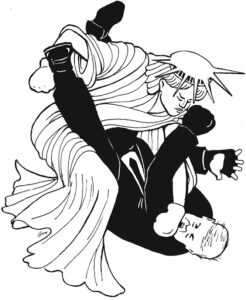
 President Donald Trump, conflating his own 80th birthday and the nation’s 250th, organized a $60 million circus-like celebration at the White House with a 92-foot-tall cage called “the claw” for a “human cock-fight” and motorcycles flying through the air. All plastered with corporate advertising. The event perfectly symbolized Trump’s “l’état c’est moi” mentality, his corruption, and the decadence of American culture under his quasi-monarchical reign. At the same time he announced the end of the war on Iran, which was not yet over. There, they were all smiles. Not so much elsewhere.
There is a profound malaise in America. There is a widespread feeling that things have gone wrong. That we as a country have gone off track. That the government is not doing what it should. That one doesn’t know what to expect tomorrow. There is much disappointment, broad vague feelings of disorientation. The new imperial adventure in Venezuela and the wars in the Middle East worry us. The deployment in our cities of troops and of thousands of violent, masked agents of Immigration and Customs Enforcement (ICE) in our streets represents an unaccustomed menace, a new threat. So, we have anxiety and fear. And now we are going to have an election.
The electorate is uneasy, doubtful. Democrats, Independents, and Republicans too are dissatisfied. A plurality now considers themselves to be Independents, 45 percent, while 27 percent consider themselves to be Democrats and 27 percent Republicans. And among Independents, a majority lean toward the Democrats. The rising number of Independents suggests that given the right circumstances and some political initiative our political system might be capable of change.
The November 3 midterm election will be a referendum on democracy. President Donald Trump has concentrated in his hands enormous power over the Republican Party and therefore over Congress, and he has by and large been supported by the Supreme Court. He has ignored the Constitution and the country’s laws, creating the most authoritarian government in our nation’s modern history. He has broken with traditions and attacked governmental and private institutions that protected us, enhanced our lives, and provided us with economic security, from the Centers for Disease Control and National Institutes of Health to the Department of Education and Social Security, the National Labor Relations Board, and others. He has ripped up government policies that protected racial and gender minorities and that worked to create a more equal society. At the same time, he has used his power to force universities to change their policies and curricula and attacked the independence of the media.
His government is rife with nepotism and cronyism. He has engaged in an orgy of corruption, accepting bribes, engaging in graft, extorting money, and using his office to expand his and his family’s business interests. He has lowered the taxes for himself and his billionaire class, the “Epstein class” as some now call it, while cutting the health and education programs of working people and the poor. He has sent U.S. troops and ICE agents into U.S. cities, with the ICE agents violently attacking and murdering immigrants and U.S. citizens alike. His dealings with our country’s people are callous and cruel, as are his interventions abroad.
Trump has engaged in imperial adventures aimed at expanding control over the Western Hemisphere, from his seizure of Nicolás Maduro, the president of Venezuela, to his strangulation of Cuba by cutting off its oil supplies. At the same time, he has threatened to take Greenland from Denmark and even to incorporate Canada into the United States. He tacitly supports Vladimir Putin in his war with Ukraine, cutting off U.S. funds and arms for the besieged victim of Russian imperialism. Like former president Joe Biden, Trump has remained aligned with Israel in its genocidal war in Gaza and its ethnic cleansing in the West Bank and permits Israel’s continuing war on Lebanon and attacks on Syria. Finally, there is his joint war with Israel on Iran, killing thousands and violating international law. Trump, who said he would be “the president of peace,” has become the president of wars, taking the lives of tens of thousands, many civilians, including many children.
The Iran war, which led to the blocking of the Strait of Hormuz, has not only brought death and destruction to Iranians, Americans, and people of other nations in the Middle East, but by cutting off the shipping of 20 percent of the world’s petroleum, along with much of its fertilizer, it has disrupted economies around the world. Several nations of the region have been drawn into the war and military aid to Iran from Russia and China raises the risk of wider war.
The election will be the culmination of two years of mass protest in the form of the No Kings demonstrations, this year’s May Day, and the Fighting Oligarchy rallies of senator Bernie Sanders, which altogether saw millions of Americans marching in over 3,500 locations. No Kings became omnibus protests against every aspect of Trump’s policies, from his undermining of democracy to his tax cuts for the rich and benefit cuts for the rest of us, from his support for Israel’s genocide in Gaza to his joint war with Israel against Iran, from his violent and inhumane attacks on immigrants to his support for oil and coal when they are causing global warming and leading to violent weather events.
Most of those protesting at No Kings and joining the “Fighting Oligarchy” rallies have been looking forward to this November as the opportunity to elect a majority of Democrats to Congress and hopefully begin to put the brakes on Trump and the Republicans. And this is so even though many view the Democrats as weak and ineffective and devoid of useful, much less inspiring, ideas. There is now a broad, active resistance to Trump throughout the country.
Is Trump Losing his Grip on the Republican Party?
There are at the same time signs that Trump—despite his ability to take vengeance on his opponents in the Republican primary elections—is losing his hold on both the Make America Great Again (MAGA) movement and the Republican Party. The America First, no-more-endless-wars wing of the movement and its influencers—former Fox News host Tucker Carlson and former congresswoman Marjorie Taylor Greene (both of whom have actually left the Republican Party), to media personality Candace Owens, and podcaster Megyn Kelly—didn’t like the Iran war from the beginning. Vice president J.D. Vance can be considered a silent partner in this company. And these people, as well as others like senator Ted Cruz and New York Times columnist Bret Stephens, are obviously not happy that despite the war’s enormous cost, now estimated at more than $132 billion, the United States has clearly lost the war, achieving none of its objectives.
People didn’t like the war and they don’t like the so-called peace either. Democrats hate Trump’s “peace deal” and Republican politicians don’t like it either, the latter saying the deal gives too much to Iran: ending all sanctions and agreeing to pay $300 billion to Iran, while postponing the negotiation of an agreement to end Iran’s nuclear program. Republican senator Bill Cassidy called the deal the “worst foreign policy blunder in decades.”
At the same time, some Republican senators are breaking with Trump over his White House ballroom, first estimated at $200 million to be paid for by private donors and then priced at $400 million to be paid for by taxpayers. Senate Republicans removed from the immigration enforcement funding bill the $1 billion Secret Service funding request that would help pay for his ballroom, a rare GOP break with him.
And they also dislike Trump’s Justice Department’s creation of a so-called anti-weaponization fund to pay people—Trump’s people—who were supposedly persecuted by the DOJ under Biden. Money from this deal could go to the January 6 insurrectionists who violently attacked Congress to prevent the election of Biden, that is, to overthrow the elected government. A would-be coup.
How did this fund get established? In January 2026, Trump sued the IRS and the Treasury Department for $10 billion because his tax reports were released. The Justice Department, headed by his appointee, in a settlement gave Trump control of almost $1.8 billion that will apparently be handed out to his allies and friends. “So the nation’s top law enforcement official is asking for a slush fund to pay people who assault cops? Utterly stupid, morally wrong—Take your pick,” said Republican senator Mitch McConnell. For the moment, it has been stopped by the courts.
Perhaps most important, several polls indicate that white working-class voters are now breaking with Trump. As the New York Times wrote:
Polls now regularly show that a majority of white voters who did not graduate from college no longer approve of Mr. Trump’s handling of the economy.
A shift in the white working class could be key to a Democratic victory in Congress, to stopping Donald Trump’s mayhem, and to building a new labor movement.
Still Trump goes into the midterms with tremendous economic and political power. The tech billionaires of Silicon Valley, many of whom were once seen as liberal idealists, have by and large gone over to Trump because of their opposition to the Democrats’ industry regulations and higher taxes. Among those now backing the president are: Elon Musk, the country’s first trillionaire, the CEO of Tesla and SpaceX, briefly the head of the Department of Government Efficiency or DOGE, who has friction with the president but remains in his camp; Peter Thiel of Palantir, founded with help from the CIA and a provider of services to the military; Marc Andreessen, the venture capitalist and co-founder of Andreessen Horowitz; David Sacks, venture capitalist and former PayPal executive; Jeff Bezos, Amazon founder and chair; Mark Zuckerberg, Meta CEO; Sam Altman, CEO of OpenAI; and Tim Cook, CEO of Apple. Almost all of these men have given Trump’s campaigns millions, have participated in his major events, and have engaged positively with his administration. They are the pinnacle of the oligarchy that Sanders decries.
Meanwhile, Trump and the Republicans have consolidated their control over much of the media. Musk, of course, owns X, a major global social networking and news platform. Trump allies Larry and David Ellison acquired Paramount, which owns CBS. After the takeover, CBS News shifted its reportage to the right. CBS also canceled Stephen Colbert’s The Late Show, which had run for eleven years and was for nine of those years the highest rated nighttime television show, clearly because of Colbert’s criticism of Trump and his administration. Nexstar Media Group and Sinclair Broadcast Group, both of which control hundreds of local TV stations that push rightwing positions. And Jeff Bezos took over The Washington Post and directed its opinion section to emphasize “personal liberties and free markets” as well as canceling the paper’s presidential endorsement. At the same time the Federal Communications Commission under Chairman Brendan Carr has used pending merger approvals to pressure networks, aiming in particular at ABC and bringing about the temporary suspension of Jimmy Kimmel’s nighttime show. He also criticized Stephen Colbert and is investigating “The View,” the daytime program during which women panelists discuss contemporary events, and sometimes criticize Trump.
In addition, Trump’s Justice Department is increasingly turning against activists on the left. It has indicted 15 members of Direct Action Minnesota involved in anti-ICE protests. Another group of anti-ICE protestors in Texas, where a policeman was shot, were accused of being antifa domestic terrorists, charged with conspiracy—some for being members of a reading group and others who were not present at the protest—and sentenced to 30 to 100 years in prison. There is now an FBI investigation into a grassroots voter registration group in Ohio, allegedly for election fraud. And a group of eight pro-Palestinian activists at the University of Michigan have been indicted for conspiracy to threaten campus leaders to get them to sever ties to Israel. The Southern Poverty Law Center is the subject of a DOJ criminal investigation regarding past use of paid informants in Klan and neo-Nazi groups. We increasingly live in a police-state.
A Desire for Change
In any case, the electorate is restive. Americans whether they are Republicans, Democrats, or Independents are looking for a new political direction. Trump’s tariffs and then the Iran war have dispelled any economic optimism. Rising gas and food prices as a result of the war, the astronomical cost of housing in many cities, expensive health care, and the instability of the economy have led to a widespread realization that there is a need for a new political program to deal with what many ordinary people perceive as an economic crisis. In California, both governor Gavin Newsom and representative Ro Khanna, who represents Silicon Valley, have talked about emulating FDR who during the Great Depression of the 1930s created a new social pact that improved the lives of workers and the elderly—and saved capitalism.
Yet it is clear that both California politicians live in fear of offending the “donor class,” especially the tech billionaires in their own state. Both Newsom and Khanna talk about taxing the billionaires but also about how much they love entrepreneurs like those in Silicon Valley. Less cautious, perhaps because he can afford to be, is Tom Steyer, an American billionaire businessman, philanthropist, and environmental advocate, who ran as a Democrat for governor with a platform calling for single-payer health care, the abolition of ICE, challenging the utilities to reduce energy costs, and other progressive measures.
Many voters will vote for the Democrats in November to stop Trump, but they have little hope that that party, led by moderates such as senator Chuck Schumer and representative Hakeem Jeffries, both of whom are deeply committed to the existing system, will be able to chart a new course. But for voters, exhausted, angry, and frightened, Democrats are at this moment the only alternative since we unfortunately live in a country with two conservative capitalist parties, one much worse than the other. And now, with congressional redistricting, it will be made more difficult for us to even choose between those two poor options.
Rigging the Elections
Demands by President Trump, Supreme Court decisions, and state legislatures’ votes are redrawing the election maps to increase the number of Republican representatives and decrease the Democratic ones. At the same time this process will reduce the number of Black and Latino congressional representatives, since 82 percent of Blacks and 61 percent of Latinos favor Democrats. And when partisan redistricting takes place, because it favors incumbents, most of whom are men, it usually also reduces women’s representation.
Midterm elections historically result in gains for the party that is out of power, which this November should mean a Democratic victory, since Republican Trump is president and Republicans also control both houses of Congress. But Trump and the Republicans are working feverishly to rig the election so that their party will win and retain control of Congress. Historically, redistricting has been carried out in all states at the time of the decennial census to reflect changes in population, but now it is being done between censuses in a partisan manner to benefit one or the other party. The process began in July 2025 when Trump demanded that Texas Republican governor Greg Abbott and the Republicans, who dominated the state legislature, redraw the state’s electoral districts, which they did.
In this redistricting process, Texas Republicans are likely to win three to four additional seats in Congress. After Texas, the Republican states of Missouri and North Carolina also redrew their maps, producing one additional Republican seat in each of those states. And because of litigation, Ohio and Utah both redistricted, resulting in two more Republican seats in Ohio and one more in Utah.
In response, California, with the largest congressional delegation, 52 seats, under the leadership of a Democratic governor, Gavin Newsom, conducted a statewide referendum approving redistricting. With the new map, Democrats should gain four to five new seats. Like California, Virginia passed a referendum to redistrict and add Democratic seats, but the state’s Supreme Court overturned the effort with dubious legal arguments.
The second part of the story begins on April 29, 2026, when the U.S. Supreme Court ruled regarding a case in Louisiana that Section 2 of the Voting Rights Act was unconstitutional racial gerrymandering because it ensured Black representation in Congress. To appreciate the significance of this, one must understand that after the U.S. Civil War (1861–65) three amendments to the Constitution liberated the former Black slaves, made them citizens, and gave Black males the right to vote. But after the brief progressive period known as “radical Reconstruction” that ended in 1877, the 11 states of the Old South where slavery had existed denied Black people the right to vote, segregated them, and tolerated lynching to punish troublemakers. Only after the Civil Rights Movement of the 1950s and 60s, a period of enormous protest and conflict, did Blacks win the right to vote by the Voting Rights Act. That act ensured that Black people throughout the South could vote and be represented in Congress in proportion to their population in their state.
When in April the Supreme Court negated the relevant portions of that Act, Republicans moved rapidly to redistrict in Tennessee and Florida, while Alabama and Georgia were also redistricted due to litigation. All of these actions will lead to more seats for Republicans and reduce representation for African Americans. For example, in Tennessee, the voting district of the city of Memphis and Shelby County, 63 percent Black, was divided into three separate districts, each attached to suburban or rural white areas, thus eliminating two Black, Democratic districts.
These are tremendous defeats for democracy and for Black Americans. Democrats might still win the midterm in November because of Trump’s current unpopularity, but in the future, the Democrats or other opposition parties will find all elections more difficult.
We should also remember that Trump adviser Steve Bannon has called on the president to send ICE or U.S. troops to polling places ostensibly to prevent voter fraud. Trump has also said he might invoke the insurrection act. Deploying ICE or military troops to polling places would violate federal law and many states prohibit any guns at polling places. Still, Trump may, as he has before, simply ignore the law. It’s also possible that neo-fascist groups like the Proud Boys and rightwing militias will interfere in the elections.
So, given the two pro-business parties, what is to be done?
Is There No Alternative?
Of course, there is the Green Party, which began back in 1984, a progressive, pro-labor party, with an eco-socialist platform, but the Green Party has been unable to attract the necessary mass public support. While it has elected dozens of local officials, it has never elected anyone to Congress, nor has it elected a governor, nor the mayor of a large city, and it received only 1 to 4 percent of the vote in presidential elections. For most voters, the Greens don’t seem like a real option.
There could be another option. Les Leopold of the Labor Institute, who has a long history as a strategist and educator with progressive union activists, argues that the time has come for a working-class alternative. He sets forth his argument for a labor party in his new book The Billionaires Have Two Parties, We Need a Party of Our Own: How working people can build independent political power. This is not a new idea. Les, alongside his union brother Tony Mazzocchi, worked for years in an attempt to organize a workers’ party. In 1996 they succeeded in bringing together in Cleveland, Ohio, 1,400 delegates from forty-four states, representing nearly two million union members, at the founding convention of the Labor Party. Afterwards, however, the unions declined to run candidates against the Democrats, and by 2007 the party had gone out of business.
Leopold believes that now the time has come. Original polling conducted in Rust Belt states of Michigan, Ohio, Pennsylvania, and Wisconsin revealed that most working-class voters, whatever their party, support progressive measures such as taxing the rich, banning mass layoffs, and capping the cost of prescription drugs. We also know from other polls that they support health care as a human right and many would like to see free trade schools, colleges, and universities. We know that millions of Americans have given up on both major parties, so that now a plurality register as Independents. So, says Leopold, it’s time for a new party, and he clearly believes that the launching pad for such a new political party is the labor union movement.
Is it possible? At present, 14.7 million wage and salary workers belong to unions, which represents 10 percent of the U.S. labor force. Public-sector workers have a unionization rate of 32.9 percent compared to 5.9 percent for private sector workers, though during his second term, Trump eliminated 350,000 federal workers. The question, of course, is not simply how many workers are in unions, but will they be willing to fight for change, economic and political change? History suggests that a new party on the left, a workers’ party, can only come out of a mass, militant working-class movement, like the great labor upsurges of the 1890s, 1930s, and 1970s. So the question is do we see such potential power today?
We have seen important mass strikes in the last few years, including the United Auto Workers strike against the big three, and the SAG-AFTRA writers’ strike against the Hollywood studios. The Teamsters union mobilized for a strike against UPS, but they settled at the last moment, averting the shutdown. The unions’ leaderships, however, don’t have uniform political positions and they have internal divisions. Union president Shawn Fain and the UAW have backed the Democrats, but Teamster president Sean O’Brien has supported Trump. And despite its success in organizing a national strike just a couple of years ago, today the UAW leadership is bitterly divided into rival caucuses and cliques. Nurses and teachers in their various unions remain the most politically progressive workers and one can imagine them adopting a labor party position—though so far, they have not.
Other social movements, if not union affiliated, have a working-class base. I already mentioned the millions in the No Kings protests, which though multi-class in character, are important measures of opposition and mobilization against Trump and the Republicans and include many workers, but they have not been militant. At the same time, however, we have seen massive, militant, civil disobedience in fights in working-class communities in Minneapolis, Chicago, and Los Angeles against the agents of ICE. Many other states and cities have anti-ICE, pro-immigrant movements that have not yet had to face the test of confrontation with these government gangsters, but surely some of them would be as militant as those in Minneapolis, Chicago, and Los Angeles.
Can these various efforts become a movement? Perhaps. UAW president Fain proposed that unions negotiate contracts with common expiration dates on May 1, 2028 with the goal of sparking the country’s first general strike. But with challenges from the employers and faction fights in his own union, Fain has not been able to work to contribute to the building of such a movement. For the last two years, a group called May Day Strong, a coalition of unions, immigrant rights organizations, and pro-democracy and civil rights organizations, has been working on his proposal, partly by calling protest demonstrations.
The Twin Cities of Minneapolis–St. Paul have had several years of almost continuous mobilization ever since the police murder of George Floyd on May 25, 2020, followed by the rebellion that then touched off the Black Lives Matter movement. Two years later, in March of 2022, Minneapolis teachers conducted a successful 18-day strike that improved wages and conditions. So, in the Twin Cities there have been attempts to deepen the resistance movement by organizing workers assemblies, the first attended by 400 activists and the second by just 200. So, it is not clear where this movement at the grassroots is going.
There are other new movements. The Supreme Court’s overturning of a key section of the Voting Rights Act of 1965, which could cause 19 Black congressional representatives to lose their seats, appears to be motivating African Americans to join in the new mass civil rights protest. Thousands of Black people joined such protests in the historic cities of Selma and Montgomery, Alabama, where their courageous forebears fought in the 1950s and 60s. So, we may be entering a new era of Black activism, perhaps picking up where the Black Lives Matter protests of 2020, the largest such demonstrations in U.S. history, left off.
What about the Democrats’ Progressive Wing?
If a labor party is not yet on the agenda, could something else be done? Trump’s approval rating as of June 17, 2026, was only 36 percent, remarkably poor. Most polls suggest that Democrats—despite the rigging of the election through redistricting—can win back the House and perhaps also the Senate. So, this raises the question, if we don’t yet have the militant mass movement needed to propel the rise of a new political party, a workers’ party, might the movement be big enough and spirited enough to increase the weight of progressive Democrats?
There are three organizations whose strategy aims to do just that, to elect more progressive Democrats. There is Justice Democrats, a political action committee formed by activists from the Bernie Sanders campaign in 2020, which has helped to elect congressional representatives Raúl Grijalva, Pramila Jayapal, Ro Khanna, Alexandria Ocasio-Cortez, Ilhan Omar, Ayanna Presley, and Rashida Tlaib. Justice Democrats makes endorsements, raises money, and offers strategic advice, but it is not a political membership organization.
Two political groups working on this project are the Working Families Party (WFP) and the Democratic Socialists of America (DSA). The WFP, founded in 1998 by labor unions, advocacy groups, and community organizations, is a political party and does run some independent candidates, though it mostly endorses Democrats. DSA is an independent socialist organization with about 100,000 members, though it is not an electoral political party, and so doesn’t appear on election ballots. DSA, too, mostly endorses Democrats, focusing on DSA members such as Alexandria Ocasio-Cortez, Rashida Tlaib, and Zohran Mamdani, though it also endorsed and succeeded in electing other progressives and socialists to Congress and to state and city offices. Then, too, DSA helped elect dozens of state, county, and city officials. The organization’s candidates did well in the primary elections in several cities and states held in the spring.
DSA has in the past elected several of its members to Congress and there are currently two serving in the House: Ocasio-Cortez and Tlaib. The election of Mamdani to the office of mayor of New York on a progressive program calling for a freeze on rents, universal childcare, and free public buses, was a major achievement. Since being elected Mamdani has been able to get New York State funding for his early childhood and pre-kindergarten programs and, it appears, his proposal for a freeze on rents in about one million rent-stabilized apartments may be realized. Mamdani is pushing for more public control of public housing and greater protection for tenants. DSA has, however, criticized Mamdani for supporting a plan to increase the NYC police force by 580 officers.
The strength of DSA strategy and Mamdani’s influence were shown when two more New York City socialists won Democratic primary nominations for Congress on June 23, over establishment Democrats endorsed by the WFP and the labor bureaucracy. Also, Mamdani-ally Brad Lander defeated Dan Goldman, an incumbent backed by the Israel Lobby. These were stunning victories for Mamdani and DSA that will affect the national Democratic Party going forward.
Within the U.S. Congress, the Congressional Progressive Caucus (CPC) currently has 100 members. Some, like senator Bernie Sanders, consider themselves socialists, but most do not. The CPC has recently focused on health care and other economic issues and most recently on “the affordability crisis.” Though some members of the caucus regularly vote against the military budget, the caucus as a whole does not. The majority of the caucus—and the caucus itself—did not support the Israeli military campaign in Gaza. And the CPC endorsed the Block the Bombs Act, which would restrict U.S. weapons transfers to the Israeli military until that country’s human rights violations cease.
The Progressive Caucus, some of whose members have been endorsed by Justice Democrats, the Working Families Party, and the Democratic Socialists of America, takes important stands, helps to educate the public, and encourages mass protests such as No Kings. The Caucus has proven, however, incapable of organizing a movement to break with the current system, with both the Republicans and Democrats who preserve the status quo. Many, including myself, will vote for their candidates, hoping to slow Trump’s march toward authoritarianism, dictatorship, and some new twenty-first-century American version of fascism. Organizing that labor party that some are working for would be better, but it probably requires a mass working-class struggle and a broader social rebellion, which we do not yet have. Perhaps Trump’s domestic and foreign policies will finally push enough people to fight back, but so far, though they face challenges, the billionaire class, the Republicans, and Trump have the upper hand.
We will in any case stand with Minneapolis and other cities and towns against ICE and in defense of immigrants. We will join in the No Kings protests. We will turn out for May Day 2028, hoping that the call for a general strike gets a national response.
A Democratic victory in the midterm elections could deliver a blow against Trump, his MAGA movement, and the Republicans. There is a good chance that, despite the partisan redistricting, the Democrats can take control of the House and possibly even the Senate. While this is far from an ideal alternative, such an outcome could hamper Trump’s various domestic and foreign policy projects, though he would still use all of the powers of the presidency to carry out his vile policies, and the Democrats may not have the will to stop him. Nevertheless, the defeat of the Republicans in the midterms would represent a defeat for Trump, a victory for the opposition, and provide the resistance with opportunities to build the social movement, and the protests, out of which a new politics could arise.
 If you’ve read this far, you were pretty interested, right? Isn’t that worth a few bucks -maybe more? Please
Leave a Reply