International Women’s Day Protests in Latin America
Below are two reports from Mexico and Chile reprinted from the Mexico-based journal, Ojala:
Rejection of violence drives March 8 actions in Monterrey
Reportage • Chantal Flores • March 19, 2026 • Leer en castellano
Pamela Martínez and two of her friends hold up a banner that reads “Justice for Blanca Liliana López” in front of the Government Palace in Monterrey, Nuevo León, on International Women’s Day. López was killed at her home in January by a man who is a US citizen, and who remains on the run.
“We’re tired of watching this happen over and over. If you don’t have money in Nuevo León, nothing gets done, if you’re not the daughter of a governor, no one comes looking for you,” said Martínez, who said considered López a second mother. “Everything goes unpunished. Why should we stay silent when anyone can take my life and carry on with their own?”
The two 8M marches in Monterrey reflect a divided movement filled with tensions around the inclusion of transgender people. Both were marked by calls for the state government to address structural violence affecting women in Nuevo León. In the morning, the inclusive march condemned a lack of accountability as it made its way to the Government Palace, which is where the second march kicked off later that afternoon.
While Governor Samuel García promotes a “new Nuevo León” focused on innovation, social development, and security, feminists highlighted the devastating impact femicides and enforced disappearances have on families and communities, as well as the psychological and economic violence that harms women in the northern Mexican state.
From October to December 2025, 90 cases of femicide, including attempted femicide, were reported in Nuevo León. Amid raised fists and glitter-covered signs, the faces of murdered and disappeared women shone through the crowds that took the streets of downtown to demand the state and federal governments end gender-based violence.
Just before five in the afternoon, women from various organizations shouted in unison: “They took them alive, we want them back alive.” Among them was Mirna Covarrubias, who carried a small wooden cross painted purple with the letters DANY JMZ.
“They killed my daughter in 2016. I’m marching so what happened to me doesn’t happen to others,” said Covarrubias, Daniela’s mother and founder of the I Want To Live Without Violence Dany Jiménez association.
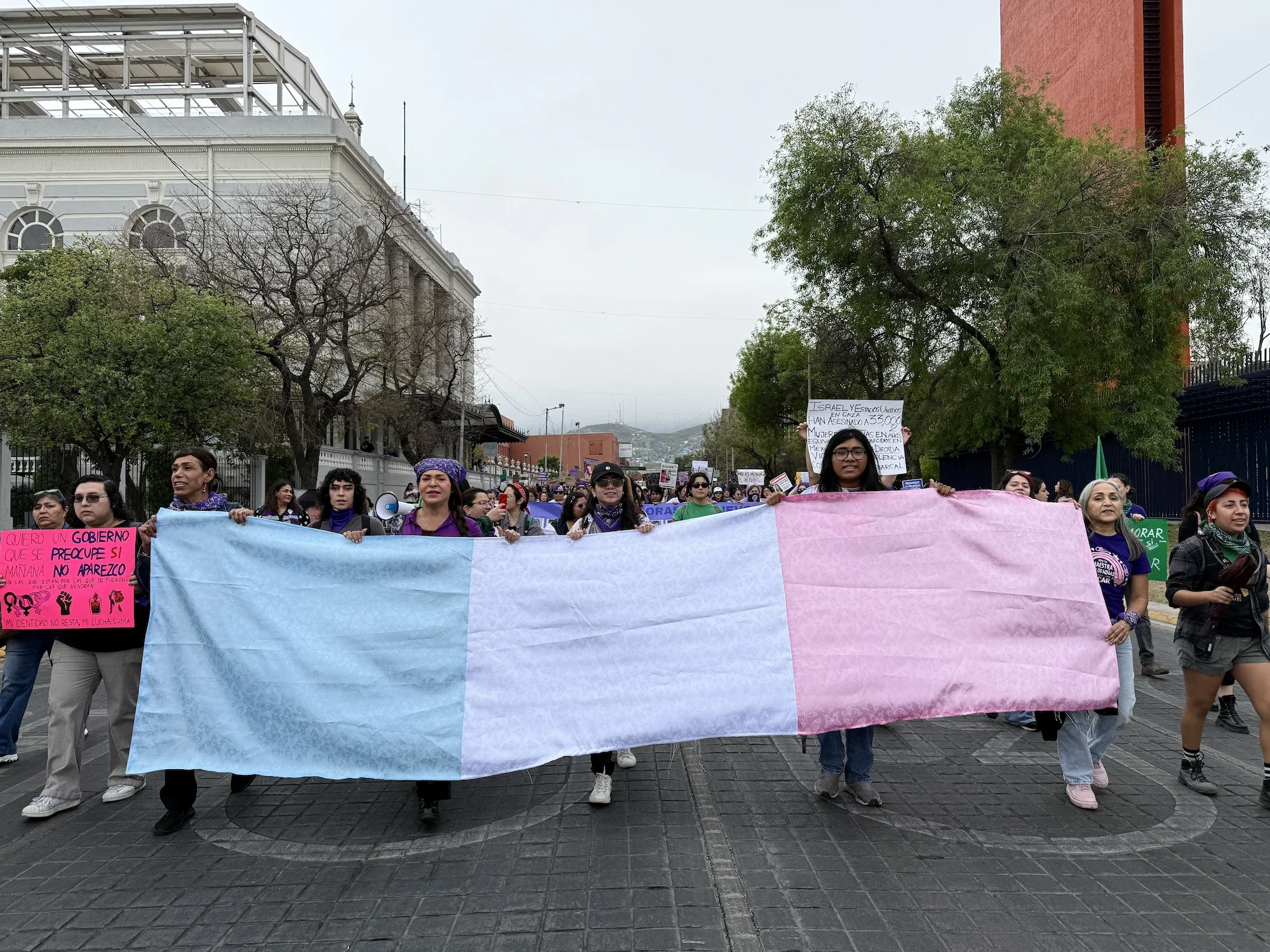
Activists and trans women demand rights and justice in the face of transfeminicides. March 8, 2026, Monterrey, Mexico. Photo © Chantal Flores
Although Nuevo León has a decades-long history of activism, a rift emerged during the 2023 IWD march. Morras Feministas—a radical, separatist, trans-exclusionary collective—attempted to take a leadership role, even though they didn’t have a base of support among marchers. This led to physical altercations, the fragmentation of contingents, and changes to the planned route, and led several groups to withdraw from the march.
This year, the inclusive march began at 11 in the morning. Surum D’Lara, one of the organizers, explained that women with disabilities were the first to demand a new space where they could feel safe. They began advocating for an inclusive march, and this year managed to achieve a broader, more horizontal organizing structure.
“We all experience different forms of violence; and though we are all oppressed by patriarchy and by capitalism, our differences—like race and social class—also fragment us,” said D’Lara. “We all have the right to protest, and that is why we created this space collectively so that all voices could be heard.”
María Sánchez, a Zoque lawyer, said she saw this march as another step on the long-standing struggle that Indigenous women have been leading “all their lives,” primarily for the right to live with dignity and free from violence in their territories.
“In 2026, we remain invisible, we keep being disappeared, and we continue to be driven from our territories,” said Sánchez, who is a representative of Mexico’s National Network of Indigenous Women Lawyers.
President Claudia Sheinbaum declared 2025 the Year of the Indigenous Woman, but Sánchez pointed out that didn’t lead to real inclusion of Indigenous women.
“There is only some women who can occupy these spaces. Forced disappearances and femicides continue to rise, meaning that not all women are necessarily represented,” she said.
There were many students and university groups among the protesters. Ana Sofía Flores, from the “GirlUp Política” group at the Autonomous University of Nuevo León, stressed the importance of raising awareness about the struggles of trans feminists and vulnerable groups, and addressing the multiple violences they face.
“People are tired of being in the shadows”, added Flores. “Taking up space matters.”
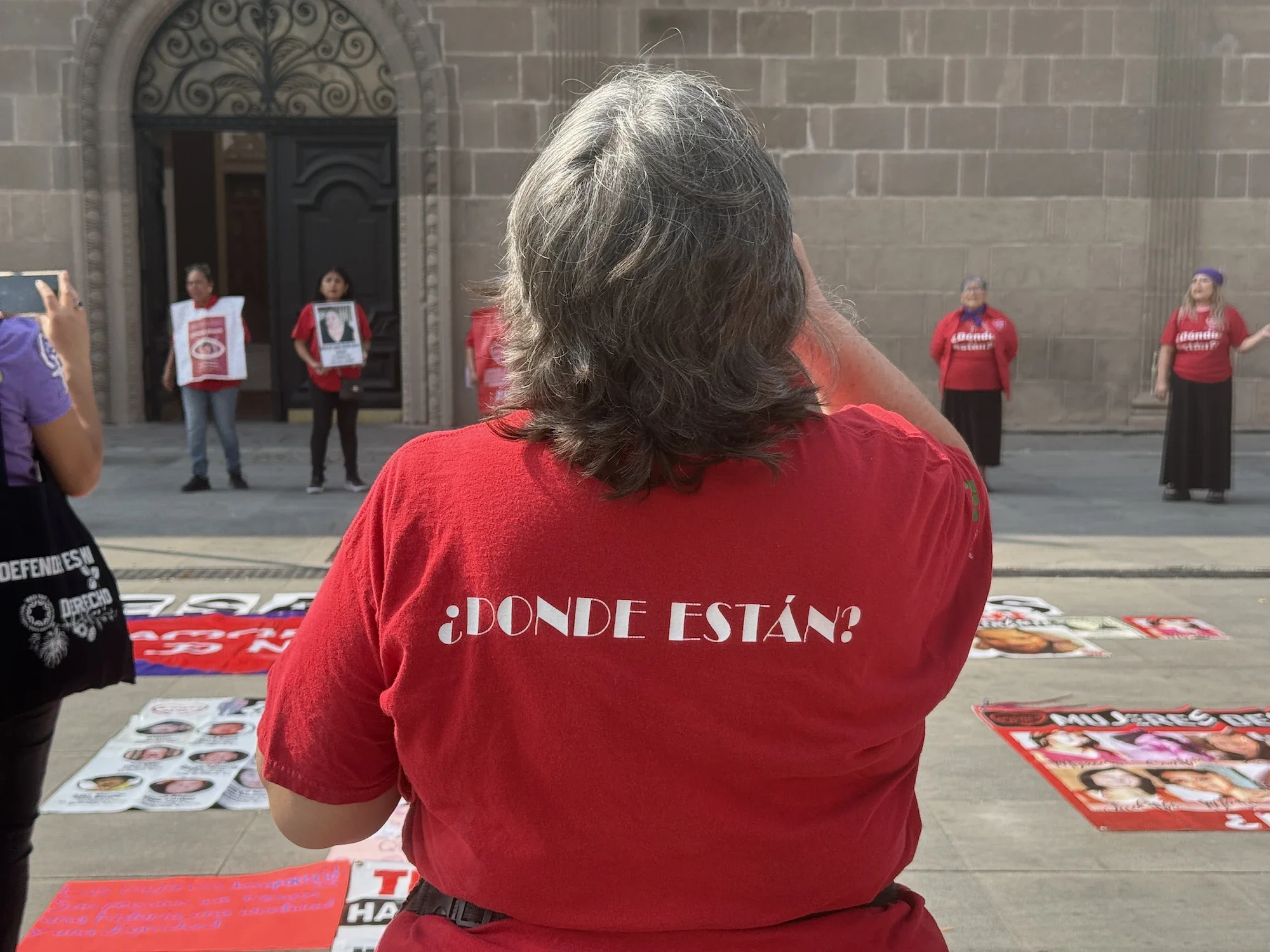
Family members of the disappeared demand action to search for and locate their loved ones. March 7, 2026, Monterrey, Mexico. Photo © Chantal Flores
Searchers and fighters
On March 7, the Association of Women Organized for the Executed, Kidnapped, and Disappeared of Nuevo León and Tamaulipas (AMORES in Spanish) held a protest in front of the Government Palace. The group is one of the first organizations formed by relatives in Nuevo León, it deals with cases that authorities have allowed to drag on for years. AMORES is specifically concerned with the health conditions of some of the mothers of the disappeared.
Sara Torres Carrizales, who has been searching for her son and daughter-in-law since 2010, explains that women have been the driving force behind the struggle and efforts to find the disappeared.
“I have my family, but no one supports me. They’ve lived in fear from the very beginning,” says Torres, 74. Despite the climate of insecurity in which searching mothers have been threatened and murdered, she insists on continuing to shed light on the reality faced by thousands of families in Nuevo León and across Mexico.
Since early 2010 to date, at least 6,708 people have gone missing in Nuevo León, according to the National Registry of Missing Persons.“It’s not fair that this is happening, that they’re being stripped of their right to live with their families,” said Torres.
Azalea Teresa Solís García looks after her 10-year-old granddaughter while fighting for the government to move forward with investigations. Her daughter-in-law, Magaly Yamileth Bernal Barraza was disappeared in September 2019, and her remains were found in early 2020.
“[AMORES] supported me when I was at my lowest,” said Solís.
“My world fell apart, and that’s when they helped me.”In Nuevo León, according to data from a 2025 survey by civic association How We’re Doing Nuevo León, women bear the brunt of caregiving responsibilities. Over half of those who take children to school are women, compared to just 14.6 percent of men. These responsibilities have a direct impact on women’s well-being: 41.0 percent of women in the state reported having experienced mental health issues over the past year, according to the survey.
Solís told Ojalá that, during the early years, she couldn’t finish a sentence without breaking down in tears. Access to counseling through AMORES was crucial in helping her cope with her new role as her granddaughter’s caregiver.“How was I supposed to handle the situation of raising a baby again, and explaining to her: ‘Your mom is missing,’ ‘Your mom was found dead’” she said. “Those are very difficult things to explain to a little girl.”
Police repression
As the evening march came to an end, the violence faced by women in Nuevo León became even more evident in front of the Government Palace, which was surrounded by metal barriers behind which hundreds of riot police were stationed.
Graffiti on the barriers condemned all forms of violence. The crowd chanted: “The new Nuevo León is a femicide state!”—a reference to Governor García’s slogan.
A few minutes before 9 p.m., the government played a recording that echoed across the plaza, congratulating the women on “their good civic behavior” and asking them to leave. When not everyone complied, a group of female police officers began to push those who remained in an attempt to remove them the plaza. They pinned one of the young women to the ground, while family members and protesters demanded her release. She was let go shortly after.
A parade of police cars circled the area with their sirens blaring, and riot police stood on the truck beds holding their shields. It was a warning of what was to come if the protesters did not leave.
The small group that remained stood in front of the line of female police officers cordoning off the palace, shouting over and over: “My friends care for me, not the police.” This continued until rainfall broke up the protest.
Original Source: https://www.ojala.mx/en/ojala-en/rejection-of-violence-drives-march-8-actions-in-monterrey
Chilean feminism rallies in the face of the far-right
Reportage • Yasna Mussa • 20 de marzo, 2026 • Leer en castellano
On March 8, women and dissidents turned the streets of Chile purple and green. This year, their call to action was especially urgent. Three days later, on March 11, José Antonio Kast, a member of the far-right, ultra-conservative, anti-reproductive-rights Republican Party, took office as Chile’s president.
Faced with his imminent arrival, a wave of women flooded public spaces, becoming like volcanic lava. “We are furious!” their signs proclaimed. They transformed their anger into art, music, and poetry.
Protests took place in almost every city in the country, where women carryied signs and cutouts and performed pieces that reflected the most pressing issues on the national and international agenda: the Epstein files, the invasion of Iran, the climate crisis, the impunity of Donald Trump, the genocide in Palestine, femicides, and resistance movements in the Global South.
“In times of conflict, women and reproductive rights are pushed aside in the interest of survival,” said Antonia Pérez, an obstetrician of Palestinian descent in Chile, who wore a Palestino soccer team jersey and carrying a Palestinian flag. “They have to survive a situation that has been going on for decades, and everything related to childbirth, the dignity of girls, and rights violations take a back seat, and no one concerns themselves with it.”
Red, green, black, and white, the colors of Palestine, could be seen throughout the march. At the front of the demonstration, protesters carried signs in the same colors bearing the names and ages of women and girls killed by the Israeli army.
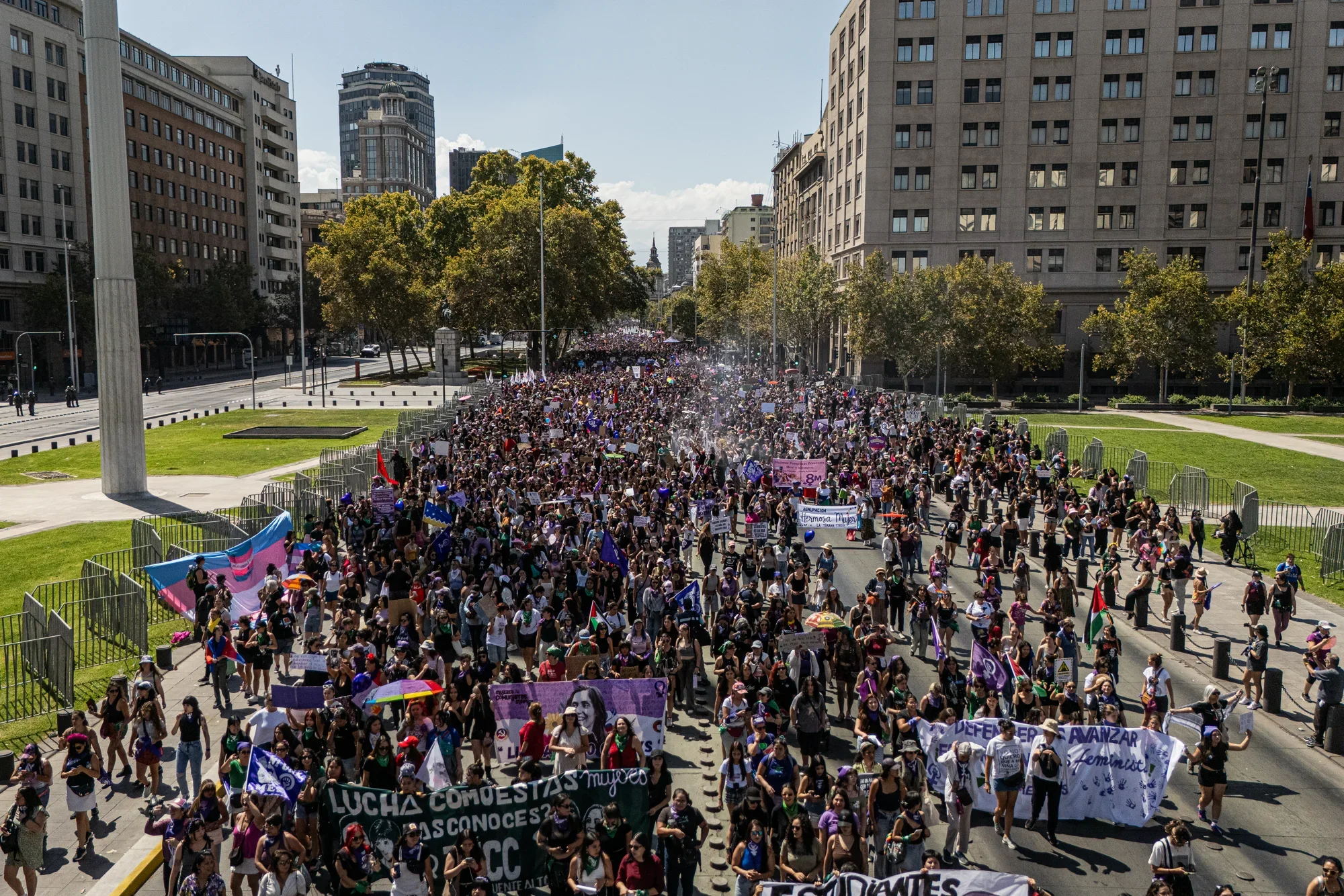
Thousands of people march to commemorate International Women’s Day on the main street of Santiago de Chile on March 8, 2026. Photo © Nicole Kramm Caifal
Punta Peuco and patriarchal impunity
The March 8 demonstration in Santiago de Chile began with dance troupes and protesters spilling out onto the sidewalks. Near the Pontifical Catholic University, a banner caught everyone’s attention, and many posed for photos and took selfies. “I wish they hated pedophiles and criminals as much as they hate feminists,” it read.
Martina Cuevas held one of the corner of the sign. She is not part of a group, but told Ojalá she considers herself a staunch feminist and plans to join Chile’s Communist Party. She’s 19 years old and has an artistic spirit, and she painted the sign with her sister and her friends.
“I wanted to show that I’ve always noticed there’s more hatred toward feminist women fighting for their rights than toward abusers,” said Cuevas. “It’s also about what’s happening today with Punta Peuco, where they’re pardoning human rights violators.
”She was referring to a bill that’s colloquially known as the Punta Peuco Law, which would commute sentences for elderly inmates or those with serious illnesses. This could benefit individuals convicted of human rights violations or sex offenders. Kast supports the initiative, which the senate approved days before the march, but which still needs pass in the lower house to become law.
Marianela Chamorro, an activist with the Feminist Front of the Broad Front—a left-wing and center-left political coalition to which Gabriel Boric’s outgoing government belonged—marched alongside them. Chamorro wore a green scarf around her neck, and raised her arms high, holding a sign reading: “Today I march for the 14 girls of Alto Hospicio. For their mothers and their memory. No to impunity! Senate, accomplice to rapists and murderers.”
She was referring to the case of 14 women—most of them teenagers—who were abused, murdered, and disappeared between 1998 and 2001 in the town of Alto Hospicio, near the city of Iquique in Chile’s north. The victims and their families were revictimized by the media and institutions, which blamed the women for being attacked, lobbing sexist and classist accusations without taking action to prevent the crimes from being repeated. If the Punta Peuco law is approved, the killer of the women could walk free.
“I am very concerned, as are many women, that such legislation is being considered today and the process is already well underway,” said Chamorro. “We all know there is an ulterior political motive, to release the prisoners at Punta Peuco, who are human rights violators.”
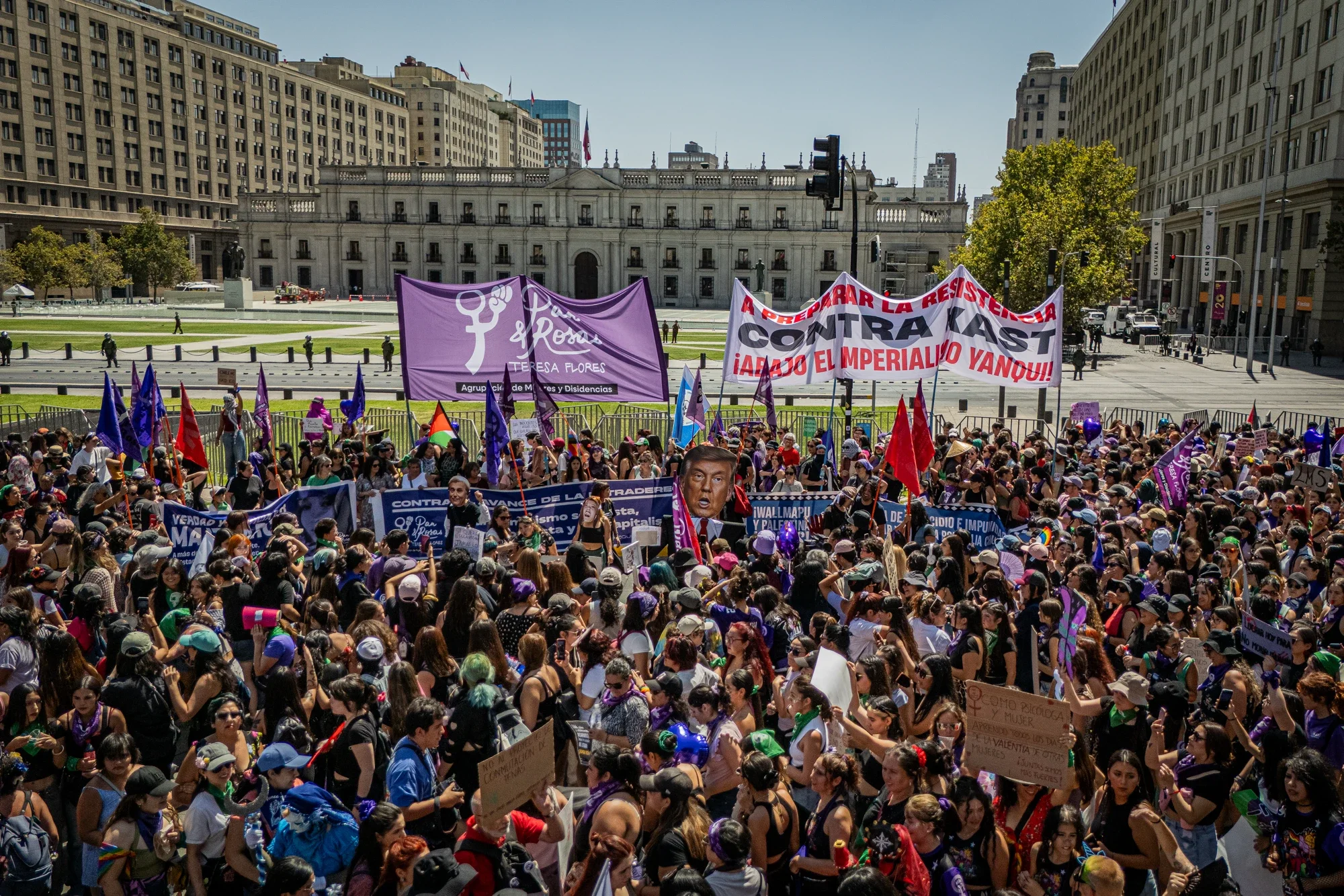
Crowds gather in front of the Palacio de la Moneda on Alameda, the main street of Santiago, Chile, on March 8, 2026. Photo © Nicole Kramm Caifal
Community care
The 26-degree heat embraced the over 500,000 people who came out to march on that late summer Sunday. Unlike in previous years, the rise of the far right was not a possibility, it was a reality. Slogans and chants called for standing firm and continuing to fight impunity. Although feminist organizations reported turnout numbers similar to previous years, the streets felt more crowded, noisy, and vibrant.
“Avoid fainting. Drink your water. Eat your fruit,” shouted a woman holding a megaphone. At a long table in the middle of the sidewalk, the Huelén Community Kitchen offered ice-cold water, slices of watermelon, blueberries, strawberries, and cantaloupe arranged alongside a box for voluntary donations.
The social and cultural center was founded by local residents during the 2019 social uprising and has been cooking for the community with conviction and love ever since.
While men are involved in the organization, it was women who took part in the 8M march. They shared caregiving responsibilities and complemented each other’s knowledge, which spans generations.
“We’re always fighting for our rights and we stand firm,” said Magaly Valencia, a retired teacher who participates in the community kitchen. “Once a month, we prepare a meal for homeless folks thanks to donations, and we serve it on the streets.”
She highlighted the social and historical role that community kitchens have played in Chile. Self-managed collective food initiatives emerged during the dictatorship and have been replicated in contexts of economic crisis, strikes, or health emergencies, and are almost always led by women from the community.
Valencia, who supported left-wing candidate Jeannette Jara in the last election, said she does not understand why people chose to vote for a president like Kast when he signalled his intention to cut social programs, women’s rights, and public education from the very beginning. To her, this meant people chose to “take a step backward with a far-right government.”
A batucada set the beat for the march as it approached the National Library. Further along the Alameda, a sign read: “I want all girls to know they can be scientists. More women in science, fewer in statistics of violence.” The small hands holding it belonged to 10-year-old Violeta Villarroel, who marches every March 8 alongside her mother, Diana Reyes.
“I believe girls need to have a voice and need to understand from a very young age that these spaces belong to them too, so I’ve been bringing her since she was two,” said Reyes. “She feels like she’s part of it and believes she can do things to change this world and make it a better place.”
“I’m here so that women can be free, our rights are respected, and so we’re heard,” added little Violeta.
Perched atop the bus stop shelter, a group of protesters chanted “You are the rapist,” a phrase that became a feminist anthem during the 2019 social uprising. That’s when the Las Tesis feminist collective staged a performance that went viral and shifted the blame to where it belongs, and pointed the finger squarely at the patriarchy.
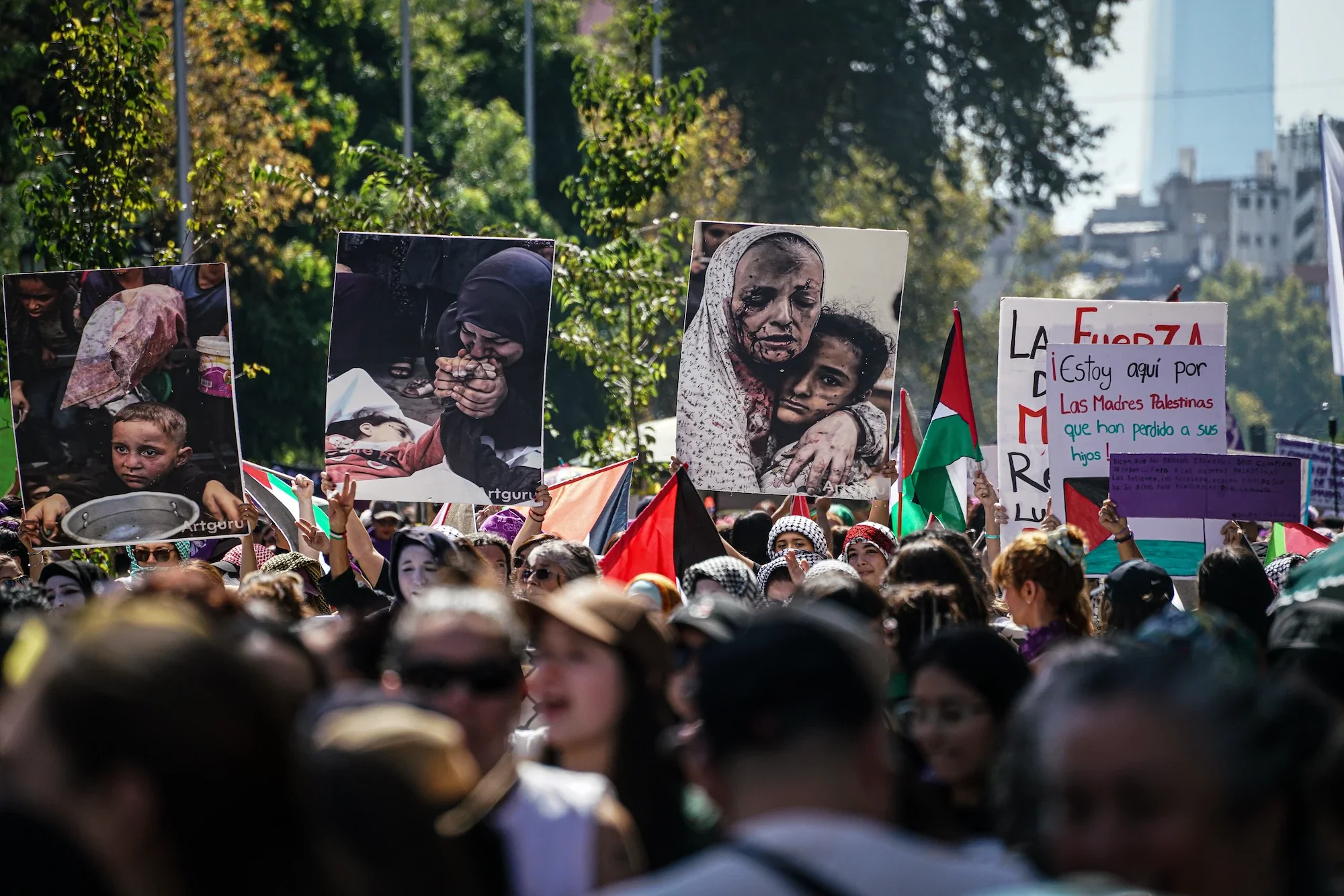
Demonstrators march with photographs of Palestinian women as part of International Women’s Day in Santiago de Chile on March 8, 2026. Photo © Nicole Kramm Caifal
Transfeminist resistance
A group of young people stopped on the sidewalk on Alameda Avenue. They lined up to take photos with a woman they admire: Emilia Schneider, a former student leader, activist, and the first transgender lawmaker in Chilean history. Schneider’s become role model, and her supporters make sure she knows it.
To one side, a cutout bearing the face of President José Antonio Kast passed by bearing a message: “We don’t deserve this Kastigo,” a play on the Spanish word for punishment.
Gender dissident collectives, the LGBTQ+ community, and feminist organizations expressed concern about looming changes in the political landscape. As the march wound through the city, far right leaders who unabashedly express homophobic and transphobic rhetoric were preparing to take power.
A vehicle with loudspeakers and activists chanting feminist slogans made its way through the crowd. It was the la camiona Mónica Briones (the “she-truck”), named in honor of a painter and sculptor who was a victim of femicide during the dictatorship in what was considered the first documented case of a lesbophobic hate crime in Chile.
Trans flags in blue, pink, and white hung from the truck. On one side were portraits of other lesbicide victims, including Nicole Saavedra and Anna Cook. As the vehicle moved slowly forward, an activist, megaphone in hand, demanded: “trans health for Chile.”
Before becoming president, Kast spent years voicing opposition to social rights and feminist causes. He is against access to free abortion, and he’s stated that he intends to roll back progress on sexual and reproductive rights.
In February, shortly after being elected president, Kast travelled to Europe to reaffirm his rejection of what he called “ideological feminism.” He’s also expressed opposition to same-sex adoption, marriage equality, the Gender Identity Law, and the rights of trans children and adolescents.
Walking kilometers with the crowd felt like a process of renewal of an urgent agenda. We’re in a hostile world in which ideas and protests stubbornly emerge with beauty and humor. March 8 is key moment to reflect as tensions come to a head, and as vulnerable groups step forward with greater strength, urgency, and conviction to defend hard-earned rights and keep moving, relentlessly, toward what remains to be won.
Original source: https://www.ojala.mx/en/ojala-en/chilean-feminism-rallies-in-the-face-of-the-far-right
Message from Ojala publisher, Dawn Marie Paley:
This month we’re dedicated to publishing coverage from March 8 feminist actions around Latin America. And we’re asking for your support to do it.
Ojalá launched three years ago to cover this growing global movement. Today, we’re seeking support of our readers in the global north who benefit from the translations our team does every week.
Every dollar you contribute strengthens our ability to share knowledge, inspire action and bring grassroots voices and perspectives to the fore.
In gratitude and struggle,
Dawn Marie Paley, Publisher, Ojalá
https://www.ojala.mx/en/about-us