Germany’s Far-Right Turn: Examining the Drivers and Aftermath of the AfD’s Victory
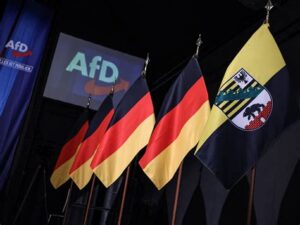 Following the electoral victory of the Alternative for Germany (AfD) party in the German state of Saxony-Anhalt, we hear from all sides that the danger of the rise of the AfD and far-right movements must be taken seriously, and that democracy is in peril. There is no doubt that this event must be treated as a serious alarm bell; not, however, as the root or totality of the danger, but rather as the manifestation and consequence of a far greater threat that remains largely undiscussed: the impulse toward fascist governance, functioning as the reactivation of a latent tendency within the sphere of bourgeois politics. From this perspective, this alarm bell has been sounding frequently on the global political stage at least since the rise of Trump[1] in 2016. Nevertheless, even today within Germany’s official political environment—amidst the clamor of expressed concerns and political scapegoating—there is scant mention of that primary danger and the trajectory of its development. On the contrary, the prevailing narrative pretends that the AfD’s victory was a bolt out of the blue.
Specifically, we are now witnessing how politicians across all German political parties and spectra depict the AfD as a dangerous exception to the rule of democratic politics in Germany; as if this party single-handedly seeks to forge a fascist path across the German political landscape and serves as the sole protagonist in a scenario they label Faschisierung (fascistization). In doing so, they attempt to frame existing practices and established norms of recent years as the very embodiment of democracy, aiming to present themselves as its ardent loyalists and unblemished servants. What this conceals is that the political ascent of the AfD is the logical outcome of the very policies that have been normalized and imposed upon the masses over all these years. Thus, the fundamental question is not how to save democracy from its recognized enemies, but how to save democracy from its self-proclaimed defenders.
The above paradoxical claim can be distilled into a single proposition: Capitalism has fundamentally never been compatible with democracy. To make such a claim is equivalent to saying that the threat of fascism has always breathed like a latent virus (in Karl Polanyi’s phrasing[2]) beneath the skin of capitalist rule. At the same time, one of the primary tasks of critical enlightenment (in the public sphere) regarding the contemporary rise of fascism is to demonstrate under what specific historical conditions this virus becomes activated within the capitalist body.
Based on the classical Marxist framework, the condensed answer to this question is: during periods of comprehensive crisis; though with the crucial caveat that a comprehensive crisis is merely a necessary—but not sufficient—condition for the emergence of fascist governance (i.e., not every crisis inevitably leads to fascism). Alternatively, from the viewpoint of more open approaches to Marxism that highlight the racial and colonial dimensions of capitalism (from Aimé Césaire to Cédric Robinson and Ruth Wilson Gilmore), the rule of “racial capitalism”[3] has always been intertwined with fascist governance or fascist mechanisms. Aimé Césaire, long before, conceptualized classical fascism in Europe as merely the return of colonial policies and governance mechanisms back to the imperial metropoles, as a “boomerang effect.”[4] Extending Césaire’s insight, I believe, one can argue that even during periods when fascist governance was absent from the Western core of capitalism, fascism was never missing from capitalism’s repertoire. Rather, the reproduction of capital relied on deploying fascist governance methods and fascist power mechanisms in the peripheral regions or the Global South. Indeed, one could contend that it was precisely because the fascist dimensions of capitalist domination were deployed in the Global South (“necro-capitalism”[5]) that the Global North enjoyed long periods of exemption from direct manifestations of fascism, enabling the sustained existence of bourgeois democracy within limited regions of the world.
Furthermore, extending Ernst Fraenkel’s analysis of German fascism (in “The Dual State,”[6] 1941) leads to a similar conclusion: while bourgeois governance functioned more or less as a “Normative State” (Normenstaat) for a substantial portion of the population in the Global North, vast populations in the Global South—primarily through imperialist relations—were condemned to live under the rule of a “Prerogative State” (Massnahmenstaat). In other words, the global political governance of capital has always rested upon a dual fascist structure.
In the present historical juncture, regardless of which analytical framework we adopt, we arrive at a similar final assessment: On the one hand, if we accept that contemporary capitalism is gripped by a chronic and comprehensive crisis that undermines its conventional capacity for the (profitable) management of crisis, then—in line with the first premise (that capitalism requires fascist governance in times of crisis)—the rise of fascist parties and states is entirely to be expected. On the other hand, observing the intensification of poverty, deprivation, oppression, authoritarianism, and violence in the Global South, for which the expansion of imperialist wars serves as the primary indicator and concentrated vehicle, the escalation of fascist mechanisms latent within imperialist expansion in the Global South cannot occur without producing a boomerang effect within Western societies. Therefore, from either angle, the German state, whether viewed as a center of global capital accumulation or as a node of imperialist power,[7] has been subjected to global impulses driving toward the development of fascist governance.
Specifically, as the global crisis of capital accumulation (post-2008) alongside the crisis of hegemony in the global power system has pushed a turn toward militarism, war, and a war-centered economy (accumulation through militarization) onto the agenda of major powers, the trajectory of the German state has undergone marked shifts. Having long prepared for rearmament and militarization, the German state has stepped forward as an active player in the “global war regime”[8] and embarked on cultivating a military-oriented economy.
While Russia’s military invasion of Ukraine provided the context for the German government to justify and accelerate its militarization[9] under the guise of countering a Russian threat, Germany’s unconditional support for Israel’s genocidal war in Gaza demonstrated that the German state occupies a specialized position within this “global war regime.” Such a strategy, however, required the systematic and continuous reduction of social services, welfare, and living standards for the working classes, alongside a structural shift of the German state toward an authoritarian surveillance apparatus.
In effect, the process initiated years ago toward expanding austerity and the neoliberal depoliticization of the public sphere has been driven toward its logical extreme through growing militarism and militarization. The allocation for basic necessities—bread, housing, healthcare, education, and public transit—was inevitably slashed to fund increased armaments and “militarized accumulation,” even as state narratives surrounding geopolitical anxieties (cloaked in defense concerns) and national chauvinism failed to conceal or compensate for these material deprivations.
The most tangible consequences of this shift have been mounting poverty, job insecurity, and livelihood precariousness, which have in turn heightened social tensions. Because the German Federal Government must maintain its legitimacy as a supposedly constitutional state (Rechtsstaat), this decline in the general condition of the masses required a scapegoat to divert public discontent away from the state itself: thus, “foreigners” were once again placed on the front lines of blame, giving renewed momentum to xenophobia. In recent years, we have seen how the trajectory of the German state (and other leading EU powers) toward militarism and militarization of economy[10] has been accompanied by the passage and enforcement of anti-asylum, discriminatory legislation[11]; both in domestic German laws and border policies, as well as European border regulations (where Germany acts as a key architect).
Accordingly, despite all justified outrage toward the AfD, the party’s recent electoral victory in state elections should neither be blamed on the alleged “irresponsible ignorance of the masses” nor taken as proof that German society is inherently predisposed to racism and xenophobia. Rather, this phenomenon can be analyzed from a different perspective: the working-class masses, long excluded from official German politics (both as citizens with rights and material needs, and as political subjects), are using the existing political framework to register a rejection of official politics. They are utilizing the periodic ritual of elections, the sole remaining political tool at their disposal, to vote for a party that claims fundamental opposition to the political establishment. The notable number of voters with foreign backgrounds who cast ballots for the AfD serves as a striking case in point.
At the same time, it is incorrect to assume that state elites have failed in their duties. On the contrary, they have worked tirelessly throughout these years to defend the interests of capital amid contemporary crises and to preserve the capitalist framework of the German state. However, because the interests of capital and the working class are fundamentally irreconcilable, the negative fallouts of these policies have inevitably fallen—and will continue to fall—upon the masses.
It is self-evident that the growing appeal of the AfD’s rhetoric to a section of the populace stems from the failure of official politics to fulfill its obligations to its citizens. Yet stopping at this observation offers little insight unless we examine the structural contradictions within the role and function of the state that inevitably produced these failures. Examining the substance of legislative enactments in Germany in recent years,[12] along with their origins and legislative trajectories, reveals that the German state has effectively pursued the very trajectory that far-right movements like the AfD have long demanded out loud. The key difference is that throughout this process, mainstream politicians’ cliché opposition to the AfD (functioning as a convenient, low-cost target) has enabled them to obscure the affinity[13] between their policies and the AfD’s political vision, all while paving the way for Germany’s rearmament, the transition to a war economy, and the establishment of an authoritarian surveillance state.[14]
As a result, official German politics appears inclined sooner or later to accommodate and make space for the AfD. This is because the political rise of this party was not merely the result of state politics, but—as part of the process of the fascistization (Faschisierung) of governance—it simultaneously offers a distinct mechanism for fulfilling the German state’s emerging needs and imperatives; imperatives forged at the intersection of the global crisis of capitalism and the global drift toward political authoritarianism, upon which the continued survival and global standing of the German state depend. Even if the German state refrains from fully legitimizing the AfD, it will be compelled (beyond the steps already taken in recent years) to increasingly integrate the vision and core slogans of the party into its upcoming policies; both to co-opt the source of the AfD’s appeal and to satisfy the state’s new historical imperatives.
Therefore, under current conditions, no meaningful demands can be placed upon the German state or capitalist states in general. Instead, the call must be directed toward those who take the danger of fascism seriously while retaining faith in the transformative potential of the working class. An essential level of response to this historical moment requires establishing an internal dialogue among left forces to formulate an effective strategy for confronting the present juncture; an era in which the turn toward fascism, whether explicit and formal or quiet and substantive, represents a structural tendency of states. The critical question (or the political challenge) is how to engage directly with the proletariat and how to reconnect masses excluded from politics to an emancipatory political project built around their tangible needs and everyday struggles; so that we can collectively organize the struggle for life alongside the struggle against capitalism and its persistent shadow, fascism.
An arduous and demanding path undoubtedly lies ahead in carrying out this task. Yet the electoral success of the AfD, coupled with expanding wars, the normalization of violence, political authoritarianism, and the systematic devaluation of (human) life, serves as a stark warning: fascism is moving aggressively to claim the political arena, and very little time remains to reconstruct the emancipatory politics that the radical and socialist left has neglected for decades.
Notes
[1] On the relationship between Trump’s rise to power and the emergence of fascism in the United States, see, for example: Frieda Afary, What Is Fascism and How Can We Resist It in the United States?, New Politics, Vol. XX, No. 2, Whole No. 78 (Winter 2025).
[2] Karl Polanyi (1934), Fascist Virus (unpublished notes).
[3] Cedric Robinson (1983), Black Marxism: The Making of the Black Radical Tradition, Zed Books.
[4] See Aimé Césaire’s seminal work: Césaire, A. (2000), Discourse on Colonialism (trans. J. Pinkham), Monthly Review Press (original work published 1950).
[5] Subhabrata B. Banerjee (2008), Necrocapitalism, Organization Studies, 29(12), 1541–1563.
[6] Fraenkel, E. (2017, original 1941), The Dual State: A Contribution to the Theory of Dictatorship (trans. E. A. Shils), Oxford University Press.
[7] The imperialist status and functions of the German state can be examined from various perspectives. Regarding the impact of these functions on Global South societies, a striking recent example is the German government’s role in the current situation in Sudan, where the inspirational revolutionary process initiated by the Sudanese people in April 2023 was engulfed in the clash between rival generals, leading to the current tragic reality. While it is widely acknowledged that the militia known as the Rapid Support Forces (RSF), one of the primary belligerents in this conflict, has been armed and supported notably by the government of the United Arab Emirates, far fewer acknowledge that the European Union (under German leadership) played an instrumental role in the early growth and consolidation of this militia through the “Khartoum Process” (2014). Designed to secure the EU’s southern borders and halt asylum seekers traveling from Central and East Africa toward North Africa, this agreement effectively outsourced border enforcement and repression to the RSF militia; the same forces that had previously played a central role in the Darfur genocide under Omar al-Bashir (see Reta Barfuss’s investigative report). Furthermore, despite extensive documentation of direct UAE involvement in the Sudanese conflict, Germany maintains close political and economic ties with the UAE: reflected both in high-level German trade and political delegations visiting the UAE shortly after recent RSF atrocities in El Fasher (the UN report on El Fasher genocide; see also this analysis), and in the formal reception hosted by the German government for a senior UAE delegation.
[8] Sandro Mezzadra and Brett Neilson have mostly developed the concept of the “global war regime” in their theoretical analyses of the contemporary global power system: Mezzadra, S., & Neilson, B. (2024), The Rest and the West: Capital and Power in a Multipolar World, Verso Books.
[9] Shortly after Russia’s military invasion of Ukraine in February 2022, the government approved a special €100 billion fund (Sondervermögen) for military rearmament and readiness: T-Online: Sondervermögen nach ‘Zeitenwende‘, Nov. 25, 2024.
[10] Regarding the militarization of the German economy, aligned with the pivot of the German state and capital toward militarism and ‘militarized accumulation,’ tracking the developments unfolding within the German automotive industry (as the heart of German industry and economy) is of particular importance. In this regard, see, for example: Christoph Steitz, Tanks not cars: How Germany’s defense industry could boost the economy, Reuters, March 5, 2025.
René Höltschi, Michael Rasch: Germany shifts gears as auto slump meets defense boom, NZZ, 17.04.2025.
[11] Given space constraints, it is impossible to list the numerous anti-asylum legislative measures passed by the German government in recent years. As a notable recent example: €313 million was recently allocated for the construction of a second detention and deportation center for asylum seekers in the state of North Rhine-Westphalia. See: Perspektive-online, Für 313 Millionen Euro: In NRW soll ein zweites Abschiebegefängnis entstehen, Sept. 15, 2026.
[12] Recent legislative changes in Germany have systematically increased living costs and precariousness for the working class. The state has consistently shifted the financial and social burdens of economic crises and militarization onto wage earners across sectors while prioritizing military and corporate interests. Workers face weakened labor protections, an expansion of temporary contracts, and stricter sick leave monitoring, while harsher unemployment penalties force individuals into low-wage or long-distance employment. Out-of-pocket medical expenses have risen sharply, and while the retirement age has been raised (to 67), pension benefits are being reduced toward a basic minimum, forcing continued labor well into retirement. Public welfare programs, including youth services and social integration support, face severe funding cuts. Concurrently, new compulsory military service measures prioritize national defense and deterrence, demanding physical sacrifices from youth and conditioning public opinion to accept reductions in peacetime welfare and civil liberties. In climate policy, despite escalating extreme weather events, policy shifts have backtracked on earlier environmental commitments to provide short-term economic incentives for fossil-fuel-dependent industries. (Summary compiled using material from: Zimmerwald-Komitee: Wir rufen auf zum Streik an Deutschland!)
[13] A recent side event, occurring on the margins of routine political activities in Germany, serves like a Freudian ‘slip of the tongue’ to expose both the porous line of supposed hostility of German political parties toward the AfD (and fascism in general) and the true caliber of their commitment to democracy. Recently, the Free Democratic Party (FDP), Germany’s most prominent advocate of liberalism (and neoliberalism), awarded its biennial Freedom Prize to Reza Pahlavi on behalf of the Iranian people; a choice officially announced right on the eve of the fourth anniversary of the Zhina Uprising. Given that Reza Pahlavi’s political vision and the practical record of the Monarchist movement abroad carry clear fascist implications, this is not merely an awkward choice. Rather, it confirms the fact that liberalism inherently has no fundamental conflict with fascism (and that neoliberalism is essentially the closest political kin of neo-fascism); it is simply a matter of the right moment for their fusion and embrace. See: Friedrich Naumann Foundation for Freedom awards: The Iranian People Receive the 2026 Freedom Prize, 14.09.2026.
[14] Under a new legislative measure, Germany’s domestic intelligence agency (BND), previously restricted to information gathering and evaluation, has been granted expanded operational authority to participate directly in domestic security operations: Redaktion Wissenschaftswelle, Vom Beobachten zum Eingreifen: Was die Geheimdienstreform verändern würde, Wissenschaftswelle, Aug. 12, 2026.