Shirley Chisholm for President – 1972
This is the fourth of a series of article about Black political candidates for the two highest offices of president and vice-president of the United States. The idea of writing this series originally begun when Cornel West announced his candidacy, the story of Black political candidates for the highest offices take on a new significance in light of Kamala Harris’’ current campaign. This is the list of candidates that we discuss in this series, though the four candiates of 1968 are discussed in one article.
- George Edwin Tayler, candidate of the National Negro Liberty Party, sometimes known as the National Liberty Party in 1904;
- Clifton Berry, of the Socialist Workers Party in 1964;
- Charlene Mitchell of the Communist Party in 1968;
- Eldridge Cleaver with the Peace & Freedom Party in 1968;
- Dick Gregory as a write-in candidate in 1968;
- Channing Emery Phillips as a Democrat, all in 1968.
- Shirley Chisholm, Democrat, in 1972;
- Angela Davis, Communist Party for vice-president in 1984 and 1988;
- Jesse Jackson, Democrat, for president in 1984 and 1988;
- Ron Daniels, People’s Party candidate in 1992;
- Cynthia McKinney, Green Party candidate 2008;
- Barack Obama, Democratic candidate in 2008 and 2012;
- Cornel West, independent, in 2024;
- and finally Kamala Harris for vice president in 2020 and 2024.
We are currently (first week of August) editing these pieces. The essay on George Edwin Taylor has yet to be posted.
Shirley Chisholm for President (1972)
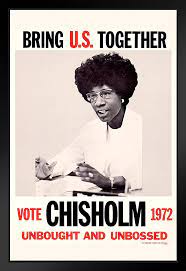
The most important Black candidate of the radical 1960s and 70s, if we judge by votes and delegates, was Shirley Chisholm. A civil rights and feminist activist from the Afro-Caribbean community of New York City, Chisholm was the first Black woman elected to Congress in 1968 and in 1972, and she sought the 1972 Democratic presidential nomination in order to fight for race and gender equality. She represented something new: a Black feminist politician.
Shirley Anita St. Hill Chisholm who was born in 1924, lived part of her childhood in Barbados, and later grew up in a Afro-Caribbean family in Brooklyn. Her father, Charles Christopher St. Hill, was a laborer from Guiana and her mother, Ruby Seale St. Hill, was a seamstress from Barbados.
In part, Chisholm’s left-of-center politics came from her family; her father was an ardent follower of Marcus Garvey, the Caribbean Black Nationalist and Pan-Africanist whose movement was large and influential in New York. Her father’s politics instilled Shirley with a strong sense of racial pride. a strong sense of racial pride. In addition, her father’s role as a union shop steward gave her an appreciation of the role of unions in improving workers’ lives.
But Chisholm’s politics were also a product of the time, the rise of the post-war African American civil rights movement. While a student at Brooklyn College just as World War II broke out, Chisholm had joined the Harriet Tubman Society, founded a club for Black students, and joined the Brooklyn NAACP and Urban League.
Ambitious, he decided to at Columbia University, and graduated in 1951 and graduated with master’s degree in early childhood education. After become a director of day care centers, she became active in League of Women Voters, the National Association for the Advancement of Colored People (NAACP), the Urban League, and the Democratic Club in Bedford-Stuyvesant, Brooklyn. (Barbara Winslow, Shirley Chisholm: Catalyst for Change [Westview Press, 2014], pp. 12-26.) Chisholm launched her own political career in the early sixties and in1964 was the second African American elected to the New York State Legislature followed by her election to the US. Congress in 1968, the first black woman ever elected to that that body.
Her congressional career was remarkable. As her biographer, Barbara Winslow, writes:
Chisholm entered Congress with a clear social and political agenda that was far more ambitious than those of most of her liberal colleagues. She envisioned an expanded welfare state: programs for the poor, the unemployed, and underserved children; greater access to higher education and more federal support for public education and health care. (Winslow, Shirley Chisholm, p. 76.)
In her maiden congressional speech, speaking as a woman and a teacher, Chisholm explained why she would vote against every military funding bill.
As I take this stand today, I am joined by every mother, wife and widow in this land who ever asked herself why the generals play with billions while families crumble under the weight of hunger, sickness and unemployment. We must force this administration to rethink its distorted, unreal state of priorities. (Winslow, Shirley Chisholm, p. 80.)
She also took a stand against the Internal Security Act’s preventative detention section that would allow the government to carry out the preventive detention of political dissidents. She pointed out that during the Second World War and unlike German citizens who had not been rounded up, Japanese Americans had been incarcerated “because of the color of their skin.” She expanded that:
Today it is not the Ku Klux Klan or the [crime] Syndicate whose doors are being kicked in, it is the Black Panthers. Skin, skin, skin color, gentlemen, that’s the criteria. It makes us special targets. (Winslow, Shirley Chisholm, p. 81).
During her Congressional service, Chisholm—a cofounder of the National Organization for Women in 1970—also became a strident voice of the feminist movement. It was she who in 1970 reintroduced in the House of Representatives the Equal Right Amendment (ERA). She called upon women to act:“ Women must do it themselves. They must become revolutionaries.” (Winslow, Shirley Chisholm, p. 83.)
She also courageously called for abortion rights, which were opposed not only by conservatives, but also by both the traditional leaders of the civil rights movement and the Black Nationalists. Sh explained just how important freedom of choice was for working class women, especially those who were Black and Latina. She became the honorary president of the National Association for the Repeal of Abortion Laws (NARAL, Pro-Choice America). She proposed federal abortion rights legislation and supported repeal of New York’s restrictive abortion law. The Supreme Court’s Roe v. Wade decision in 1973, which legalized abortion at the federal level, was due to the strong pressure that Chisholm and many other feminists exerted. (Winslow, Shirley Chisholm, 86-88.)
On January 25, 1972, Chisholm announced her candidacy, not, she said, just as a Black or female candidate, but as the candidate of the American people formed decades of civil rights struggles that preceded her campaign and by the rising feminist movement. At this juncture, it is necessary to discuss the National Black Political Convention held in Gary, Indiana in March 1972.
The National Black Political Convention
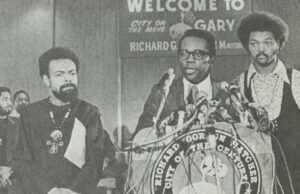
The NBPC was in many ways, the culmination of the civil rights movement that had begun in 1955 with the Montgomery, Alabama bus boycott led by the Rev. Martin Luther King Jr., and had culminated in the Civil Rights Act of 1964 and the Voting Rights Act of 1965, which abolished the legal pillars of Jim Crow in the South. While racism and economic inequality had not been ended, this legislation had been an enormous step forward, and the Black freedom movement was proud of that accomplishment. Thousands of Black activists attended the convention, which was addressed by many movement leaders: Gary Mayor Richard Hatcher, Amiri Baraka, Coretta Scott King,, Betty Shabazz (widow of Malcolm X), Queen Mother Moore, Congressman Charles Diggs, Black Panther chair Bobby Seale, and the Rev. Jesse Jackson.
In his opening address, Hatcher suggested that the Democrats and Republicans were now getting their “last chance” to respond to the needs of the African American people, and if they didn’t, Blacks might organize an independent political party and take with them Puerto Ricans, Native Americans, white youth, impoverished whites, and some of the white working class. The crowd cheered loudly for all but the latter, in which they clearly had little faith.
Jackson led a call and response, asking, “What time is it?,” to which the crowd responded, “It’s nationtime?” The neologism “nationtime” suggested that black people had become a political power on the national stage, that they should assert their identity as a nation, and that perhaps their nation needed their own political party. Jesse Jackson’s statement, “I am a Black man and I want a Black party,” brought the hall to its feet. The political question—reform the Democratic Party or creation of a new Black party to lead all of the country’s oppressed—was left open.
Unfortunately, this climax of the Black freedom movement of the 1960s was also its funeral. Though Baraka had called for “unity without conformity,” the delegates could not overcome their differences over whether or not to create a black political party. The convention ended in political division, dispersed, and disappeared, never carrying out its promises
Richard Hatcher had declared in his opening speech that Angela Davis, then in prison, would be welcome at the NBPC, but he never mentioned Shirley Chisholm, who was by then a presidential candidate. Chisholm was not in attendance , perhaps because she didn’t want to be seen as a “Black candidate,” perhaps because the NBPC was male-dominated and dismissive of feminism, and perhaps because its politics was more radical than hers, at last rhetorically. Though some of her fellow Black Political Caucus members had helped organize the event, the NBPC leadership did not back her and the gathering did not endorse her. “Black male politicians are no different from white male politicians,” Chisolm said at the time. “This ‘woman thing’ is so deep.”
The Chisholm Campaign
Chisholm had little money, no big-name backer, and had no actual organization except in a few states—though she did somehow find the means to campaign in California and Florida. The Democratic Party’s predominantly white liberal establishment leadership worked to stop her from having a major role at the convention and excluded her from the debates. Black establishment politicians and elected officials shunned her, and in North Carolina some went so far as to declare that “a vote for Shirley Chisholm is a vote for George Wallace,” the segregationist governor of Alabama.
Chisholm, however, won the support of feminists such as Gloria Steinem, who campaigned for her, wrote speeches for her, and was one of her pledge delegates to the Democratic Party National Convention. Betty Friedan, a founder and leader of the National Organization for Women (NOW), also ran to be a Chisholm delegate.
Despite these obstacles, Chisholm entered 12 Democratic Party state primaries and won a remarkable 152 Convention delegate votes or 10 percent of the total. When her bid had failed, she threw her support to George McGovern, the candidate of the liberal anti-war movement and campaigned with him in New York and Pennsylvania, in an attempt to find support among Black voters. Speaking at the The election was a landslide for Republican Richard Nixon, who carried every state but Massachusetts and the District of Columbia, winning 520 Electoral College votes to McGovern’s 17. The Democrats, the left, the progressive movements had been smashed.
However, Chisholm was notable as a social and political activist and political leader of both Black movement and the women’s liberation movement who had created an organization and a relatively broad base of support. On the other hand her allegiance of the Democratic Party, committed to maintaining the system and opposed to fundamental change, meant that her effort remained constrained with in its limits. Had she run as an independent candidate could she have done as well? Not likely. The Democrats would have been even more hostile and even the anti-war candidates would have eschewed her.