
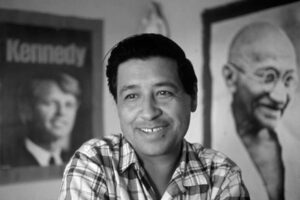
 We have all been horrified to learn of Cesar Chavez’s sexual assaults and rape of young girls and women. We who worked for years as volunteers or supporters of the United Farm Workers, even those of us like myself who were critical of Chavez, never expected anything like this. The story recently published in The New York Times, carefully investigated and documented, leaves no doubt that Chavez violated those girls as well as betraying the trust that so many had placed in him.
When I wrote my biography César Chávez and La Causa twenty years ago, part of the Library of American Biography series made up of books to be read by college freshmen and sophomores, I thought about the young Mexican Americans and other Latinos who might read my book and be influenced by it. So, I attempted to give a balanced view of a man who, despite his significant faults, might still inspire young people.[1]
Chavez for most of his adult life worked to promote the well-being of the Mexican American people, who in the U.S, Southwest in the early twentieth century still faced racial segregation and discrimination. In the 1950s, Chavez was hired by the Community Service Organization, which was backed by labor organizer Saul Alinsky, to registered people to vote. Later through the farm worker organizations that he founded he worked to improve the working conditions and wages of agricultural laborers. In the 1960s Chavez not only headed the United Farm Workers union, but had also become one of the outstanding leaders of the Latino civil rights movement and helped Mexican Americans to play a prominent role in American society and politics. Many believed his achievements were comparable to the work of the Rev. Martin Luther King, Jr. in Black America.
Chavez’s Political Problems
But Chavez was not without his political faults and weaknesses. In fact, there were many. In 1965 Chavez merged the predominantly Mexican American National Farm Workers Association (NFWA) that he and Dolores Huerta (one of his rape victims) had founded with the Filipino American Agricultural Workers Organizing Committee (AWOC) to form the United Farm Workers (UFW). Chavez, however, soon pushed the Filipino workers aside, so that the Spanish language, Mexican nationalism as represented by figures like Emiliano Zapata, and Mexican Catholicism with the symbol of the Virgin of Guadalupe became the public image and culture of the union. Arab workers’ identity also became erased in the Mexicanized union. Under Chavez, the United Farm Workers gave a political voice to working class and poor Mexican workers, but to the neglect of the Filipino and Arab workers.
Chavez based the UFW on the Mexican American Workers who were U.S. citizens, most of whom lived permanently in rural communities. At the same time, he was a strong opponent of undocumented immigrant workers since he felt it would be impossible to organize the vast immigrant Mexican workforce. I remember once in the late 1960s, California Congressperson Lionel Van Deerlin and Cesar Chavez together entered fields in Southern California to drive out the workers that Chavez called “wetbacks” and “illegals.” As a young leftist in my early twenties, I was shocked, but this was Chavez’s position and he went on to organize a “Campaign against Illegals.”
Chavez extolled the union’s ideology of “mutualismo,” that is of cooperativism, the notion that the members were pooling their resources to support each other. But this was contradicted by the union’s dependence on federal government funds for much of its social work. The UFW received those funds because Chavez formed an alliance with Democratic Party officials, in particular with Robert Kennedy, a Roman Catholic. Chavez hitched the union’s fortunes to the Democrats, who in turn provided the union with money for its social programs to support farm worker families. Chavez and Kennedy turned the UFW into part of the Democratic Party political machine.
Chavez also virtually turned the UFW into a Catholic union, the faith of most of the union’s members. While Protestant churches and preachers also provided much assistance to the union, as did Jews who were involved as top advisors. Most of the unions Arab members were Muslims, and while the leaders of the Filipino workers were Communist and secular. Yet the union marched under Catholic banners of the Virgin of Guadalupe.
Chavez also worked to concentrate all power in his own hands. The UFW leadership bodies were made up of Chavez’s long-time associates and family members. Unlike most unions, Chavez did not permit the organization of union locals in different regions of California because he feared he couldn’t control the rank-and-file members who might oppose him. Chavez parodically purged the union of dissident and critics, whether rank-and-file workers, staff, or advisors.
Chavez was an authoritarian leader in the union, who oversaw everything from labor and political strategy to the management of the everyday affairs of the union office such as who was cleaning the bathrooms. Without consulting the members or his leadership circle, staff or advisors, he often made controversial decisions such as dropping everything to go on a hunger strike. He had the first and last word on virtually everything the union did.
In the mid- to late-1970s, Chavez became connected to Charles Dederich, the founded of Synanon, the drug rehabilitation program that developed into a cult that controlled its members personal lives. Chavez adopted and brought into the union Synanon’s practice known as “The Game,” a practice of psychological manipulation and vebal abuse. Chavez used The Game to insure the loyalty of his leadership, staff, and union members. Chavez stood by Dederich even when the cult leader had a rattlesnake placed in the mailbox of Paul Morantz, an attorney who had sued Synanon. The snake bit Morantz who became seriously ill and might have died.
While Chavez succeeded in creating the first stable farmworkers union in California in the 1970s, by the 1980s the union had begun to lose its contracts. Chavez turned toward the organization of a nebulous poor people’s movement. The UFW began to disintegrate. Today less than 1% of U.S. farmworkers are represented by labor unions. There are over one million wage-earning farmworkers, but the unionized percentage is among the lowest of any sector. Only 54,000 to 60,000 workers were covered by collective bargaining agreements as of 2022-2023. Chavez died on April 23, 1993, at the age of 66.
Chavez’s Pedophilia and Rape
During his lifetime, his family, friends and associates knew that he had had many sexual affairs that he and they worked to keep secret from his wife Helen Fabela Chavez, mother of their eight children, who died in 2016. Some people in the UFW we now know, thanks to the New York Times reporting, also knew back then about his sexual relations with young girls, some as young as thirteen.
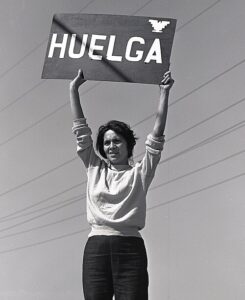
Let us let Dolores Huerta, Cesar Chavez’s partner in the organization of the union, reveal her experience and how she sees it.
“As a young mother in the 1960s, I experienced two separate sexual encounters with Cesar. The first time I was manipulated and pressured into having sex with him, and I didn’t feel I could say no because he was someone that I admired, my boss and the leader of the movement I had already devoted years of my life to. The second time I was forced, against my will, and in an environment where I felt trapped.
“I had experienced abuse and sexual violence before, and I convinced myself these were incidents that I had to endure alone and in secret. Both sexual encounters with Cesar led to pregnancies. I chose to keep my pregnancies secret and, after the children were born, I arranged for them to be raised by other families that could give them stable lives.
“I carried this secret for as long as I did because building the movement and securing farmworker rights was my life’s work. The formation of a union was the only vehicle to accomplish and secure those rights and I wasn’t going to let Cesar or anyone else get in the way. I channeled everything I had into advocating on behalf of millions of farmworkers and others who were suffering and deserved equal rights.”
So, for sixty years Huerta kept her personal experience a secret, as did the other women in the UFW.
Huerta has attempted to put these issues into perspective, writing,
“The farmworker movement has always been bigger and far more important than any one individual. Cesar’s actions do not diminish the permanent improvements achieved for farmworkers with the help of thousands of people. We must continue to engage and support our community, which needs advocacy and activism now more than ever.””
While appreciating the pain, suffering, and humiliation of Huerta’s experience, and valuing her thoughts, I believe we need a critical analysis of Chavez’s leadership role and of the structure and culture of the union. We need to analyze the patriarchy characteristic of governments, corporations, and labor unions, and its expression in the machismo of Chavez and the other men who ran the union. I think there is a connection between the political issues that I discussed in my biography of Chavez and the rape and abuse of women and girls.
The authoritarian leader always stands above the rest, always in charge, always unchallenged, always permitted everything he wants. Chavez and the union he created, the union that kept his secrets, as several people have pointed out, violated the very principle of the union, its members and supporters, that is, the protection and advancement of society’s exploited and oppressed. And who among them was more oppressed than the farmworker women?
[1] My book César Chávez and la Causa (2005) is no longer in print, but it can be found as a PDF in the Internet Archive and used copies are available from second hand book dealers online.
 If you’ve read this far, you were pretty interested, right? Isn’t that worth a few bucks -maybe more? Please



Leave a Reply