
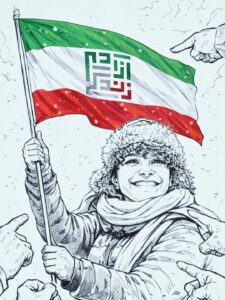
Of all the global liberation struggles, Iran’s situation is one of the most paradoxical and confusing. The Islamic regime is a theocratic modern capitalist state that dominates the lives of Iranians through a military corporation, the IRGC. It came to power through a violent counter-revolution where autonomous networks of worker councils were systematically targeted. The daily rule of the clerical aristocrats is brutal to everyone yet has upheld an ethnic hierarchy pitting Persians against other groups. The loudest and most vocal opposition to this military corporation’s rule is a coalition of right-wing activists who loudly denounce leftists, want a Western friendly government, and want to proclaim a king. Support for this state built on environmental injustices against minorities comes from anti-capitalist groups who have been hosting workshops on how to resist militarism for decades.
While many are still in denial, the truth about the Iranian regime is that it is a deeply authoritarian, oppressive, violent project meant to bring about a messianic liberation for Shiites. And yet it even oppresses Muslims with persecutions against Ismailli communities and Sufi collectives. It has consistently failed to provide a basic standard of living for most and yet seems to have all this money for its ideological projects with low support. Protests and desires for the regime to fall have been present since its inception. There have been several mass protests movements from the reformist “where is my vote” protests in 2009 which united millions in calling for reform to more recent protests that are calling for the abolition of the state.
In every situation the formula is the same, a shocking level of mass violence and a ruthless manipulation of geopolitics. There is not genuine free speech and organized political opposition is not allowed. After 4 decades of crushing any alternative, the only organized political opposition has been in the diaspora. The failure of the left to help build an alternative political movement has allowed for the son of the former dictator and right-wing allies to fill that gap. Many Iranians who would never think to go back to his rule have been gradually courted into this coalition which started subtly and increased declarations of support for Reza Pahlavi over time. Many are not ideologically believing the West needs to intervene, but are deferring to the only large political coalition that is firmly against the Islamic Regime’s rule.
The current coalition leading Iran’s protest claims to have clarity in its stated goal of bringing down the Iranian regime and installing Pahlavi as a transition leader or monarch, depending on who you ask. They have built networks that highlight the regime’s undeniable crimes while publicizing and naming the victims. They also loudly advocate for stronger sanctions, labeling the state on a terror list, and taking action to protect protesters (although the level of military intervention they are asking is unclear and generally kept vague). There isn’t a fundamental safety in this approach as it is at the whim of a notoriously flaky aspiring despot to press the “final” button to end the regime. They fundamentally believe Trump’s rhetoric on being a strongman whose status as a wildcard can be used to break the regime. This ignores multiple major retreats after big threats (to the chagrin of neocons) including the U.S.-North Korea confrontation in his first term, allowing a Turkey-backed government in Syria to develop (instead of deposing Iran’s ally Assad), and keeping the Venezuelan state apparatus intact.
This flawed analysis and one dimensional strategy doesn’t account for Trump’s tendencies nor does it account for genuine political disagreements in the regime’s opposition. The Pahlavi coalition also failed those in Iran after encouraging protesters to take unprecedented risks in their desire to change. They were told that mass IRGC defections were around the corner and they had convinced international powers to intervene. Iranians used this information to escalate their protests believing that help was imminent. To understand the context of the pro-Shah chants, Chowra Makaremi and Amir Ahmadi Arian describe the situation as one where Iranians already believed that action was taken. These chants were more a celebration of a perceived victory than a strong ideological current towards monarchy. What followed is one of the most tragic memories in all of Iranian history. The current death toll has different estimates but even the lowest reliable estimate by the Iranian human rights organization HRANA (6,800) is a testament to the terrifying mass murder capacity. The diaspora organizers need to be accountable to inform us whether the coalition was given bad information or are they using Iranian grief as a political tool?
On the other end of the spectrum you see a broad coalition of liberals, leftists, antiwar activists, pro-Palestine groups, and human rights coalitions failing to live up to the moment. While there is disagreement among these groups, and plenty of exceptions (especially with individual Palestinian calls for solidarity) this end of the political spectrum is struggling to have real relevance with Iran politics. Within this broad coalition there are some common currents to how Iran is talked about.
- Directly calling for solidarity with the Iranian government and supporting their actions as an act of resistance against imperialism. This is a vile position espoused by people who host regime-connected figures such as Mohammad Marandi on the Electronic Intifada or Mint Press.
- Acknowledging Iran’s oppressive nature but believing their role in an anti-imperialist struggle requires us to ignore their “contradictions.” This a worldview that robs Iranians of their agency and ignores working class struggles. It is very similar to Western war hawks’ views of civilians as disposable agents for a larger strategy. This worldview is common in figures like Vijay Prashad and a popular Palestine advocacy page SavesheikJarrahNow which fundraised for war victims in Palestine but has used the platform to encourage people to ignore Iran protests
- Perpetually confused activists who know something is wrong but their worldview doesn’t allow them to witness a dynamic solution. These are people who will stand in solidarity with folks in the global South through anti-war activism. They don’t have an answer when U.S. rivals commit atrocities. They will likely say something along the lines of “I criticize my own government first” which is limiting and unhelpful in this context.
- Organizers who care deeply about Iran and Palestine and are overwhelmed at the political divisions. They try to raise awareness and some even raise funds but generally we are at a loss. I am in this camp.
Much of the U.S. left has gladly used the Pahlavi coalition’s manipulation as an excuse to demonize Iranian protesters and betray working class resistance. These polarizing narratives do not serve anyone living under the boot of the current fascist Iranian state.
I desire an activism to bring down the Islamic Republic and preserve the rebel heart of Iranian society. I believe this can be done with a deep understanding of the dynamics of resistance without an organized figure.
The purpose of this article is not to propose a concrete strategy. That is a loaded prospect should not fall on one person. I write this article as guidance for building a liberatory political strategy that embraces the diversity of popular struggle against the Islamic Republic. I hope this helps people discover points of unity around Iran that allow them to form creative coalitions and develop an emergent strategy. At the end of this article I will propose 6 concepts that can nourish a liberation movement. These include non-partisan rallies, getting money into hands of Iranians, supporting smaller disruptive protests over mass rallies, building diverse coalitions, disrupting propaganda, and a transitional council with many leaders.
Beyond Persians and Iranians
When we talk about the repression of the Iranian state we are not only talking about Persians. This struggle includes Iraqis whose government has been taken over and acts as a puppet for the IRGC. It can include Yemenis and Afghans whose nations have been intervened with by the Islamic regime, as well as the diverse ethnicities living within Iran.
The past 100 years at least, Iran has gone through a deep centralization hoping it would foster modernity and development. The reality is that it has strengthened inequality and resorted to the central state to repress people’s dreams and even movement. Alborz Ghandehari writes:
“The Islamic Republic, like the Pahlavi monarchy before it, has also pursued centralist development policies which have enriched the country’s Persian centre while institutionalizing the organised abandonment of peripheral regions populated by national minorities including Kurdish, Baluch, Arab, and Lor communities.”
At the heart of Iran’s struggle is also a divide between ethnically Persian groups and many other ethnicities, some brought into the state through force in the early 20th century. These are the most likely to put out statements against all interventions and occupiers.
In Southwest Iran, the Ahwazi struggle has its own character and list of grievances. In the late 2010s, the UN came out with a report naming Ahwaz as one of the world’s most air polluted cities. It has also dealt with regular strikes due to water shortages from industries that inefficiently use water depriving the region. To try to weaken opposition, the government has started bringing in unemployed Persian workers from central regions to displace workers. Different Ahwazi groups on social media bring further attention to their struggle. There are many parallels between how Iran has treated non-Persians and racial/economic injustice in the U.S. Kurdish people are 10% of Iran’s population yet 50% of its prisoners. There’s long history of Kurdish resistance against the Shah’s and Islamic regime and they were at the forefront of the Women Life Freedom protests. Originally a slogan used for Kurdish guerrilla fighters, they have been appropriated by monarchists without respecting their origin. The current Iranian government doesn’t allow for traditional Kurdish names to appear on government documents. When Jina Amini was murdered, both the Persian diaspora and regime insisted on using the name “Mahsa” which was forced on her.
These are only a couple examples of Iran’s tremendous ethnic diversity and there needs to be more of a focus on bringing their voices and perspectives to the mainstream. This round of protests featured prominent anti-regime and anti-Pahlavi slogans among Azeri’s in Iran. Using divisions to enable autocracy must be stopped and we need a move towards pluralism.
Outdated tools – Who’s still talking about sanctions?
As an antiwar activist who opposes imposing sanctions as an act of warfare, I don’t endorse them as a strategy. I do however witness the strategic dilemma where advocating for sanctions relief could cause harm. The last time there was sanctions relief almost all the money was sent to Iran’s foreign interventions including IRGC war crimes in Syria and supporting its sectarian proxies in Iraq to put down popular uprisings. Any strategy that utilized sanction relief needs to have a strategy to get that money to everyday people. Whether sanctions have succeeded or failed (I believe the latter view) people need to realize taking an action that improves the material conditions for a regime is also a form of harm. There isn’t any evidence that regime members being able to access funds will leads to a return of wealth to the working class. Therefore organizing around this topic is not considerate or effective around this time.
The Iranian regime is a predatory apparatus that chronically steals from Iran’s working and popular classes. There needs to be a strategy to weaken the power of the state or at least gain significant concessions from it. The reform strategies of working with the reformist coalition have failed and used by the state to create an image of being to modernize. In reality, Iran has pursued ruthless neoliberal policies and modernized its surveillance apparatus while keeping the country backwards, the people oppressed, and opportunities limited.
Iran’s dynamic labor struggle
Iran shows that there is a fundamental need to organize in a new way. In absence of organized clear political opposition, much of the resistance to the Islamic Republic operates like a shadow. Large labor unions are replaced with a labor council that could disappear tomorrow due to threats, and another one may reappear a few days later.
The left holds this idea of an industrial formal working representing working class struggle while missing that Iran’s working class struggle is largely in informal and feudal-like sectors of the peripheries. This can look like Kurdish “Koolbars” passing goods between borders and regularly dealing with violent border patrol or arbitrary extraction. Fishers in Ahwaz who use it to feed the communities. Fuel transporters in Baluchistan have also organized and faced abuse. These are lifestyles and survival strategies with a very distinct relationship to labor so more education is needed among the left. Small collectives of domestic workers may get together to organize a mutual aid drive after a disaster then disperse or organize secretly once their organization takes a form that the state can grasp. It’s different local committees in non-Persian areas in the peripheries who are even more abused and failed by the government.
A lot of people who are leftist or anti-war lack this fundamental understanding of progressive forces in Iran. Long-term durable organizations are replaced by short term-charters offering a pathway to organize. As an example during the Women, Life, Freedom uprisings, 20 organizations including unions, professional organizations, and collectives put out a 12 point statement declaring goals for the revolution. This document called for free speech & freedom of religion as well as emphasizing demands not as present in diaspora protests such as LGBTQ protection and dismantling state capitalist institutions and directing the funds through educational and environmental initiatives.
Another prominent labor struggle (ignored by most labor radical activists) was the Haft Tappeh Sugar Cane privatization struggle. Workers in the Haft Tappeh factory revived a union and started selecting leaders to expand the labor struggle. Women’s right’s activist Sepideh Gholian was arrested for her journalism uplifting the labor struggle. Note this confluence of labor and media activists coming together to highlight a shared struggle. contrasts to the diasporic loud expressions of indignation, these activists use the little resources they have to tell a story and push for a better life.
Due to intense repression of labor unions by the Iranian government, workers would often go weeks or more at a time without sharing updates. When I was trying to uplift this struggle, I was always anticipating an update or hoping for a concrete step to support. I learned that the needs of the people are dynamic and changing according to the freedom they can breathe when given the opportunity. I believe there is a lesson here for every political faction to challenge what solidarity means to them.
This is not a vague idea of the past, since labor organizing & progressive struggles are still very much alive in Iran and does not get the support it needs. During this uprising, a joint statement was put out by student activists from multiple universities in solidarity with the protests:
“Today these crises have accumulated upon on another: poverty, inequality, class oppression, [the long list continues….] and the environmental crisis. All are direct products of a corrupt and worn out system: the naked embodiments of the policy of repression revealing its bloodthirsty face more clearly than ever.”
It continues, “Neither Pahlavi nor the regime,” and, “The University has once again reminded us that it stands against despotism.” The full statement can be found by activists who translated their statements. Another statement was put out by the syndicate of bus workers in Tehran which named this round of violence as one of the worst killings in this regime’s history while condemning foreign interference and Pahlavi’s opportunism.
When statements like these are released, they show that people on the ground still have hope for change and believe there are still ways to resist without depending on intervention. Instead of building relationships and dreaming strategies to support them, all the political coalitions choose to ignore these voices for their convenience. We need to support the Iranian labor and popular coalitions for a free Iran and prioritize protecting their organizing.
Analyzing the state and understanding Iranian capitalism
A lot of the modern left doesn’t have an astute analysis of the nature of the Iranian state’s brand of capitalism. I’ve even seen some pages boast about their generous welfare programs. While there have been some social programs implanted, their effects can vary and are subject to cuts during neoliberal austerity phases. Most union activity is banned as this counterrevolutionary government consolidated its power in the early 80s through a mass murder of union activists and the violent closure of many labor councils that held sway during the revolutionary transition. Iran does have state intervention but even the state industries are run privately and for profit, often by untalented government cronies
Wages are low for most with stark inequality and a high unemployment rate. Reducing international tariffs devastated some local industries including Haft Tappeh Sugar in favor of inviting private capital. There is also rampant predatory behavior by private institutions that goes unregulated. Fake visa processing or property sales can leave someone walking into an empty office to realize all the money they’ve spend was a clever scam. People who fell victim to these convincing frauds are almost never able to recuperate their money as the government allows predatory industries to be unregulated. Iranians are used to their currency being low value so they have to wager their currency against expensive gold coins hoping they appreciate in value. In this area there are some similarities with the current status of US capitalism where some people gamble on crypto to make up for the weakness of the labor market.
Ironically, one of the biggest failures of the anti-imperialist movement is failing to recognize the Islamic Republic as an imperial project. The amount of denial from many progressive groups about Iran’s interventions has been curious. During the Syrian uprising Bashar Assad’s government, on the verge of multiple crises, survived longer than expected thanks to Iranian military intervention. In the book Syria After the Uprisings, Joseph Daher documented that shortly after sanctions relief Iran invested $40 billion in Syria over a few years and had thousands of troops there. 40 billion is an amount that would be significant investment in the U.S. In Iran it could revitalize an entire industry and pull millions out of poverty. They also sell missiles to other members of the axis of resistance including militias in Iraq, the Houthis who played a role in putting down the Yemeni uprising of 2011, and Hezbollah. All of these countries has mass protests against Iranian influence in their economy which were not supported by anti-imperialists. The crimes committed against their opposition, especially in Syria, are truly a tragic chapter in the history of Middle East warfare. The people of Iran witness these major investments and make the connection to their government’s imperial actions and their own poverty. Paria Rahimi writes:
“Inside Iran, people have long rejected this rhetorical trap. One of the most common protest slogans of recent years—’Neither Gaza nor Lebanon, I will sacrifice my life for Iran’—is not a chauvinist or xenophobic rejection of international solidarity. It is a refusal to be sacrificed in the name of an opportunistic, imperialized version of anti-imperialism. It is also a direct inversion of the regime’s founding slogan, “Neither East nor West, Islamic Republic,” and its project of dissolving the nation into an abstract Islamic ummah while exporting violence beyond its borders to enforce a Shiʿa imperial doctrine rather than any emancipatory project.”
Seeing billions of dollars go into foreign interventions has enraged almost everyone living in Iran deeply. There is a long list of investments people would like to see including more efficient environmental projects that protect water. Instead a number likely reaching over 100 billion was spent on spreading the government’s Shiite sectarianism. Seeing the violence of this interventionist project and a lack of a solution from activists, many have started to turn to the West for support, tired of anti-imperial slogans that ignore their lived experience.
The failures of the left & long term liberation in Iran–
After decades of failures from progressive and left organizers, the loudest and most organized opposition is right wing. There are a loud number of voices outside (and increasingly in) Iran who think Pahlavi as a transition leader is the only option. I personally fear a coalition that acts with foreign money and behaves in a dictatorial manner in the safety of the diaspora. Their uncritical use of AI, contributing to a global water crisis, is a testament to their hostility towards other human rights and environmental causes. Right now Iran’s injustices are deeply rooted in environmental damage, and if they can’t use better tools out of concern for the world’s drying waters, how can they be expected to fix Iran’s water crisis? I don’t believe contracts with more bids will fundamentally make the Iranian economy more sustainable.
I fear their political alliances will make Iran a state that will experiment with deeper resource extraction and predatory contracts from outside power. They will also continue much of Iran’s surveillance and oppression of the peripheries with a few concessions, such as no mandatory hijab. The coalition is still focused on humanitarian appeals for Trump to help, offering political cover for his many scandals and failures.
While he may intervene, it will come at a cost of giving him positive media attention. He will use our community to build his base teasing Iranians with the promise of change. He’s using rhetoric to build political capital and build and may escalate but historically he uses strategic or symbolic strikes over actual overthrows. Much of the Iranian opposition isn’t interested in a long-term strategy as they have convinced themselves for decades that the regime’s fall is around the corner. While this unpredictable situation may be the end, we must still build a movement. The recent overthrow of Assad took 13 years after multiple disasters early on seeming to spell the end. A new kind of emergent strategy is needed whether the regime survives this crisis, or the Pahlavi supporters get their way and install him in power.
The other angle is that there is no guarantee Trump will pick Pahlavi, as he is notoriously unpredictable and goes for situations he can control. If the West does win and installs their own oppressive agenda, the Western powers will have the Islamic Republic to thank for decades of preventing organized and popular resistance of gaining a foothold. Pariah Rahimi writes:
“The left must confront an uncomfortable fact: the Islamic Republic is, in practice, one of the most advantageous adversaries the United States can have in the Middle East. Its permanence stabilizes regional antagonisms, legitimizes militarization, and sustains the circuits of global capitalism far more effectively than a nationalist, secular, right-leaning political order ever could. Any agreement with this regime does not weaken imperial power; it consolidates it.”
For the left to gain relevance, the first step is to apologize and admit the failures of these coalitions that were supposed to be liberatory. There needs to be accountability to listen and communicate with Iranians in general. There needs to be an updated analysis, and there needs to be new coalitions with the courage to “cancel” certain long term propagandists. There can’t be any change if organizers can’t get the first step: acknowledgment.
Let’s build a coalition
Overall there is a new form of organizing needed, one that witnesses and supports the diversity of Iran’s ethnicities, movements, and tactics.
1. Hold non-partisan rallies
Much of the failure to respond to the current crisis is people’s commitment to their ideology. Monarchist protesters hold “pro-democracy” rallies where they tell people who the next KING is. Anyone who speaks against this will be escorted out or even risk physical violence. People deserve to attend rallies where their choice and agency can be respected. It should also be a place of open debate and sharing where people can learn about actions they can take. For this reason I don’t even support framing the protests as “anti-war” or “leftist” as we want a diverse range of voices to be present. Pahavi supporters can show up as their own contingent, not the stated voice of “the Iranian people.”
2. Get money and power into the hands of Iranians.
At this point I’m not focused on sanctions, be it putting more in or removing them, though I don’t endorse them as a strategy. We need to hone in on our goal to get actual funds to people in Iran. No one really knows how the Pahlavists spend their money on Iran. But I can’t seem to find any indications that they’re supporting labor strikes and uplifting non-Persian voices. To fill this gap, targeted fundraising needs to help localized networks and unions to build capacity under the shadows. There needs to be maximum pressure on the regime that any funds, made by its ruling class or potential sanctions relief, need to go to civil society organizations rather than furthering repression (The last time–2015–when there was sanctions relief, almost all the money was sent to Iran’s foreign interventions including IRGC war crimes in Syria and supporting its sectarian proxies in Iraq to put down popular uprisings) The Iranian regime is a predatory apparatus that chronically steals from Iran’s working and popular classes. There needs to be a strategy to weaken the power of the state or at least gain significant concessions from it for a sanctions removal strategy to be worthwhile or effective.
3. Supporting smaller, localized and disruptive protests.
The current Iranian uprising is incredibly brave and deeply inspiring which makes their repression and betrayal more tragic. Unfortunately, this regime has survived by developing strategies to break mass protests. Much of Iranian resistance has for purposes of safety gravitated towards smaller protest that can be dispersed quickly for protesters safety. Mass protests are a language that many in the West can understand but they may be too risky of a tactic for this context. Many resisting authoritarianism in this past century have offered a range of tactics that can keep a movement alive without encouraging hypervisibility. Mass protests can be taken out when organizers on the ground decide the risk is worth it and it is the responsibility of those in diaspora to provide them with accurate information about their level of support. These movements can gradually be built into diverse opposition parties as the safety of the situation will allow.
4. Organizing Diverse coalitions
The current movements don’t account for deep movement building and depend on figureheads and figures on limited strategies. Everyone has their own language but when it comes to Iran I think of it as a struggle for “victims/targets/resistance of/to the IRGC” as much as if not more than “Iranian voices.” While identifying as Iranian can be supportive this nuanced understanding is an invite to bring in a larger coalition. Iran’s oppression is not limited to Persians, though both Shah supporters and tankies find convenience in framing it as such. There are ethnic groups within Iran that aren’t Persian and need a voice. There are Afghans and Arabs who have had the IRGC intervene in their economy.
Beyond ethnic diversity we also need political diversity. A lot of political organizing around Iran targets major governments. I believe organizing should encourage solidarity between U.S. and Iranian labor unions and strikers. There should also be a shared struggle with U.S. anti-authoritarian protests as in Minnesota are standing up to government that acts as an occupier and increases it’s daily intrusions in people’s lives.
There are also increasing collectives of activists in the U.S. who create their own networks to counter the major protests. In 2022 in response to Persian hostility towards Kurdish protesters, groups like Feminists 4 Jina were created to honor the Kurdish origin of the Woman Life Freedom slogans. They also held political education reminding people of the brutality of the Pahlavi regime towards Kurdish areas and how the current movement is whitewashing the history while appropriating their slogans. At a major Iran protest in New York a few weeks ago, different groups created an anti-monarchist contingent to share solidarity with Iranian protesters.
5. Disrupting propaganda networks with grassroots power
All propaganda networks (right and “left”) that promote a reductive narrative on Iran without highlighting protesters’ views need to be condemned. A recent analysis of Iranian media analyzed thousands of clips of protests and found that pro-Shah chants were shouted at just 17% of protests in Iran. Major “Iranian voice” outlets mostly highlighted only those favoring Reza Pahlavi. They generally won’t publish statements by union activists and student groups, or periphery focused groups because it’s easy to ignore their condemnations of Pahlavi. More and more Iranians are reporting it is hard to attend support rallies as they are increasing their partisan disposition towards Reza Shah and bringing Israel flags. There are also reports of people facing violence for speaking out.
On the other side, any of the major “anti-war” coalitions that host “hands off Iran” rallies will have an awful pro-regime slant. People who know literally nothing about Iran will have the mic praising the government purely because of its rhetoric. Much of the pro-Palestine movement allowed sectarian voices to be present at their protest. There were many joint solidarity articles and statements, but many protests were taken over by sectarian leaders. A lot of these voices fill the internet with false information and gaslit the thousands of people that trusted them to be a voice for peace. With some exceptions, organizers as a whole were unable to take stances for other countries. This coalition rightfully called out the inhumane siege of Gaza but were praising the Houthi’s who at the same time were carrying out their own siege of Taiz in Yemen.
All of these voices are religiously anti-intersectional and awful spokespeople for a politics that can bring hope. We have a region plagued by war and tyranny and yet we keep producing political leaders who find a way to grift and continue the peoples suffering. Both these polarizing narratives must be challenged whether it be at their protests or public exposure campaigns.
6. Call for a transitional council where people of different backgrounds and views nominate 20-100 people to act as a shadow government.
They can nominate their own leader with their definition of a quorum. One thing that is perplexing to me in this moment is the sheer number of Iranian leaders I have seen over the years that have shown brilliance and courage and inspired millions. And yet these protests are honed in on one figure who hasn’t been to Iran. He can give good speeches but most of his policies are generic templates of policies one can print out from any think thank or UN working group. I refuse to believe that we can’t do better. My personal nomination is Nasrin Sotoudeh as she is an international lawyer who knows the Iranian legal system well and has worked officially and unofficially in Iran. I still believe if we have a nominating system,we can put the true desire of Iranian people to the forefront.
This shadow government should be independent and can play a role in strategic fundraising and international pressure. It can hold votes virtually for members who register and can define who participates.
The 120-year liberation struggle against authoritarianism started in 1906 and continues to this day. I have walked the streets of Iran many years ago. I see a spirited people whose essential gentleness and buoyant optimism in hard times as a source of inspiration. I have also seen the spiritual, emotional, and physical toll this regime has taken on the collective dignity. There is no doubt they need to go and reformism is doomed to fail especially in this context. I, however, see people outside Iran needing to do better. We don’t know what it will take to finally break this regime, but we can still get together and dream of a new coalition to carry Iran forward.
 If you’ve read this far, you were pretty interested, right? Isn’t that worth a few bucks -maybe more? Please
Leave a Reply