Author: Dan La Botz
DAN LA BOTZ is a member of the editorial board of New Politics. Learn more about him and his writings at danlabotzwritings.com
The Mexican Secretary of the Interior will meet with the Mexican Electrical Workers Union (SME) and a group of mediators tonight (December 16) some months since President Felipe Calderón liquidated the state-owned Light and Power Company, seized the facilities, and fired of the 44,000 workers. The union, which has sought in the courts the return of all workers to their jobs, has more modest goals for these negotiations, according to general secretary Martín Esparza.
The Mexican Electrical Workers Union (SME), made up of approximately 43,000 active and 22,000 retired workers in Mexico City and surrounding states, is fighting for its life. The union's struggle has rallied allies in the labor movement and on the left in Mexico and solidarity from throughout the country and around the world, but, if it is to survive, the union and its supporters have to take stronger actions than they have so far, and time is not on their side.
October 11, 2009 — Mexican Federal Police last night and early this morning seized the plants of the Central Light and Power Company of Mexico (LyF) which provides electricity to Mexico City and several states in central Mexico. The government of President Felipe Calderón also announced the liquidation of the company, the termination of the workers, and thereby the elimination of the Mexican Electrical Workers Union (SME) which has opposed the government's policies.
The Mexican Preventive Police (PFP) are preparing to occupy the facilities of the Central Light and Power Company in Mexico City in an attempt to break the militant Mexican Electrical Workers Union (SME), according to a union press release. The union warns that the quasi-military occupation of the plants could come within a week. The PFP have been used in the last three years to attempt to break strikes of miners and steelworkers as well as to try to crush popular social movements.
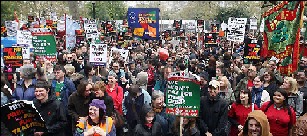
THE WORLD’S WORKING PEOPLE FACE the greatest challenge in three generations. The economic crisis that began in the banking institutions of the United States last year has rapidly spread around the globe, creating a financial and industrial disaster. In one country after another banks have failed, corporations have gone bankrupt, and millions around the world have lost their jobs.
MILLIONS OF IMMIGRANTS took to the streets between March and May of 2006 in Los Angeles, New York, Chicago and dozens of other U.S. cities in the largest social and political demonstrations in American history. As the immigrants left work or school to join the marches, in some areas the protests, dominated by Latino workers, had the effect of a general strike, shutting down local businesses and blocking traffic in the centers of major cities.
- « Newer Posts
- 1
- …
- 18
- 19
- 20
- 21