Author: Dan La Botz
DAN LA BOTZ is a member of the editorial board of New Politics. Learn more about him and his writings at danlabotzwritings.com
David Cronenberg’s new film “A Dangerous Method” begins in the opening years of the twentieth century with the delivery to the Burghölzli Clinic of the Zurich Hospital of a young woman named Sabina Spielrein (Keira Knightly) who, suffering from hysteria, becomes one of the early patients to undergo psychoanalysis. Spielrein, a wealthy, well-educated, and lovely young Russian Jewish woman—whose hysterical outbreaks express themselves in fits, tortuous postures, tormented speech, and bizarre behavior—comes under the care of Dr.
New Politics interviews an MJEM activist in the United States
The Occupy movement has changed the American political landscape. We are at the opening of a new mass movement and a radicalization that presage an era of coming social upheaval and class conflict that require the left to both analyze these developments and to develop a strategy to intervene. The left today, small, divided, and weak, must develop an approach that will make it possible for it to grow and unite so that it can influence events.
At a moment when Occupy faces severe police repression and cold weather, and as we are both extending our movement to the streets and rethinking our future, various pressures are beginning to build with the objective of taking our movement into the Democratic Party.
The emergence of a mass movement, the beginning of a new radicalization
And some of the Pharisees among the multitude said unto him, Master, rebuke thy disciples. And he answered and said unto them, I tell you that, if these should hold their peace, the stones would immediately cry out. —Luke 19:39-40
A Victory After Decades of Struggle for Racial Justice
Cincinnati's recent selection of someone who is not white and is not from the West Side of Cincinnati as the city's new police chief is a victory for justice and civil rights, and a vindication of the efforts of those activists who for decades have struggled against the racism, violence and abuse that have characterized the Cincinnati Police Department.
Javier Batiz, the great Mexican rock-and-roll guitarist, played and sang last week in a concert that embodied and gave voice to everything that is most wonderful about Tijuana and the U.S.-Mexico border region.
During the 1970s, Michael Löwy, a leading intellectual of the Trotskyist Fourth International, attempted to generalize Leon Trotsky’s "theory of permanent revolution" into a general theory that could explain not only the Russian, but also the Yugoslavian, Chinese, Vietnamese, and Cuban revolutions. He believed his version of the theory could explain recent and still unfolding events in the colonies and developing nations of Asia, Africa, and Latin America.
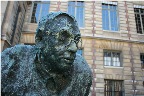
In the late 1960s it seemed to many almost certain that Jean-Paul Sartre would be remembered as the most important philosopher of the twentieth century and the most important public intellectual on the left of that era. Certainly it seemed so to me at the time. Sartre had in the 1930s taken Martin Heidegger’s Being and Time and its reactionary and religious version of phenomenology and transformed them in Being and Nothingness into his new humanist philosophy of existentialism, a leftwing philosophy of freedom.
The new American workers movement, which has developed so rapidly in the last couple of months in the struggle against rightwing legislative proposals to abolish public employee unions, suddenly finds itself at a crossroads. Madison, Wisconsin, where rank-and-file workers, community members, and social movement activists converged to create the new movement, remains the center of the struggle. In Ohio, which faces similar legislation, unions have also gone into motion, while working people around the country have been drawn into the fight.
The new American workers movement—born in the last few weeks in the giant protests in Wisconsin and Ohio—faces a fateful confrontation this coming week. In Madison and Columbus, Republican legislators are pushing to abolish public employee labor unions and tens of thousands of workers are protesting and resisting. We have seen nothing like this face off between workers and bosses in the United States since the labor upheaval of the early 1970s, though the issues in the balance are more like those of the 1930s.
Thousands of workers demonstrated at the state capital in Madison, Wisconsin on Feb. 15 and 16 to protest plans by that state’s Republican Governor Scott Walker to take away the state workers’ union rights. Walker, cleverly attempted to divide the public workers by excluding police and firefighters from his anti-union law, and the media have worked to divide public employees against private sector workers.
James D. Cockroft’s "Mexico’s Revolution Then and Now," written for the centennial of the Mexican Revolution of 1910, is a radical scholar’s guide to radical Mexico and well worth the read. Both a scholar and a political activist, Cockcroft writes as a partisan of oppressed and exploited and an opponent of capitalism.

The Dan La Botz Socialist for Senate Campaign in Ohio in 2010 was one of the most successful socialist electoral campaigns in more than 60 years. The 25,000 votes cast for La Botz compare favorably with earlier Socialist Party candidacies in Ohio, with other socialist parties, and with reformist parties to the left of the Democrats. The La Botz campaign, in fact, compares favorably with all Socialist, Communist and Socialist Workers Party and other leftist party campaigns since the heyday of socialism. Only Eugene V.
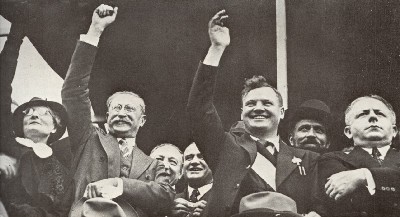
Decades since the spring of 1934 when the Communists first proposed the Popular Front as their strategy for fighting fascism and even longer since the summer of 1939 when it was suddenly terminated by the Hitler-Stalin Pact, the Popular Front—the alliance of the Communists with Socialists, liberals, and even sometimes conservative political parties—remains an issue for the left.
Diana Denham and the C.A.S.A. Collective, Teaching Rebellion: Stories from the Grassroots Mobilization in Oaxaca (Oakland: PM Press, 2008) and Peter Kuper, A Sketchbook Journal of Two Years in Oaxaca (Oakland: PM Press, 2009).
Unions Representing Workers in Canada, Mexico qnd U.S. Explore Merger:
Would Create International Union of One Million Metal Workers and Miners
The United Steelworkers (USW), which represents 850,000 workers in Canada, the Caribbean and the United States, and the National Union of Miners and Metal Workers (SNTMMRM), known as the Mineros, which represents 180,000 workers in Mexico, have announced plans to explore uniting into one international union. The agreement to begin exploration of a merger was signed on June 21.
Max Lane. Unfinished Revolution: Indonesia Before and After Suharto. New York: Verso, 2008. 312 pages. Notes, index. $29.95
From the Tea Party to the Coffee Party, How Political Parties Grow the Grass and Mow the Lawn
The collapse of the financial sector of the United States detonated the current global economic crisis, and its auto industry was soon crumpling as well.[1] Yet, though it all began here, American labor unions and workers have been slow to respond and their response has been weak. Millions of workers in hundreds of French cities have struck and demonstrated repeatedly against their government and against the banks and corporations throughout the spring of 2009, and the story was similar in Italy and Greece.
- « Newer Posts
- 1
- …
- 17
- 18
- 19
- 20
- 21
- Older Posts »