Author: Dan La Botz
DAN LA BOTZ is a member of the editorial board of New Politics. Learn more about him and his writings at danlabotzwritings.com
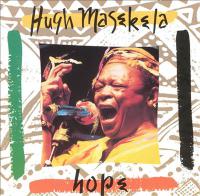
Hugh Masakela, the great South African trumpet player was joined by Vusi Mahlasela, the guitarist and singer in a “Twenty Years of Freedom” concert at Queens College on February 19, 2015. They played many of Masakela’s classics of the 1960s and 70s such as the lovely 1968 hit “Grazin’ in the Grass,” the joyful and inspiring“Bring Back Nelson Mandela”, and the sad “Stimela – the Coal Train”, to an audience many of whom had been supporters of the freedom struggles against apartheid in South Africa until its overthrow in 1994.
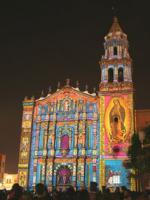
With the left by and large failing to provide political leadership in the critical political situation that has developed in Mexico following the kidnapping of 43 students in Iguala, Guerrero and the “white house” scandal surrounding President Enrique Peña Nieto, Catholic priests have been attempting to fill the void. Several Catholic priests—Padre Gregorio (Goyo) López, Padre Alejandro Solalinde Guerra, and Archbishop Raúl Vera most prominent among them—have in different ways been playing the role of spokespersons for the oppressed. These priests have been speaking out against government corruption and the politicians’ links to the drug cartels, defending local armed self-defense organizations, demanding an investigation into the role of the Mexican Army, and even calling for a constituent assembly to refound the country on a new and more democratic basis.
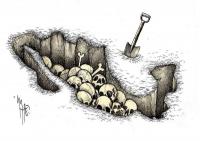
Robert Joe Stout. Hidden Dangers: Mexico on the Brink of Disaster. Sunbury Press: Mechanicsburg, Pennsylvania, 2014. 209 pages. Notes. Bibliography.
Shannon K. O’Neil. Two Nations Indivisible: Mexico, the United States, and the Road Ahead. A council on Foreign Relations Book. Oxford University Press, 2014 [2013]. 239 page. Notes. Bibliography. Index. Map.
“Mexico is undergoing economic and political changes that lie like landmines ready to explode beneath the troubled and often discordant impulses of the two countries to satisfy their divergent social and political needs,” writes Robert Joe Stout in Hidden Dangers: Mexico on the Brink of Disaster.
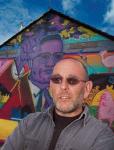
Mike Alewitz, the internationally famous muralist, is fighting for the installation his mural “The City at the Crossroads of History” at the Museum of the City of New York. Commissioned by the Puffin Foundation, the museum has refused to install the piece because of objections to its content. Alewitz calls this a case of censorship, while the museum argues it is a question of “curatorial standards.” There is a petition campaign in support of the installation of the mural. (Find at the foot of this article links to a slideshow of the mural, an interview with Alewitz, and the petition site.)
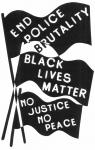
The Black Lives Matter Movement is alive and well. If it has for the moment—under political attack and facing the winter’s sub-freezing temperatures—withdrawn from the streets, it has done so to plan a new stage in the fight for justice for African American victims of police racism and violence. As many as 400 people, mostly young people of color, attended the eight-hour long Black Lives Matter Gathering at the famous Riverside Church in Manhattan on January 30 where in workshops, trainings, and plenary sessions it seemed that a new direction was being set for the movement.
The “Russian question,” that is, the question of the nature of the Soviet Union, dominated much of Marxist debate throughout the twentieth century as first anarchists and Leninists, and later Trotskyists and Stalinists, and then Maoists argued about the economic, social, and political character of Soviet Russia (and then also of Eastern Europe, China, Cuba, Vietnam, and North Korea).
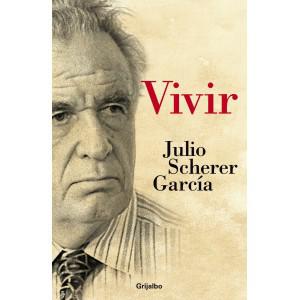 Julio Scherer, who worked as a journalist for 70 years, will be most remembered for founding Proceso, the weekly news magazine that transformed Mexican journalism and helped to contributed to the ongoing struggle for democracy in Mexico.
 Dilma Rousseff of the Workers Party (PT) won Brazil’s presidential election on October 26, meaning that when her term ends her party will have held the nation’s top office for a remarkable 16 years, longer than any party in Brazilian history.
The killings of Michael Brown and Eric Garner, by police who were not indicted by grand juries in Missouri and New York, represent only the latest in a string of such police or vigilante killings—sometimes clearly murders—of African-American or Latino men.
Contemporary capitalist society faces multiple crises: environmental catastrophe, proliferating wars, multiplying authoritarian governments, inequality, poverty, and failing health and education systems. Everywhere new democratic and progressive social movements continue to arise, from Ferguson, Missouri, to the Climate March in New York City, to the movement for democracy in Hong Kong. And yet, in most countries the democratic socialist left is small, weak, and divided.
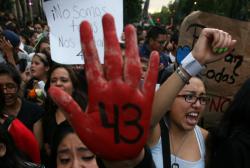
President Enrique Peña Nieto, who had been so successful in advancing his fundamentally conservative economic program during his first year and a half in office, suddenly faced a serious challenge beginning in September 2014 when police apparently cooperating gangsters killed six students, injured at least 25 injured, and kidnapped 43 in the town of Iguala in the state of Guerrero.
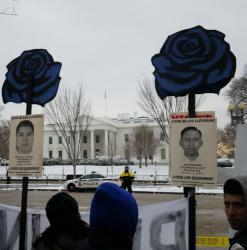
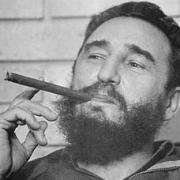
When in 1959 I was fourteen, my socialist, pacifist father gave me a gift subscription to Liberation, the leftist magazine sponsored by the War Resisters League that was published from 1956-1977. My parents had divorced and I lived with my mother in the town of Imperial Beach, California, on the Pacific Ocean and the Mexican border, while my father lived in Chicago. Liberation was my father’s way of seeing to my political education from a distance. In the pages of Liberation I first read C. Wright Mills’ essay (later a book) “Listen Yankee” as well as other articles about the revolution in Cuba.
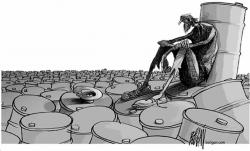
The Mexican government confronts a major political crisis on two fronts. The first is as a result of the massacre and kidnapping that took place on September 26 when police and other assailants in Ayotzinapa, Guerrero killed six, wounded twenty-five, and kidnapped 43 students. Since the massacre and kidnapping took place, there have been demonstrations in Guerrero, Mexico City, and several other states, some of them massive and some violent.
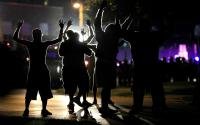
Pain and anger at the police killing of Michael Brown became transformed into protests that swept across America just before Thanksgiving. Thousands of people in the town of Ferguson, Missouri, and tens of thousands in cities throughout the country reacted with indignation, anger and in Ferguson with violent protests after the grand jury failed to indict Officer Darren Wilson in the shooting death of 18-year-old Michael Brown.
We at New Politics were saddened to learn and are very sorry to have to inform our readers that our good friend and writer Özlem Ilyas Tolunay, 39, died on Nov. 16 of a heart attack. We are heartsick that this young woman, a fighter for social justice in Turkey, wife and mother of a young child, is no longer with us.
Dilma Rousseff of the Workers Party (PT) won Brazil’s presidential election on October 26, meaning that when her term ends her party will have held the nation’s top office for a remarkable sixteen years, longer than any party in Brazilian history. Rousseff began as part of an armed revolutionary guerrilla organization during the dictatorship from 1964-1985, then helped found the Democratic Workers Party (PDT), and only joined the PT in 2001.
The failure of President Barack Obama and the Democratic Party to lead a fight for many of the major social issues on which he had campaigned—jobs and wages, African Americans’ civil rights, immigration, labor union power, and the environment—led to a sweeping victory for the Republican Party and a crushing defeat for the Democrats in the midterm election.
Throughout Mexico there is continued shock, horror, indignation, and anger at the police killing of 5 and wounding of 17 other students, and above all at the disappearance of 43 students on the night of September 26 and the early morning of September 27. For almost a month now protests peaceful and violent involving tens of thousands have rippled across Mexico, as students, teachers, and other citizens demand that the missing students be returned alive, though some evidence suggests they may already be dead.
The Climate Convergence with its more than one hundred workshops, its large plenary sessions, and its miles-long mass march of more than 300,000 people, the largest climate protest in American history, represents a turning point for the environmental movement. The gigantic and passionate parade of indigenous people, ethnic groups of all sorts from everywhere in the country, students by the tens of thousands, neighborhood organizations by the dozen, several major national labor unions, and every conceivable sort of ecological cause tramping through New York City carrying huge banners and giant puppets, striding and dancing to the tunes of 29 marching bands, put the issue of the environment and climate change on the national agenda as never before. The national climate movement has arrived—now what will it do?
- « Newer Posts
- 1
- …
- 13
- 14
- 15
- 16
- 17
- 18
- 19
- …
- 21
- Older Posts »