
 I oppose the U.S.-Israeli war on Iran, the sanctions regime that preceded it, and every project of externally engineered regime change. I also oppose the Islamic Republic, a state that has governed for forty-seven years through political imprisonment, executions, gendered coercion, and the methodical destruction of independent organization. I am an Iranian feminist researcher, and I have spent enough time in left spaces in Europe and North America to know that holding both positions at once is still treated, in some quarters, as an incoherence in need of correction.
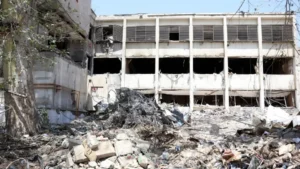
The row over the Guardian‘s open letter to Iran’s political prisoners has made the correction unusually visible. What the document actually says is not in dispute. It is addressed to the activists, students, scholars, workers, and artists held in Iranian prisons. It names the systematic use of torture, the unfair trials, and the state executions carried out by the Islamic Republic, and it demands an immediate end to executions and the release of all political prisoners. It also condemns U.S. and Israeli policy toward Iran, cites the Israeli strike on Evin prison in June 2025, and closes by calling for an immediate end to the war and to U.S.-Israeli sanctions. Among its published signatories are Angela Davis, Ruth Wilson Gilmore, Judith Butler, and Yassin al-Haj Saleh. For this the letter was accused of manufacturing false symmetry, of weakening Iran in wartime, of handing ammunition to the enemy. That does not put the letter beyond criticism — there are real questions about whose voices it centers. But those are arguments for taking prisoners’ own political thought more seriously, not for postponing solidarity with them.
Vijay Prashad put the objection most cleanly. Writing days after the letter appeared, he argued that “there is a time to make a demand and a time to act in solidarity,” that “neutrality or a third space does not exist in the midst of a war of aggression,” and that the scissors image at the heart of the letter — two blades, one body — is “evocative but erroneous,” since it makes the aggressor and the attacked appear as parallel sources of the same danger.
Prashad is not defending Evin prison, and it is worth reconstructing what he is defending in a stronger form than he states it. Read that way, the argument concerns the political economy of speech: criticism voiced in the metropole during a war of aggression does not travel as criticism, it travels as war material, and Iranians who say these things in English contribute, whatever their intentions, to a discursive infrastructure that ends in cruise missiles. That formulation is mine, not his. It is also the version worth answering, and anyone who has watched Iranian women’s suffering laundered into a case for bombing knows it is not paranoid.
The argument breaks on contact with the people it claims to protect.
The prisoner’s calendar
Begin with the question the sequencing argument never answers: solidarity with whom?
The Iranian political prisoner does not live in geopolitical time. American bombs do not open her cell. Sanctions do not stay an execution order. The overwhelming asymmetry between U.S. and Iranian military power does not cause her interrogator, her guard or her Revolutionary Court judge to vanish for the duration. Whatever is true at the level of states, at the level of her body two forms of power are operating at once, and neither has agreed to wait for the other.
Notice, too, that the argument has no exit condition. Who announces that the war is over and criticism may resume? Not the Iranian prisoner. The Islamic Republic has already made its own position clear: it has declared that wartime conditions are precisely the moment when repression must accelerate. Amnesty International documents the judiciary instructing officials in April to fast-track prosecutions with “extreme speed,” the head of the judiciary warning in March that anyone acting in line with “the wishes of the aggressor enemy” would be dealt with “decisively and severely,” and more than six thousand arbitrary arrests, thirty-nine political executions, and an eighty-eight-day internet shutdown since the attack began on February 28. In late July, Amnesty International warned that at least sixty more people faced imminent execution.
The Iranian state and some of its anti-imperialist critics abroad arrive, for very different reasons, at the same political sequencing: not now. One says: not now, there is a war on. The other says: not now, there is a war on. The prisoner is the only party to the argument for whom the postponement is not rhetorical.
The blades share a hinge
The deeper problem with the false-symmetry charge is that it treats the metaphor as if it were a claim about moral equivalence between two states. But the metaphor is better understood as describing a position: the position of people on whom different forms of power act simultaneously. As Farah Mokhtareizadeh has pointed out, the image of the “two blades” was already being used by former political prisoner and labor activist Keyvan Mohtadi after Israel bombed Evin prison, while his wife Anisha Asadollahi remained imprisoned there. The point was not that the two powers were equal. It was that both entered the lived reality of the same people. And once we look at how external coercion and domestic repression reshape one another’s effects, the two pressures cannot be treated as operating in sealed compartments either.
This is where the debate needs class analysis rather than cartography. Consider what four decades of sanctions have done to Iran’s internal balance of forces. A sanctioned economy does not distribute pain evenly. Sanctions did not create the economic power of Iran’s parastatal and security-linked sectors; decades of state contracting and pseudo-privatization helped do that. But sanctions alter the terrain on which economic actors compete. Small and formally operating firms lose access to finance, technology, and markets, while organizations already embedded in state contracting and informal cross-border networks are better positioned to adapt. The result is not that sanctions leave the ruling elite untouched. They do not. It is that external economic coercion can simultaneously impoverish society and reinforce the relative leverage of institutions already closest to state power.
The rial closed at 2.02 million to the dollar on August 24, a record. Rice has risen roughly 60 percent since February; beef by more than 150. The IMF’s April projections put Iranian output down 6.1 percent this year with inflation near 69 percent. These numbers describe a working class being ground down. They do not describe a state being weakened in any sense that helps that class, and the ordinary Iranian who cannot buy meat knows the difference.
Meanwhile the other blade is at work on the same bodies. Between mid-July and the beginning of August, authorities sealed at least forty-two cafés, restaurants, and shops, blocked or seized seventy-two social media pages and accounts, and forced the operators of twenty-one more to publish pledges of compliance — most of it over compulsory hijab. Sealing a café is not only an act of gender discipline. It is a wage cut. The staff are dismissed, the rent still falls due, the loan still accrues interest in an economy where the currency loses value weekly. A researcher I know in Tehran was recently barred from a major library and archive after two hijab warnings, cut off from the material her work depends on; Iran’s National Library did the same to women members in 2023.
The same worker can be impoverished by the blockade, terrified by the bombing, and then thrown out of work because the state closes her workplace over a headscarf. There is no contradiction in her account of her life. The contradiction belongs to a politics that requires people to have one oppressor at a time.
Whose testimony counts
What is really being adjudicated in this debate is not timing but credibility — whose account of Iranian reality carries political authority.
For Iranians, credibility on parts of the metropolitan left has become conditional in a way that is easy to demonstrate. Speak about the 1953 coup, about sanctions, about Israeli bombardment, and the Iranian is a valuable witness. Speak to the same audience about executions, compulsory hijab, the crushing of the Haft Tappeh sugarcane workers or the teachers’ unions, and a second set of questions appears. Why now? Who benefits from your saying this? Are you reproducing Western narratives? Have you established your anti-imperialist credentials? The testimony is received when it confirms the geopolitical schema and interrogated when it complicates it. Miranda Fricker’s concept of testimonial injustice helps name this credibility deficit: the speaker is wronged specifically in her capacity as a knower.
There is no single Iranian voice waiting to be heard. Iranian prisoners, workers, feminists, Kurds, Baluchis, and diaspora organizations disagree sharply among themselves — about sanctions, about federalism, about what should replace the Islamic Republic. Those disagreements are political thought, and this is what the current arrangement erases: Iranians supply the testimony, and someone else supplies its meaning. Appointing a different interpreter would not fix that.
Yassin al-Haj Saleh, who signed the Guardian letter and who spent sixteen years in Assad’s prisons, named the same experience a decade ago. He called it the denial of epistemological agency. Syrians were permitted to supply suffering, anecdote, and quotation; the right to say what Syria meant was retained elsewhere. He was lectured by European leftists on the imperialist character of a revolt he was living inside. His formulation still cuts: an anti-imperialism that can recognize imperial power only when it is headquartered in Washington ends up reproducing an imperial relation in the domain of knowledge itself.
The tendency has a name. Campism decides in advance which states make up the anti-imperialist camp, then reads every social struggle through that alignment. But this is not a politics of Cold War-style equidistance, and the Iranian position is not a third camp between two governments. As Mokhtareizadeh argues, refusing both imperial war and domestic repression is a claim to political autonomy rather than neutrality. Iranian workers, feminists and leftists are not standing halfway between Washington and Tehran. They are standing somewhere campism’s map does not show.
Iran has run this experiment
Iranians do not need a thought experiment about what happens when anti-imperialism is declared the contradiction before which every other struggle must wait. We have the history.
Women met it within weeks. By early March 1979 the Family Protection Law had been declared abrogated, Khomeini had announced that women could not serve as judges, and the veiling injunction was reaching workplaces. Tens of thousands marched. They were arguing about who the revolution was for. One of their slogans was “Freedom is neither Eastern nor Western — it is universal.”
Leftist women were among the organizers of those marches, and some currents on the left supported them. But much of the organized left subordinated women’s autonomy to anti-imperialist unity. When the provisional government appeared to retreat on compulsory veiling, some socialist and democratic groups withheld support from the rally called for March 11, arguing that further mobilization would divide the revolution and benefit imperialism. The attack on women could be acknowledged and still filed as a contradiction whose time had not come.
The contradiction was registered inside the left itself. Homa Nateq — historian, active in the Fedayeen milieu, and a co-founder of the National Union of Women — later gave a harsh account of her own conduct. In a 1984 oral-history interview, she recalled helping to shut the demonstrations down in the name of anti-imperialist unity and described her role as a betrayal of Iranian women.
None of this makes the left responsible for the repression that followed. That belongs to the state that carried it out. In February 1983 the Tudeh Party, which had gone furthest in reading the Islamic Republic as anti-imperialist, was declared illegal, its leadership arrested, and its general secretary later subjected to televised confession. Five years after that, the state executed thousands of political prisoners, including hundreds of leftists in a later wave in which many were interrogated over religious belief and practice.
Postponement protected no one. The state used those years, and then turned its prisons and killing apparatus on many who had accepted the postponement.
Defiance is not emancipation
Some of what animates this dispute has little to do with Iran. For parts of the metropolitan left, Iran becomes politically legible mainly when the Islamic Republic squares up to Washington or Tel Aviv. The missiles, the speeches, the brinkmanship offer proof that somebody, somewhere, is refusing an order that activists in the West feel powerless to affect. That is an understandable hunger. It is also a substitution of one people’s state for another people’s movement.
The regional record shows why the two must be held apart. Iranian support for Palestinian resistance has been real and materially consequential. It has also been pursued as part of a regional policy organized around deterrence, strategic depth, and regime security, and it has coexisted with the repression of Iranian Arabs, Kurds, and Baluchis at home. Palestinian liberation and the strategic requirements of the Iranian state are not the same project.
Iranians know this history from the inside. Iranian Marxists were training and organizing with Palestinian movements before the Islamic Republic existed, and many of them were later executed by it. Anti-authoritarianism and anti-imperialism are not rival traditions in Iranian political history. They have repeatedly inhabited the same movements and the same political lives.
What solidarity would actually require
So when Iranians who refuse both foreign domination and domestic authoritarianism enter the conversation, we become inconvenient. We interrupt the spectacle. We are the feminist killjoys of anti-imperialist certainty.
But an internationalism that needs the people of a country to disappear behind their state is not internationalism; it is a foreign policy position with a red flag on it. The alternative is not neutrality, and it is not a third camp abstracted from the balance of forces. It is an orientation toward people rather than states: stop the war and lift the sanctions because they are destroying the class that could change Iran; oppose the executions and the political imprisonment because the workers, teachers, feminists, and organizers who make up that class are the ones filling Evin, Qarchak, and Ghezel Hesar; support the independent unions, the teachers’ councils, the women’s networks, and the Kurdish and Baluchi organizations that will still be there when this war ends, whatever the outcome. And build relationships with them rather than issuing statements in their name — carefully, because inside Iran a foreign connection is itself treated as evidence, and solidarity practiced carelessly from abroad is paid for by someone else. Refuse, finally, the presumption that a state earns immunity by learning to speak the vocabulary of resistance.
A left worth the name should be able to say all of it in one breath. No U.S.-Israeli war. No sanctions. No executions. No torture. No political prisoners. No compulsory hijab. No imperial domination, and no exemption for any state that invokes it.
Iranians do not owe anyone a choice between their killers. Neither do Palestinians, Syrians, Kurds, Afghans, or Ukrainians. If emancipation is universal, our solidarity has to be able to carry more than one truth at a time.
[This is one of a collection of articles responding to the controversy over the open letter in the Guardian expressing support for Iranian political prisoners and at the same time opposing the U.S.-Israeli war and sanctions on Iran.]
 If you’ve read this far, you were pretty interested, right? Isn’t that worth a few bucks -maybe more? Please
Leave a Reply