
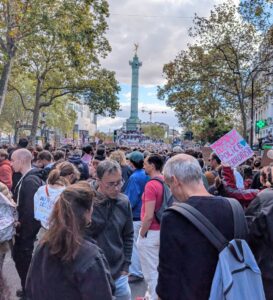
[Paris, October 8) Tens of thousands of French students, as many as 250,000, nationally, held massive peaceful protest rallies and marches in more than 40 cities. In Paris between 25 and 50 thousand young people, white and Black, some young women in hijabs and other students wrapped in the LGBT rainbow flag filled La Place de la Bastille, a reflection of the cities racially and ethnically diverse population. Some we talked to came from Beaux-Arts de Paris, the fine arts school, others from Lycée Voltaire, and from many of the other 468 public high schools in the capital’s Ile-de-France region. All them we spoke to talked of the same issues: deteriorating buildings, lack of teachers, overcrowded classrooms.
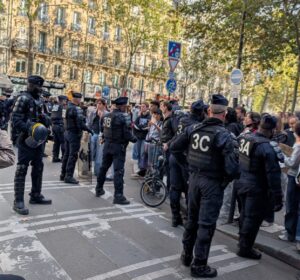
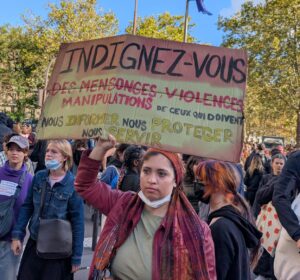
Surrounded by police who attempted to keep them from leaving the enormous square, apparently to prevent a march from parading through the city streets, students wore their feelings on their faces, anger about the failure of the government to take care of their education, anxiety about the police, joy in carrying out their massive protests. On the Place de la Bastille, small groups of students formed for a while and then broke up again, marched toward the monument or away from it, exchanging opinions with their friends or new acquaintances. While the media have focused on violent incidents, these have been overwhelmingly peaceful protests by students who range in age from 15 to 18.
The Emmanuel Macron government’s first response to the crisis came from the Minister of the Interior, who mobilized police to beat and fire teargas at the students, which however only increased support for the movement. With the protests continuing, French Minister of Education Édouard Geffray has been forced to negotiate with the students.
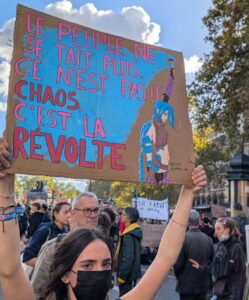
Student Demands
Students created a list of demands which they presented to the government including:
- Immediate hiring to fill vacant teaching positions and additional support staff.
- Reduction of class size to 20 – 25 students.
- Repair of crumbling school buildings.
- Improvement to deal with extreme heat and cold.
- More money—billions of euros more—for the education budget.
- An end to the police violence against student protestors.
The student protests have led Geffray to propose educational reforms, among them deploying 3,000 teachers to fill vacancies, beginning with the 500 neediest schools. Geffray has also proposed to increase student representation on the national education council, reserving one third of seats for pupil representatives.
Yet, while the demonstration was huge, one does not have the impression of a city or a nation convulsed by social protests. So far, France’s labor unions have not yet joined the students’ protest movement, though it is possible they will soon. When that happens the government will face a more serious challenge and offer either greater repression of more fundamental changes.
 If you’ve read this far, you were pretty interested, right? Isn’t that worth a few bucks -maybe more? Please
Leave a Reply